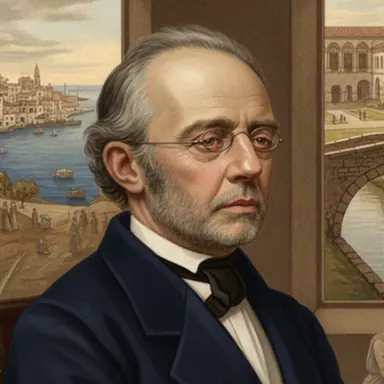
The Work and Torah Thought of Samuel David Luzzatto (Shadal): The Integration of Critical Philology, the Defense of Tradition, and the Great Controversy over the Antiquity of the Book of the Zohar
10 min read1,964 words
Summary
The text surveys the scholarly and spiritual work of Samuel David Luzzatto (Shadal), a nineteenth-century Italian-Jewish intellectual who served as a bridge between the modern world of the Enlightenment and the religious tradition. Shadal is presented as one who revived biblical interpretation in the manner of peshat using scientific and philological tools, without abandoning his strict commitment to the observance of the commandments. A central component of the work deals with the controversy over the antiquity of the Book of the Zohar, in which Shadal argued that a linguistic analysis of the vowel signs proves that the book is not the product of the pen of Rashbi but a later work. In the end, the article emphasizes that Shadal's legacy laid the foundations for Modern Orthodoxy and for the proper integration of critical academic research with deep religious faith.
The Figure of Shadal as a Bridge between Enlightenment and Tradition
Samuel David Luzzatto (Shadal, 1800–1865) represents one of the most original and influential intellectual phenomena within the "Chokhmat Yisrael" movement in nineteenth-century Western Europe, and he is regarded by many as the greatest of the sages of Italy in his generation.[1] Shadal's scholarly and literary work spanned vast areas of research and creation, and he was active as a biblical commentator, linguist, poet, philosopher, literary scholar, translator and historian.[2, 3] His public and educational influence reached its peak with his appointment to the lofty Torah and academic post of senior lecturer at the rabbinical seminary in Padua, Italy—an appointment made possible thanks to the intervention of his friend, Rabbi Isaac Samuel Reggio.[2, 3] At this institution Shadal taught Bible, Hebrew philology, Jewish philosophy and the history of the Jewish people until his last days, and raised many students who constituted the next generation of the spiritual and scholarly leadership of the Jews of Italy and of all Europe.[1, 3]
Shadal's great uniqueness lies in his wondrous ability to bridge the methodological and spiritual gap that many of his contemporaries perceived as unbridgeable. On the one hand, Shadal displayed deep devotion to scientific truth and to critical philological and historical research, and on the other hand, he maintained uncompromising zeal for the Jewish tradition, strict observance of the commandments and absolute loyalty to the generations of the past.[1, 3] In contrast to radical maskilim in Central and Northern Europe, who tended to abandon the practical observance of the commandments as part of integration into the modern world, Shadal proved that critical research does not pose a threat to religious faith but serves as an essential aid for cleansing the tradition of later accretions and for revealing the original face of Judaism.[3]
Biblical Interpretation and the Renewal of the Peshat Approach
At the center of Shadal's Torah and scholarly work stands biblical interpretation, which presents a veritable revolution relative to the generations that preceded him. Shadal is regarded as the central reviver of peshat interpretation after a prolonged interruption of about 300 years, since the decline of the classical biblical interpretation of the Middle Ages and the Golden Age.[1] In his commentaries on the Torah and the Prophets, Shadal applied sophisticated philological tools, comparison of versions of ancient texts, and deep grammatical analysis.[3] He did not shrink from using the newest research methodologies, but took care that science would not undermine the sacred foundations of belief in divine revelation.[1, 3]
Shadal's contribution to the translation of the Bible and to making it accessible to the modern public was unprecedented. He translated the Torah and the prayer book into Italian, thereby giving the Jewish community in Italy, which had partly lost its command of the Holy Tongue, direct access to its spiritual sources.[2] His scholarly and intellectual writing yielded a series of fundamental works that accompany the learner to this day.
In addition to these works, Shadal engaged in pioneering research on medieval poetry, published many historical and linguistic articles, and even translated Aesop's fables into Hebrew out of an aspiration to enrich the modern Hebrew language with classical and general wisdom.[2]
The Great Controversy over the Antiquity of the Book of the Zohar and the Wisdom of Kabbalah
One of the stormiest, most penetrating and most influential chapters in Shadal's scholarly and Torah activity is connected to his sharp criticism of the wisdom of Kabbalah in general, and of the antiquity of the Book of the Zohar in particular. In 1852 Shadal published in Gorizia his monumental work "A Debate on the Wisdom of Kabbalah, on the Antiquity of the Book of the Zohar, and on the Antiquity of the Vowel Points and Accents."[5, 6] The work was written under the inspiration of the literary structure of the "Kuzari" of Rabbi Yehuda Halevi, and is shaped as a dramatic and lively dialogue between two figures: the author (Shadal), who presents himself as one apparently inclined to believe in Kabbalah, and a learned guest from Poland, who represents the position of critical opposition to Kabbalah.[5]
At the center of Shadal's arguments stood a philological and historical proof that was, in his view, decisive, refuting the traditional claim that Rabbi Shimon bar Yochai (Rashbi), a tanna of the second century CE, was the one who composed the Book of the Zohar.[5] Shadal pointed out that the Book of the Zohar presupposes the existence of the vowel signs and the cantillation accents of Scripture.[5] However, according to Shadal's historical research, the vowel signs and accents did not exist in the period of the Tannaim, but were invented and formulated for the first time by the sages of Tiberias (the Masoretes) only in the seventh century CE.[5] From this Shadal concluded that the author of the Book of the Zohar must be much later than the period of the Talmud, and that Rashbi cannot be the writer.[5] This criticism fit into a broader trend in modern Kabbalah research, which attributes the writing of the Zohar to Rabbi Moshe de León or to a circle that operated in his vicinity in thirteenth-century Spain.[6]
The publication of Shadal's "Book of the Debate" aroused waves of fierce opposition among traditional and kabbalistic circles throughout the Jewish world, who saw the challenge to the antiquity of the Zohar as a grave injury to the spiritual authority of Kabbalah and to the foundations of religious custom based on it.[6] The most prominent and sharpest of Shadal's critics was his countryman, the esteemed Italian kabbalist and thinker Rabbi Eliyahu Benamozegh.[4, 6] In response to Shadal's work, Rabbi Benamozegh published in 1861 in Livorno the book "Ta'am le-Shad" (a name that is an intentional transposition of the letters of the acronym Shadal).[4, 6] Rabbi Benamozegh chose to fight Shadal with his own tools: he used the same philological, intellectual and literary methodologies that Shadal used, in order to defend the originality, antiquity and validity of the wisdom of Kabbalah.[7] The structure of the book "Ta'am le-Shad" is likewise shaped as a dialectical debate between two figures—"Chofni" (the questioning and doubting figure) and "Pinchas" (the respondent who represents Rabbi Benamozegh's position and refutes Shadal's claims one by one).[7] Criticism of Shadal's ideas was also expressed by Rabbi Yosef Qafih in the pamphlet "Sichat Dekalim" that he composed in his youth.[4]
The Historical Background of the Controversy over the Antiquity of the Zohar
In order to understand the force of the upheaval that Shadal caused, one must examine the debate in its broad historical context. The controversy over the antiquity of the Zohar did not begin with Shadal, but accompanied the world of Torah and Jewish thought almost immediately upon the disclosure of the Zohar at the end of the thirteenth century.[6] The scholarly and Torah confrontation with the doubts about the antiquity of the Zohar generated a rich polemical literature throughout the generations, in which the greatest sages of Israel took part on both sides of the barricade.
The following table presents in chronological order the central milestones in this historical controversy, emphasizing the interplay between those who doubted the antiquity of the Zohar and its defenders:
From this historical development it emerges that Shadal worked within a long-standing tradition of textual criticism, but he gave it additional scientific force thanks to the systematic use of philological tools and his focus on the question of the development of the Hebrew language and the Tiberian vocalization.[5]
Long-Term Influence on Biblical Research and Religious Zionism
Although Shadal's thought aroused stormy controversies in its time, his interpretive and intellectual method had a deep and long-term influence, which extended far beyond the borders of nineteenth-century Italy. Shadal paved a new path for the Orthodox and conservative public in its confrontation with the challenges of modern science.[1, 3] By proving that one can adopt scientific, philological and historical tools without in the least harming loyalty to the commandments and the recognition of the divine origin of Scripture, he laid the foundations for the interpretive approach that today characterizes the stream of Modern Orthodoxy and religious Zionism.[3, 8]
In recent decades, with the flourishing of biblical research within the world of the yeshivot and in the religious academy, a distinct return to the interpretive principles outlined by Shadal is evident. The use of literary tools, comparative linguistic analysis, and consideration of the findings of archaeology and of the study of the ancient Semitic languages—all these are done today from a position of deep religious commitment, in the spirit of Shadal's method.[8] A clear example of this continuity can be found in contemporary Torah works, such as "Chibbat Yeteirah" on the Torah, written by Rabbi Yehuda Herzl Henkin, one of the leading figures in religious Zionism in the twentieth century, which combines modern scientific and literary tools out of absolute loyalty to the Torah tradition and in the spirit of Shadal's interpretive heritage.[8]
Summary and Outlook: Shadal's Legacy in Modern Research
Samuel David Luzzatto remains an exceptional exemplary figure in the cultural and Torah landscape of the Jewish people in the modern era. He succeeded in integrating in his personality and work science and tradition, criticism and faith, devotion to philological truth on the one hand and uncompromising loyalty to halakha and to the historical chain of tradition of the people of Israel on the other.[1, 3] His groundbreaking studies in biblical interpretation revived the world of peshat and gave it modern tools that it had lacked for hundreds of years.[1]
The great controversy he generated around the antiquity of the Book of the Zohar, although it aroused fierce opposition from kabbalists and scholars of his generation such as Rabbi Eliyahu Benamozegh, demonstrated the intellectual price that Shadal was willing to pay for what he perceived as the uncovering of historical truth.[5, 7] His linguistic contributions, his innovative translations and his intellectual essays continue to inspire scholars and learners alike, and they attest to the power of a Torah that can contain the wisdom of the world and scientific criticism, and still remain pure, clean and committed to the continuity of the generations.[1, 3]
Sources8
- 1.שד״ל ותלמידיו – shadal.co.il - מאוצר יהדות איטליה, shadal.co.il/home/shadal-students/
- 2.אל תקראו לו רב: הושלם פרוש שד"ל על התנ"ך - כיפה, kipa.co.il/תרבות/ספרים/943464-אל-תקראו-לו-רב-הושלם-פרוש-שדל-על-התנך/
- 3.שד"ל | מקורות מתוך ספריית ספריא, sefaria.org.il/topics/samuel-david-luzzatto
- 4.שמואל דוד לוצאטו – ויקיפדיה, he.wikipedia.org/wiki/שמואל_דוד_לוצאטו
- 5.הויכוח - ויכוח על חכמת הקבלה ועל קדמות ספר הזוהר וקדמות הנקודות והטעמים / שמואל דוד לוצאטו, sefer.org.il/items/7083168-הויכוח-שד-ל-שמואל-דוד-לוצאטו-הוצאה-לאור-מאוצר-יהדות-איטליה
- 6.חיבור ספר הזוהר - ויקיפדיה, he.wikipedia.org/wiki/חיבור_ספר_הזוהר
- 7.אליהו בן-אמוזג - ויקיפדיה, he.wikipedia.org/wiki/אליהו_בן-אמוזג
- 8.Exodus 15:25 with Commentary | Sefaria Library, sefaria.org/Exodus.15.25?with=Commentary ConnectionsList