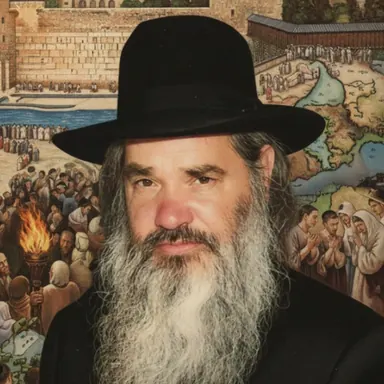
The outer struggle as an inner mirror; a demand for repair and unity between religious and secular; "there is no Messiah unless we ask for him".
Biography
A kabbalist and scribe. Warnings and predictions are attributed to him (the Six-Day War, Yom Kippur). He stressed active redemption: prayer, unity and calling for the Messiah.
includes 1 inspiration linkThe generations follow the Rambam’s introduction to the Mishneh Torah. A dashed line is inspiration, not direct transmission.
Rabbi Levi Saadia Nahmani: His Teaching, Prophecies and Legacy
12 min read·2,339 words
Executive Summary
This document summarizes the life, teaching, prophecies and legacy of the kabbalist Rabbi Levi Saadia Nahmani, of blessed memory (5681-5755, 1921-1995), an extraordinary spiritual figure who won wide recognition for his penetrating vision and his wonder-working abilities. Rabbi Nahmani, who was born in Morocco and was active in Jerusalem, became famous for a series of accurate predictions about current events, the best known of which foresaw the Six-Day War and the Yom Kippur War years in advance and in minute detail. Of his last years, his 1994 prophecy about a future nuclear threat from North Korea became especially famous, a warning delivered 12 years before the first nuclear test of that isolated state.
At the core of the Rabbi's teaching stood a distinctive theological conception, according to which the conflict of the people of Israel is not with its physical enemies but "with the God of Israel." He argued that Israel's enemies, and in particular the children of Ishmael, are nothing but "puppets on strings" whose purpose is to rouse the people of Israel to cry out to its Creator and return to Him in repentance. Accordingly, he championed "active redemption" – the view that in an era of Jewish sovereignty in the Land of Israel one must not wait passively for redemption but must act vigorously to unite the people and to draw hearts closer. He stressed that redemption depends on the people's request and prayer, and that the Messiah will not come until the people of Israel demand him insistently. Rabbi Nahmani's legacy continues to resonate through his writings, his many disciples, and the renewed circulation of his prophecies on social media, which arouse wide public interest and debate.
✦
1. Biography
Early Life in Morocco
Rabbi Levi Saadia Nahmani was born on 11 Adar I 5681 (19 February 1921) in Marrakesh, Morocco. His father was the kabbalist Rabbi Yaakov Nahmani, author of the books "Me'at Devash" and "Lekach Yaakov," and his mother was Rabbanit Rina. His birth was bound up with a miracle, after his parents had lost eight children in infancy. He was named "Levi" after Rabbi Elazar Halevi (author of "Avodat Halevi"), and "Saadia" after Rabbi Saadia Rabah, at whose grave his parents had prayed for children who would survive. The family's roots are traced back to Nahmanides (Ramban).
From childhood his talents and diligence were evident, and, as he recounted, he studied 18 hours a day from the age of six. He studied with his father, and also with Rabbi Yaakov Hazut and Rabbi Avraham Abitbol, head of the yeshiva of Marrakesh. Later he studied in Casablanca with a group of rabbis headed by Rabbi Shalom Messas, who also ordained him to the rabbinate.
In 5700 (1940) he was appointed safra de-dayyana (scribe of the rabbinic court) in Marrakesh. Between 5710 and 5719 (1950-1959) he served as a ram (yeshiva instructor) in the "Otzar HaTorah" network, as head of a yeshiva for the network's graduates, and as ram for Talmud and the halakhic codifiers in the city of Asfi (Safi). He also taught at the "Neve Shalom" yeshiva and at the teachers' seminary in Casablanca.
Immigration and Activity in Israel
In 5724 (1964) Rabbi Nahmani immigrated to the Land of Israel. He explained his decision to his students as preparation for the Six-Day War, which he had foreseen five years earlier. He settled first in Petah Tikva, where he was offered a rabbinic post, but he gave it up in favour of his friend, Rabbi Moshe Malka.
He then moved to Jerusalem, where he established his extensive spiritual activity:
Founding institutions: he was among the founders of the "Ohel Moed" yeshiva in Bayit Vegan, a partner in founding the "Beit Shmuel" synagogue in Shmuel HaNavi, and he established the "Darkei Noam" institution for spreading Torah.
Teaching and spreading Torah: he gave many lessons, including classes in Kabbalah on the book "Etz Chaim" at the kabbalists' yeshiva "Beit El" on Friday nights. He was known for his wonderful power of explanation and worked to bring the estranged closer, including among academics at the universities and at the Technion.
Modesty and livelihood: Rabbi Nahmani fled from all honour and publicity and lived in great modesty. He did not want to derive his livelihood from teaching Torah, and therefore earned his living by writing STaM (Torah scrolls, tefillin, mezuzot).
Rabbi Nahmani passed away on 7 Shevat 5755 (8 January 1995) and was buried on Har HaMenuchot in Jerusalem.
✦
2. Prophecies and Predictions about the End of Days
One of Rabbi Nahmani's most prominent characteristics was his ability to foresee historical and geopolitical events with extraordinary accuracy, sometimes many years before they occurred.
A. The Six-Day War
In 5722 (1962), five years before the war, during a lesson at the "Magen David" yeshiva in Morocco, Rabbi Nahmani announced to his students his decision to immigrate to Israel. He explained it as follows:
"In another 5 years there will be a fateful and difficult war in Jerusalem the holy city, mainly over the area of the Old City and the Western Wall... and on the 28th of Iyar the hand of the Jewish soldiers will prevail; they will capture the remnant of our Temple from their hands."
One of his students, Dr. Victor Abikzer, recorded the precise prophecy in his notebook, and years later testified to its complete fulfilment.
B. The Yom Kippur War
On the night of Hoshana Rabbah, a year before the war, the Rabbi declared before his students:
"Next year there will be a war. If we are worthy it will be in the month of Nisan, and then there will be miracles and wonders... but if it is in the month of Tishrei, then may God guard and save us... it will be a hard and painful war."
On the morning of Yom Kippur 5734 (1973), even before the war had been officially announced, the Rabbi told his students: "What we spoke about last year on Hoshana Rabbah is now happening. The war has broken out." He instructed all the worshippers to stay in the synagogue and recite Psalms. On that same night of Hoshana Rabbah, he went on to tell his students that "tonight the IDF will cross the Suez Canal," a detail that was published only two days later.
C. The Nuclear Threat from North Korea
In 1994, 12 years before North Korea carried out its first nuclear test, Rabbi Nahmani issued a sharp and surprising warning, which was spread in a video that gained wide circulation years later. In his words, he stressed that the main threat in the future would come not from Iran or Syria but precisely from Korea.
"Do you know what will happen? Korea, not Syria, Iran and Gaddafi. Korea will reach here. God protect us. Everyone who pays attention to what is happening in Korea today, it is for us... an atomic bomb. It will be worse than the Holocaust."
His son, Rabbi Sar Shalom, explained that his father interpreted the verse from the portion Ha'azinu, "For a fire is kindled in My anger, and it burns unto the lowest Sheol (she'ol tachtit)," as a hint that the city of Seoul (She'ol), the capital of South Korea, would be the first to suffer a nuclear attack from North Korea, and that this would be a warning sign to the world.
D. The Destruction of Gaza and the Redemption
In various lessons, Rabbi Nahmani linked the fate of Gaza with the coming of the Messiah. The following saying is attributed to him:
"Know that Gaza will be destroyed, the Messiah will come."
✦
3. The Principles of His Spiritual Teaching
Beyond his predictions, Rabbi Nahmani presented an orderly and consistent theological teaching, which focused on the essence of redemption, the role of the people of Israel, and the attitude toward its enemies.
A. "We Have No Conflict with the Arabs, We Have a Conflict with the God of Israel"
This is perhaps the most central and foundational principle of his teaching. Rabbi Nahmani rejected the view that the conflict is a merely political or military struggle. He argued that Israel's enemies, headed by the children of Ishmael, are instruments in the hands of the Creator whose role is to rouse the people of Israel.
"Their purpose is the purpose of the billion and a half Muslims around us... their nature is to cause us, that is their purpose, to cry out to the Holy One, blessed be He."
According to the midrash he quoted, the name "Ishmael" itself hints at their role: "For the Holy One, blessed be He, will in the future hear the groaning of the people... because of what the children of Ishmael are destined to do in the land at the end of days... therefore his name was called Ishmael, as it is said, God shall hear (Yishma-El) and answer them." That is, the pressure and threats from the Ishmaelites are meant to bring the people of Israel to the point at which it cries out to God with an inner, deep cry, and only then will salvation come. The solution is not a matter of security or diplomacy but a spiritual one: repentance and prayer.
B. Active Redemption: "To Rise and Shake Off the Routine of Exile Life"
Rabbi Nahmani strongly opposed the passive conception of waiting for redemption. He distinguished between the period of exile, in which we were under the rule of the nations of the world and every messianic awakening was dangerous, and the period of sovereignty in the Land of Israel.
"The approach according to which we have nothing to do but wait until the redeemer comes was correct as long as we were under the rule of the nations of the world... Today, on the contrary, every awakening and mobilization in ways of pleasantness and paths of peace to draw hearts closer has the power to save the situation and to return the Shekhinah to its natural abode, which is the people of Israel in the Land of Israel."
He called on people not to sit with folded arms, but "to gird their strength, and to act, and to revive the soul of the people and unite it."
C. The Messiah Depends on the People's Request
Rabbi Nahmani stressed that redemption is not an automatic process, but depends directly on the will and the request of the people of Israel.
"The Messiah depends on us. In Egypt Moses our teacher did not come... until 'the children of Israel sighed by reason of the bondage, and they cried.' And their cry came up unto God... There is no Messiah without our asking. He will not come. It is a great lie to think that the Messiah will come, etc. No, the Creator of the world is waiting for our prayer."
He saw mass, united prayer for redemption as the central key to bringing it nearer.
D. The Unity of Israel
The theme of unity ran like a common thread through all his writings and sermons. He warned against the "iron partition between the believer and the non-believer" and against polarization and factionalism, and saw them as an existential danger. He called for following the way of Aaron the High Priest: "loving peace and pursuing peace, loving people and bringing them near to the Torah." The motto that guided him was the verse: "Then they that feared the Lord spoke one with another, and the Lord hearkened and heard."
✦
4. Wonder Stories and Practices
Rabbi Nahmani's life was interwoven with supernatural events and many wonder stories, which testified to the holy spirit that rested upon him.
Locating the husband of an agunah: a woman whose husband had disappeared for years came to the Rabbi. After contemplating, he gave his student an exact address in the United States and said: "I see him now in a printing house... send a messenger from the beit din with a get (bill of divorce)." The messenger found the husband exactly in the place and the circumstances the Rabbi had described, and the woman was released from her status as an agunah (a "chained" wife).
Healing the sick: his student, Elazar Rabbani, recounted that his father lay dying in hospital after several heart attacks. The doctors had given up hope for his life. After Rabbi Nahmani performed a "pidyon nefesh" (redemption of the soul) for him, he told the son: "Tomorrow your father is being discharged from the hospital." The next day the father got up on his feet, healthy and whole, to the amazement of the doctors, and lived another 17 years.
The stolen horses: on a Sabbath when he was a guest in one of the villages, two horses were stolen from a religious family. When the youths came to ask for help in the search, the Rabbi broke off his sermon, turned to them and said: "I ask you not to go looking for the horses on the Sabbath... if you keep the Sabbath... the Sabbath itself will bring the horses back to you." At the close of the Sabbath, the Arab youths who had stolen the horses returned them, claiming that they had found them wandering.
The founding of Ma'ale Adumim: after the evacuation of Yamit, when the government began levelling the ground in the area (without a building plan), the Rabbi instructed his gabbai to take ten men and pray Shacharit at the site every day. One day the Rabbi joined them, turned to the contractor working at the site and said to him: "Know that in this place a city and a mother in Israel will be built and established." Years later, the city of Ma'ale Adumim was built on the site.
Sha'atnez in a shtreimel: at a Purim celebration, one of the Hasidim placed his shtreimel on the Rabbi's head. The Rabbi was shaken and cried out "Sha'atnez!" (the forbidden mixture of wool and linen). Upon examination, sha'atnez was indeed found in the shtreimel.
Document 2/2
Rabbi Levi Saadia Nahmani
12 min read·2,307 words
Summary
This text surveys the life and teaching of the kabbalist Rabbi Levi Saadia Nahmani, a many-faceted rabbinic figure who grew up in Morocco and deeply influenced the spiritual landscape of Israel. The text highlights the distinctive combination he forged between halakhic leadership, the study of the hidden Torah and a historiosophical outlook that sees current events as part of the process of redemption, while focusing on the values of "toil in Torah" and extreme humility. The source details his extensive educational and public work – from his service as scribe of the rabbinic court in Marrakesh to the founding of Torah institutions and outreach in universities and in distressed neighbourhoods of Jerusalem. The close of the text is devoted to his moral and literary legacy, which emphasizes his absolute commitment to national unity and to social responsibility grounded in the inner dimension of the Torah.
Spiritual Leadership, Education and the Doctrine of Redemption: The Work and Torah Teaching of the Kabbalist Rabbi Levi Saadia Nahmani
The kabbalist Rabbi Levi Saadia Nahmani represents a distinctive and complex model of Torah leadership that grew out of Moroccan Jewry and became deeply integrated into the spiritual and public life of the State of Israel in the second half of the twentieth century.[1] His figure combines proven halakhic authority, deep engagement with the esoteric Torah, and an innovative educational pedagogy focused on the values of toil in Torah and love of Israel.[1, 2, 3] Rabbi Levi Saadia acted throughout his life out of an alert historiosophical consciousness, and saw the current events of his generation as an inseparable part of the meta-historical process of the redemption of the people of Israel.[1] This conception moved him to go out beyond the walls of the traditional beit midrash toward academia, the general public and young people, out of a desire to mend sectoral rifts and to establish a national unity founded on the inner dimension of the Torah.[1, 2]
✦
Lineage, Family Background and Key Figures in His Circle
Rabbi Levi Saadia Nahmani was born on 11 Adar I 5681 (19 February 1921) in the city of Marrakesh in Morocco, to a family of sages and kabbalists with deep roots in the local Torah tradition.[1] His father was the kabbalist Rabbi Yaakov Nahmani, author of the famous kabbalistic work "Me'at Devash," who served for his son as a spiritual father figure and principal teacher.[1, 2] His mother, Rabbanit Rina, and his paternal grandfather, Rabbi Shlomo, gave him a family foundation wholly devoted to holiness and the service of God.[2] This family environment shaped Rabbi Levi Saadia's early inclination to the study of Kabbalah alongside the plain meaning of Scripture and the Talmud.[1]
During his years of study in Morocco, Rabbi Levi Saadia was educated by several of the great figures of the generation, among them his father Rabbi Yaakov, the kabbalist Rabbi Yaakov Hazut and Rabbi Avraham Abitbol.[1] These figures imparted to him the foundations of deep study of both the revealed and the hidden Torah. Throughout his career he formed close ties with prominent contemporaries, foremost among them the renowned rabbinic judges of Morocco and Jerusalem, Rabbi Yitzhak Hazan and Rabbi Shalom Messas.[1] In his personal life Rabbi Levi Saadia established a family together with his wife, Rabbanit Fibi, and to them were born his sons – Rabbi Sar Shalom Nahmani and Rabbi Yisrael Nahmani.[1, 2] His family ties also included his brother Gavriel and his sister Rivka.[2]
✦
His Public and Educational Work in Morocco
Even before he immigrated to the Land of Israel, Rabbi Levi Saadia gained a position of honour in the Jewish community of Morocco thanks to his intellectual qualities and his legal and public skills.[1] He served as scribe of the rabbinic court (safra de-dayyana) of the city of Marrakesh.[1] This role demanded complete mastery of the laws of monetary matters, divorce and marriage, together with exemplary precision and flawless writing. This work refined his ability to resolve complex human disputes with great halakhic sensitivity.
Alongside his work at the rabbinic court, he devoted most of his energy to the field of education and to shaping the hearts of the future generation in Casablanca.[1] He taught at the Talmud Torah of the "Otzar HaTorah" network, and in 5714 (1954) he was appointed rabbi and educator at the "Neve Shalom" yeshiva.[1] His most significant educational work in those days was teaching Bible and Talmud at the teachers' seminary in Casablanca.[1] His decision to teach specifically at an institution for training teachers stemmed from a preventive strategic conception: he understood that in order to secure the spiritual future of Jewish youth in Morocco and in the Land of Israel, one must first and foremost shape the Torah and methodological world of the educators themselves, imparting to them deep knowledge of Scripture and the Talmud (Shas).[1]
✦
The Move to the Land of Israel and the Expansion of Torah Institutions in Jerusalem
In 5724 (1964) Rabbi Levi Saadia decided to immigrate to the State of Israel.[1] This decision was not based on merely personal motives, but rested on a deep historiosophical analysis of the political and spiritual reality in the region. He explained to his students in Morocco that they must immigrate urgently, since in a few years a great and fateful war was destined to break out in the Land of Israel – a prediction that was fully realized with the outbreak of the Six-Day War in 5727.[1]
Upon settling in Jerusalem, Rabbi Levi Saadia opened a new era of wide-ranging public activity, intended to bridge the social and religious gaps in the young State of Israel [1, 2]:
The "Ohel Moed" yeshiva: he was a central partner in founding this yeshiva in the Bayit Vegan neighbourhood of Jerusalem, an institution that became a magnet for students from every shade of the religious spectrum.[1]
Synagogues and community: he helped establish the "Beit Shmuel" synagogue in the Shmuel HaNavi neighbourhood, thereby contributing to the spiritual and social rehabilitation of a complex border neighbourhood.[1]
The "Darkei Noam" institutions: he founded this institution in order to spread Torah, moral values and Judaism among adults and young people who were not necessarily religiously observant, with an approach that draws people near rather than coerces them.[1]
Activity in academia and the community: he regularly gave lectures on Torah and Judaism at various universities throughout the country.[1] This step was pioneering and unusual for a kabbalist and rabbinic judge from Morocco, and it stemmed from the belief that the inner dimension of the Torah and moral thought belong to every part of the people.[1] At the same time, he organized special Torah classes for young people in the afternoon hours in order to keep them away from the street and to shape their character.[1]
The home beit midrash in Ramot: in his last years he moved to the Ramot Gimmel neighbourhood of Jerusalem, where he set up within his private home a bustling place of Torah and prayer, which served as a spiritual centre to which crowds streamed for advice, blessing and shared study.[2]
Despite his extensive public activity and the management of Torah institutions, Rabbi Levi Saadia refused to benefit from the crown of Torah or to make his living from public funds.[1, 2] He chose to earn his living by writing STaM (Torah scrolls, tefillin and mezuzot), a craft that demanded spiritual concentration and purity of him and allowed him to maintain complete independence and freedom from reliance on the political or religious establishment.[1]
✦
His Torah Teaching and Writings
The Torah teaching of Rabbi Levi Saadia Nahmani extended over diverse fields: Bible, Talmud, mussar, sermons, redemption, current affairs and Kabbalah.[1] He used to give in-depth lessons in the esoteric Torah, especially on the book "Etz Chaim" by Rabbi Chaim Vital, while taking care to connect abstract kabbalistic concepts with the practical work of the individual on his character traits.[1]
These works reveal his exegetical and intellectual method: he did not see Kabbalah as an abstract science detached from history, but as a tool for deciphering concrete reality.[1] In his view, the events of the generation are not accidental, but form part of a planned cosmic process in which the people of Israel is required to show moral and spiritual responsibility in order to merit a complete and rectified redemption.[1, 2]
✦
The Struggle over the Concept of "Toil" in His Teaching
One of the central foundations most closely identified with the Torah and educational teaching of Rabbi Levi Saadia is the concept of "toil" (amal).[3] In a generation often characterized by a search for easy solutions, quick achievements and material and spiritual comfort, Rabbi Levi Saadia waged a stubborn intellectual and educational struggle to restore the standing of toil in Torah.[3] In his eyes, Torah study that involves no deep intellectual, emotional and physical effort is incapable of bringing about the metaphorical change required in the soul of the learner.[3]
This position is studied and researched extensively in the batei midrash of our generation, as reflected in series of lessons devoted to his teaching [3]:
Rabbi Boaz Kahana, in his lesson "Toil in Torah with Love in the Field of Education," points out that Rabbi Levi Saadia saw toil as a tool driven by an immense love for the Torah and the Shekhinah, and not by cold moral coercion.[3]
Rabbi David Giami, in his lesson "The Struggle over the Concept of 'Toil' in Our Generation," analyses Rabbi Levi Saadia's confrontation with modern tendencies toward slackness and presents his view that "toil" is the only measure for acquiring a true and lasting spiritual possession.[3]
Rabbi Uri Sherki deals with his teaching within the lessons of "Beit HaMidrash Orot HaKodesh," connecting the ideas of Rabbi Levi Saadia with the meta-historical teaching of Rav Kook.[3]
Rabbi Lior Lavi, in his lesson on "Middot HaRe'iyah" on the subject "Covenant: Desire or Will?", links Rabbi Levi Saadia's ideas to the processes by which a person makes a spiritual covenant with his destiny, examining the deep motives that drive human will – whether it is a momentary desire (cheshek) or a deep inner will (chefetz) that demands toil and effort.[3]
✦
His Moral Conduct, Simplicity and Modesty
Rabbi Levi Saadia Nahmani was known as one of the most distinguished "masters of mussar" of his generation, who demanded of himself what he demanded of his students.[1] His conduct was based on extreme modesty and a complete flight from any shadow of honour, publicity or pride.[2] He lived in poverty and in exceptional modesty, despite his high public standing in the Torah world.[2]
Remarkable testimony to his moral modesty is found in his conduct when he travelled to distant places where his identity was not known.[2] In such cases he would deliberately wear simple, less polished clothes, so that people would not notice his greatness and would not show him honour or take him for an important person.[2] This conduct reflects a conscious spiritual method of self-nullification, out of an understanding that an elegant outward appearance might lead to an illusory self-satisfaction that harms the pure service of God.
In his dealings with the general public, an immense and unconditional love of Israel stood out.[2] He received every person in his home personally, warmly and calmly.[2] In his home there were no attendants, gabbaim or secretaries to screen those who came to him; he himself answered the many telephone calls that came in without pause.[2] To everyone who turned to him – whether a Torah scholar or a simple, hard-pressed person – he listened with endless patience, giving him the feeling that he was his only son.[2]
His activity focused to a great extent on making peace between people and between husband and wife, a task he performed with great self-sacrifice and without any monetary reward or benefit.[2] In many cases, when he identified financial distress among those who came to him, he did not content himself with giving a blessing and advice, but gave them real financial and material help from his own pocket and his meagre means, thereby translating the teaching of mussar into a concrete act of kindness.[2]
The chapters of his life, his moral guidance in the service of God and the wonder stories associated with him were recorded in the book "Hu Haya Omer" ("He Used to Say"; Beersheba, 5769), written by his student Rabbi Avraham Vazana.[1] Likewise, his biography and his extensive public work were documented at length in the biographical book "Pe'ulat Tzaddik" ("The Work of a Righteous Man"; Jerusalem, 5769).[1]
✦
His Legacy for Generations
The kabbalist Rabbi Levi Saadia Nahmani returned his soul to his Maker on the night after the holy Sabbath, 7 Shevat 5755 (8 January 1995).[1, 2] His death left a deep void in the world of mussar, education and Kabbalah in the Land of Israel.[1, 2] Nevertheless, his teaching and spiritual influence continue to resonate powerfully.[2, 3] In his memory and to continue spreading his legacy, the Torah and charity institutions "Avodat HaLevi" were established in the community of Tel Zion.[2]
His worldview, which combines a demand for uncompromising toil in Torah with extreme humility and love of humanity, has remained an educational beacon for Torah learners and educators who seek to connect the world of halakha and of the mystical secret with a deep social commitment and responsibility for the fate of the people of Israel.[1, 2, 3] Rabbi Levi Saadia proved in his life that the true kabbalist does not seclude himself in detached mysticism, but harnesses his highest spiritual attainments to the repair of society, to drawing hearts closer and to establishing the moral foundations of the process of redemption.[1, 2]