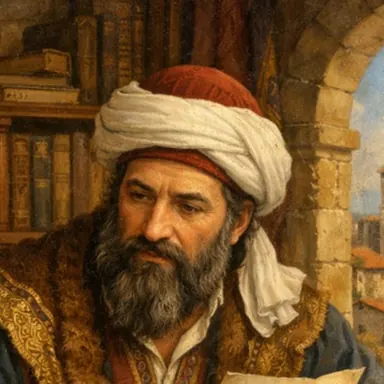
Rabbi Yehonatan ha-Kohen and the Tradition of Halakhic Decision-Making and Talmudic Commentary
16 min read3,184 words
Summary
The text surveys the highly influential figure of Rabbi Yehonatan ha-Kohen of Lunel, one of the greatest of the Sages of Provence in the 12th century, emphasizing his role as a cultural and spiritual bridge between the traditions of Spain and the East and the Jewry of Europe. The article details his unique exegetical contribution as the first commentator on the Rif and the Mishnah in Hebrew, an enterprise that made the world of halakha accessible to many learners and became a cornerstone of Torah literature. Alongside this, it highlights his close bond with Maimonides (Rambam), since his support and halakhic correspondence were a decisive factor in the acceptance of the "Mishneh Torah" among the communities of Europe in the face of the critics' objections. Finally, the source describes the rabbi's practical vision as the one who led the "Aliyah of the Three Hundred Rabbis" to the Land of Israel, a step that sealed his life and established a new Torah center in the city of Acre.
The Great Luminary of Lunel: The Work, Teaching and Torah Contribution of Rabbi Yehonatan ha-Kohen to the Tradition of Halakhic Decision-Making and Talmudic Commentary
Historical and Geographical Introduction: Provence as a Cradle of Creativity between East and West
The twelfth and thirteenth centuries in European Jewry marked one of the most fruitful and complex periods in the history of halakha and Jewish thought. At the heart of this flourishing stood the region of Provence, a geographical area in southern France that served as a unique cultural and spiritual crossroads. To its north flourished the scholarship of the Tosafists in France and Ashkenaz, which focused on sharp dialectical analysis of the Talmudic text; to its south, in Muslim and Christian Spain, there developed a tradition of systematic codification, linguistic research and scientific-philosophical thought. Within this space, the city of Lunel became a Torah center of the first rank, and was called by the people of that generation "a tower of strength" and "Zion in the Diaspora".[1] The most prominent and influential figure who led this center was Rabbi Yehonatan ben David ha-Kohen of Lunel, known by the appellation "Rabbi Yehonatan of Lunel".[1]
Rabbi Yehonatan, who was born around 1135 and died in 1211 in Acre in the Crusader Kingdom of Jerusalem, represents to a great extent the characteristic portrait of the Sages of Provence: broad-minded scholars who mastered the secrets of the Babylonian and Jerusalem Talmuds, were committed to the tradition of the Geonim and the Rif, and at the same time were open to the scientific and philosophical innovations of their time.[1, 2] His contribution is not limited to the writing of commentaries alone; it constitutes a vital bridge through which the Torah of Spain and the East passed to the Jewry of Europe, and vice versa.
The importance of Rabbi Yehonatan of Lunel stems from his being the meeting point of three central trends in the history of Israel: first, his exegetical work on the Sefer ha-Halakhot of the Rif, which became a cornerstone of halakhic study in Europe; second, his close and special ties with Maimonides (Rambam), which included an extensive correspondence on halakhic and philosophical questions that influenced the reception of the "Mishneh Torah"; and third, his leadership in the Aliyah of the Three Hundred Rabbis to the Land of Israel, a step that carried heavy symbolic and practical weight in the history of the Jewish community in the Land.[2, 3]
His Life and Development as a Spiritual Leader
Rabbi Yehonatan was born into a distinguished priestly (kohanim) family in Lunel, a city known for its wealthy and learned community. His father, Rabbi David ha-Kohen, was one of the local sages, but Rabbi Yehonatan acquired most of his Torah from the great men of the generation in Provence, chief among them Rabbi Meshullam ben Yaakov of Lunel. Rabbi Meshullam was not only an immense Torah scholar, but also a patron of the sciences and of translation, and his house served as a center for the translators of the Ibn Tibbon family, who rendered works of science and philosophy from Arabic into Hebrew. This environment shaped Rabbi Yehonatan's personality as a sage who combined tradition with intellectual openness.[1]
Rabbi Yehonatan's public standing grew steadily until he was regarded as "the head of the sages of Lunel".[3] This title was not merely formal; it expressed the recognition by his contemporaries, including great sages such as the Ra'avad (Rabbi Avraham ben David of Posquières), of his Torah authority and his communal leadership. Rabbi Yehonatan headed the yeshiva in Lunel, which became a magnet for students from all over the Jewish world, and thereby ensured the continuity of the tradition of Provence.
The following is a summary of biographical data and the main stations in his life:
The death of Rabbi Yehonatan in Acre in 1211 marked the end of the golden age of the original sages of Lunel. The laments found in the Cairo Genizah, bewailing the passing of "the great Rav," testify that in the East and in Egypt, too, the magnitude of the loss to the world of Torah upon his death was recognized.[2]
His Torah Work: The Exegetical Enterprise on the Rif and the Mishnah
The central and best-known work of Rabbi Yehonatan of Lunel is his comprehensive commentary on the Sefer ha-Halakhot of Rabbi Yitzchak Alfasi (the Rif). To understand the importance of this enterprise, one must appreciate the standing of the Rif in the 12th century. The Rif's Sefer ha-Halakhot was regarded as a "little Talmud"; it summarized the discussions of the Babylonian Talmud, omitted the give-and-take not needed for halakha, and decided disputes. For the sages of Provence and Spain, the Rif was the central halakhic text for study, in certain cases even more than the Talmud itself.[1]
The First Commentator on the Rif and the Mishnah in Hebrew
Rabbi Yehonatan was the first to compose a systematic and comprehensive commentary on the Rif.[1] Unlike Rashi's commentary on the Talmud, which focused on explaining the words and the logical course of the Gemara, Rabbi Yehonatan's commentary on the Rif was intended to serve a double purpose: to explain Alfasi's terse text and to defend it against difficulties and objections. In his commentary, Rabbi Yehonatan reveals the Talmudic sources on which the Rif relied, at times making use of the Jerusalem Talmud and of the literature of the Geonim.
A further significant innovation of Rabbi Yehonatan is his being "the first commentator on the Mishnah in Hebrew".[1] Whereas Maimonides (Rambam) wrote his commentary on the Mishnah in Judeo-Arabic, and Rabbi Ovadia of Bartenura wrote his commentary hundreds of years later, Rabbi Yehonatan incorporated within his commentary on the Rif a Hebrew explanation of the Mishnah. This fact made his work an essential aid for learners in Europe who did not command the Arabic language, and it contributed greatly to establishing the study of the Mishnah as an independent and explicated order of Torah study.
The Scope of the Commentary and Its Dissemination
For many generations, what was known in the world of the yeshivas was chiefly Rabbi Yehonatan's commentary on the Halakhot of the Rif on tractate Eruvin.[1, 4] This commentary was printed alongside the Rif already in the early editions (Constantinople 5269) and became an inseparable part of the study of the tractate. However, modern research has shown that Rabbi Yehonatan wrote a commentary on very extensive parts of the Rif, covering at least 21 tractates.[1, 4]
The following is a list of the tractates on which Rabbi Yehonatan composed a commentary on the Rif, as they appear in the sources and in the new printed editions:
The influence of the commentary was immense. Many citations from his commentaries are found in the books of the great sages of Provence and Spain who came after him. Rabbi Yosef Chaviva, author of the "Nimukei Yosef," and Rabbi Betzalel Ashkenazi in the "Shitah Mekubetzet" frequently cite "the Rav Yehonatan ha-Kohen" as a supreme exegetical and halakhic authority.[1] The commentary excels in its pure language and clarity, and it is an example of the fusion of French scholarship with Provençal systematicity.
Rabbi Yehonatan and Maimonides: The Bond That Decided the Fate of the "Mishneh Torah"
One of the most important chapters in the biography of Rabbi Yehonatan, and in the history of Jewish thought in general, is his relationship with Rabbi Moshe ben Maimon (Maimonides, Rambam). When Maimonides completed the writing of his vast work "Mishneh Torah" (the Yad ha-Chazakah) in Egypt, he sent copies of it to various Jewish centers. In most places the book was received with a mixture of admiration and suspicion: admiration for its exemplary order, and suspicion over the omission of the sources and over the philosophical positions presented in the "Book of Knowledge" (Sefer ha-Madda).
The sages of Lunel, headed by Rabbi Yehonatan, were among the first to recognize the greatness of the hour. They turned to Maimonides with an exceptional letter of admiration, in which they described him as one who had restored the crown to its former glory. Maimonides for his part answered them with immense respect, and saw in them the "survivors of the sword" of true Torah study in Europe, at a time when he feared that the Torah centers in Babylonia and Spain were in decline.[3]
The Twenty-Four Questions: A Give-and-Take of Torah
The relationship between Rabbi Yehonatan and Maimonides was not merely one of one-sided admiration, but one of profound halakhic give-and-take. Rabbi Yehonatan sent Maimonides a list of twenty-four questions (the "24 Questions") on various rulings in the "Mishneh Torah".[1] These questions were not intended to provoke, but to clarify Maimonides' sources and to elucidate difficult Talmudic discussions that Maimonides had decided in a particular way.
This correspondence is essential for understanding Maimonides' method, since in his answers to Rabbi Yehonatan he sometimes reveals his way of thinking and the sources (including from the Jerusalem Talmud and from the Geonim) that were before him and that were not indicated in the code itself. Rabbi Yehonatan served here as "the representative of the learners"; he asked what every Torah scholar asked himself when reading Maimonides, and Maimonides' answers to him became an inseparable part of the interpretation of the "Mishneh Torah" for generations.
The Controversy over Astronomy and Astrology
A high point in this correspondence was the question on the subject of astrology. In the Middle Ages, most sages (including some of the Sages of Provence) believed that the stars have a direct influence on the fate of human beings ("mazal le-Yisrael"). Rabbi Yehonatan sent a question to Maimonides on this matter, in an attempt to understand how the words of the Sages on the subject fit with scientific knowledge.[1]
Maimonides' famous answer to the sages of Lunel (the Letter on Astrology) is a foundational document in rationalist Jewish thought. Maimonides rejected astrology utterly, called it "foolishness" and idolatry, and distinguished between it and astronomy, which is a true science. Rabbi Yehonatan's support for Maimonides, even on these charged subjects, gave the Maimonidean system religious legitimacy among the conservative communities of southern France.[3]
The Defense of Maimonides against the Objections of the Ra'avad
While Rabbi Yehonatan embraced Maimonides warmly, his neighbor, the Ra'avad of Posquières, came out with sharp criticism of the "Mishneh Torah." The Ra'avad feared that Maimonides' work would cause learners to abandon the study of the Talmud and to rely on "rulings without a source." The Ra'avad wrote his famous glosses (hasagot), in which he at times attacks Maimonides in harsh language, such as "he is a youth and we are elders".[3]
Rabbi Yehonatan of Lunel found himself in the position of a mediator. On the one hand, he recognized the greatness of the Ra'avad, who was among the most senior of the Sages of Provence; on the other hand, he saw in Maimonides the great luminary of the generation. Rabbi Yehonatan worked to resolve the Ra'avad's objections to Maimonides in his commentaries and writings, showing that Maimonides' rulings are well anchored in the Talmudic tradition and in the method of the Rif.[3]
This effort of Rabbi Yehonatan's was critical. Had it not been for his support and mediation, Maimonides' work might have been rejected by the sages of Europe at that time, which would have changed the face of Jewish law for generations. Thanks to him, the "Mishneh Torah" became a foundational book in Provence as well, and eventually in Ashkenaz and Spain too.
The Aliyah of the Three Hundred Rabbis: A Vision That Became Reality
Toward the end of his life, in 1210-1211, Rabbi Yehonatan of Lunel stood at the head of a large group of Torah scholars from France and Provence who decided to leave their homes and go up to the Land of Israel. This event, known as the "Aliyah of the Three Hundred Rabbis," is regarded as one of the most significant group immigrations of the Middle Ages.[2]
The Historical and Political Context
The situation in the Land of Israel at that time was turbulent. The Land was a battleground between the Crusader kingdom (the Second Kingdom of Jerusalem) and the Muslims under the leadership of Saladin and his Ayyubid successors. Jerusalem had been reconquered by the Muslims in 1187, and the Christians held mainly the coastal strip, whose center was the city of Acre.[2]
Despite the lack of security, the rabbis decided to go up. Their motives were religious and messianic, together with the desire to fulfill the commandments dependent on the Land. Rabbi Yehonatan, although he was already of advanced age (over 70), did not hesitate to set out on the grueling journey.[1]
The following are central figures and data concerning the aliyah:
Torah Activity in the Land of Israel
Upon his arrival in the Land, Rabbi Yehonatan settled in Acre. The city became a lively Torah center, a kind of "branch" of the yeshivas of Provence and France on holy soil. Correspondence has been preserved between him and the Ritzba (Rabbi Yitzchak ben Avraham), one of the great Tosafists of France, dealing with practical questions of fulfilling the commandments in the Land of Israel.[2] The book "Or Zarua" mentions that the Ritzba answered him "a practical halakhic ruling... at the time when he went up to the Land of Israel," a fact that testifies that Rabbi Yehonatan immediately began applying the Torah he had learned in the Diaspora to the new conditions of the Land.[2]
It should be noted that although the aliyah is called "the Aliyah of the Tosafists," Rabbi Yehonatan himself was not counted among the Tosafists either methodologically or geographically (he was Provençal, not French-Ashkenazi), but he was the unifying figure who led the entire undertaking.[2]
His Halakhic Teaching: Synthesis and Innovation
The Torah teaching of Rabbi Yehonatan of Lunel is characterized by a multidimensional approach that combines ancient tradition with an orderly legal structure. His method can be characterized along several axes:
Faithfulness to the Rif as a central axis: Rabbi Yehonatan saw the Rif as the last and most authoritative decisor. His commentary was intended to explain the Rif's rulings and to reconcile his words with those of the Gemara, even in places where the Rif appears to contradict the Talmudic discussion. He did not hesitate to use the responsa of the Geonim to support the Rif's method.[1]
- Use of the Jerusalem Talmud: unlike the sages of Ashkenaz, who focused almost exclusively on the Babylonian Talmud, Rabbi Yehonatan (as part of the tradition of Provence) made extensive use of the Jerusalem Talmud. He saw it as a complementary and important source for understanding halakha, especially in matters connected with the commandments dependent on the Land and with the order of Zeraim.[3]
- A moderate rationalist approach: under the influence of Maimonides and the sages of Lunel, he tended toward interpretation that does not contradict common sense. Nevertheless, he remained committed to the strict halakhic framework and was not drawn after extreme philosophy.
- Practical rulings: in his commentaries he frequently cites the custom practiced in Provence, and thereby preserves ancient traditions of halakhic decision-making that were passed down from generation to generation in southern France.
The Importance of His Commentary on Tractate Eruvin
Tractate Eruvin is regarded as one of the most difficult and technical tractates in the Talmud, dealing with the Sabbath domains and the ways of rectifying them. Rabbi Yehonatan's commentary on this tractate (printed alongside the Rif) became a classic.[3, 4] It excels in the ability to make complex geometrical and spatial discussions clear and accessible. His influence here was so great that later decisors such as the "Beit Yosef" (Rabbi Yosef Karo) rely on him in almost every difficult discussion in this tractate.
His Last Days and the Lament Found in the Genizah
Rabbi Yehonatan was not granted length of days in the Land of Israel. He died in 1211, a short time after his arrival in Acre.[1] His death aroused deep mourning throughout the Jewish dispersion. Moving evidence of this was found in the Cairo Genizah, where laments written in his honor have been preserved.
The laments describe the great loss:
"Woe, for great is the mourning, for the great Rav... for Jerusalem and Zion without a great nation (goy gadol)".[2]
His description as a "great nation" (goy gadol), a biblical term denoting a nation or an influential leader, testifies to the almost royal standing he had in the eyes of his disciples and contemporaries. The fact that the laments were found in Egypt testifies to the close tie he had with the community of Maimonides and to the fact that his Torah and his personality crossed borders and seas.
Summary and Legacy: The Luminary That Was Not Extinguished
Rabbi Yehonatan of Lunel was a unique figure who connected worlds. He was "the first" in many senses: the first to interpret the Rif systematically, the first to write a Hebrew commentary on the Mishnah, and the first to lead an organized aliyah of great Torah scholars to the Land of Israel in the Middle Ages.[1, 2]
His legacy lives on in every page of the Rif and in every halakhic discussion of the "Mishneh Torah." Without his exegetical and public contribution, the world of halakha would have looked completely different. He provided the intellectual and political tools for the acceptance of Maimonides in Europe, and thereby ensured the unity of Jewish halakhic decision-making and thought.
The figure of Rabbi Yehonatan of Lunel remains a symbol of the triumphant combination of scholarly depth, courageous leadership and openness to the spirit of the time. He was the luminary that illuminated Lunel, and from there the entire Jewish world, until he reached his rest and inheritance in the soil of the Land of Israel, which he loved so much.[1, 2, 3]
Sources5
- 1.יהונתן מלוניל – ויקיפדיה, he.wikipedia.org/wiki/יהונתן_מלוניל
- 2.פרק 72 • עליית שלוש מאות הרבנים • בעלי התוספות בארץ ישראל - קדמא Kedma, kedma.xyz/2025/07/72.html
- 3.הראבד: רבי אברהם בן דוד מפושקיירה - הילולה בתאריך כ"ו כסלו - המאיר לארץ, hameir-laarets.org.il/hilulots/רבי-אברהם-בן-דוד-הראבד-מפושקיירה-בע/
- 4.תלמוד, בבלי, ראשונים על התלמוד, רי"ף | ספריית ספריא, sefaria.org.il/texts/Talmud/Bavli/Rishonim on Talmud/Rif
- 5.רי"ף על הש"ס - ויקיטקסט, he.wikisource.org/wiki/רי"ף_על_הש"ס