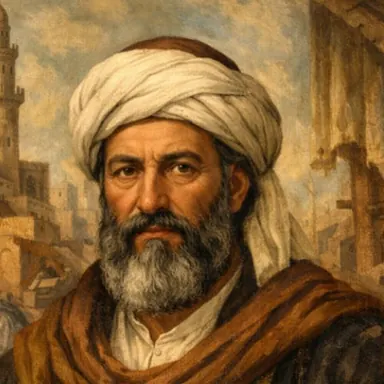
The Torah Teaching and Public Leadership of Rav Perachia ben Nissim: A Historical, Halakhic, and Philosophical Analysis of a Sage in Ayyubid Egypt
20 min read3,936 words
Summary
The text surveys the Torah work and leadership of Rav Perachia ben Nissim, a central sage in Egypt in the thirteenth century who was active at the heart of the dynasty of the Maimonidean Negidim as the brother-in-law of Rabbi Abraham ben Maimonides. The article highlights his unique contribution to preserving the legacy of the Rif and Maimonides (Rambam) through the writing of halakhic novellae that combine conceptual precision in Judeo-Arabic, together with an in-depth analysis of issues in tractate Shabbat in the light of philosophy and ethics. The author sketches his figure as a connecting link in the movement of the "Hasidim of Egypt," which sought to deepen religious devotion and moral repair through principles of spiritual freedom and the humility of leadership. Finally, the source traces the fortunes of the manuscripts of the work, from the Cairo Genizah to modern scholarly discoveries, which establish his standing as a pillar of learning in the late period of the Rishonim.
The Social Structure and Intellectual Fabric of Egypt in the Thirteenth Century
The thirteenth century in Egypt, and in particular in the urban center of Fustat, constituted a decisive period of transition in Jewish history. After the death of Rabbenu Moses ben Maimon (Maimonides, Rambam) in 1204, the leadership of the community faced the complex challenge of preserving his legacy while coping with new spiritual currents and political changes under the Ayyubid dynasty and the Mamluk Sultanate. At the heart of this process stands the figure of Rav Perachia ben Nissim, a sage whose life and work are interwoven with the family of the Maimonidean Negidim and with the central institutions of leadership of Egyptian Jewry.[1, 2]
Rav Perachia was active in a period in which Fustat was not only an administrative center but a focus of extensive Torah creativity that sought to bridge classical Talmudic scholarship with Maimonidean philosophy and ethics. Rav Perachia's presence is documented in historical documents already from the year 1240, when he was mentioned as an active figure in Fustat, and in 1247 he completed the writing of his central work on the Halakhot of the Rif.[1] This period is characterized by the flourishing of the movement of the "Hasidim of Egypt," a group of sages who sought to deepen religious devotion through a combination of asceticism, abstinence, and extra halakhic stringency, drawing inspiration both from the Jewish tradition and from the Sufi environment in which they lived.[3]
The historical context of Rav Perachia's activity is essential for understanding his writing methodology. He was active in an environment in which Judeo-Arabic was the dominant language of everyday communication and of intellectual creativity, which is reflected in the judicious use of Arabic words within his Hebrew works in order to be precise with technical and conceptual terms.[1, 4] This fact attests that his target audience was the educated stratum of Egypt, those who commanded both linguistic worlds and needed a commentary that combined traditional scholarship with the conceptual precision of the scientific outlook of the period.
The Genealogy and the Social Network of the Leadership of Egypt
Rav Perachia ben Nissim's standing derived not only from his scholarship but also from his belonging to the hard core of the leadership of the community in Fustat. An analysis of his family ties reveals a dense network of marriage alliances and Torah ties that placed him at a crossroads of authority and influence.[2, 3]
The Connection with Rav Hananel ben Samuel
Rav Hananel ben Samuel, the father-in-law and nephew of Rav Perachia, was a key figure in the Egyptian community. He served as head of the judges and head of the yeshiva in Fustat and was regarded as one of the foremost disciples of Maimonides (Rambam).[3] The connection between the two was twofold: Rav Perachia was the son of Rav Hananel's sister, and upon reaching maturity he married his daughter.[2] This closeness attests that Rav Perachia was not merely a student in Rav Hananel's study hall, but an integral part of the family that managed the halakhic system of Egypt. Rav Hananel served as the link between the teaching of Maimonides (Rambam) and its practical application in the courts, and Rav Perachia inherited from him the interpretive approach that combines a deep commitment to the Talmudic text with loyalty to the method of Maimonides (Rambam).
The Affinity with Rav Abraham ben Maimonides
The most significant connection that shaped Rav Perachia's world was his relationship as brother-in-law to Rav Abraham ben Maimonides. Rav Abraham, who was his father's successor in the office of Nagid, also married one of the daughters of Rav Hananel ben Samuel.[3] As a result, Rav Perachia and Rav Abraham were married to two sisters. This family tie makes Rav Perachia one of the people closest to the Nagid, and this is reflected in his writings, in which he cites Rav Abraham's words with reverence and adds the expression "of blessed memory," which attests that the work was edited after Rav Abraham's death.[4]
Rav Abraham's influence on Rav Perachia is evident not only in the family connection but also in the "pietistic" worldview. Rav Abraham was the engine behind the movement of Egyptian Hasidism, which sought to combine halakhic depth with the refinement of character traits and purity of heart. Rav Perachia, as part of the inner circle, absorbed these ideas and integrated them into his halakhic novellae, as can be seen from the great emphasis he places on the intention of the heart in prayer and on the spiritual value of Torah study.[3, 7]
The Next Generation: The Connection with Rav David HaNagid
As the uncle of Rav David HaNagid (the son of Rav Abraham), Rav Perachia continued to serve as a spiritual and halakhic support for the next generation of the Maimonidean leadership.[2] His involvement in the education and shaping of the character of Rav David HaNagid attests to a continuity of tradition within the family. In a period of controversies and challenges to the authority of Maimonides (Rambam), figures such as Rav Perachia constituted the backbone that ensured the stability of the dynasty and the preservation of the Torah legacy in Fustat and beyond.
The Methodology of "Chiddushei Rabbenu Perachia" on the Halakhot of the Rif
Rav Perachia's choice to write a commentary specifically on the Halakhot of Rabbi Isaac Alfasi (the Rif) is a strategic decision that attests to his conception of the history of halakha. In the thirteenth century, when Maimonides' (Rambam's) "Mishneh Torah" was already widespread and accepted, there would apparently have been room to abandon the Rif, who had served as the central code before Maimonides (Rambam). However, the sages of Egypt saw in the Rif an essential link connecting the Babylonian Talmud with Maimonidean halakhic decision-making.[1, 8]
The Rif as a Basis for Talmudic Study
The Halakhot of the Rif are not merely a final halakhic ruling, but a distillation of the Talmudic passage. In his novellae on tractate Shabbat, Rav Perachia uses the text of the Rif as a kind of "guide" within the thicket of the passages of the Bavli.[1] He examines the Rif's determinations, compares them with the conclusions arising from the Jerusalem Talmud and the halakhic midrashim, and thereby creates a synthesis between the early Spanish tradition and the late Egyptian scholarship. This approach is to some extent similar to that of the "Tosafists," as the Jewish Encyclopedia notes, in the sense that he is not content with literal commentary but engages in logical and comparative analysis of the sources.[4]
Integration of Sources and a Critical Approach
In Rav Perachia's writings one finds extensive use of diverse sources:
- The Jerusalem Talmud: like Rabbenu Nissim Gaon (it is possible that the name of Rav Perachia's father hints at an affinity with this tradition), Rav Perachia makes frequent use of the Yerushalmi to clarify obscure passages in the Bavli.[6]
- Halakhic midrashim (Mekhilta, Sifre, Sifra): the use of these Tannaitic sources enables him to arrive at the midrashic root of the halakhot, especially on topics connected with the Tabernacle and the labors of the Sabbath.[1, 9]
The teaching of Maimonides (Rambam) and of his son Rav Abraham: Rav Perachia sees them as the supreme interpretive authority, but he uses their words as a tool for understanding the Rif and not only as a final ruling. This fact makes his work an important source for understanding the way Maimonides (Rambam) was studied in Egypt in the first century after his death.
Language as an Interpretive Tool
Rav Perachia's use of Arabic within a Hebrew work is no accident. In his time, Hebrew had developed as a liturgical and Torah language, but Arabic supplied the scientific and philosophical terminology required for fine precision.[4] When Rav Perachia encounters a technical concept in tractate Shabbat – such as types of plants, manual labors, or physical concepts – he turns to Arabic in order to ensure that his students understand the exact intent of the Gemara.[4] This approach reflects the realism that characterized the Fustat school, which sought to connect the Torah with the reality of concrete life.
Studies in Tractate Shabbat: Between Halakha, Aggadah, and Philosophy
Rav Perachia's work on tractate Shabbat, which has been preserved in part in the Bodleian manuscript 438 and in quotations in "Ma'aseh Rokeach," reveals a rich intellectual world in which halakha is the expression of deep cosmological and ethical conceptions.[1, 4, 9]
The Sabbath as Testimony to the Origination of the World
One of the central themes in Rav Perachia's novellae is the connection between the commandment of the Sabbath and the philosophical concept of the "origination of the world" (Creatio ex nihilo). According to Rav Perachia, the Sabbath is not merely a social day of rest, but a theological declaration that the world was created by the Creator of His own free will.[9] Ceasing from labor on the seventh day is an imitation of the divine cessation at the completion of Creation, and thereby a person who observes the laws of the Sabbath becomes a partner in testifying to the origination of the world.
He connects the Sabbath with God's governance in the wilderness. The open miracles in the wilderness, such as the manna and the clouds, were a case of "something from nothing" – acts that changed nature temporarily in order to prove the sovereignty of the Creator.[9] Since the laws of the Sabbath are derived from the Tabernacle that was erected in the wilderness, Rav Perachia argues that the structure of the laws of the Sabbath was intended to cause a person to contemplate God's way in the world and the miracles that occur above nature.
The Miraculous and the Spatial in the Labors of the Tabernacle
In the discussion of the labors of the Sabbath and their connection to the Tabernacle, Rav Perachia raises an interesting insight regarding sacred space. He notes that in miracles, space is not perceived by ordinary measurement: "The place of the Ark is not part of the measure," and in the Tabernacle "they stand crowded and bow down with room to spare."[9] He uses this conception to explain the labors connected with carrying out from one domain to another and with the boundaries of space on the Sabbath. The affinity between the miracle and the human act in the Tabernacle teaches that the Sabbath is a time in which a person rises above the physical limitations of this world and connects with a dimension of holiness in which human measurement does not apply.
Freedom and Ethics: The King as a Free Man
Rav Perachia deals extensively with the figure of the leader and the moral person. In his commentary on the verse "Happy are you, O land, whose king is a free man," he develops a conception of freedom that derives from the laws of the Torah.[9] In his view, kingship and freedom are not measured by political power or by wealth, but by a person's ability to master his inclinations and to act according to "objective laws of wisdom" fixed in the soul.
He argues that one who lives by the Torah is "truly free" because he knows how to distinguish between good and evil and is not enslaved to temporary and fleeting motives that have no stable foundation.[9] This conception echoes the Maimonidean approach, which sees intellectual and moral perfection as the pinnacle of human aspiration. For Rav Perachia, the Sabbath is the ideal time for realizing this freedom, since it frees a person from the affairs of this world and enables him to concentrate on study and the service of God.
Sabbath Customs and Communal Arrangements in His Work
From the fragments of the work preserved in "Sinai" and in "Kiryat Sefer" (in the publications of Simcha Assaf), a detailed picture emerges of religious and communal life in Fustat in the thirteenth century.[1, 7] Rav Perachia does not discuss only abstract halakhot, but gives practical guidelines concerning the order of the Sabbath day and the functioning of the community's institutions.
The Order of the Sabbath Day and Prayer
Rav Perachia discusses the details of the commandment of Kiddush, and in particular "Kiddusha Rabba" (the Kiddush of the Sabbath day). He addresses practical problems such as a shortage of wine in certain communities and how the commandment can be fulfilled in the most dignified manner.[7] He also deals with the subject of tasting before Kiddush and the order of the meals, emphasizing the importance of adding "Retzeh ve-hachalitzenu" ("Be pleased and strengthen us") in the Grace after Meals as an expression of a request for spiritual rest.[7]
Another subject that arises in his writings is "sleeping on the Sabbath" as a delight. In contrast to extreme ascetic approaches, Rav Perachia sees physical rest as an inseparable part of the Sabbath delight, provided that it serves as a means of gathering strength for the study of Torah.[7] The use of time on the Sabbath is a central value for him, and he warns against idleness that does not lead to spiritual growth.
Communal Leadership and Synagogue Wardens
In an especially interesting passage, Rav Perachia discusses the role of "synagogue wardens" (gabbaim) and cites the saying "Make for yourself congregations, congregations."[7] He sees communal organization as a necessary instrument for preserving the Torah. He addresses the importance of humility among public leaders, but warns against "unfitting humility" – a situation in which the leader refrains from making necessary decisions or from rebuking the public in the name of modesty, thereby harming the functioning of the community.[7]
He emphasizes the duty of the sage to prepare the "lesson" before delivering it to the public. The demand for meticulous preparation of the sermon or lesson attests to the level of responsibility that Rav Perachia placed on spiritual leadership. In his eyes, the leader is not merely a decisor, but an educator who must present the words of Torah in the clearest and most profound manner.
The Reward for Torah Study and Torah Novellae
Rav Perachia sees the merit of one who innovates Torah novellae, and especially on the Sabbath, as a supreme value. He argues that a novel insight in Torah – whether in halakha or in aggadah – is the highest way to connect with the Creator on the Sabbath.[7] The reward for Torah study on the Sabbath is many times greater than on weekdays, since on the Sabbath the soul is freer to receive the divine light. This conception explains why he devoted his best energy to writing "novellae" on the Rif, out of a belief that fresh study of the ancient texts is a religious commandment of the first order.
Rav Perachia and the Rise of the "Hasidim of Egypt"
Rav Perachia's standing as the brother-in-law of Rav Abraham ben Maimonides requires an in-depth examination of his affinity with the Egyptian Hasidic movement. This movement, which was very active in the thirteenth and fourteenth centuries, sought to revive the Jewish religious world by adopting practices that emphasize the direct relationship between man and his God.[3]
The Influence of Pietistic Ethics
Egyptian Hasidism championed "piety" in the sense of going beyond the letter of the law. In Rav Perachia's writings one can find echoes of this conception especially in the discussions of humility, prayer, and abstinence. The expressions of spiritual "delight" as opposed to physical delight ("the joy of strength and not through the drinking of wine") reflect the pietistic ideal of rising above matter.[9] For Rav Perachia and his colleagues in the Egyptian circle, halakha was the foundation, but upon it an additional story of inner service was erected.
The Affinity with Jewish Sufism
Scholars note that the circle of Rav Abraham ben Maimonides was influenced by the terminology and practices of Muslim mysticism (Sufism), while adapting them to Jewish sources (literally, Judaizing them). Rav Perachia, in his use of Arabic and in the discussions of the states of soul of the "free man," fits into this trend.[4, 9] He sees the Torah as a system of laws of wisdom intended to purify the soul, a conception that combines Maimonidean rationalism with the aspiration to devotion characteristic of the Hasidim of Egypt.
Preservation of the Work: From Manuscripts to Printed Editions
The history of the text of Rav Perachia is a story of survival and rediscovery, reflecting the fate of the Fustat library as a whole. His work was not printed as a complete book in his time, but was transmitted in precious manuscripts among Torah scholars in Egypt and North Africa.[1]
Bodleian Manuscript 438
The most important testimony to the existence of the work is a manuscript found in the Neubauer collection in the Bodleian Library in Oxford.[4] The manuscript, whose number is 438, was written in 1304, about fifty-seven years after Rav Perachia completed his work.[1] This fact attests that within less than sixty years his work had become a permanent asset ("iron-flock property") of the local scholarship, to the point that copyists devoted effort to preserving it. The manuscript includes the commentary on tractate Shabbat, in which one can find the notes in Arabic and the quotations from Rav Abraham ben Maimonides.[4]
The Quotations in "Ma'aseh Rokeach"
In the eighteenth century, Rabbi Masud Chai Rokeach, one of the sages of Libya and Italy, composed his monumental book "Ma'aseh Rokeach" on Maimonides (Rambam). In the introduction to his book and within the work itself, he appended passages under the title "Novellae of Maimonides (Rambam) on the Talmud," but later scholars (such as Zalman Havlin and M. L. Zaks) proved that a considerable portion of these quotations in fact originate in the work of Rav Perachia ben Nissim.[1] Rabbi Rokeach, who had access to rare manuscripts from the Genizah and from North African sources, greatly valued Rav Perachia's words and saw in them a key to understanding the sources of Maimonides (Rambam) himself.
Modern Research and the Discovery in the Genizah
In the twentieth century, with the development of Cairo Genizah research, additional fragments of Rav Perachia's works began to be discovered. Simcha Assaf, one of the greatest Genizah scholars, published passages from Rav Perachia's novellae in the journals "Sinai" and "Kiryat Sefer."[1] These publications made it possible to reconstruct additional parts of the work, beyond tractate Shabbat, and to understand Rav Perachia's methodology better.
In 1970 a broad fragment of the work on chapters 5–6 of tractate Shabbat was published in the book "Siyyata di-Shmaya," which made his words accessible to the modern learning public.[1] The study by Zalman Havlin in the Encyclopaedia Judaica summarized what is known about his life and work, and emphasized the importance of Rav Perachia as a connecting link between the sages of Egypt and the general world of the "Rishonim."[1]
A Historical Distinction: Rav Perachia ben Nissim versus Rabbenu Nissim Gaon
An important point that must be clarified is the distinction between Rav Perachia ben Nissim and the famous figure of Rabbenu Nissim ben Jacob of Kairouan (known as Rabbenu Nissim Gaon). Despite the similarity in names and the affinity with the North African tradition, these are two different figures active about two hundred years apart.[2, 5, 6]
Rabbenu Nissim Gaon (990–1062)
Rabbenu Nissim Gaon was active in Kairouan in Tunisia in the eleventh century. He was a disciple of Rabbenu Chushiel and the teacher of the Rif.[5, 6] His most famous work, "Sefer HaMafteach LeManulei HaTalmud" ("The Key to the Locks of the Talmud"), laid the foundations for the method of using one Talmud to interpret another.[10] He was a central figure in the era of the Geonim and was a partner in correspondence with Rav Hai Gaon and with Samuel HaNagid in Spain.[5, 10]
Rav Perachia ben Nissim (Thirteenth Century)
Rav Perachia was active in Egypt in the thirteenth century, in the Ayyubid period. He is not a "Gaon" in the technical sense of the title (head of a yeshiva in Babylonia), but an Egyptian sage belonging to the late period of the Rishonim.[1, 2] He interpreted the Halakhot of the Rif – the same Rif who was a disciple of the original Rabbenu Nissim Gaon.
The confusion stems at times from the fact that the name of Rav Perachia's father was Nissim, and from the fact that both sages engaged in the methodology of "keys" and in broad interpretation that combines the two Talmuds.[1, 6] However, Rav Perachia represents the stage at which the tradition of Kairouan had already been absorbed into the Maimonidean system of Egypt.
Summary: Rav Perachia's Place on the Eastern Wall of the Sages of Egypt
Rav Perachia ben Nissim is a clear example of a sage who succeeded in preserving his uniqueness within the heavy shadow of giant figures such as Maimonides (Rambam) and Rav Abraham ben Maimonides. His work does not amount only to writing halakhic novellae; he represents a model of spiritual leadership that combines theoretical depth, communal responsibility, and moral devotion.[2, 3, 7]
Through his work on tractate Shabbat, he bequeathed to later generations the conception that halakha is a tool for repairing the world and for testifying to the Creator. His discussions of human freedom, of the essence of the miracle, and of the importance of preparation for study make his teaching relevant not only for the community in thirteenth-century Fustat, but for every student seeking to find the connection between dry law and the living heart.[9]
His contribution to the transmission of the tradition of the Rif in Egypt ensured that classical Talmudic scholarship would not be forgotten in an age of codification, and his novellae, which were preserved by a miracle in the Genizah and in later manuscripts, continue to illuminate the eyes of scholars and students to this day. Rav Perachia remains an essential link in the golden chain of the sages of Egypt, a figure who reminds us of the spiritual and cultural richness of Eastern Jewry at the peak of its flourishing.[1, 7, 9]
Sources10
- 1.Pera?yah ben Nissim | Encyclopedia.com, encyclopedia.com/religion/encyclopedias-almanacs-transcripts-and-maps/perahyah-ben-nissim
- 2.פרחיה בן ניסים – ויקיפדיה, he.wikipedia.org/wiki/פרחיה_בן_ניסים
- 3.רבי אברהם בן הרמב"ם - הרב יורם אברג'ל ובנו הרב ישראל - המאיר לארץ, hameir-laarets.org.il/hilulots/רבי-אברהם-בן-הרמבם/
- 4.PERAḤYAH B. NISSIM - JewishEncyclopedia.com, jewishencyclopedia.com/articles/12017-perahyah-b-nissim
- 5.Nissim ben Jacob ben Nissim Ibn Shahin - Jewish Virtual Library, jewishvirtuallibrary.org/nissim-ben-jacob-ben-nissim-ibn-shahin
- 6.Nissim ben Jacob - Wikipedia, en.wikipedia.org/wiki/Nissim_ben_Jacob
- 7.השבת בהלכה ובאגדה - תורת אמת, toratemetfreeware.com/online/f_01819.html
- 8.Rabbi Isaac Alfasi - Jewish law - Tzadikim, dailyzohar.com/tzadikim/392-Rabbi-Isaac-Alfasi
- 9.באורי אגדות שבת - מכון הלכה ברורה, halachabrura.org/agada/shabat.htm
- 10.NISSIM BEN JACOB BEN NISSIM IBN SHAHIN - JewishEncyclopedia.com, jewishencyclopedia.com/articles/11560-nissim-ben-jacob-ben-nissim-ibn-shahin