The Teaching, Work and Thought of the Maharsha: The Foundation of Study and Thought in Polish Jewry
15 min read2,955 words
Summary
This article surveys the life and the multidimensional legacy of the Maharsha, Rabbi Shmuel Eliezer HaLevi Edels, who was one of the pillars of Polish Jewry in its golden age. The text shows how the Maharsha combined an unprecedented exegetical genius, which became an inseparable part of the page of Gemara, with active public leadership within the framework of the "Council of Four Lands." The author of the article stresses his distinctive method of study, which strives for textual truth and for "straight pilpul," alongside a revolutionary innovation that grants the aggadot of the Sages a deep speculative and intellectual standing. Beyond his scholarly achievements, the work portrays an exemplary figure who links the world of halakha with the inner dimension of the Torah, while expressing a high moral sensitivity and gratitude toward the community and the family.
The Historical and Spiritual Introduction: The Figure of the Maharsha on the Seam of the Modern Era
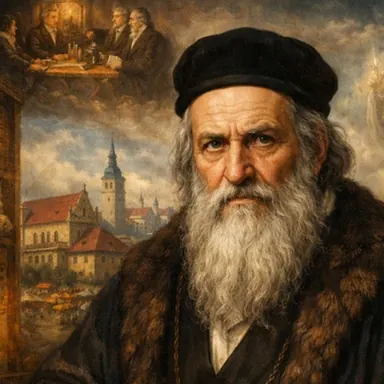
Rabbi Shmuel Eliezer HaLevi Edels, known for generations by the acronym Maharsha (Morenu HaRav Shmuel Eliezer, "our teacher Rabbi Shmuel Eliezer"), represents one of the most splendid high points of Torah creativity in Polish Jewry in its golden age. The Maharsha, who lived from 1555 to 1631, was active in a period in which the Jewish center of gravity moved finally and completely from Western Europe and Germany to the expanses of Poland, Lithuania and Ukraine. His figure is not only that of a brilliant Talmudic commentator; it embodies the community leader, the thinker, the formative head of a yeshiva and the man of political action within the autonomous institutions of Eastern European Jewry.[1, 2, 3]
An in-depth analysis of his work requires an understanding of the environment in which he grew up. Krakow of the 16th century was a bustling center of Torah and science, a place where ancient Ashkenazi traditions met new winds of pilpul and inquiry. The Maharsha, who was born into a family of lofty lineage—a descendant of Rabbi Yehuda HeChasid—carried on his shoulders the mystical and moral heritage of Chasidei Ashkenaz (the Ashkenazi Pietists) together with the new logical tools of Polish yeshiva study.[1] Already in his youth he was called the "prodigy of Krakow," a title given to him because of his exceptional mental abilities and his total diligence, which was sometimes described in ascetic terms: he would tie his hair to the wall so as not to fall asleep.[1]
The Maharsha's influence on the page of Gemara is almost without precedent. Whereas many commentators were pushed to the margins of the page or printed as separate books, the Maharsha became an integral part of the printed "Shas" (the six orders of the Mishnah). In almost every edition of the Talmud since the 17th century his words appear at the end of the tractate or in the margins of the page, forming the indispensable bridge between the words of the Rishonim (Rashi and the Tosafot) and the later understanding of the sugya.[1, 2] This standing is not accidental; it stems from an exegetical method that sought to bring order to the world of Talmudic thought, to separate halakhic study from aggadic thought, and at the same time to unite them under one roof of pure Torah truth.[4]
Milestones and Biography: From the Prodigy of Krakow to the Rabbinate in Ostroh
The Maharsha's life divides into several key stations that reflect his development from a young prodigy into the leader of his generation. Each station contributed another layer to his work as a whole, from the exceptional financial support he received in Posen to public leadership in Lublin and Ostroh.[1, 5]
The name "Edels" (Yiddish: "of Edel") attached itself to the Maharsha as an expression of the immense appreciation he felt for his mother-in-law, Mrs. Edel Ashkenazi Heilprin. Edel, a wealthy widow, took upon herself full financial responsibility for maintaining her son-in-law's yeshiva in Posen for two decades.[1, 2] The Maharsha, who saw her as his "second mother," sought to commemorate her kindness and the partnership of women in the enterprise of Torah by adopting her name as his family name. This fact attests to his moral sensitivity and to his conception that Torah study cannot exist without a firm economic and moral infrastructure provided by the community and the family.[1, 5]
The death of his mother-in-law in 1608 was a turning point in his life. Without the financial support that had allowed him to study free of every burden, the Maharsha was compelled to accept official rabbinic posts. This transition, despite the difficulty it involved, enriched his Torah teaching with a practical perspective of public leadership. The rabbinate in Chelm, and after it the prestigious post in Lublin—the city of fairs and the center of the Council of Four Lands—made him the most influential figure in the Jewish life of Poland at that time.[1, 3]
The Methodology of "Chiddushei Halakhot": Precision, Structure and Straight Pilpul
The Maharsha's central contribution to the world of the yeshivas lies in his work "Chiddushei Halakhot" (Novellae on Halakha). This book is not merely a collection of questions and answers; it offers a new language of study based on three pillars: the Talmudic text, Rashi's commentary and the words of the Tosafot.[2, 5]
The Maharsha assumed that Rashi's wording is absolutely precise. Unlike other commentators, who might regard certain additions in Rashi as linguistic embellishments, the Maharsha argued that every superfluous word in Rashi comes to answer a hidden difficulty in the text of the Gemara. His method of study trains the learner to ask: "What was difficult for Rashi?"[8, 9] Out of the precision of Rashi's words, the Maharsha uncovers the logical structure of the entire sugya. This method is sometimes called the classic "method of iyun" (analytical study), and it is the basis of study in many yeshivas to this day.[8]
Alongside his engagement with Rashi, the Maharsha grapples with the complex questions of the Tosafists. He works by way of "straight pilpul"—pilpul that seeks to reconcile contradictions between different sugyot in the Shas without resorting to far-fetched assumptions or obscure logic.[5] The Maharsha was one of the sharp opponents of the "pilpul of falsehood," which had been widespread in the yeshivas of Poland in the generations before him, in which students would build splendid logical structures detached from the plain meaning of the text. The Maharsha brought study back to the text, using his analytical abilities to show how the sugyot are honestly reconciled.[5, 8]
"Chiddushei Aggadot": The Philosophy of the Sages in the Mirror of the Maharsha
One of the Maharsha's most revolutionary innovations was the decision to devote a significant part of his energy to interpreting the aggadot of the Shas. In his time the prevailing tendency in the yeshivas was to focus almost exclusively on the halakhic parts ("shmaata"), while the aggadot were sometimes regarded as material for homiletics only and not for analytical study. The Maharsha changed this fundamentally, arguing that the aggadot contain the inner dimension of the Torah and the foundations of faith.[2, 5]
In the Chiddushei Aggadot the Maharsha uses philosophical, kabbalistic and moral tools to decipher the words of the Sages. He explains that the stories of the Gemara are not merely folk tales but deep parables for spiritual ideas.[5] For example, in his discussion of the saying "Everything is in the hands of Heaven except the fear of Heaven," the Maharsha proposes a fine distinction: whereas in prayer for the needs of this world a person depends on the will of Heaven to grant his request, in prayer for spiritual growth Heaven is, as it were, "obligated" to grant it, since it is the will of the Creator that man should choose the good.[1]
The Maharsha attached such great importance to the aggadot that at first he printed them as a separate work, so that they would not be mixed with the halakhic pilpul. His later wish, however, was to unite them, out of the understanding that the Torah life of a Jew must combine law (halakha) with thought and feeling (aggadah).[4] His influence in this field was so great that the Lubavitcher Rebbe notes that in this commentary the Maharsha reveals the "view of the Kabbalists," that is, foundations of the hidden Torah clothed in a rational garb accessible to every learner.[5]
The Aggadot of the Destruction as a Historiosophical Doctrine
A special and formative chapter in his teaching is his commentary on the aggadot of the Destruction in Tractate Gittin. The Maharsha is not content with the historical description of the destruction of Jerusalem but looks for the spiritual and social causality that led to the disaster.[11, 12] He analyzes the story of Kamtza and Bar Kamtza not only as an event of baseless hatred but as a failure of the spiritual leadership, which did not protest in time. In his eyes the Destruction is a process of temporary "divorce" between the Holy One, blessed be He, and the Congregation of Israel, a concept explained through the placement of the aggadot in the chapter "HaNizakin" of Tractate Gittin—to hint that the damage can be repaired and that a return to a relationship of wholeness is possible.[11]
He dwells on the figure of the captive child cited in the Gemara, whose ransom by Rabbi Yehoshua symbolized the beginning of the rehabilitation of the Torah world after the Destruction. The Maharsha sees Torah study and the raising of a new generation of halakhic teachers as the only answer to the physical destruction.[11] This conception of "redemption through Torah" is a central motif in all his writings, which stress that even in the darkness of exile, spiritual light is the key to national survival.
The Maharsha as a Public Leader: The Council of Four Lands and the Regulations of the Land
Alongside his Torah creativity, the Maharsha was one of the most influential figures in shaping the political and communal structure of Polish Jewry. As rabbi of Lublin he filled a key role in the "Council of Four Lands"—the central administrative body that united the communities of Greater Poland, Lesser Poland, Volhynia and Red Ruthenia.[3, 13] The Maharsha was called "head of the speakers," a title that attests to his unchallenged authority in the halakhic and public deliberations of the Council.[5]
His activity in the Council focused on several critical areas intended to protect the Jewish community from internal disintegration and outside interference:
- Purity of the rabbinate: The Maharsha fought the phenomenon in which men of means "bought" rabbinic posts through the authorities or by means of gifts. He was a party to the regulation forbidding a rabbi to purchase his position, out of the understanding that spiritual authority based on money will in the end bring disaster on the community.[13]
- Oversight of the world of printing: In that period Jewish printing houses began to flourish. The Maharsha and the Council enacted that no book may be printed without a "haskamah" (approbation) from recognized rabbis. This was meant to prevent the spread of halakhic errors or heretical statements, and also to protect the authors' copyright.[13]
- Regulation of the economy and the law: The Council served as a supreme court for settling disputes between communities. The Maharsha worked to prevent Jews from turning to gentile courts and strengthened the independent legal system of the Jewish community.[3, 14]
- Regulations on interest and the heter iska: To enable proper commercial life in the developing modern economy of Poland, the Maharsha was involved in drafting regulations that allow loans at interest within the halakhic framework of the "heter iska" (partnership permit), a step that was essential to the economic survival of the Jews.[13]
Foundations of Faith and Redemption in His Teaching
The Maharsha's spiritual world rests on a direct bond between man and the Creator, with an emphasis on the power of prayer and repentance. In his novellae on Tractate Berakhot he discusses at length questions of suffering, reward and punishment. The Maharsha distinguishes between "afflictions of love"—sufferings that come upon a person without sin in order to increase his reward—and sufferings that are the fruit of a person's sin.[10] He analyzes the positions of Rashi and the Tosafot on this matter and proposes a synthetic approach that recognizes the complexity of divine justice.
On the subject of redemption the Maharsha takes an active and spiritual approach. He interprets the words of the Gemara about the Messiah ("he smells and judges") as a test of supreme moral sensitivity. For him, redemption is not only a political event of return to the Land of Israel but a transformation of the human heart. In his commentary on Tractate Moed Katan he links the laws of mourning with the great hope of "And I will remove the heart of stone from your flesh," and explains that moral repair is the necessary condition for the abolition of death and sorrow in the world.[15]
The power of prayer occupies a central place in his writings. He explains that the Divine Presence dwells with Israel even in their exile, and that wherever they mention the name of the Holy One, blessed be He, by way of study, He comes and blesses them.[10] This conception gives existential meaning to every moment of Torah study, which becomes an act of holiness that redeems the world from the darkness of exile.
The Maharsha and Hasidism: His Transformation into a Wonder-Worker and a Segulah
Although the Maharsha was active in the classic "Mitnagdic" world, generations before the rise of Hasidism, the Hasidic movement took him to its heart as a holy man and wonder-worker. The attitude toward him among the Hasidic Rebbes was one of total veneration, to the point of attributing to every word of his works that it was written "by the Holy Spirit."[5]
The deepest connection appears in the Breslov tradition. Rabbi Nachman of Breslov saw in the Maharsha a figure the study of whom and of whose stories is able to heal illnesses. The story of Adel, Rabbi Nachman's daughter, who was healed thanks to three stories about the Maharsha, became a cornerstone of the Hasidic belief in the power of the righteous of the past.[1] Hasidim explain this by saying that in his works the Maharsha succeeded in "sweetening the judgments" through his wondrous combination of halakha and aggadah.
In the Lithuanian world, too, the Maharsha was preserved as a supreme authority. The "Chazon Ish," hundreds of years later, would consult the Maharsha's Chiddushei Halakhot on every difficult sugya and saw in him the key to understanding the Rishonim. The fact that his work was printed within the "Shas" made him "the teacher of all Israel," a figure who belongs not to this or that stream but is part of the genetic infrastructure of the Torah world.[2, 5]
His Last Days and His Spiritual Testament in Ostroh
In the year 5385 (1625) the Maharsha reached his final station, the city of Ostroh, a city that earned the epithet "Ot Torah" ("a sign of Torah") because of the great Torah scholars who lived there over the generations.[1] In Ostroh he completed the later editions of his books ("Mahadura Batra"), which include additions and clarifications that arose from discussions with his students and his son-in-law, Rabbi Moshe.[4]
The Maharsha died on the night after the holy Sabbath, 5 Kislev 5392 (1631), at the age of 76.[1, 7] His grave in Ostroh became a place of pilgrimage, where Jews in every generation sought to arouse the mercy of Heaven by the merit of the man who devoted his life to clarifying Torah truth. The traditions of miracles that occurred around his grave, and of the local church being unable to interfere with his funeral, attest to the deep imprint he left on the hearts of the masses no less than on the hearts of Torah scholars.[1]
The Maharsha's legacy remains alive and vibrant. It teaches us that the Torah is not merely a collection of laws but a living organism that combines cold intellectual precision with the fire of faith and feeling. The Maharsha, the prodigy of Krakow who became a leader of the Four Lands, remains the compass that directs the learner to the depth of the sugya and to the depth of the Jewish soul.[1, 3, 5, 8]
The Maharsha's teaching continues to resonate in every beit midrash where a volume of Gemara is opened. The unique combination of logical genius, personal humility, public responsibility and depth of thought makes him one of the greatest luminaries who arose for the people of Israel in the modern era. His books are not merely commentaries; they are a spiritual testament that calls on every learner to seek the truth honestly, to be precise in every word, and to see in every Talmudic sugya another layer in the building of the future redemption.[1, 5, 8, 15]
Sources14
- 1.רבי שמואל אליעזר איידלס - המהרש"א » ברסלב סיטי, breslevcity.co.il/הילולת-הצדיקים-רבי-שמואל-אליעזר-איידל/
- 2.מהרש"א | מקורות מתוך ספריית ספריא, sefaria.org.il/topics/maharsha
- 3.חב״ד און ליין - COL מרכז התקשורת החב״די - ועד ארבע ארצות: מועצת השלטון היהודית במזרח אירופה, col.org.il/news/131435
- 4.חידושי הלכות ואגדות מהרש"א – ויקישיבה, yeshiva.org.il/wiki/index.php/חידושי_הלכות_ואגדות_מהרש"א
- 5.התקשרות 1021 | רבי שמואל אליעזר אידלס – המהרש"א - חב"ד, chabad.org.il/Magazines/Article.asp?ArticleID=10284&CategoryID=1823
- 6.חיי המהרש"א: מסלול חייו של ר' שמואל אליעזר הלוי איידלס (שיום פטירתו חל בה' בכסלו), tehillim-center.co.il/article/685
- 7.מחבר:מהרש"א - ויקיטקסט, he.wikisource.org/wiki/מחבר:מהרש"א
- 8.סדר הלימוד הנכון והזמן הראוי להקדיש ללימוד העיון - ישיבת כסא רחמים, ykr.org.il/question/15542/
- 9.רש"י - ויקיפדיה, he.wikipedia.org/wiki/רש"י
- 10.מהרש"א על הש"ס/ברכות/פרק א - ויקיטקסט, he.wikisource.org/wiki/מהרש"א_על_הש"ס/ברכות/פרק_א
- 11.אגדות החורבן – ויקישיבה, yeshiva.org.il/wiki/index.php/אגדות_החורבן
- 12.ביאור:אגדות החורבן - ויקיטקסט, he.wikisource.org/wiki/ביאור:אגדות_החורבן
- 13.ועד ארבע ארצות - ויקישיבה, yeshiva.org.il/wiki/index.php/ועד_ארבע_ארצות
- 14.ועד ארבע ארצות - ויקיפדיה, he.wikipedia.org/wiki/ועד_ארבע_ארצות