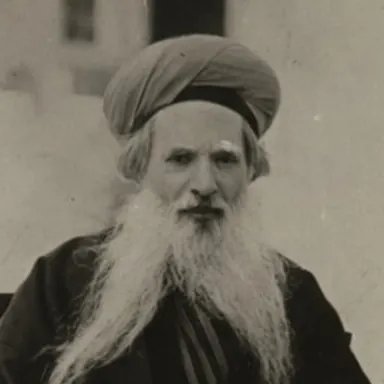
The Work and Torah Teaching of Rabbi Chaim Chizkiyahu Medini: The "Sdei Chemed"
14 min read2,821 words
Summary
This article surveys the life and teaching of Rabbi Chaim Chizkiyahu Medini, one of the great halakhic decisors of the modern era, known for his monumental work the "Sdei Chemed." The text traces his unique life path from Jerusalem, through the leadership of communities in Constantinople and the Crimean Peninsula, to his tenure as rabbi of Hebron, while stressing his role as a cultural bridge that united the traditions of Sepharad and Ashkenaz. The heart of the article deals with the methodological revolution the rabbi brought about in creating the first halakhic encyclopedia, which gathered and arranged the sea of Torah literature into alphabetical entries. Alongside his scholarly genius, the source highlights his rare moral qualities, above all humility and modesty, which made him a revered and unifying figure for all sections of the Jewish people to this day.
Introduction: The Figure of the "Sdei Chemed" as a Cultural and Halakhic Crossroads
The figure of Rabbi Chaim Chizkiyahu Medini (HaChaChaM), known to all as the "Sdei Chemed" after his monumental series of books, represents one of the most fascinating and significant chapters in the history of Torah literature and rabbinic leadership in the 19th century and the beginning of the 20th century. He was not merely an ordinary halakhic decisor but the innovator of the genre of the modern halakhic encyclopedia, a figure who bridged in his person and in his teaching East and West, the world of the Sephardim and the world of the Ashkenazim, and isolated communities in the steppes of Crimea with the spiritual centers of Jerusalem and Hebron.[1, 2, 3]
The "Sdei Chemed" was active in a period of momentous upheavals in the Jewish world, and his teaching reflects an unprecedented historical attempt to gather, arrange and make accessible the sea of Jewish wisdom accumulated over generations. His work goes beyond the narrow bounds of local halakhic ruling; he created a methodological infrastructure that changed the way Torah scholars approach the study of sugyot.[3, 4] Alongside his intellectual genius, his personality radiated humility and righteousness, as his will and the wondrous stories about his personal conduct attest, which made him a figure revered by all sections of the people, from Chabad Hasidim to the rabbis of Lithuania, and from the remote communities of Crimea to the sages of Bukhara and Jerusalem.[5, 6, 7]
His Life: From the Jerusalem Spring to the Expanses of Exile and Back
His Childhood and Education in Jerusalem (1832–1853)
Rabbi Chaim Chizkiyahu Medini was born in Jerusalem on 7 Cheshvan 5593 (1832) to an old Sephardi family.[1, 2] His father, Rabbi Raphael Asher Eliyahu Medini, was one of the outstanding Torah scholars of the city, and it was he who served as his son's first teacher and master, instilling in him the foundations of erudition and diligence.[1, 6] His mother, Kalo Vida, shared in raising him in an atmosphere of holiness and abstinence.[1, 2]
Already in his youth the young Chizkiyahu stood out for rare talents. He had the privilege of studying with the great rabbis of Jerusalem of that time, among them Rabbi Yitzchak Kovo, who served as "Rishon LeZion" and "Chacham Bashi," and Rabbi Yosef Nissim Burla, who was later appointed head of the rabbinic court in the city.[1, 2] These teachers recognized the potential within him and foretold for him a brilliant future as a luminary of the Diaspora.[1] At the age of only 13, an age at which most boys are just beginning their mature studies, Rabbi Medini was already ordained to teach and to serve as a judge, a rare achievement that attests to the scope of his knowledge already at the dawn of his youth.[2, 8]
At a young age he married Rivka, and his wedding was celebrated with great splendor in the month of Elul, with the participation of "almost all the great men of the generation, the rabbis, the geniuses, the mighty ones of the Land of Israel."[2] His early life, however, was not free of suffering; in 5613 (1853), when he was only 21, his father died.[1, 2] This death was not only a personal tragedy but also a severe economic crisis, since the burden of supporting his mother, his wife and his entire extended family was laid on his young shoulders.[1, 2, 6]
The Years of Wandering: Constantinople and Crimea (1853–1899)
In the wake of the economic distress in Jerusalem, Rabbi Medini made the difficult decision to leave the Land of Israel. He set out with his family for Constantinople (Istanbul), where he hoped to be helped by wealthy relatives who lived in the city.[1, 2, 6] The departure from Jerusalem was accompanied by deep sorrow, but he saw it as a necessity for the sake of supporting his family. In Constantinople he served as a judge, but he did not find the financial ease he had hoped for, and he went on devoting his time to Torah study amid hardship.[2, 8]
In 5627 (1867) an approach came from the community of Karasubazar (Bilohirsk) on the Crimean Peninsula. The local community, which consisted of Krymchak Jews and Ashkenazim, was looking for a rabbi of stature who could unite the ranks.[2, 9] Rabbi Medini accepted the offer and served there as chief rabbi (chacham) for 33 years.[9] In this period he began writing his vast work "Sdei Chemed," which made his name famous throughout the Jewish world.[1, 2]
During his stay in Crimea the rabbi experienced two severe personal tragedies: in 5628 his only son died, in whose memory he composed the book "Ohr Li," and in 5638 he fell gravely ill with a disease of the eyes that nearly took away his sight.[1, 2] As a segulah for healing, the name "Chaim" was added to his name, and from then on he was known as Rabbi Chaim Chizkiyahu Medini.[1, 2] Despite his weak eyesight he continued his tremendous work of writing, aided by his students and by his inexhaustible willpower.
The Methodology of the "Sdei Chemed": The Revolution of Compiling and Organizing
Rabbi Medini's central enterprise, the book "Sdei Chemed," is not merely a compilation of laws but a new method of study. The rabbi recognized that the sea of Torah literature—thousands of books of responsa, novellae and halakhic rulings—was becoming inaccessible to the average deciding rabbi and learner.[3] His solution was to create a halakhic encyclopedia arranged in alphabetical order, a method that had not existed on such a scale before (apart from a much earlier attempt in the book "Pachad Yitzchak").[3, 7]
The Structure of the Work: Principles and a Collection of Laws
The book "Sdei Chemed" consists of 18 volumes divided into thematic sections.[2, 3] The inner structure of the book is made up of two main divisions:
- Kelalim (Principles): In this part the rabbi gathered the principles of the Shas and the decisors. He deals not only with the particular law but with the guiding principles of ruling and of study. Here one can find entries such as "safek sefeika" (a double doubt), "chazakah" (presumption), "the halakha follows the later authorities" and more, with the rabbi citing all the various views of the sages of Ashkenaz and Sepharad alike.[4, 11, 12]
- Asifat Dinim (Collection of Laws): This part deals with practical halakha on various subjects, such as chametz and matzah, Chanukah, festivals, mourning, blessings and more.[12] The rabbi gathers everything written on a given subject in the books of responsa and presents the learner with an exhaustive summary that allows quick access to the halakhic decision.[3]
The book also includes subdivisions such as "Pe'at HaSadeh" and "Shiyurei HaPe'ah," which form additions and supplements to existing entries, evidence that the rabbi went on updating and perfecting his work throughout his life.[3, 12]
The Library and the Scope of the Compilation
To carry out this tremendous enterprise, Rabbi Medini needed an enormous library. In his home in Hebron and in Crimea there was a library of more than 10,000 books, some of them extremely rare.[2, 3, 7] The rabbi was not content with quoting Sephardi sources but fully integrated the rulings of the sages of Poland, Russia and Germany, thereby creating a unique synthesis that united the world of Jewish halakha.[3] His influence was so great that many rabbis of Russia, Poland, Hungary, Romania and North Africa turned to him with their questions and asked for his opinion.[1]
The Leadership in Crimea: Rabbi of Two Communities and a Figure Revered by All
Rabbi Medini's period of service in Crimea is a testimony to his exceptional capacity for leadership. He came to a relatively isolated community, but thanks to him it became a world Torah center.
Chacham of the Krymchaks and the Ashkenazim
The community in Karasubazar consisted of Krymchak Jews—an ancient community that preserved special customs and spoke a Judeo-Tatar dialect—and of Ashkenazi Jews.[2, 9] Rabbi Medini served as a bridge between the two groups. He served as rabbi of both communities at the same time, respecting their different customs while leading them in a single spirit.[2, 9] His halakhic expertise and his ability to integrate the rulings of the sages of all the communities made him accepted by everyone.
His attitude toward the Krymchak community was fatherly and devoted. He founded a respected yeshiva in Crimea, in which only the most gifted students studied, and he himself bore the financial burden of maintaining it.[13] His son-in-law, Rabbi Nissim Natan HaLevi Tzachtzir, even published a Passover Haggadah in the Tatar language of Crimea, evidence of the rabbi's cultural and spiritual influence on the local community.[2]
Relations with the Non-Jewish Population
The esteem for the rabbi went beyond Jewish bounds. Local Christians and Muslims in Crimea also revered him and saw him as a man of God.[2] His impressive appearance, his long beard and his noble personality gave him a position of honor among all the inhabitants of the peninsula. His letters attest to ties he maintained with rabbis and public leaders throughout the world, which made Crimea a significant point on the Jewish map of that time.[6]
The Return to Zion: The Days of Hebron and Beit Romano
In 5659 (1899), after 33 years of activity in Crimea, Rabbi Medini decided to return to the Land of Israel. His parting from the community in Crimea was full of tears; thousands of people accompanied him to the port and stood on the shore until his ship disappeared.[1]
The Move to Hebron and the Leadership of the City
After a short and stormy stay in Jerusalem, where he was caught up in internal disputes that did not suit his tranquil spirit, the rabbi moved to Hebron in 5661 (1901).[9] In Hebron he was appointed chief rabbi of the city, a post in which he served until the day of his death.[7] Members of the Romano family, wealthy men of Turkish origin, invited him to live in the magnificent building they had erected—"Beit Romano."[8, 14]
In this building the rabbi founded his yeshiva, the "Sdei Chemed Yeshiva," in the room adjoining his apartment on the second floor.[7, 10] On the ground floor was his tremendous library, which served as a center of study for the sages of the city.[7] Rabbi Medini is regarded as the one who granted Hebron the building up of a world of Torah in his last days, and his influence on the city was enormous.[8, 14] In Hebron, too, he was greatly honored by the Arab population, which saw him as a holy figure.[7]
The Connection with Chabad Hasidism and His Legacy in Kehot
A special chapter in his last days and in his legacy is connected with Chabad Hasidism. Rabbi Medini held the Chabad Rebbes in enormous esteem, and in his books he quotes the author of the "Tzemach Tzedek" with admiration.[5] After his death, "Beit Romano" was bought by the Chabad Rebbe, the Rashab, and the "Torat Emet" yeshiva was founded in it.[8, 10]
The connection continued in later generations, when the Lubavitcher Rebbe attached supreme importance to a new edition of the books of the "Sdei Chemed."[5, 8] Chabad's "Kehot" publishing house issued a splendid edition of the book, with the Rebbe himself editing and proofreading the "Biography of the Author" and stressing the uniqueness of the work as a tool that unites all parts of the Torah.[5]
His Personality and Character: A Model of Humility and Kindness
Beyond his genius, the "Sdei Chemed" is known as a model of moral perfection. The Lubavitcher Rebbe noted that "a chapter in itself are his noble qualities, his humility and his righteousness."[5]
Extreme Humility and a Life of Simplicity
Despite his worldwide fame, Rabbi Medini lived in extreme modesty. He refused to accept money and gifts, and every time a higher salary was offered to him than that of his poor community in Crimea, he refused.[1, 6] A famous story tells of a Jew from Bukhara who came to Hebron and offered the rabbi a purse full of gold as a gift, but the rabbi politely refused, quoting the verse "He who hates gifts shall live" and explaining that he preferred to merit a long life over material wealth.[6]
A powerful expression of his humility can be found in his decision to marry his daughters to God-fearing craftsmen: one a shoemaker, the second a tailor and the third a hatmaker.[5] The rabbi believed in the value of "Torah together with a trade" and sought to prevent the members of his family from using the crown of Torah as a means of livelihood.
His Public Figure and His Influence on the Nation
Rabbi Medini was an ardent Lover of Zion who saw the settlement of the Land as a supreme value. In his writings he called on the Jews of the Diaspora to go up to the Land and take part in building it.[7] He maintained ties with key figures such as Rav Kook (the Raaya), and saw himself as part of the enterprise of national revival.[14] His work went beyond the narrow rabbinic world; he was a noble personality who radiated light and gentleness, and his words were received with love in all sections of the people.[6]
His Other Books and Works
Besides the "Sdei Chemed," the rabbi left behind a series of works encompassing all areas of the Torah:
- Michtav LeChizkiyahu: A book printed in Izmir in 5625, which includes responsa and novellae on the Shas.[2, 15]
- Ohr Li: A book of responsa written in memory of his only son. Because of his humility, the book was first printed anonymously.[2, 5]
- Pekuot Sadeh: An addition and supplement to the "Sdei Chemed," printed in Jerusalem in 5660.[2, 3]
- Bnei Binyamin: A commentary on Tractate Avot that stresses the values of ethics and humility.[16]
Summary and Legacy: The "Sdei Chemed" as a Living Spring
Rabbi Chaim Chizkiyahu Medini died in Hebron on the eve of Chanukah, 24 Kislev 5665 (1904), and was buried in the old cemetery of the city.[2, 8] His death was a heavy loss to the Jewish people, but his books became a permanent asset in every Torah library.
The legacy of the "Sdei Chemed" lives on at two levels: the first is the level of study—almost every modern halakhic decisor makes use of the encyclopedic method he created in order to clarify complex sugyot.[3] The second is the moral level—his figure as a humble, devoted rabbi who loved people serves as a model for generations of rabbis and leaders.[5, 7] His library of 10,000 volumes, which was donated to the "Misgav Ladach" hospital, was indeed partly destroyed in the wars over Jerusalem, but his teaching, disseminated in millions of copies in the Kehot editions and others, continues to illuminate the world of halakha and to serve as a bridge of truth and peace between the parts of the nation.[2, 5, 17]
Sources17
- 1.הרב חיים חזקיהו מדיני (חח"ם) - Encyclopedia of the Founders and Builders of Israel - Touro University Libraries, tidhar.tourolib.org/tidhar/view/1/37
- 2.חיים חזקיהו מדיני - ויקיפדיה, he.wikipedia.org/wiki/חיים_חזקיהו_מדיני
- 3.שדי חמד (ספר) – ויקיפדיה, he.wikipedia.org/wiki/שדי_חמד_(ספר)
- 4.כ"ד כסלו: רבי חיים חזקיהו מדיני – ה'שְׂדֵי חמד' - המאיר לארץ, hameir-laarets.org.il/hilulots/רבי-חיים-חזקיהו-מדיני-השְׂדֵי-חמד/
- 5.התקשרות 510 | רבי חיים-חזקיהו מדיני וסדרת ספריו - 'שדי חמד' - צעירי אגודת חב"ד, chabad.org.il/Magazines/Article.asp?CategoryID=462&ArticleID=943
- 6.הרב חיים חזקיהו מדיני בעל ה"שדי חמד" - בוכרים.קום, bucharim.com/הרב-חיים-חזקיהו-מדיני-בעל-השדי-חמד/
- 7.הכר את חברון - אתר ישיבת שבי חברון, shaveihevron.org/הכר-את-חברון/
- 8.רובע חזקיהו - נחלת חב"ד בחברון | היישוב היהודי בחברון, hebron.org.il/רובע-חזקיהו-נחלת-חבד-בחברון-נעם-ארנון/
- 9.הרב חיים חזקיהו מדיני, רבן של הערים קרסו-בזאר (בילוהירסק) שבחצי האי קרים ..., nli.org.il/en/archives/nnl_archive_al997009635444305171/NLI
- 10.בית רומנו – ישיבת שבי חברון, tourhebron.com/בית-רומנו-ישיבת-שבי-חברון-ורובע-חזקיה/
- 11.שדי חמד - ויקיטקסט, he.wikisource.org/wiki/שדי_חמד
- 12.שדי חמד – אוצר הספרים היהודי השיתופי, wiki.jewishbooks.org.il/mediawiki/wiki/שדי_חמד
- 13.עלילת השווא של המשרתת - BeitChabad.com - בית חבד, he.chabad.org/library/article_cdo/aid/2163007
- 14.שכונת חזקיהו - נחלת חב"ד בחברון, hebron.org.il/שכונת-חזקיהו-נחלת-חבד-בחברון-דר-נעם-אר/
- 15.מכתב לחזקיהו (PB) [E#41767] - Lulu, lulu.com/shop/-publishyoursefercom/%D7%9E%D7%9B%D7%AA%D7%91-%D7%9C%D7%97%D7%96%D7%A7%D7%99%D7%94%D7%95-pb-e41767/paperback/product-1qn8qwep.html
- 16.בני בנימין - על מסכת אבות - תורת אמת, toratemetfreeware.com/online/f_01516.html
- 17.בית החולים משגב לדך - יד יצחק בן צבי, ybz.org.il/בית-החולים-משגב-לדך/