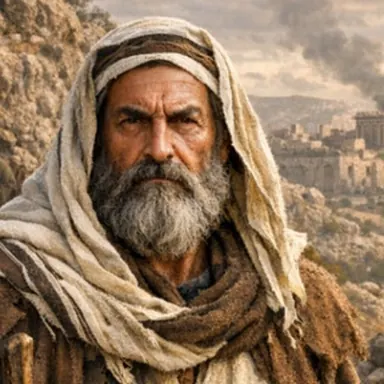
The Teaching, Work and Historical Place of the Tanna Yehuda ben Tema: A Comprehensive Phenomenological and Halakhic Study
20 min read4,089 words
Summary
This study surveys the figure of the Tanna Yehuda ben Tema, an influential personality who was apparently active in the second century CE, and examines his decisive contribution to shaping Jewish ethics and halakha after the destruction of the Temple. The text analyzes his famous teaching that urges a person to adopt the traits of wild animals—boldness, lightness, swiftness and strength—in order to overcome social and inner barriers in the service of the Creator, while creating a delicate balance between holy boldness and the trait of humility. In addition, the article discusses his mysterious historical identity and his phenomenal mastery of six hundred orders of Mishnah, a fact that places him as a vital link in the preservation of ancient traditions of study. In conclusion, the study presents the Tanna's educational doctrine of the stages of life and his philosophy of life as a moral compass guiding the individual and the nation in how to preserve spiritual vitality and national identity even under conditions of exile and crisis.
The figure of the Tanna Yehuda ben Tema is one of the most fascinating and elusive junctions in the study of Tannaitic literature and of the history of the Mishnaic period. Although his name does not appear as frequently as those of the giants of the generation such as Rabbi Akiva or Rabbi Meir, his influence on the collective Jewish consciousness, on the world of ethics and on the foundations of the halakhic daily order is unprecedented. His famous teaching in Tractate Avot, which calls for boldness and strength in the service of the Creator, became the cornerstone of the "Shulchan Arukh" and a spiritual compass for generations of learners. This study seeks to analyze in depth the figure of Yehuda ben Tema, examining the historical, geographical, philosophical and textual contexts of his work and teaching.
Chapter 1: His Historical Identity and the Contexts of the Period
Determining the exact time of Yehuda ben Tema is a complex task that relies on cross-referencing internal and external sources. Unlike Tannaim whose biographies are interwoven with explicit political events, Yehuda ben Tema often appears as a figure standing on his own, almost outside of time. Nevertheless, a careful analysis of his words reveals layers of response to a turbulent historical reality.
The Period of Activity and His Chronological Placement
The prevailing view in research, supported by philological and textual evidence, places Yehuda ben Tema in the second century CE, in the period between the destruction of the Second Temple and the generation of Rabbi Yehuda HaNasi.[1, 2] Some scholars narrow the range of his activity to the period of the Bar Kokhba revolt and after it, a period characterized by the move of the Torah centers from Judea to the Galilee and by the struggle to preserve the tradition under Hadrian's decrees of persecution.[1, 3]
The central evidence that he was active after the Destruction is the prayer that appears at the end of his mishnah in Avot: "May it be Your will, O Lord our God... that You rebuild Your city speedily in our days."[4] This wording reflects a deep longing for a spiritual center that was destroyed and a strong wish for its restoration, which attests to life in the shadow of the national trauma of the loss of the Temple. Moreover, his inclusion in the Mishnah (Tractate Avot, chapter 5) alongside relatively late Tannaim strengthens the hypothesis that he belongs to the fourth or fifth generation of the Tannaim.[2, 5]
Geographical Identification and the Origin of the Name "ben Tema"
The Tanna's name, "ben Tema," has aroused many conjectures among geographers and Talmud scholars. The geographer Yehuda Ziv put forward the view that the name points to his origin in the city of Tema, an important oasis in the Arabian Peninsula.[1] At that time Tema was a central station on the incense route, and a significant Jewish community lived there that was in contact with the Torah centers in the Land of Israel. If this identification is correct, it attests to the wide reach of the Sages' influence even beyond the geographical borders of the Mandatory Land of Israel of those days.
On the other hand, there is a proposal to identify Yehuda ben Tema with the Tanna Yehuda ben Dama, one of the Ten Martyrs and the nephew of Rabbi Yishmael.[4] This identification rests on interchanges of phonetically similar names in certain manuscripts and on the fact that both were active in the same intellectual milieu of the generation of the revolt. Most scholars, however, see Yehuda ben Tema as an independent figure, characterized by a unique style of thought that combines halakhic concision with philosophical and moral depth.
His Ties with the Sages of His Generation
The Babylonian Talmud notes that Yehuda ben Tema was active alongside "his colleagues," who are defined as "masters of Mishnah."[2] The designation "his colleagues" hints at a group of sages who specialized in preserving and editing ancient Tannaitic traditions. These ties show that he was part of a collective spiritual leadership that sought to stabilize the Oral Torah in an era of political instability.
Chapter 2: The Ethics of Boldness and Strength – An Analysis of the Mishnah "Be Bold as a Leopard"
The mishnah in Tractate Avot (chapter 5, mishnah 20) is without doubt the crowning glory of Yehuda ben Tema's ethical teaching. In a short saying charged with images from the animal world, he draws a psychological map of the person who seeks to serve his God wholeheartedly.
The Four Animals as Archetypes of Self-Transcendence
Yehuda ben Tema states: "Be bold as a leopard, light as an eagle, swift as a deer and strong as a lion—to do the will of your Father in Heaven."[4, 6] The choice of these animals is not accidental; it is meant to illustrate the need to mobilize all the natural human powers for the spiritual task.
Boldness like the leopard: The leopard was chosen to represent "boldness"—the ability to stand up to social pressure and ridicule. Rabbi Ovadia of Bartenura explains that the leopard is the product of a hybrid mating between a lioness and a wild boar, and precisely because of its "illegitimate" origin it is marked by excessive brazenness even though it is not the strongest of the animals.[4] The moral meaning is that a person is sometimes required to display "holy boldness" in order to ask his teacher what he did not understand ("the bashful one does not learn") or in order to fulfill commandments in a hostile and mocking environment.[4, 7] The Maharal of Prague adds that boldness is a trait needed to overcome the human tendency to efface oneself before public opinion.[4]
- Lightness like the eagle: The eagle symbolizes soaring above the difficulties of matter and the ability to view reality with a broad vision. The main interpretation connects this with the mental "lightness" needed for reviewing one's study. Just as the eagle does not tire in its flight, so the learner should strive for the state of "they shall mount up with wings as eagles; they shall run and not be weary," out of an inner passion that cancels the sense of physical effort.[4]
- Swiftness like the deer: The deer represents promptness in execution. Whereas the eagle belongs to the world of thought and the eyes, the deer belongs to the world of the feet and of action. "Swift as a deer" means actively pursuing opportunities to perform commandments, without waiting for them to come one's way.[4, 7]
- Strength like the lion: The lion is a symbol of conquering the evil inclination. This is not physical strength directed outward but an inner willpower that allows a person to set clear boundaries against transgression. Strength is the ability to say "no" to natural urges when they contradict the will of the Creator.[4, 5]
The Hierarchical Structure of Action
The commentators on the Mishnah, foremost among them the "Tiferet Yisrael," propose to see in these four images a systematic division of human powers. They can be divided into two main categories: positive actions (positive commandments) and actions of restraint (negative commandments), and also into physical actions and mental actions.[4]
The influence of this division is evident to this day in the Jewish daily order. The Tur, in the first section of Orach Chaim, quotes the mishnah of Yehuda ben Tema as the basis of all of a person's service—rising in the morning with "strength like a lion" is the first and necessary step for every other spiritual activity.[6]
Chapter 3: The Paradox of Boldness and Shame
Immediately after Yehuda ben Tema's call to be "bold as a leopard," he brings a saying that warns against boldness: "He used to say: The brazen-faced is destined for Gehinnom, and the shamefaced for the Garden of Eden."[4] This apparent contradiction is the key to understanding his doctrine of character traits.
Holy Boldness versus Brazenness
Yehuda ben Tema distinguishes between the trait in itself and the use made of it. Boldness is raw energy; when it is directed heavenward to overcome obstacles, it is positive ("bold as a leopard"). However, when it becomes "brazenness" toward the sages, toward the truth or toward the will of God, it turns into a corrupt trait that brings a person to Gehinnom.[4, 6]
Brazenness shows in a person's face, which is the "windows of the soul." The Maharal explains that the five senses are located in the face, and through them the personality is reflected. A brazen-faced person is one who blocks natural shame, which is the instrument of the intellect and of morality, and lets the urges take over his countenance.[4]
Shame as the Foundation of National Existence
Shame ("shamefacedness") is not seen by Yehuda ben Tema as a weakness but as a clear sign of "the seed of Abraham our father." The Sages determined that whoever has shamefacedness is assured that he will not sin easily, since his awe is upon his face.[4, 6] The "Magen Avot" of the Rashbatz notes an etymological and philosophical connection between shame and intellect: when a sage was asked, "What is intellect?" he answered, "Shame," and when he was asked, "What is shame?" he answered, "Intellect."[4] Shame is the practical expression of a person's intellectual understanding of his place before the infinity of the Creator.
There is a close connection between this trait and the prayer for the rebuilding of Jerusalem that appears at the end of the mishnah. According to the Bartenura, the prayer is a kind of request: "Just as You have graced us with the trait of shame, which is a sign of Your children, so grant us the building of Your House."[4, 7] The Temple is the place where shame and awe become a collective experience, and the Divine Presence rests precisely in the place where a person recognizes his lowliness.
Chapter 4: "The Mishnah of Yehuda ben Tema" and the Riddle of the 600 Orders of Mishnah
One of the most mysterious and important references to Yehuda ben Tema appears in Tractate Chagigah (14a), where it is stated that he and his colleagues were versed in "six hundred orders of Mishnah."[2, 8] This fact places him in the front rank of the guardians of the Oral Torah and raises weighty questions about the scope of the knowledge they possessed.
The Lost Codex of the Tannaim
The Mishnah we have today comprises only six orders, as edited by Rabbi Yehuda HaNasi. The reference to 600 orders hints at the existence of a sea of halakhic and conceptual knowledge that was current in Yehuda ben Tema's study house.[2, 8] Scholars believe that these orders included an enormous elaboration of the laws of sacrifices, purity and the administration of the Temple, subjects that gained added importance after the Destruction as a way of preserving the national memory.
In the literature of the Geonim, and especially in the "Machzor Vitry," there are references to "the Mishnah of Yehuda ben Tema" as a collection that was widespread and known even many generations after the closing of the official Mishnah.[9] This collection was sometimes marked by readings different from those of Rabbi Yehuda HaNasi, which attests to an independent and strong tradition of study. Rabbi Yosef Yaavetz notes that the words of Yehuda ben Tema were often connected with matters of the "Tent of Meeting" and the sacrifices, which strengthens his image as one who preserved the teaching of the Temple in exile.[8]
Halakhic Rulings in the Mirror of the Generations
Although most of his teaching has been lost, several halakhic rulings attributed to him remain that shed light on his way of study:
- Laws of Passover: In the Bavli, Pesachim (70a), a dispute is brought concerning the festival offering (chagigah), in which "ben Tema" proposes a unique position regarding its combination with the Passover offering.[2] This position reflects precision in the details of the Temple service.
- Laws of conditions in divorce: In the Tosefta (Gittin 5:12) a halakhic debate is brought about impossible conditions (such as "on condition that you go up to the firmament"). Yehuda ben Tema takes a principled position on the validity of these conditions, a discussion that forms a foundation for the laws of contracts and of betrothal to this day.[2]
- Laws of eruvin and partitions: Further references to him in the Tosefta (Eruvin 2:6) show his involvement in shaping public and private space in accordance with halakha.[2, 5]
Chapter 5: The Course of Human Life – The Socio-Educational Interpretation of Avot 5:24
One of the most quoted mishnayot in the Jewish world, which details the stages of a person's development from the age of five to one hundred, is attributed in many sources to Yehuda ben Tema.[10] This mishnah is not merely a list of milestones but a complete educational and psychological doctrine.
The Anthropology of the Jewish Life Course
Yehuda ben Tema offers a developmental model that combines physical maturity with intellectual commitment. He sees life as a "journey" in which each station prepares a person for the next one.
Yehuda ben Tema's observation continues up to the age of one hundred, where he describes a person as one who "has already passed away from the world." Modern studies see this mishnah as the earliest source for the concept of "bar mitzvah" and for the division of ages accepted in Judaism.[10] He stresses that education never stops; at eighty a person reaches "strength"—not the physical strength of thirty, but a spiritual strength that enables him to withstand the difficulties of the body and preserve clarity of mind.[10]
The Connection between Study and Practice
The mishnah stresses the graded transition from "Mikra" (text) to "Mishnah" (halakha) and on to "Talmud" (analysis). Yehuda ben Tema considers it of supreme importance that knowledge should not remain theoretical. As emerges from his words elsewhere, he warns against a situation in which "his wisdom exceeds his deeds," since in such a case a person is not stable, like a tree whose roots are few.[5] His developmental model is meant to ensure that the roots (deeds and commandments) always precede the branches (scholarly knowledge).
Chapter 6: The Philosophy of Relations between Man and His Fellow
Although Yehuda ben Tema is often identified with pure religious "service of God," his social teaching is no less radical and profound. In the traditions attributed to him, he sets an extremely high moral bar for interpersonal relations.
Moral Asymmetry
Yehuda ben Tema teaches that a person must adopt different "spectacles" for himself and for his fellow. He demands that a person be strict with himself and lenient with his fellow:
- If you did your fellow a small wrong—regard it as great (out of a wish to set it right).
- If you did your fellow a great kindness—regard it as small (so as to prevent pride).
- If your fellow did you a small kindness—regard it as great (gratitude).
- If your fellow did you a great wrong—regard it as small (forgiveness).[2]
This approach is an attempt to dismantle the natural human mechanism of social "bookkeeping." Yehuda ben Tema understands that the boldness required for the service of God ("bold as a leopard") may, if not restrained, turn into brazenness and into difficulty in relations with people. Therefore he balances the demand for strength with the demand for complete humility in the social sphere.
Fear of Heaven and Love of Heaven
He calls on a person: "Love Heaven, fear Heaven, tremble and rejoice in all the commandments."[2] The combination "tremble and rejoice" is unique; it expresses the existential tension of the Jew performing a commandment—on the one hand awe and fear before the greatness of the occasion, and on the other hand immense joy at the privilege of serving "your Father in Heaven." This joy is the fuel that drives the "swiftness like a deer" and the "lightness like an eagle."[4, 11]
Chapter 7: The Liturgical and Kabbalistic Influences of His Teaching
Yehuda ben Tema's prayer for the building of the Temple did not remain only between the pages of the Mishnah but penetrated deep into the prayer book and into Jewish mystical thought.
"Yehi Ratzon" – The Prayer as the Seal of the Mishnah
The wording of the "Yehi Ratzon" ("May it be Your will") that appears at the end of chapter 5 of Avot became an inseparable part of the morning prayer and of the conclusion of the study of mishnayot. Commentators note that Yehuda ben Tema sought to connect the world of character traits (boldness and shame) with national redemption.[4, 6] The Maharal explains that the building of Jerusalem depends on the correction of the character traits of the people of Israel; when we truly become "bashful, merciful and performers of kindness," the barrier preventing the building of the House will be removed.[4]
The use of the term "your Father in Heaven" (in Aramaic: "Avukhon di-vishmaya") attributed to him is a theological breakthrough. It is an expression that stresses the closeness of God, as opposed to images of a distant king or a strict judge. It is this closeness that allows a person to "be bold" in prayer and to ask for the speedy building of the city.[4, 6]
The Connection to the World of the Chariot and the Esoteric
The reference to Yehuda ben Tema and his colleagues in Tractate Chagigah, which deals mostly with the "Work of the Chariot" and the secrets of Creation, hints that they engaged not only in dry laws but also in the esoteric layers of the Torah.[2, 8] Mastery of 600 orders of Mishnah apparently also included the ancient traditions on the structure of the upper worlds, which explains the images of the "eagle" and the "lion"—which are also creatures that appear in Ezekiel's vision of the Chariot.
Chapter 8: The Reception of His Teaching among the Rishonim and the Acharonim
The teaching of Yehuda ben Tema became a touchstone for thinkers and decisors throughout the Middle Ages and the modern era.
Maimonides and Psychological Balance
Maimonides (Rambam), in his Commentary on the Mishnah and in his ethical writings (the Eight Chapters), dwells on the call to be "bold as a leopard." He explains that a person is sometimes required to use "extreme" traits in order to reach the balanced mean. Boldness is necessary to break the barrier of negative bashfulness that prevents a person from learning or from rebuking his fellow.[4] Maimonides sees in Yehuda ben Tema a psychologist who recognizes the need to use "inferior" tools (such as boldness) for lofty ends.
The Maharal and Israelite Nationhood
The Maharal of Prague sees in Yehuda ben Tema the one who formulated the "Israelite nature." In his book "Netzach Yisrael" he discusses the fact that Israel are "the boldest of the nations." It is this boldness that sustained them in exile, but it is also what may bring destruction if it is not channeled to the Torah. The prayer "and grant our portion in Your Torah" at the end of the mishnah is, according to the Maharal, the only way to turn existential boldness into a blessing.[4]
The Maharsha and the Mystical-Liturgical Aspect
The Maharsha, in his commentary on Tractate Chagigah, connects the "running" (swiftness like a deer) with the practical commandments of the pilgrimage to the Temple. He explains that the feet of Israel were called "beautiful in sandals" ("O prince's daughter") precisely because they run to do the will of their Father in Heaven, as Yehuda ben Tema taught.[11]
Chapter 9: A Philological and Textual Analysis of the Sources
Modern studies, such as those of Prof. Shamma Friedman, examine the readings of the Mishnah and the Tosefta of Yehuda ben Tema in order to determine the precision of the traditions.[12, 13]
Variations in Manuscripts
There are textual disputes about the second part of the mishnah in Avot. There are manuscripts in which the passage "the brazen-faced is destined for Gehinnom" does not appear, or in which it is attributed to another Tanna.[4] Nevertheless, most of the Rishonim (such as the Rashbatz and the Meiri) read it as an inseparable part of the mishnah of Yehuda ben Tema and see it as the necessary balance to the first part of the mishnah.
In addition, the discussion of the "six hundred orders" raises questions about the number "600." Is it a typological number indicating completeness (like the number of letters of the Torah or the number of those who went out of Egypt), or a historical description of a broad halakhic codex that was lost? Most scholars tend to see it as evidence of the enormous intellectual wealth that existed before the standardization of the Mishnah by Rabbi Yehuda HaNasi.[8]
Chapter 10: Summary and Conclusions – The Figure of the Tanna as a Bridge between Periods
Yehuda ben Tema appears in Jewish history as a figure who combines opposites: boldness and humility, enormous erudition (600 orders) and wondrous concision, fear of Heaven and love for his "Father" in Heaven.
His work in preserving the Mishnah and in setting the principles for the service of God formed a critical bridge between the world of the destroyed Temple and the world of the study houses that began to be built in Yavneh and in the Galilee. He understood that in order to survive as a people without territory and without a Temple, the Jew needs an inner "boldness" that will not efface itself before the dominant cultures (such as Rome or Greece), but in the same breath he must preserve "shame" and inner morality so as not to become brazen and wicked.[4, 6]
His educational teaching on the stages of life created a stable social structure that accompanied the people of Israel through two thousand years of exile and ensured that every Jewish child would know his place and the spiritual goals expected of him at every age.[10] In the end, Yehuda ben Tema is the Tanna who taught Israel how to turn their natural animal powers—the lion, the leopard, the eagle and the deer—into instruments of self-transcendence and of cleaving to God.
His prayer "that You rebuild Your city speedily in our days and grant our portion in Your Torah" has remained a testament for the generations, a reminder that study and deeds are what will ultimately bring the complete redemption and the rebuilding of the national and spiritual House.[4] In a world in which boldness and audacity often become a supreme value, the teaching of Yehuda ben Tema sets up a sign of warning and guidance: boldness is only a tool of service, and the final goal is always "to do the will of your Father in Heaven" out of humility and the shamefacedness that leads to the Garden of Eden.
Sources13
- 1.יהודה בן תימא – ויקיפדיה, he.wikipedia.org/wiki/יהודה_בן_תימא
- 2.Judah ben Tema | Encyclopedia.com, encyclopedia.com/religion/encyclopedias-almanacs-transcripts-and-maps/judah-ben-tema
- 3.Tanna, Tannaim | Encyclopedia.com, encyclopedia.com/religion/encyclopedias-almanacs-transcripts-and-maps/tanna-tannaim
- 4.משנה אבות ה כ – ויקיטקסט, he.wikisource.org/wiki/משנה_אבות_ה_כ
- 5.מסכת אבות פרק א - מאגר ספרות הקודש, kodesh.snunit.k12.il/b/h/h49.htm
- 6.מה מקור הביטוי 'עז כנמר' ? מדוע דווקא הנמר הוא סמל לתעוזה - Quora, he.quora.com/מה-מקור-הביטוי-עז-כנמר-מדוע-דווקא-הנמר-הוא
- 7.התקשרות 580 | "הוי עז כנמר" - צעירי אגודת חב"ד, chabad.org.il/Magazines/Article.asp?CategoryID=746&ArticleID=2297
- 8.פירוש מסכת אבות זצ"ל רבנו יוסף יעבץלחסיד, machonso.org/uploads/images/יעבץ.pdf
- 9.מחזור ויטרי חלק א, beureihatefila.com/files/Machzor_Vitri_1.pdf
- 10.Judah ben Teima used to say: At 5 years Old A Person Should Study The Scriptures, jewishpostopinion.com/pirke-avot-when-jewish-education-begins-2/
- 11.חברותא - חגיגה - תורת אמת, toratemetfreeware.com/online/f_02349.html
- 12.Some Observations Regarding the Mah Nishtannah - The Seforim Blog, seforimblog.com/2010/03/some-observations-regarding-ma/
- 13.Untitled, asif.co.il/download/kitvei-et/netiot/netiot 13/13 (7).pdf