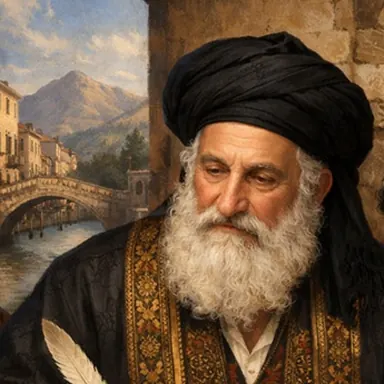
The Work and Torah Teaching of Rabbi David Pardo: A Comprehensive Study of His Figure, His Writings and His Influence on the World of Halakha and Midrash
17 min read3,314 words
Summary
This text is a comprehensive research survey of the many-sided figure of Rabbi David Pardo (the Radaf), one of the leading sages of the Jewry of Italy, the Balkans and Jerusalem in the 18th century. The article surveys the geographical and spiritual stations of his life, from his education in Venice, through his service as rabbi in the communities of Spalato and Sarajevo, to his emigration to Jerusalem and his ties with the Chida. The heart of the work analyzed in the text is his exegetical and halakhic enterprise, with an emphasis on his monumental commentary "Chasdei David" on the Tosefta, which brought about a revolution in the study of the text and in the understanding of the plain meaning of Tannaitic literature. By presenting the range of his works on Scripture, midrash and poetry, the text seeks to illuminate the pedagogical and critical method of the Radaf and his decisive contribution as a shaper of the world of the Oral Torah for generations.
The Historical and Cultural Fabric of the Jewry of Italy and the Balkans in the 18th Century
The 18th century in the Jewish world, and particularly in the Sephardi-Mediterranean sphere, marked a period of deep religious and cultural changes. While traditional Jewish centers in Western Europe began to feel the first buds of the Haskalah movement, the Jewish communities in the Balkans, in Italy and in the Land of Israel experienced a Torah flowering characterized by a return to the Tannaitic sources, linguistic precision and a reorganization of halakhic authority. At the heart of this fabric stands the figure of Rabbi David Shmuel ben Yaakov Pardo (called the Radaf), a Renaissance figure in the Torah sense of the word, who united the depth of Italian analytical study, the Balkan tradition of halakhic ruling and the spiritual fervor of Jerusalem.[1, 2]
Rabbi David Pardo was born in Venice on 29 March 1719, a city that was at that time a central crossroads of Hebrew printing and of intercultural encounter.[3, 4] Venice of the 18th century provided the Radaf with his first intellectual infrastructure: access to rich libraries, exposure to the research methodologies of the sages of Italy, and a deep understanding of the importance of textual precision. His father, Rabbi Yaakov Pardo, one of the sages of Venice, who originated in Ragusa, imparted to his son not only the foundations of the Talmud but also an awareness of the illustrious lineage of the Pardo family, a family of sages and poets that wandered throughout the Mediterranean basin.[3, 5]
The geopolitical reality of that period, in which the Balkan communities were under the rule of the Ottoman Empire while Italy was divided into states and republics, created a dynamic of high mobility among sages. The Radaf embodied this dynamic in his own mobility, moving from Venice to Ragusa, to Sarajevo, to Spalato and finally to Jerusalem.[2, 3] Each such station was not only a geographical move but a stage in the development of his Torah teaching. In Sarajevo and in Spalato he formed his educational and leadership outlook, while in Jerusalem he reached the peak of his scholarly and Torah writing.[2, 6]
Chronological Milestones in the Life of Rabbi David Pardo
The Years of Wandering and Personal Formation: From Sarajevo to Spalato
The Radaf's adult life began with an upheaval caused by a family inheritance dispute, which led him to leave prosperous Venice for the unknown in the Balkans.[2] This move, which began as a necessity, turned out to be a rare spiritual opportunity. In Ragusa and in Sarajevo the Radaf began his professional path not as an exalted rabbi but as a teacher of children.[2, 5] This period of basic teaching was critical in shaping his pedagogical teaching; it instilled in him the recognition of the importance of studying the plain meaning and the fundamentals, an approach that would accompany all his later writing.
In Spalato (today Split, Croatia), the local rabbi Avraham David Papo recognized the potential in the young teacher and invited him to teach in the local yeshiva.[3, 4] The relationship between the two was a classic relationship of apprenticeship, in which the Radaf absorbed the halakhic tradition of Dalmatian Jewry while bringing with him Italian precision. After the death of Yitzchak Tzedaka, Papo's successor, the Radaf was chosen as rabbi of the community.[3, 5] In this period he began to raise students who would themselves become luminaries of the Diaspora, among them Rabbi Shabtai Ventura, author of "Nehar Shalom" on the Shulchan Arukh, and Rabbi David Pinto.[3]
The Radaf's educational methodology was characterized by the encouragement of independent and critical thinking. He was not content with imparting knowledge but demanded that his students analyze the halakhic sources with analytical tools.[1] This approach finds expression in his responsa, in which he often quotes the questions and novellae of his students, a practice that was relatively rare among the decisors of the generation and attested to great humility and a deep appreciation of the learning process.[1]
"Shoshanim LeDavid": The Breakthrough and the Critical Discourse
In 1752 the Radaf published in Venice his first work, "Shoshanim LeDavid," a comprehensive commentary on the Mishnah.[2, 4] This book was not merely a textual explanation but a methodological declaration of intent. The Radaf sought to restore to the Mishnah its standing as an independent unit of study, and not only as a preface to the Talmudic discussion. In his commentary he strives to understand the "peshat" (plain meaning) of the Mishnah, using linguistic and comparative tools.[1]
The publication of the book aroused a significant Torah storm because of the sharp language the Radaf used in its first part toward sages of his own time.[2] The disagreements with figures such as David Corinaldi and Masud Rokeach in Livorno were not merely a matter of style but represented a clash between the Radaf's critical and innovative analytical approach and the accepted exegetical traditions. Nevertheless, the Radaf's personal greatness was revealed in his ability to admit error; in the second part of the book he published an apology and softened his style, which led to a broad reconciliation in the Torah world.[2]
"Shoshanim LeDavid" laid the foundations for all his subsequent exegetical work. The dynamic that arose around the book taught the Radaf the importance of balancing incisive criticism with respect for tradition, a balance that would find perfect expression in his work on the Tosefta.
A Comparison of the Features of the Radaf's Exegesis in His Various Works
"Chasdei David": The Revolution in the Study of the Tosefta and Its Transmission to the Generations
The most monumental enterprise of Rabbi David Pardo is without doubt the commentary "Chasdei David" on the Tosefta.[2, 8] Until the appearance of this work the Tosefta was a "sealed book" for most learners. Whereas the Mishnah and the Talmud enjoyed an extensive system of commentary, the Tosefta remained on the margins of study, suffering from severe textual corruptions and from the absence of systematic explanation.[1]
The Radaf devoted the best of his years to this enterprise, which he completed in Jerusalem on his 68th birthday.[2] His approach to the Tosefta was revolutionary in three respects:
Emendation of the text (textual criticism): The Radaf understood that without an accurate text it is impossible to reach a correct halakhic understanding. He emended the text on the basis of comparisons with the citations in the Bavli, in the Yerushalmi and in the halakhic midrashim.[9, 10]
Explanation of the plain meaning as a continuum: Unlike earlier commentators who dealt with the Tosefta only in connection with the sugyot of the Gemara, the Radaf provided a continuous commentary that tries to explain the Tosefta as an organic unit.[8, 9]
Integration of halakha and aggadah: He recognized the enormous moral and aggadic value contained in the Tosefta, which sometimes dwells on these matters at greater length than the Mishnah, and integrated these insights into his commentary.[10]
The importance of "Chasdei David" was recognized immediately upon its publication. The first edition was printed in Livorno between 1776 and 1790.[2] Over time the commentary became an inseparable part of the major editions of the Shas, including the famous Vilna Shas, where the commentary was printed in abridged form.[8, 9] However, researchers and scholars point out that the abridged edition in the Vilna Shas omits many layers of depth, hence the importance of the modern editions (such as that of the "Lev Same'ach" Institute), which present the commentary in ten complete volumes.[8, 9]
The part of "Chasdei David" on the Order of Tohorot remained in manuscript for many years and was considered lost or inaccessible, until it was discovered and published in recent decades.[9] This discovery completed the puzzle of one of the greatest exegetical enterprises in the history of the literature of the Oral Torah.
"Maskil LeDavid" and His Commentary on Rashi: A Bridge between Peshat and Derash
Another work that demonstrates the Radaf's depth is "Maskil LeDavid," published in Venice in 1760.[1, 4] This book is a "super-commentary" on Rashi's commentary on the Torah, a literary genre that was very popular among the sages of Sepharad and Italy. The Radaf came not only to explain Rashi's words but to analyze Rashi's own methodology.[1]
In "Maskil LeDavid" the Radaf grapples with the fundamental question: why did Rashi choose to bring one particular midrash and not another? What is the difficulty in the plain meaning of the verse that caused Rashi to depart from the literal interpretation?[1] His analysis is characterized by exceptional linguistic precision and by an attempt to create harmony between the different layers of interpretation. The book became an essential aid for rabbis and preachers, and it is considered to this day one of the most profound and faithful commentaries on Rashi's method.[1, 5]
"Sifrei de-Vei Rav" and the Midrash: Work with Manuscripts
Rabbi David Pardo did not stop at the Tosefta. He recognized that the halakhic midrashim—the Sifra and the Sifrei—suffered from neglect similar to that of the Tosefta. His book "Sifrei de-Vei Rav" (published after his death in Salonika in 1799) is a monumental commentary on the Sifrei on the books of Numbers and Deuteronomy.[2, 4]
In working on this commentary the Radaf displayed the skills of a modern textual scholar. He collected and used rare manuscripts of early commentators that were in his possession, such as Rabbi Hillel ben Elyakim and Rabbi Eliezer ibn Nachum.[2] This use of primary sources enabled him to propose solutions to textual difficulties that had troubled students of the midrash for generations. The commentary is considered to this day the backbone of the study of the Sifrei, and it is cited in every scholarly or traditional edition of the midrash.[1, 2]
Halakhic Ruling and Leadership: "Michtam LeDavid" and Life in the Balkans
The Radaf's activity as a community rabbi in Sarajevo and in Spalato produced the responsa "Michtam LeDavid" (Salonika, 1772).[2, 4] This collection of responsa provides a rare glimpse into Jewish life in the Balkans in the 18th century, and into the way the Radaf applied his enormous knowledge to solving practical problems.
His rulings in "Michtam LeDavid" are characterized by:
- Original analysis: He was not content with quoting earlier rulings but strove to understand the Talmudic root of every law.[11]
- Social sensitivity: In his responsa he addresses the economic and social reality of the Balkan communities, while upholding the principles of halakha.[7]
- Empowering students: As mentioned, he incorporates discussions with his students into his responsa, which makes the responsa also a pedagogical guide to halakhic writing.[1]
In addition to the responsa, the Radaf composed "Mizmor LeDavid" (Livorno, 1818), notes on the works of the sages of the preceding generation—Rabbi Chizkiyah da Silva (the "Pri Chadash") and Rabbi Chaim ben Attar (the "Or HaChaim")—on the Shulchan Arukh.[2, 3] This work attests to his integration into the central halakhic discourse of the Sephardi Torah world.
The Move to Jerusalem and the Peak of His Torah Activity
In 1776, at the height of his powers and influence, Rabbi David Pardo decided to go up to the Land of Israel.[2, 7] The motive for his emigration was a combination of religious longing and the recognition that Jerusalem was becoming the most important Torah center for the Sephardi sages. His arrival in Jerusalem was not merely a personal event but a significant strengthening of the Jewish community in the city.[7]
In Jerusalem the Radaf was appointed to head the "Chesed LeAvraham uVinyan Shlomo" yeshiva.[2] This yeshiva, founded in 1747 from the endowment of Avraham Natan of Rashid, was located on the Street of the Karaites in the Old City and was a center of attraction for sages from all over the Jewish world.[12] Under his leadership the yeshiva became a center of in-depth study of the Tannaitic sources, combining the Radaf's exegetical method with the old Jerusalem tradition.
The "Chesed LeAvraham uVinyan Shlomo" Yeshiva: Data and History
The yeshiva's library was among the most important in Jerusalem. After the War of Independence in 1948, when the Jewish Quarter fell, the library was looted and many of the books were lost.[12] Nevertheless, some 1,500 books and manuscripts were eventually handed over to the Porat Yosef yeshiva, where they remain to this day a testimony to the rich spiritual heritage of the institution.[13]
The Connection with the Chida and the Pardo-Azulai Lineage
One of the fascinating chapters in the life of the Radaf in Jerusalem is his close connection with Rabbi Chaim Yosef David Azulai (the Chida).[2, 7] The Chida, who was the greatest bibliographer and scholar of the generation, saw in the Radaf a faithful partner in the path of research-based and halakhic study.
The connection between the two giants became personal and familial when the Radaf's son, Avraham Pardo, married the Chida's daughter.[2] Avraham Pardo was himself an outstanding Torah scholar, and after the death of his father-in-law the Chida he was appointed to replace him as head of the "Chesed LeAvraham uVinyan Shlomo" yeshiva.[2] This family alliance united two central Torah dynasties—the Italian-Balkan dynasty of Pardo and the Jerusalem-Moroccan dynasty of Azulai—and created a Torah force that influenced the Old Yishuv for generations.
Sacred Service: Piyyut, Liturgy and the Customs of Prayer
A less known but highly significant aspect of the Radaf's work is his contribution to liturgy and religious poetry. The Radaf was a gifted poet, and his piyyutim entered the prayer books of the Sephardi communities.[2, 4]
Among his works in this field:
- "Shifat Revivim" (1788): A collection of prayers and piyyutim that includes the "Seder HaAvodah" for Yom Kippur in his own distinctive formulation.[2, 4]
- "Sechiyot HaChemdah" (1756): An order of prayers and tikkunim for Rosh Chodesh Nisan, which enjoyed great popularity and was printed in many editions.[3, 6]
- "Shirah Chadashah": The story of the Scroll of Esther in rhyme.[3, 4]
- "Chukat HaPesach" (1796): An order of the Passover Haggadah with laws and explanations.[4]
The Radaf's liturgical work reflects his conception that the service of God should combine intellectual study with religious feeling and aesthetic beauty. His piyyutim are characterized by pure Hebrew and a classical structure, reflecting his broad education and his mastery of the language.[2]
The Dynasty of the Sages of the Pardo Family and the Continuity of the Torah Enterprise
The legacy of Rabbi David Pardo spread throughout the Jewish world also through his sons and students, who formed a network of Torah leadership.[3]
- Rabbi Yaakov Pardo (the Radaf's son): Served as chief rabbi of Ragusa (Dubrovnik) and later went up to Jerusalem. He was known as enormously learned in the revealed and the hidden Torah (Kabbalah). He composed "Kehillat Yaakov" on the Early Prophets, "Appei Zutrei" on the laws of marriage in the Shulchan Arukh, and "Minchat Aharon" on the laws of prayer.[2, 3]
- Rabbi Yitzchak Pardo (the Radaf's son): Succeeded his father in the rabbinate of Sarajevo. His principal work, "To'afot Re'em," is a commentary on the She'iltot of Rav Achai Gaon, a work that continues his father's line in the study of the literature of the Geonim and the Tannaim.[2, 3]
- Rabbi Avraham Pardo (the Radaf's son): As mentioned, the son-in-law of the Chida and head of a yeshiva in Jerusalem. It was he who published many of his father's writings after his death, among them the commentary on the Sifrei.[2]
- Rabbi Shabtai Ventura (a student): Author of "Nehar Shalom," one of the important commentaries on the Shulchan Arukh, Orach Chaim, which attests to the level of study in the Radaf's study house in Spalato.[3]
The Pardo family continued to produce sages in the 19th century as well, among them Rabbi David Shmuel Pardo (his grandson or great-grandson), who was a student at the rabbinical seminary in Padua and died young.[3] The geographical dispersion of the members of the family—Jerusalem, Sarajevo, Ragusa and Italy—preserved the influence of the Radaf as a unifying factor in the Torah world.
Summary and Conclusions: The Radaf as an Architect of the Oral Torah
Seen historically, Rabbi David Pardo emerges not only as an important commentator but as an architect who redesigned the approach to Tannaitic literature. His work teaches several deep insights:
- Textual restoration as the key to halakha: The Radaf proved that it is impossible to rule halakha correctly without returning to the accurate text of the Tannaitic sources.[7, 10] His work in "Chasdei David" and in "Sifrei de-Vei Rav" laid the foundations for traditional and academic research into Tannaitic literature in the centuries that followed.
- Leadership based on critical thinking: In a society that sometimes sanctified the existing without question, the Radaf imparted to his students and his community the value of independent analysis and of the ability to emend and correct, out of a deep fear of Heaven.[1]
- Harmony between layers: His work encompassed the whole spectrum of Jewish thought—Scripture (Rashi), Mishnah, Tosefta, midrash, halakha, piyyut and Kabbalah.[2, 4] He saw no contradiction between meticulous textual research and liturgical and spiritual fervor.
- The centrality of the Land of Israel: His emigration to Jerusalem and the establishment of the Torah center there marked the shift of the center of gravity of Sephardi learning from Europe to the Land of Israel, a process that intensified in the 19th century.[2, 7]
Rabbi David Pardo died in 1792 in Jerusalem, but his "chasadim" ("kindnesses")—like the name of his book—continue to accompany the Torah world to this day.[3, 4] Every student of the Tosefta in the Vilna Shas or researcher of midrash in a university library encounters the brilliant figure of the sage of Venice, Sarajevo and Jerusalem, who redeemed the words of the Tannaim from oblivion and set them on a firm footing. The analysis shows that the Radaf succeeded in creating a rare synthesis of boundless erudition, scholarly precision and personal humility, which made him one of the most influential figures in shaping Torah study in the modern era.
Sources13
- 1.דוד פארדו | מקורות מתוך ספריית ספריא, sefaria.org.il/topics/david-pardo
- 2.Pardo, David Samuel ben Jacob | Encyclopedia.com, encyclopedia.com/religion/encyclopedias-almanacs-transcripts-and-maps/pardo-david-samuel-ben-jacob
- 3.PARDO - JewishEncyclopedia.com, jewishencyclopedia.com/articles/11906-pardo
- 4.David Pardo (Italian rabbi) - Wikipedia, en.wikipedia.org/wiki/David_Pardo_(Italian_rabbi)
- 5.Shulchan ha-Tahor by David ben Ya'akov Pardo, 1719 - 1792 - Center for Jewish Art, cja.huji.ac.il/gross/browser.php?mode=set&id=35462
- 6.Shchiot ha-Chemdah by David Pardo - Center for Jewish Art, cja.huji.ac.il/gross/browser.php?mode=set&id=37763
- 7.שיעור 4 | רבי דוד פארדו - YouTube, youtube.com/watch?v=mle4p2D7H6Y
- 8.Chasdei Dovid Im Hatosefta - 10 Volume Set - חסדי דוד מרבינו דוד פרדו, עם התוספתא, moznaim.com/products/chasdei-dovid-im-hatosefta-חסדי-דוד-מרבינו-דוד-פרדו-עם-התוספתא
- 9.חסדי דוד מרבינו דוד פרדו, עם התוספתא, 10 כרכים - הוצאת ספרים ח. וגשל בע"מ, vagshalbooks.co.il/חסדי-דוד-מרבינו-דוד-פרדו-עם-התוספתא-10-כר/
- 10.תוספתא - ויקיפדיה, he.wikipedia.org/wiki/תוספתא
- 11.למנצח על־שושן עדות ס מכתם לדוד ללמד: (תהלים פרק ס פסוק א) - מקראות גדולות הכתר, mgketer.org/tanach/27/60/1
- 12.ישיבת חסד לאברהם ובנין שלמה - ויקיפדיה, he.wikipedia.org/wiki/ישיבת_חסד_לאברהם_ובנין_שלמה
- 13.ישיבת פורת יוסף - ויקיפדיה, he.wikipedia.org/wiki/ישיבת_פורת_יוסף