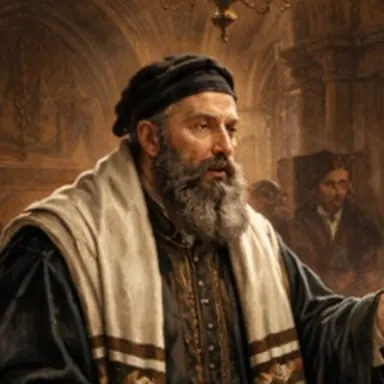
Rabbi Meir ben Shimon HaMe'ili: The Hidden Luminary of the Sages of Narbonne
11 min read2,119 words
Summary
This source surveys the life and Torah contribution of Rabbi Meir ben Shimon HaMe'ili, one of the prominent leaders of the Jewry of Provence in the 13th century, who was active at a decisive historical crossroads. The text presents the sage's movement from halakhic creativity in his work "Sefer ha-Me'orot," which strives for a practical codification of the Talmud, toward active public leadership that included theological polemics against the Christian Church. Alongside his defense of the community, the source highlights HaMe'ili's internal struggle to preserve rationalist monotheism, with sharp opposition to the beginnings of Kabbalah and the Sefer ha-Bahir on the one hand, and a resolute defense of the teaching of Maimonides (Rambam) on the other. By detailing his lineage, his books and his political connections, the article paints the portrait of a "man of many talents" who combines halakhic conservatism with intellectual militancy for the sake of shaping the character of Judaism in southern France.
The Work and Torah Teaching of Rabbi Meir ben Shimon HaMe'ili: The Hidden Luminary of the Sages of Narbonne
The 13th century in southern France, and in particular in the region of Provence, marked one of the most turbulent and formative periods in the history of the Jewish people in the early modern era. At the heart of this storm, at the crossroads between rationalist philosophy, conservative halakhic ruling and the first growth of the esoteric teaching, stood the many-faceted figure of Rabbi Meir ben Shimon HaMe'ili, known by his byname "ha-Me'orot." HaMe'ili's work was not confined to the walls of the study hall alone; he combined profound halakhic writing, active public leadership vis-à-vis the authorities of the crown and the Church, and the conduct of an uncompromising internal polemic over the purity of Jewish monotheism.[1, 2] His principal work, "Sefer ha-Me'orot," together with his polemical work "Milchemet Mitzvah," are living testimony to the struggle over the character of Judaism at a time when ancient traditions were put to the test in the face of both external and internal influences.[2, 3]
The Historical and Geographical Background: Narbonne as a Stronghold of the Provençal Tradition
In order to understand the teaching of Rabbi Meir HaMe'ili, one must first examine the space in which he grew up—the city of Narbonne. Narbonne was at that time a Torah and economic center of the first rank, the seat of sages who saw themselves as the direct continuers of the path of the Geonim of Babylonia. The Jewish community in Narbonne enjoyed relative autonomy, but lived in the shadow of tremendous religious changes in the surrounding Christian world.[2] The 13th century saw the rise of the preaching orders of friars, the Dominicans and the Franciscans, who set themselves the goal of converting the Jews by means of public disputations and close scrutiny of the Scriptures.[4, 5]
At the same time, within the Torah world itself, Provence served as a bridge between the Torah center of Spain, which was saturated with philosophical and scientific influences, and the center of northern France (Ashkenaz), which was characterized by the method of the Tosafists and a focus on incisive textual analysis of the Gemara.[3] Rabbi Meir HaMe'ili grew up within a family dynasty of sages whose role was to preserve the Provençal distinctiveness—one that combines halakhic precision, respect for local custom and a moderate rationalist approach.[3]
The Dynasty of Leadership and the Education of Rabbi Meir HaMe'ili
Sefer ha-Me'orot: The Enterprise of Codification and Commentary
The work most identified with Rabbi Meir HaMe'ili is "Sefer ha-Me'orot." It is not a standard talmudic commentary, but a bold attempt to formulate a halakhic literature arranged according to the order of the Talmud, while extracting the decided halakha from the intricate discussion.[3] The book was written in the first half of the 13th century, and its style attests to a formal closeness to the novellae of Nahmanides (Ramban) and the Rashba, although it represents the earlier Provençal tradition.[3]
The Methodology of Sefer ha-Me'orot
One of the most prominent features of "Sefer ha-Me'orot" is the author's conscious decision to omit the names of the Amoraim and sages appearing in the Talmud.[3] This approach does not stem from a lack of respect, but from a conception of codification: HaMe'ili established a rule according to which when he quotes a talmudic statement without a name, its meaning is that this is how the halakha was decided in practice.[3] This is an approach somewhat reminiscent of the method of the Rambam in the "Mishneh Torah," but unlike the Rambam, HaMe'ili preserves the structure of the Talmud and does not detach the halakha from its textual context.[3]
The book focuses on halakhic topics that apply at the present time, ignoring subjects that are not practically relevant after the destruction of the Temple.[3] This focus shows HaMe'ili as a practical halakhic authority who sought to make the Torah accessible to his community in Narbonne and in all of Provence.[1, 2] The book also serves as a kind of "second story" to the work of his uncle, Rabbi Meshulam, author of "Sefer ha-Hashlamah." Whereas Rabbi Meshulam built his work upon the Rif, HaMe'ili returned directly to the talmudic source, and thereby completed and expanded the discussions of topics that the Rif had omitted or abridged.[3]
The Preservation of the Book and Its Editions
For hundreds of years "Sefer ha-Me'orot" was considered lost for the most part. The scholarly and Torah breakthrough took place in the year 5724, when Rabbi Moshe Yehuda ha-Kohen Blau published the book from a unique manuscript found in the Parma library (Italy).[3] This manuscript is of supreme importance, since it was written during the author's lifetime and includes notes in the handwriting of Rabbi Meir HaMe'ili himself.[3]
Despite this wealth, significant parts of the book on the Order of Nashim and the Order of Kodashim were lost over the generations, although many citations from them survived in the works of other Rishonim, such as in the "Shitah Mekubbetzet" of Rabbi Betzalel Ashkenazi on tractates Ketubot, Nedarim and Gittin.[1, 3]
"Milchemet Mitzvah": The Polemicist and the Defender
If "Sefer ha-Me'orot" represents HaMe'ili's inner halakhic world, his book "Milchemet Mitzvah" represents his going out to the front line. It is a wide-ranging work, most of which is still in manuscript, that brings together the central struggles of the period.[1, 2]
The Confrontation with Christianity and the Authorities
Rabbi Meir HaMe'ili was not only a man of books but a political leader. He served as the spokesman of the community of Narbonne and its environs before the Church hierarchy and the institutions of the crown.[1, 2] In the year 1245, a short time after the burning of the Talmud in Paris (1242), HaMe'ili headed a delegation of community leaders that met with the cardinal of Narbonne in order to thwart decrees and discriminatory laws.[2]
In "Milchemet Mitzvah" he records a sharp theological disputation that he conducted with the bishop of Narbonne.[2] In this disputation HaMe'ili displayed impressive mastery not only of the Jewish texts but also of Christian methods of argument. He refuted the Christian attempts to find allusions to the messiahship of Jesus in the Bible, explained the meaning of the Thirteen Attributes of Mercy, and passionately defended the rationality of the commandments.[2] His influence was so great that he was also active at the court of the emperor and before senior ministers, using his standing to ensure the physical and spiritual survival of the community.[2]
The Internal Struggle against the Doctrine of the Sefirot and the "Sefer ha-Bahir"
A fascinating and stormy chapter of his work "Milchemet Mitzvah" is devoted to an internal war: the struggle against the beginnings of Kabbalah. HaMe'ili identified in the breakthrough of the doctrine of the sefirot and in the dissemination of the "Sefer ha-Bahir" a theological danger of the first order.[1] In his view, belief in ten sefirot as independent forces or as divinities emanating from the Infinite constitutes a grave violation of the absolute unity of God.[1]
He defined belief in the sefirot as "heresy" and idolatry, and argued that it bore a disturbing resemblance to the Christian belief in the Trinity, against which he was fighting on the second front.[1] HaMe'ili doubted the authenticity of the "Sefer ha-Bahir" and saw it as a recent forgery attributed mistakenly (or maliciously) to the sages of the Talmud.[2] Modern studies, foremost among them that of Prof. Tzachi Weiss, point out that HaMe'ili's opposition was also connected with his fear of a cult of angels, and especially of the angel Metatron, which might blur the boundary between the Creator and the created.[1, 6]
In an unusual step, HaMe'ili sent a sharp epistle "to our masters in each and every city," in which he called for these opinions to be banned and uprooted from the communities.[2] This activity of his was carried out in coordination with, and on behalf of, his uncle, Rabbi Meshulam of Béziers, which indicates that the opposition to Kabbalah in its beginnings was not merely a personal position, but the position of the long-established Torah establishment in Narbonne.[1]
His Thought and His Defense of the Rambam
Despite being a halakhic conservative, Rabbi Meir HaMe'ili was a distinct rationalist following the teaching of the Rambam. In his time the great controversy over the writings of the Rambam broke out, and many of the sages of France and Ashkenaz tended to take a stringent line and to ban his philosophical books.[4] HaMe'ili, by contrast, took his stand on the side of the Rambam in a special work called "Kuntres Meshiv Nefesh."[1]
In this work he defends the Rambam against objections directed at the first two chapters of the Laws of the Foundations of the Torah.[1, 2] These chapters deal with the essence of God, the negation of corporeality and the celestial spheres. HaMe'ili saw the Rambam as the great defender of the unity of God, and used his teaching to check the mystical and anthropomorphizing tendencies he saw around him.[1] This attachment to the Rambam was passed on also to his disciple, Rabbi Manoach, whose commentary on the Rambam ("Sefer ha-Menuchah") became one of the pillars of the commentary on the "Mishneh Torah."[1]
A Comparison of Theological Positions in the Controversy of the 13th Century
His Legacy and His Further Works
Beyond his main works, Rabbi Meir HaMe'ili was a prolific writer who touched on every field of Torah. Some of his works have been lost, but their names and echoes of them remain in the writings of the sages of the generations:
- Me'or ha-Torah: a comprehensive commentary on the Five Books of the Torah, which apparently combined peshat and rationalist thought.[1, 2]
- The work of homilies: a collection of homilies for the festivals (Passover, Rosh Hashanah and Sukkot) in the style of the homilies of Nahmanides (Ramban), which attests to his activity as a preacher shaping the spiritual world of the public.[1, 2]
Ma'aseh Bereshit and a work on the Masorah: works that dealt with cosmology and with the grammar of Scripture, fields of interest indispensable to an enlightened Provençal sage.[1]
A commentary on the piyyutim of the Hoshanot: a unique work printed in "Sefer ha-Mikhtam," which shows HaMe'ili's attachment to the world of liturgy and prayer, alongside his halakhic acuity.[1, 2]
The work of Rabbi Meir HaMe'ili outlines the figure of a Jewish "man of many talents" in the Middle Ages: a Torah scholar at the head of a yeshiva, a halakhic authority shaping the halakha for his generation, a philosopher defending the principles of faith, and a political leader risking his life for his community.[2] This combination of Torah authority with deep social involvement made him one of the brightest luminaries in the sky of Provence, a figure whose teaching and influence continue to resonate in scholarship and in Torah study to our own day.[1, 3]
HaMe'ili's steadfastness in the face of the winds of the time—both those that blew from the Church and those that grew from within the house—shows the strength of the Provençal tradition and the importance of the intellectual struggle over the character of Judaism.[1, 4] Sefer ha-Me'orot and his polemical writings remain an eternal testimony to a period in which every word written in the study hall was part of a "Milchemet Mitzvah" (obligatory war) for the soul of the Jewish people.[2]
Sources6
- 1.מאיר בן שמעון המעילי - ויקיפדיה, he.wikipedia.org/wiki/מאיר_בן_שמעון_המעילי
- 2.Meir ben Simeon Ha-Me'ili | Encyclopedia.com, encyclopedia.com/religion/encyclopedias-almanacs-transcripts-and-maps/meir-ben-simeon-ha-meili
- 3.ספר המאורות - ויקיפדיה, he.wikipedia.org/wiki/ספר_המאורות
- 4.Daggers of Faith: Thirteenth-Century Christian Missionizing and Jewish Response - Liverpool University Press, liverpooluniversitypress.co.uk/doi/pdf/10.18647/1619/JJS-1991?download=true
- 5.Daggers of Faith - UC Press E-Books Collection, publishing.cdlib.org/ucpressebooks/view?docId=ft0w1003jg;chunk.id=0;doc.view=print
- 6.The Beginning of Kabbalah | Lesson 4 - The Opposition to the Sefirot | Prof. Tzachi Weiss, youtube.com/watch?v=pYHY1hLxJhI