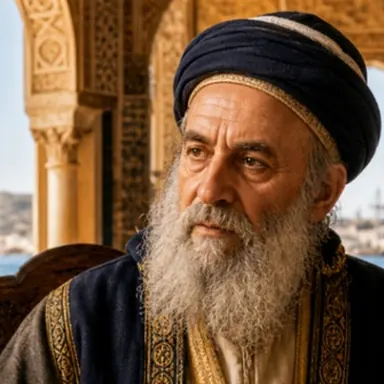
The Teaching, Work and Influence of Rabbeinu Shimon ben Tzemach Duran (the Rashbatz): Architect of Leadership and Thought in North African Jewry
19 min read3,880 words
Summary
This survey describes the multidimensional figure of Rabbi Shimon ben Tzemach Duran (the Rashbatz), who acted as a spiritual architect and an architect of leadership who rebuilt the world of Torah in North Africa after the persecutions of 5151. The text traces the Rashbatz's dramatic transition from a life of comfort as a physician and scientist in Majorca to the status of a refugee in Algiers, where he brought about an institutional revolution by institutionalizing the salaried rabbinate and formulating innovative social ordinances. Beyond his extensive halakhic rulings, concentrated in the Responsa of the Tashbetz, the source highlights his original philosophical contribution in reducing the principles of faith and his scientific erudition in the fields of astronomy and linguistics. In conclusion, the work presents the Rashbatz's legacy as a bridge between eras, which shaped the religious and cultural identity of Maghrebi Jewry through the generations by means of a rare combination of Torah scholarship and broad learning.
The history of the Jewish people in the early modern period is marked by unprecedented geopolitical and religious upheaval, centered on the destruction of the splendid Torah center in Spain and the rise of new centers in the Mediterranean basin. At the heart of this process stands the towering figure of Rabbi Shimon ben Tzemach Duran, known by the acronym Rashbatz or by the name Tashbetz after his principal book.[1, 2] The Rashbatz was not only a halakhic authority of the first rank, but a polymath in the classical sense of the word: physician, scientist, philosopher, linguist and political leader, who knew how to channel the crisis of the persecutions of 5151 (1391) into the rebuilding of the world of Torah and Jewish law in North Africa.[3, 4] His figure serves as a bridge between the late period of the Rishonim and the beginning of the period of the Acharonim, and his rulings shaped the way of life of Algerian Jewry and of the entire Maghreb for hundreds of years.[4, 5]
Chapter 1: The Formative Years in Majorca and the Dramatic Move to Algiers
Rabbi Shimon ben Tzemach Duran was born in the month of Adar in the year 5121 (1361) to a family with a rich Torah and scientific tradition.[3, 5] The sources differ as to his exact place of birth, some pointing to Barcelona and others to the island of Majorca.[3, 4] His family lineage linked him to one of the boldest intellectual figures in Jewish history, Rabbi Levi ben Gershon (the Ralbag), with whom he maintained a polemical intellectual engagement throughout his life.[4, 5]
In 14th-century Majorca, the Rashbatz absorbed the Spanish educational model that combines in-depth Talmud study with the external sciences. He studied Torah under the great sages of the generation, foremost among them Rabbi Ephraim Vidal, from whom he received not only the foundations of the Gemara but also extensive knowledge of philosophy and the exact sciences.[1, 3] Another prominent teacher was Rabbi Yonah de Maestre, the rabbi of Saragossa, whose daughter Bongoda the Rashbatz married.[6, 7] During this period the Rashbatz earned his living as a physician and surgeon in the city of Palma de Majorca, where he acquired a professional reputation and a solid economic standing.[1, 8]
The great rupture came in 1391, when a wave of violent pogroms swept over Spain. The riots in Majorca were especially severe, and the Rashbatz, who lost all his property and his home, was forced to flee for his life together with his father and his sister.[4, 5] The choice of Algiers as a destination for emigration was not accidental; the city offered relative refuge outside Christian jurisdiction, and at once became a center into which many refugees from among the sages of Spain streamed, among them Rabbi Yitzchak bar Sheshet (the Rivash).[3, 4] This move marks the transition from a life of comfort as a physician and researcher to a life of exile as a refugee, which ultimately led to an institutional revolution in the world of the rabbinate.[8, 9]
Chronology of the Transition Period and the Consolidation of Leadership
Chapter 2: The Institutional Revolution—the Salaried Rabbinate and the Social Ordinances
One of the Rashbatz's most revolutionary contributions to Jewish history is the transition to the system of the "salaried rabbinate." Before his time, the office of rabbi was usually an honorary position performed alongside another occupation.[9] The Rashbatz, who arrived in Algiers destitute, at first tried to continue in his occupation as a physician. However, he encountered a local population that preferred superstitions and amulets to scientific medicine, which did not allow him to earn a respectable living.[3, 8]
Out of this hardship, and contrary to the explicit and stringent view of Maimonides (Rambam), which forbids receiving payment for Torah study and instruction, the Rashbatz set a historic precedent and agreed to receive a fixed salary from the community.[9] He justified this by arguing that in generations of exile and crisis, if Torah scholars are not free to teach and to rule because of worries about their livelihood, the Torah may be forgotten from Israel.[2, 5] This step became the accepted model throughout the Jewish world to this day, and it reflects the Rashbatz's pragmatic outlook, which prefers the continued existence of the Torah institution over theoretical ideals that do not withstand the test of reality.[8]
In parallel with establishing his economic standing, the Rashbatz worked together with the Rivash to establish a social and legal order in the new community. In 1394 they formulated the "Ordinances of Algiers," which regulated matters of marriage, inheritance and court procedure.[3] In 1421, after he had become the sole authority in the city, the Rashbatz explained and expanded these ordinances, thereby turning them into a binding legal code for all the communities of the Maghreb.[2] One of the most important ordinances he enacted concerned the ketubah, and was intended to protect women's rights amid a reality of wandering and economic instability.[5]
Chapter 3: The Responsa of the Tashbetz—the Summit of Halakhic Ruling
The Rashbatz's halakhic work is concentrated mainly in the book "Responsa of the Tashbetz," which contains over 900 responsa divided into three parts.[2, 10] Unlike other halakhic authorities, who tended to be brief, the Rashbatz developed a style of "framework responsum," in which he analyzes the issue from its Talmudic root, through the methods of the Rishonim, up to a practical decision.[2]
A prominent feature of his rulings is intellectual independence. The Rashbatz testified about himself that he never retracted a ruling, since every responsum he gave was based on meticulous study and on unambiguous logical analysis.[2, 8] He did not hesitate to disagree with the greatest of his predecessors if he believed that halakhic logic required it, and he regarded the power of reasoning as a decisive tool in the process of ruling.[2]
Key Issues in the Responsa of the Tashbetz
- The status of the anusim (forced converts): The Rashbatz dealt extensively with the status of the Jews who remained in Spain after the persecutions and lived as Christians.[8] He ruled with a relatively lenient approach, out of a desire to preserve their bond with the Jewish people and to help them return to Judaism when the time came, while distinguishing between one who was forced to convert under duress and one who did so willingly.[2, 8]
- Agunot and divorce: Under the Rashbatz's leadership, bold halakhic solutions were developed for the problem of agunot ("chained" wives), which had grown more acute as a result of the wanderings across the Mediterranean.[8] He made extensive use of communal ordinances and of the analysis of circumstantial evidence in order to release women from their chains.[2]
- Conversion for the sake of marriage: In his responsa he analyzes the possibility of accepting converts who seek to convert because of a relationship with Jewish partners.[11] Although conversion should fundamentally be for the sake of Heaven, the Rashbatz recognized the reality in which rabbinic courts accept such converts from the outset in order to prevent wider assimilation, relying on sources that allow a certain flexibility after the fact.[11]
Chapter 4: His Philosophical Teaching—"Magen Avot" and the Reduction of the Principles of Faith
The Rashbatz was not content with the world of halakha, and his monumental philosophical work "Magen Avot" attests to the depth of his thought and to his broad knowledge of the sciences.[2, 4] The book, divided into four parts, discusses the existence of the Creator, prophecy, providence, and a commentary on tractate Avot.[2]
His most original contribution in this field is the attempt to reduce the thirteen principles of faith of Maimonides (Rambam) to only three principles:
- The existence of God: belief in the Creator of the world as existent, one and eternal.[2, 8]
- Torah from Heaven: belief in revelation and in the eternity of the Torah.[2, 8]
- Reward and punishment: belief in divine providence and in recompense for human deeds.[2, 8]
The Rashbatz argued that all the other principles laid down by Maimonides (Rambam) are included within these three categories.[8] This approach gained wide currency and directly influenced Rabbi Yosef Albo in his "Sefer ha-Ikkarim" (Book of Principles).[9] Unlike other thinkers, the Rashbatz integrated a great deal of medical and astronomical knowledge into the philosophical discussion, and used the Aristotelian structure of the soul to explain the concept of the "neshamah" as a divine component emanating from the Active Intellect.[8]
On the subject of providence, the Rashbatz developed a conception that emphasizes the connection between the observance of the commandments and divine protection. He disagreed with the view of Maimonides (Rambam), who linked providence to intellectual perfection, and argued that even a simple person who observes the commandments in faith merits individual providence.[8] This discussion reaches its peak in his book "Ohev Mishpat," a commentary on the Book of Job.[12] There he analyzes the problem of evil in the world and explains that suffering is not vengeance but a means for the rectification of the soul, distinguishing between "reward" (sakhar) given by right and "prize" (peras) given as an act of grace.[13, 14]
Chapter 5: Religious Polemic—Defending Judaism against Christianity and Islam
The Rashbatz's life in Algiers placed him at the forefront of the religious struggle: on the one hand, the memories of the Christian persecutions in Spain, and on the other, the Muslim reality of North Africa. In response to these challenges, the Rashbatz wrote the polemical sections of "Magen Avot," which were sometimes printed as a separate book under the title "Keshet u-Magen" (Bow and Shield).[2, 4]
His polemic against Christianity focused on criticism of what was, in his view, the New Testament's distorted interpretation of the biblical texts.[2] He argued that Jesus himself regarded the commandments of the Torah as binding, and that the changes introduced by his followers are not in keeping with the spirit of the original.[2] In his work "Al Tehi ka-Avotekha" (Be Not Like Your Fathers), he uses sharp satire to answer Jewish apostates who try to persuade their own people to abandon their religion.[15]
His critique of Islam is considered one of the most profound and incisive written in the Middle Ages.[4] The Rashbatz displayed expertise in the Qur'an and in Muslim conceptions of paradise, which he criticized for their overly corporeal and material character.[2, 4] He pointed out logical contradictions in the religion of Islam and sought to strengthen the confidence of the Jews living under Muslim rule in the rightness of their way.[2]
Chapter 6: Science, Linguistics and Astronomy as Tools for the Torah
The Rashbatz regarded the external sciences as "handmaids" serving the "mistress," which is the Torah.[2] His approach to science was very positive, and he saw the study of the natural sciences, mathematics and astronomy as a way to know the greatness of the Creator and to defend religion.[1, 2]
In the field of astronomy, he wrote the book "Tiferet Yisrael," which deals with calculations of the molad (the new moon) and of the Hebrew calendar, a subject critical for the observance of the festivals in the dispersed communities.[4] He also composed "Cheshev ha-Efod," a comprehensive astronomical table dedicated to the physician of the king of Castile.[15] In the field of linguistics, the Rashbatz integrated into his halakhic responsa profound discussions of Hebrew grammar, out of the understanding that linguistic precision is necessary for a correct understanding of the sources and for reliable halakhic ruling.[4, 7]
His medical knowledge is clearly evident in his discussions of terefot in animals, where he combines scientific anatomical knowledge with the Talmudic tradition.[2] Despite his admiration for Maimonides (Rambam), the Rashbatz did not reject astrology entirely, as Maimonides did, and leaned more toward the approach of Ibn Ezra on this subject, which shows his openness to diverse traditions in the sciences as well.[8]
Chapter 7: Legacy and Continuity—the Duran Dynasty and Maghrebi Jewry
Rabbi Shimon ben Tzemach Duran died in Algiers in the year 5204 (1444), after nearly four decades of undisputed leadership.[3, 5] He left behind an enormous spiritual and institutional heritage. His son, Rabbi Shlomo ben Shimon (the Rashbash), succeeded him as rabbi of Algiers and continued his father's path of halakhic ruling.[5, 7] The Rashbatz's descendants continued to lead the communities of North Africa for many generations, and the Duran family became a symbol of a rabbinate that combines scholarship with broad learning.[5]
The Rashbatz's influence extends beyond the borders of Algeria. His books, and especially the Responsa of the Tashbetz and "Magen Avot," were printed in many editions in Amsterdam, Livorno and Constantinople, and they are studied to this day throughout the Jewish world.[2, 10] The customs of Algiers, as formulated and established by him, became a living, breathing tradition among Jews of North African origin.[5, 11]
Summary and Conclusions
An examination of the Rashbatz's work and teaching reveals the figure of a multidimensional leader who knew how to turn a national crisis into an opportunity for growth and renewal. The Rashbatz was not only a preserver of the tradition of Spain, but an architect who built a new model of a Jewish community suited to a reality of exile and wandering.
His ability to combine medicine and halakhic ruling, astronomy and the fixing of the Hebrew calendar, deep philosophy and simple moral guidance made him one of the most influential figures in Jewish history. His halakhic rulings, marked by intellectual integrity and independence of thought, and his philosophical teaching, focused on the principles of faith, remain to this day an inexhaustible source of wisdom and insight.[2, 8]
The Rashbatz proved that even amid destruction and life as a refugee it is possible to establish spiritual institutions that will survive for hundreds of years. His figure remains a testimony to the power of the Jewish spirit that combines Torah with science, and firm leadership with deep social sensitivity. The Rashbatz's legacy continues to light the way of the communities of Israel, as a pillar of wisdom, faith and leadership.[1, 3, 4]
Sources15
- 1.שמעון בן צמח דוראן | מקורות מתוך ספריית ספריא, sefaria.org.il/topics/shimon-ben-tzemach-duran
- 2.שמעון בן צמח דוראן – ויקיפדיה, he.wikipedia.org/wiki/שמעון_בן_צמח_דוראן
- 3.Tashbetz by Shimon ben Tzemach Duran - Center for Jewish Art, cja.huji.ac.il/browser.php?mode=set&id=35363
- 4.Simeon ben Zemah Duran - Wikipedia, en.wikipedia.org/wiki/Simeon_ben_Zemah_Duran
- 5.רבי שמעון בן צמח דוראן – ויקישיבה, yeshiva.org.il/wiki/index.php/רבי_שמעון_בן_צמח_דוראן
- 6.Rabbi Simeon ben Zemah Duran - Tzadikim, dailyzohar.com/tzadikim/743-Rabbi-Simeon-ben-Zemah-Duran
- 7.Shimon ben Tzemach Duran | Texts from the Sefaria Library, sefaria.org/topics/shimon-ben-tzemach-duran
- 8.Duran, Simeon ben ?ema? - Encyclopedia.com, encyclopedia.com/religion/encyclopedias-almanacs-transcripts-and-maps/duran-simeon-ben-zemah
- 9.Simeon ben Zemah Duran | Jewish philosopher, rabbi, kabbalist - Britannica, britannica.com/biography/Simeon-ben-Zemah-Duran
- 10.ספר התשב"ץ | ספריית ספריא, sefaria.org.il/Sefer_HaTashbetz
- 11.מסורת הגיור | פרק כה | צפון אפריקה והשפעת המערב - ישיבת הר ברכה, yhb.org.il/shiurim/giyur-25/
- 12.אוהב משפט - ביאור על ספר איוב, לרשב"ץ דוראן - מכון שלמה אומן, machonso.org/publications/item.asp?id=1824
- 13.משנה אבות א ג - ויקיטקסט, he.wikisource.org/wiki/משנה_אבות_א_ג
- 14.משנה אבות ג׳:טו עם מפרשים | ספריית ספריא, sefaria.org.il/Pirkei_Avot.3.15?with=Commentary
- 15.DURAN - JewishEncyclopedia.com, jewishencyclopedia.com/articles/13725-simeon-b-zemah-duran
Rabbeinu Shimon ben Tzemach Duran (the Rashbatz)—Leadership, Halakha and Thought in an Era of Upheaval
Executive Summary
Rabbi Shimon ben Tzemach Duran (1361–1444), known as the Rashbatz or the "Tashbetz," represents the figure of the "all-encompassing sage"—a multidisciplinary personality who combined halakha, science, philosophy and political leadership. As a refugee from the persecutions of 5151 (1391) who uprooted himself from Majorca to Algeria, the Rashbatz became the spiritual architect of North African Jewry. His decisive contribution is expressed in the institutionalization of the salaried rabbinate, in the formulation of historic communal ordinances, and in the creation of a wide-ranging halakhic and philosophical corpus that forms a bridge between the period of the Rishonim and the period of the Acharonim. His influence on the world of halakhic ruling is unprecedented, as reflected in the complete reliance of the "Beit Yosef" on his rulings.
1. Biographical Background and Historical Upheavals
The Rashbatz grew up within the splendid Torah and scientific tradition of the Jewry of Spain and Majorca, and the trials of his life shaped his pragmatic worldview.
- Formative years: He was born in Majorca (or in Barcelona) to a distinguished family (a descendant of Nahmanides (Ramban) and a relative of the Ralbag). He acquired a comprehensive education in medicine, mathematics, astronomy and philosophy, and worked as a physician and surgeon in Majorca.
- The crisis and the turning point: The persecutions of 5151 (1391) led to the ruin of his property and to his flight to Algiers. This move marked his transformation from a physician engaged in the sciences into a full-time communal leader.
Key timeline:
| Period | Key event | Impact |
|---|---|---|
| 1361–1391 | Studies and medical practice in Majorca | Acquisition of scientific tools that serve his rulings. |
| 1391 | Emigration to Algiers following the riots | Loss of personal wealth and change of professional path. |
| 1394 | Formulation of the "Ordinances of Algiers" | Shaping of the community's institutions together with the Rivash. |
| 1407/8 | Appointment as chief rabbi of Algiers | Assumption of sole leadership and establishment of the local customs. |
| 1444 | Death and bequeathing of the leadership | Establishment of the Duran dynasty (his son the Rashbash). |
2. The Institutional Revolution: The Rabbinate and the Community
The Rashbatz brought about profound structural changes in the way the Jewish community in exile was run.
- Institutionalization of the salaried rabbinate: Out of personal hardship and an inability to make a living from medicine in Algiers (because the locals preferred amulets to science), the Rashbatz set a precedent and agreed to accept a salary from the community. He justified this by the need to ensure the continued existence of the Torah in generations of crisis, contrary to the stringent position of Maimonides (Rambam) on the matter.
- The Ordinances of Algiers: The Rashbatz shaped the social and legal order (marriage, inheritance and the ketubah) in the Maghreb. These ordinances were intended to protect women's rights and to create stability in the community of immigrants.
- Dealing with communal tensions: He worked to bridge the gaps between the immigrants from Spain ("the Megorashim") and the local community, who at times refrained from marrying one another.
3. The Halakhic Method: "A Computer of Torah"
The Rashbatz's rulings are marked by phenomenal mastery of the sources and by rare intellectual independence.
Mastery of lost sources: The Rashbatz quoted passages of the Jerusalem Talmud that do not exist in the familiar printed editions. Later research on the Cairo Genizah confirmed his accuracy, which attests to his being a human "computer" that produces sources automatically.
Hierarchy and authority:
- Fidelity to the Talmud: He rejects any reasoning that disagrees with the Talmud.
- Deference to the Geonim: The Rashbatz set aside his own view entirely before the Geonim, seeing them as the bearers of "the flame of the tradition."
- Independence vis-à-vis the Rishonim: He did not hesitate to disagree with the greatest of his predecessors if he believed that halakhic logic required it.
- The testimony of the "Beit Yosef": Rabbi Yosef Karo cites the Rashbatz in about 300 places and disagrees with him only "once and a half"—an exceptional figure that attests to his standing as an undisputed halakhic authority.
4. Thought, Philosophy and Polemic
The Rashbatz saw the Torah as a single unit encompassing philosophy, science and tradition.
Reducing the Principles of Faith
In his work "Magen Avot," the Rashbatz reduced the thirteen principles of Maimonides (Rambam) to only three principles:
- The existence of God (the existence of the Creator).
- Torah from Heaven (revelation).
- Reward and punishment (providence). This approach deeply influenced later philosophers, such as Rabbi Yosef Albo.
Religious Polemic (Keshet u-Magen)
The Rashbatz displayed impressive knowledge of the rival religions in order to defend Judaism:
- Against Christianity: He argued that there are contradictions in the New Testament. In an original argument, he ruled on an intra-Christian dispute over the kind of bread (leavened or unleavened) and determined that the Orthodox are right historically (because on the eve of Passover they ate leavened bread).
- Against Islam: He criticized the corporeal conception of paradise in the Qur'an and pointed out logical contradictions in the religion.
5. Science in the Service of the Torah
For the Rashbatz, science is a "handmaid" serving the Torah, the "mistress."
- Mathematics and astronomy: He calculated the value of the number \pi (pi) to an accuracy of three digits after the decimal point in order to provide guidelines for building a round mikveh. In addition, he composed astronomical tables for calculating the Hebrew calendar ("Tiferet Yisrael").
- Medicine and halakha: He incorporated precise anatomical knowledge into the examination of terefot in animals.
- Linguistics: He is considered the first comparative linguist, who studied the relationship between Hebrew, Arabic and Aramaic.
6. The Land of Israel and Tradition
Although he lived in Algiers, the Land of Israel stood at the center of his thought and of his rulings.
- The importance of immigration: He debated with his son (the Rashbash) whether immigrating to the Land is a "mitzvah" or only a "preparation for a mitzvah," especially in situations involving desecration of the Sabbath in caravans.
- Settlement and land purchase: He was the first since Rabbeinu Hai Gaon to instruct the purchase of land in the Land of Israel.
- Solutions for the Sabbatical year: He proposed halakhic solutions to the problem of the crops being declared ownerless to the Arabs, by building a fence and keeping an opening open to every Jew.
- The holiness of intention: He ruled that a Jew who planned to immigrate to the Land and was prevented by force on the way is considered as though he had immigrated ("If a person intended to perform a mitzvah... Scripture accounts it to him as though he had performed it").
Key Quotations and Insights
"Algerian Jewry pulled a trick for the Rashbatz... they did not allow a single Jew to change a single custom of the Rashbatz." (Rabbi Zini on the preservation of his customs).
"This man, this sage—he is a computer. This is not a sage, this is a computer." (On his complete mastery of the sources).
"The Torah is founded on tradition. Not on logic, not on rationality... tradition is central for him." (On the importance of tradition in philosophy and in halakha).