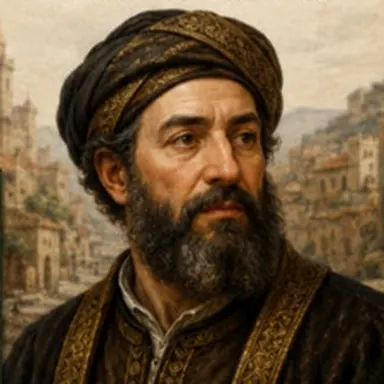
Rabbi Crescas Vidal
11 min read2,129 words
Summary
The text surveys the multifaceted figure of Rabbi Crescas Vidal, one of the prominent sages of Catalonia and Provence at the turn of the thirteenth and fourteenth centuries, examining his unique contribution as a public leader and as a halakhic decisor. The article stresses his decisive role as a moderate mediator at the height of the controversy over the study of philosophy, in which he formulated the historic compromise of limiting the age of study so as to prevent a rift in the Jewish community. Alongside his political activity, the source reveals his intellectual independence within the school of Nahmanides and the bibliographic complexity of his writings, many of which were mistakenly attributed to other Rishonim and are now being newly identified. Ultimately, the work sketches the life of a thinker who combined a conservative scholarly tradition with intellectual openness, and thereby shaped the Torah world of Spanish Jewry for generations.
The Torah Teaching, Public Work and Historical Place of Rabbi Crescas Vidal
Rabbi Crescas Vidal, whose original Hebrew name was Rabbi Yehuda, represents one of the most fascinating and influential figures in the Torah and public landscape of the Jewry of Catalonia and Provence at the end of the thirteenth century and the beginning of the fourteenth.[1, 2] As the son of a distinguished Catalan family, Rabbi Crescas was active at a historic crossroads at which the study method of the school of Nahmanides was taking shape, on the one hand, and a sharp theological controversy flared up over the limits of the legitimacy of studying the sciences and philosophy, on the other.[1, 3, 4] His Torah work extends to the writing of profound novellae on the tractates of the Talmud, some of which were mistakenly attributed over the generations to other Rishonim such as the Ritva and the Rashba, while his public work was marked by his role as a political mediator with a systemic and moderate outlook, who succeeded in shaping the historic compromise formulation of the ban on the study of philosophy.[1, 2, 5]
The Biographical, Family and Geopolitical Setting
Rabbi Crescas Vidal was born in Barcelona in the Crown of Aragon, apparently between the years 1240 and 1250.[1] His family background indicates membership in the economic and political elite of Spanish Jewry; the scholar Yitzhak Baer conjectured that his father was Shlomo Vidal, who served as treasurer to the king of Aragon, James I.[1] This standing gave the family broad communal influence that crossed geographical and political borders. Rabbi Crescas' brother, Don Bonfas Vidal of Barcelona, was one of the city's prominent sages and later served as one of the most forceful conservative voices in the controversy against the philosophical current.[1, 6, 7] Rabbi Crescas' son, Astruc, married around 1297 the daughter of the family of Shmuel Shekail, who was among the wealthy and leaders of Narbonne, a fact that attests to his deep family ties with the leadership of the Jewry of southern France.[1]
Owing to historical circumstances that are not fully known, Rabbi Crescas moved from Barcelona to the city of Marseille in France, and from there continued to Perpignan, where he established himself and became one of the leading notables of the community.[1, 2] Perpignan at that time, the capital of the Kingdom of Majorca, served as a unique geopolitical space – a cultural and political bridge between the more conservative Crown of Aragon and the cities of science and philosophy of the Languedoc region and Provence.[2, 8] This physical movement between Catalonia and Provence shaped Rabbi Crescas' worldview as a personality capable of bridging between different Torah study traditions and between polarized outlooks.[6, 7] Later in life he returned to Barcelona, and in 1306 he is mentioned in the "Little Epistle of Apology" of Rabbi Kalonymus ben Kalonymus, one of the disciples of the Rashba, as a key figure in the leadership of the community.[1]
To understand the historical identity of Rabbi Crescas Vidal, a precise scholarly distinction is required between him and related figures bearing similar names in the same geographical space, who are often prone to confusion among less thorough researchers.
The Scholarly Network of Catalonia and Teacher–Disciple Relations
Rabbi Crescas Vidal was educated in the study hall of the giants of Torah of Catalonia, the Rashba and the Re'ah (Rabbi Aharon HaLevi), both of whom were principal disciples of Nahmanides.[1, 3] This fact placed him at the heart of the intellectual lineage of the sages of Girona and Barcelona.[1, 3] Although the Rashba was the undisputed leader of Spanish Jewry in that generation, for Rabbi Crescas the Re'ah was personally his principal teacher.[1, 2] This deep personal affinity is expressed in the fact that Rabbi Crescas in his writings customarily calls only the Re'ah by the honorific title "my teacher, may the Merciful One guard and redeem him."[1]
This scholarly choice of Rabbi Crescas attests to marked intellectual independence. At that time a sharp halakhic and methodological confrontation was under way between the Rashba and the Re'ah, which reached its peak with the publication of the Rashba's book "Torat HaBayit" and the Re'ah's sharp critique of it in his book "Bedek HaBayit."[3, 11] Rabbi Crescas succeeded in navigating this tense scholarly space, integrating into his talmudic novellae traditions and halakhot from both of his teachers and from their common teacher, Nahmanides.[1] This synthesis played a key role in shaping the study method of later generations, and in particular deeply influenced the manner of writing and ruling of the Ran (Rabbi Nissim of Girona), who used the novellae of Rabbi Crescas as a cornerstone for his own works.[1]
The Controversy over Philosophy and the Development of the Age-Restriction Mechanism
From 1303, the fourth Maimonidean controversy flared up in the communities of Provence and Spain.[4, 7] The dispute arose in the wake of the activity of itinerant and local preachers in Languedoc and Provence, who preached in public in the spirit of Aristotelian philosophy and interpreted the biblical stories and the commandments in an extreme allegorical manner, which was liable to undermine commitment to the observance of halakha and the authority of the Sages.[4, 5] The leader of the conservative struggle in Provence, Abba Mari of Lunel (who had relocated to Montpellier), turned to the Rashba in Barcelona asking him to exercise his authority and impose a ban on secular studies.[4, 5]
The Rashba, who recognized the Torah standing and public influence of Rabbi Crescas Vidal in Perpignan, turned to him directly to mobilize his community and the notables of the region for the struggle against the "philosophizers."[2] Rabbi Crescas' position in this controversy reveals halakhic diplomacy and exceptional moderation.[6, 7] At first Rabbi Crescas took a neutral and even skeptical stance toward the struggle; he held that the Rashba and the people of Barcelona had been influenced by exaggerated descriptions from religious zealots who were unjustly persecuting the local enlightened scholar and philosopher, Rabbi Levi ben Avraham of Villefranche.[2, 6, 7]
Although Rabbi Crescas was a devout Orthodox halakhist, he believed that there is no essential flaw in the study of the sciences and philosophy, and that young people should be permitted to acquire a broad general education alongside their talmudic studies.[6, 7] This view found practical expression when he firmly sided with his wealthy friend Shmuel Sulami (or Shmuel l'Askalta), who gave refuge in his home to the excommunicated Levi ben Avraham, even though this step drew sharp criticism toward Sulami and Rabbi Crescas from conservative circles.[6, 7, 12] Rabbi Crescas' letters from that time reveal deep empathy for the persecution of the philosopher.[6, 7]
However, as the dispute deepened and threatened to tear the communities to shreds, Rabbi Crescas understood that clinging to extreme positions would not bring a solution.[2, 4] He understood that a total ban on the sciences would push the intellectuals outside the Torah world, while total freedom without supervision would bring disaster upon the halakhic commitment of the younger generation.[4, 5] To this end, Rabbi Crescas formulated a moderate and brilliant communal proposal: instead of prohibiting the sciences and philosophy altogether, the age of the students should be restricted.[2, 5] His original proposal was to prohibit the study of physics and metaphysics (except for medical studies, which were necessary) under penalty of a ban until the student reached the age of thirty – an age at which it is assumed that his religious and halakhic personality has already been formed and stabilized.[5]
The Rashba adopted the principle of age restriction proposed by Rabbi Crescas, but in the course of negotiation with the various communities, and in order to ensure acceptance of the enactment among broader circles, the minimum age was lowered and set at twenty-five years.[2, 4] This ban was finally proclaimed in Barcelona in the year 5065 (1305), and shaped a historic compromise that prevented a general culture war in the Jewry of Spain and Provence.[4]
The Interpretive Legacy and the Mystery of the Attribution of Manuscripts
The production of Rabbi Crescas Vidal's talmudic novellae is accompanied by one of the most complex bibliographic mysteries in the literature of the Rishonim.[1, 10] Because of his belonging to the same Catalan scholarly school and his use of sources identical to those of the Rashba, the Re'ah and the Ritva, over the years corruptions and substitutions occurred in the copying of the manuscripts of his works.[1] Some of his novellae were printed over the generations under the names of other great figures of the generation, and only modern philological work has succeeded in restoring to him the copyright over his works.[1]
Scholarly Methodology and Multi-Generational Influence
The study method of Rabbi Crescas Vidal faithfully reflects the analytical methodology of the school of Nahmanides in Catalonia.[1, 3] His writing is not merely local interpretation (in the style of Rashi) but a constant striving to build a broad conceptualization of the talmudic passage, systematically confronting the opinions of the Re'ah, the Rashba and Nahmanides.[1] He excels in clarity of formulation and in logical analysis that breaks down the Gemara's difficulties into clear foundational principles.
Rabbi Crescas' influence on later generations was enormous, mainly through two central channels:
- The novellae of the Ran: the Ran (Rabbi Nissim of Girona), who was among the great shapers of halakha and interpretation in the following generation, was deeply influenced by the novellae of Rabbi Crescas and incorporated many of them into his commentaries on the Talmud and on the Rif.[1] Through the Ran, Rabbi Crescas' reasonings became an integral part of traditional Talmud study to this day.[1]
- The compilatory literature of the Acharonim: the inclusion of extensive passages from his work on Ketubot in the book "Shitah Mekubetzet" of Rabbi Betzalel Ashkenazi opened to the sages of Egypt, the Land of Israel and the Ottoman Empire direct access to his teaching.[1, 2] Prominent sages such as Rabbi Chaim Algazi in his book "Netivot Mishpat" used these novellae as an authoritative source for halakhic ruling and for clarifying the laws of monetary matters and of the ketubah, thereby contributing to making his teaching an integral part of the chain of ruling in the Torah world.[1, 2]
Summary and Historical Assessment
Rabbi Crescas Vidal represents the model of creative intellectual leadership of the Jewry of Spain and Provence in its golden age.[1, 2, 4] On the Torah plane, his works attest to a splendid scholarly independence that does not shrink from presenting interpretive alternatives against his great teachers, while preserving absolute loyalty to the tradition of Nahmanides.[1] On the public plane, he revealed himself as a halakhic pragmatist who refused to surrender to religious zealotry on the one hand and to philosophical radicalism on the other, and thereby prevented the tearing apart of the Jewish community in the midst of a difficult identity crisis.[2, 4, 6]
His balancing activity in Perpignan and Barcelona, combining defense of the freedom of thought of mature intellectuals with ensuring the wholeness and education of the community, remains one of the most glorious chapters of medieval Jewish diplomacy.[2, 6, 7] The restoration of his writings and works to their proper place in the Jewish library by modern scholarship makes it possible to appreciate correctly his figure as an essential connecting link in the shaping of the Torah and thought of the Jewry of Catalonia throughout its generations.[1]
Sources12
- 1.קרשקש וידאל - ויקיפדיה, he.wikipedia.org/wiki/קרשקש_וידאל
- 2.Vidal, Crescas | Encyclopedia.com, encyclopedia.com/religion/encyclopedias-almanacs-transcripts-and-maps/vidal-crescas
- 3.רשב"א - ויקיפדיה, he.wikipedia.org/wiki/רשב"א
- 4.COMMUNICATION AND PROPAGANDA BETWEEN PROVENCE AND SPAIN: THE CONTROVERSY OVER EXTREME ALLEGORIZATION - Brill, brill.com/edcollchap/book/9789004679184/B9789004679184_s013.pdf
- 5.Jewish Encyclopedia/Abba Mari ben Moses ben Joseph don Astruc - Wikisource, en.wikisource.org/wiki/Jewish_Encyclopedia/Abba_Mari_ben_Moses_ben_Joseph_don_Astruc
- 6.CRESCAS, (DON) VIDAL, OF PERPIGNAN - JewishEncyclopedia.com, jewishencyclopedia.com/articles/4756-crescas-don-vidal-of-perpignan
- 7.Crescas Vidal - Wikipedia, en.wikipedia.org/wiki/Crescas_Vidal
- 8.Crescas - Wikipedia, en.wikipedia.org/wiki/Crescas
- 9.CRESCAS, VIDAL, DE CASLAR - JewishEncyclopedia.com, jewishencyclopedia.com/articles/4755-crescas-vidal-de-caslar
- 10.רא"ה - ויקיפדיה, he.wikipedia.org/wiki/רא"ה
- 11.מחברים | מקורות מתוך ספריית ספריא, sefaria.org.il/topics/category/authors
- 12.Why Was Levi Ben Ḥayyim Hounded - AAJR, aajr.org/wp-content/uploads/2019/03/Halkin-article.pdf