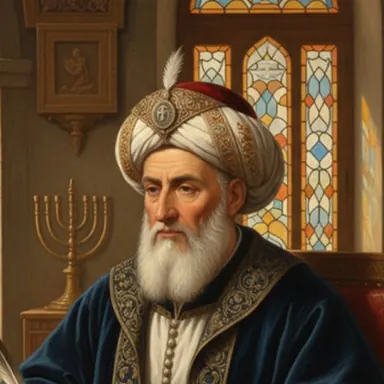
Rabbi Menachem ben Shlomo HaMeiri
14 min read2,790 words
Summary
This text surveys the Torah and intellectual teaching of Rabbi Menachem HaMeiri, one of the leading sages of Provence in the 13th century, dwelling on his distinctive combination of traditional Talmudic scholarship and philosophical rationalism. The article details the structure of his central work, "Beit HaBechirah," which is characterized by exemplary order, lucid Hebrew and the use of distinctive epithets for the sages of the past, intended to emphasize the continuity of the tradition. The most revolutionary idea presented in the text is the definition of "nations restricted by the ways of religions," a halakhic category that distinguishes ancient idolaters from the Christians and Muslims of his own day, a distinction that bears on the duty of fair dealing and peace toward them. Finally, the source describes the process by which HaMeiri's writings were rediscovered in the twentieth century, which made them a fundamental and influential component of the world of the yeshivot and of modern halakhic ruling.
The Torah Teaching and Literary Work of Rabbi Menachem ben Shlomo HaMeiri: A Historical, Halakhic and Philosophical Analysis
The Historical and Cultural Setting of Provençal Jewry in the 13th Century
The world of Rabbi Menachem ben Shlomo of the House of Meir, known by the epithet "HaMeiri," is deeply anchored in the distinctive cultural and intellectual structure of Provençal Jewry in the thirteenth century. This period, the last golden age of Jewish creativity in southern France (the Languedoc region), was characterized by a rare synthesis between the conservative rabbinic tradition and the rationalist and philosophical currents that arrived from Muslim Spain. HaMeiri was born in the Hebrew year 5009 (1249) in the city of Perpignan, a significant economic and cultural center at the time, and was active there for most of his life until his death in 5075 (1315).[1, 2]
The environment in which HaMeiri grew up was saturated with intellectual tensions. On the one hand, the influence of the Tosafists of northern France brought to Provence the method of pilpul (dialectical argumentation) and the in-depth analysis of Talmudic topics. On the other hand, the translations by members of the Ibn Tibbon family of the philosophical and scientific works of Maimonides, Rav Saadia Gaon and Rabbi Yehuda HaLevi created a stratum of Jewish intellectuals who sought to understand the Torah through a rational lens.[2] HaMeiri, who was the outstanding disciple of Rabbi Reuven ben Chayim (referred to in his writings as "my master, Rabbi ... the universal sage"), succeeded in forging a method that merged these two worlds into a single coherent work.[2]
HaMeiri's public standing as head of the community in Perpignan gave him a practical perspective on halakhic reality. He maintained close ties with the great figures of his generation, foremost among them the Rashba (Rabbi Shlomo ben Aderet) of Barcelona, with whom he conducted extensive correspondence on matters of halakha and outlook.[2] An understanding of his biographical background is essential for grasping the roots of his revolutionary approach to the gentile and of his distinctive literary style, which seeks to create order and clarity amid the stormy sea of the Talmud.
Milestones in HaMeiri's Biography and Environment
Beit HaBechirah: The Architecture of the Talmudic-Halakhic Codex
HaMeiri's monumental book, "Beit HaBechirah," is regarded as one of the most comprehensive and orderly works in the history of Rishonim literature. The composition serves neither as a literal commentary (like Rashi's) nor as a collection of objections and dialectical arguments (like the Tosafot), but as a structured summary of all the Talmudic topics and the halakhic conclusions that emerge from them.[3, 6] HaMeiri attests in his introduction that the book was named "Beit HaBechirah" because it presents the "selected matters" (devarim nivrarim) of the Talmudic give-and-take, omitting the tortuous dialectical structure in favor of the clear conclusion.[3]
The Interpretive Methodology and Formal Structure
The structure of "Beit HaBechirah" reflects an aspiration to order and linearity. Each unit of study opens with the citation of the Mishnah, usually accompanied by the Rambam's Commentary on the Mishnah, which served HaMeiri as a firm interpretive foundation.[3, 6] HaMeiri then analyzes the Gemara's topic thematically: he begins by explaining the Mishnah according to the conclusions of the Gemara, continues by summarizing the other parts of the topic that are not directly related to the Mishnah, and concludes with the practical halakhic conclusion and with ethical and reflective remarks arising from the subject.[3]
HaMeiri's central innovation lies in his linguistic choice. Unlike most sages of his generation, who wrote in Talmudic Aramaic or in a rabbinic Hebrew saturated with Aramaic, HaMeiri wrote "Beit HaBechirah" in lucid, clear medieval Hebrew.[3] This style, influenced by the translations of the Ibn Tibbons, was intended to make the Talmud accessible not only to Torah scholars but also to educated readers seeking to encompass the world of halakha with fluency and concision.[3]
The Use of the Jerusalem Talmud and of Early Sources
One of the features that distinguish HaMeiri is his deep affinity for the Jerusalem Talmud. Whereas in the centers of learning in Ashkenaz and Sefarad the Yerushalmi sometimes served as a secondary aid, HaMeiri grants it a central standing and integrates its rulings and insights into every topic.[3] Studies point out that HaMeiri had before him versions of the Yerushalmi that we no longer possess today, which makes "Beit HaBechirah" a critical source for the textual reconstruction of the tradition of the Land of Israel.[3]
In addition, HaMeiri displays exceptional mastery of the literature of the Geonim and of the works of the sages of Sefarad and France. In his work he summarizes and sifts the opinions of the Rif, the Rambam, Rashi, the Tosafists, the Raavad and the Ramban.[3] His interpretive inclination leans markedly toward the Rambam, but he does not refrain from disagreeing with him when the Provençal tradition or the conclusion of the topic points otherwise.[3]
The Distinctive System of Epithets: Anonymity as a Pedagogical Device
One of the fascinating phenomena in "Beit HaBechirah" is HaMeiri's almost total avoidance of mentioning the personal names of sages from the generations after the Talmud. Instead, he created a system of fixed honorific epithets, which allows the reader to identify the "school" or the "role" of the cited sage without entering into personal disputes.[5, 7]
This approach stems not only from modesty but from a pedagogical conception that seeks to present the Oral Torah as a single continuum of tradition in which what matters is the "opinion" and not the "personality." Nevertheless, HaMeiri's adherence to this format is so strict that finding the personal name of a sage in his work is considered an extremely rare event.[7]
His Revolutionary Halakhic Teaching: The Status of the "Nations Restricted by the Ways of Religions"
HaMeiri's most significant contribution to halakhic thought, which has resonated enormously in recent centuries, is his renewed definition of the attitude toward the gentile of his own time. HaMeiri was active in a period when Jewish communities lived in constant friction with the Christian and Muslim environment, and he identified a vast gulf between the idolaters mentioned in the Talmud and the adherents of the monotheistic religions of his day.[7, 8]
The Third Category: Neither Jewish nor Pagan
HaMeiri coined the term "nations restricted by the ways of religions" (ummot ha-gedurot be-darkhei ha-datot), a group that includes the Christians and Muslims who believe in the reality of the Creator, in providence and in the giving of the Torah (even if in a distorted form from the standpoint of Judaism).[7, 8] In his view, these peoples are not included in the Talmudic category of worshippers of stars and constellations (akum), since they are subject to an orderly moral and religious system of laws.[7]
This definition had far-reaching practical implications in his writings:
The prohibition of robbery and the duty of fair dealing: HaMeiri rules categorically that the prohibition against robbing the gentile, the duty to return a lost object to him and the prohibition against deceiving him apply in their full severity with respect to these nations.[7] He explains that the permissions mentioned in the Talmud regarding "forfeiting his loan" were said only about those ancient peoples who had no religion and were not subject to law and morality.[7]
- Trade on Sabbaths and festivals: HaMeiri permitted commercial ties with Christians on their holiday, arguing that on that day they are not serving idols but directing their hearts to the God of heaven, even if they associate other powers with Him.[8]
- Human fellowship: HaMeiri emphasizes the duty to behave with piety and in the ways of peace toward everyone who belongs to a "restricted" nation, out of recognition of the shared moral value.[7]
The debate over the sincerity of HaMeiri's words—whether they were written out of deep philosophical conviction or as a result of fear of Christian censorship ("out of fear")—occupies Torah and academic scholarship to this day.[8] Nevertheless, the fact that he integrates this conception consistently throughout his entire work, and in complex halakhic discussions that do not bear directly on relations with the authorities, strengthens the view that this is a principled and settled conception.[8]
Rationalism and Science in HaMeiri's Interpretation
HaMeiri did not confine his knowledge to the Talmudic world alone. As a Provençal polymath, he was versed in the natural sciences, physics, astronomy and the philosophy of his time.[2] He believed that knowledge of the "external wisdoms" is not merely permitted but an essential tool for understanding the Torah and reality.
The Rejection of Magic and Demons
HaMeiri's rationalist position finds sharp expression in his attitude toward supernatural phenomena. In his commentary on the Book of Proverbs and in Talmudic topics, HaMeiri categorically denies the reality of demons, spirits and magical forces.[9] In his view, these mentions in the words of the Sages are allegories for psychic forces, physical illnesses or imaginary phenomena arising from a certain state of mind.[9]
This approach aroused fierce opposition among later generations. The Radbaz, for example, attacked HaMeiri sharply and ruled that denying the reality of demons is heresy against the plain sense of Scripture and the explicit words of the Sages.[9] HaMeiri, by contrast, held that the Torah cannot contradict common sense and the laws of nature known to us, and therefore the words of the Sages must be interpreted allegorically in a way that is reconciled with reason.[4, 9]
The Influence of the Rambam on His Thought
HaMeiri regarded himself as a faithful disciple of the Rambam, not only in halakha but also in thought. He was master of the "Guide of the Perplexed" and of the Rambam's other philosophical works, and drew on them to elucidate complex theological issues such as prophecy, providence, reward and punishment, and the purpose of the commandments.[2, 4] In his work "Seder HaKabbalah" (his introduction to Tractate Avot), he lays out the history of the tradition while incorporating historiographical insights that emphasize the continuity of rational wisdom alongside the transmitted Torah.[2]
Additional Works and His Varied Literary Activity
Besides "Beit HaBechirah," HaMeiri left behind a broad literary legacy covering various aspects of Jewish life.
Chibbur HaTeshuvah
This work, also known as "Meshiv Nefesh," is a unique composition that combines halakha, ethics and philosophy.[9, 10] The book deals with the foundations of repentance, the importance of confession and the ways of improving one's character traits. In it HaMeiri analyzes the psychology of sin and the human capacity for change, basing himself on the structure of the Temple service on Yom Kippur.[10]
Kiryat Sefer
A comprehensive halakhic book dealing with the laws of writing a Torah scroll, tefillin and mezuzot.[1, 9] In this work, HaMeiri displays mastery of the biblical tradition and of the fine points of the letters, and provides detailed lists of words written in full or defective spelling.[9] The book was first published in the 19th century in Izmir and received scholarly editions in the 20th century because of its importance to halakhic decisors.[1]
Magen Avot
This is a polemical work in which HaMeiri comes to the defense of the ancient customs of Provence.[1] In his time, customs from Sefarad had begun to penetrate (following the influence of the Ramban and his disciples), and HaMeiri sought to preserve the distinctiveness of the local community. The book offers a window onto the cultural tensions within the world of halakha and onto HaMeiri's determination to preserve the tradition without giving up theoretical depth.[1]
Biblical Commentaries
His commentaries on Psalms and Proverbs are a masterpiece of the interpretation of the plain sense.[2, 9] HaMeiri focuses on an ethical and philosophical elucidation of the verses, keeping away from distant homilies and seeking the practical lesson for the believing and educated person.[2]
The Vicissitudes of HaMeiri's Writings: From Oblivion to Modern Revival
One of the most remarkable phenomena connected with HaMeiri is the almost complete disappearance of his writings for nearly five hundred years, and their meteoric return to the center of the Torah world in the 20th century.[6] While the names of the Rif, the Rambam and the Ramban were on everyone's lips, HaMeiri was known mainly through quotations in the "Shitah Mekubbetzet" of Rabbi Betzalel Ashkenazi.[6]
The Discovery of the Parma Manuscript
The great turning point came with the discovery of the Parma manuscript (in the Palatina Library in Italy), which contained most of the parts of "Beit HaBechirah."[6, 11] The manuscript, which was preserved in exceptional condition, enabled scholars and rabbis to reconstruct the comprehensive work that had been considered lost.[11]
Rabbi Abraham Sofer (Schreiber) is regarded as HaMeiri's principal and most famous editor in our generation.[1, 6] He labored to decipher the manuscripts, add references and notes, and make the text accessible in modern dress.[12] This work is regarded as one of the most important Torah enterprises of the twentieth century, since it restored a "lost object to Israel" and changed the face of Torah study.[6]
The Influence of HaMeiri on Halakhic Ruling and on the World of the Yeshivot in Our Time
HaMeiri's entry into the modern study hall brought about a quiet but profound revolution. For the contemporary student, HaMeiri offers a clear "road map" through the thicket of Talmudic topics.[6] The ability to see the summary of the views in such an orderly fashion, without giving up the depth of the halakha, made "Beit HaBechirah" a foundational book for preparing lessons and for knowing the halakha.
HaMeiri as a Bridge between Halakha and Modernity
Prominent decisors in the 20th century, foremost among them Rabbi Abraham Isaac HaKohen Kook and Rabbi Ovadia Yosef, found in HaMeiri's approach foundations for resolving pressing halakhic problems.[13] His approach regarding "nations restricted by the ways of religions" served as a basis for discussions on the status of the secular Jew in the State of Israel (who is not considered an idolater), on relations with the Christian and Muslim world in the modern era, and on the ways of peace and the drawing together of hearts.[8, 13]
HaMeiri succeeded in creating a model of "open conservatism": absolute loyalty to the tradition of the Sages and to halakhic ruling, together with a sober view of the changing reality and openness to human wisdom.[2] His figure serves today as a paragon of the combination of classical Talmudic scholarship with broad-minded rational and ethical thought.
Conclusion: HaMeiri's Eternal Legacy
Rabbi Menachem HaMeiri was not merely a commentator on the Talmud but an architect of Jewish knowledge. His life's work, which encompasses all the strata of the Torah—from Scripture and the Mishnah to practical halakha and philosophy—expresses the aspiration to unity and order in a complex spiritual world. The linguistic clarity of "Beit HaBechirah," the methodology of summary and selection, and the revolutionary approach to interpersonal relations place him among the great Rishonim whose words are ever relevant.[3, 7, 8]
The revival of his writings in the 20th century is testimony to the power of a Torah that is not forgotten, and to the need of every generation for sages who know how to bridge worlds.[6] Today HaMeiri remains a veritable "house of choice" (beit bechirah)—a place where the student finds the selected essence of Jewish thought at its best, infused with fear of Heaven, common sense and love of humanity.
Sources13
- 1.רבי מנחם המאירי - ויקישיבה, yeshiva.org.il/wiki/index.php/רבי_מנחם_המאירי
- 2.ר' מנחם המאירי כפרשן המקרא, jewish-faculty.biu.ac.il/files/jewish-faculty/shared/JSIJ14/tzeitkin.pdf
- 3.בית הבחירה למאירי – ויקיפדיה, he.wikipedia.org/wiki/בית_הבחירה_למאירי
- 4.משנתו הפילוסופית של הרמב''ם: מבחר פרקים - Dov Rappel - Google Books, books.google.com/books/about/משנתו_הפילוסופית_של_ה.html?id=1Pl2sSYQpOIC
- 5.חכמי ישראל בפי המאירי | פרוג • קהילה עסקית - חרדית הגדולה בעולם, prog.co.il/threads/חכמי-ישראל-בפי-המאירי.552576/
- 6.בית הבחירה – ויקישיבה, yeshiva.org.il/wiki/index.php/בית_הבחירה
- 7.המאירי, מחבר פורה שספריו כמעט ונשכחו - BeitChabad.com - בית חבד, he.chabad.org/library/article_cdo/aid/3334259
- 8.דרשני:שיטת המאירי ביחס לאומות הגדורות בדרכי הדתות - ויקישיבה, yeshiva.org.il/wiki/index.php/דרשני:שיטת_המאירי_ביחס_לאומות_הגדורות_בדרכי_הדתות
- 9.מנחם המאירי - ויקיפדיה, he.wikipedia.org/wiki/מנחם_המאירי
- 10.חיבור התשובה למאירי - מוסד הרב קוק, mosadharavkook.com/shop/חיבור-התשובה-למאירי/
- 11.כתב יד פארמה - ויקיפדיה, he.wikipedia.org/wiki/כתב_יד_פארמה
- 12.הרב אברהם סופר (שרייבר) – ויקישיבה, yeshiva.org.il/wiki/index.php/הרב_אברהם_סופר_(שרייבר)
- 13.עובדיה יוסף - ויקיפדיה, he.wikipedia.org/wiki/עובדיה_יוסף