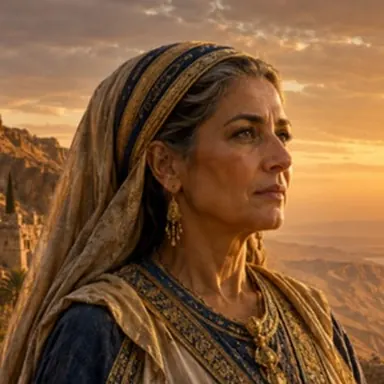
The Work, Torah Teaching and Spiritual Standing of Zeruiah: A Woman of Valour, Mother of the Kingdom's Mighty Men and the Axis of Authority in the House of Jesse
14 min read2,810 words
Summary
This text examines the biblical figure of Zeruiah, the sister of King David, as a spiritual and educational axis of authority that was decisive in shaping the beginnings of the kingdom of the House of David. The source stresses the historical anomaly of her sons' being named after her rather than after their father, a phenomenon that attests to her dominant matriarchal standing and to her exalted righteousness, which was reflected onto the army heroes Joab, Abishai and Asahel. Through genealogical and exegetical analysis, the article presents Zeruiah as an earthly realization of the "woman of valour," who handed down to her descendants a combination of physical heroism and absolute submission to the Torah and to halakhic authority. Ultimately, the text outlines an inseparable metaphysical bond between the house of Zeruiah and the House of David, presenting her figure as the moral and familial pillar on which the strength of the entire kingdom rested.
- Zeruiah's standing
- Matriarchal lineage
- The sons of Zeruiah
- The kingdom of the House of David
- Female spiritual authority
The Work, Torah Teaching and Spiritual Standing of Zeruiah: A Woman of Valour, Mother of the Kingdom's Mighty Men and the Axis of Authority in the House of Jesse
The figure of Zeruiah, the sister of King David and the daughter of Jesse and Nitzevet daughter of Adael, stands at one of the most fascinating historical and spiritual junctures of the period in which the kingdom of the House of David was established [cite: 1]. Although the biblical text does not present direct monologues from her mouth, her leading and spiritual presence resonates powerfully throughout the books of Samuel, Kings and Chronicles through the deeds, heroism and struggles of her three sons, Joab, Abishai and Asahel, who were among the chief mighty men of the kingdom and pillars of the army of Israel [cite: 1, 2]. In complete contrast to the patriarchal custom accepted in the Bible and in the ancient world, in which sons are named after their father, these heroes are consistently, systematically and exclusively named after their mother and called "the sons of Zeruiah" [cite: 1, 3]. This literary and historical anomaly attests to her unique standing as a figure of spiritual authority and exalted righteousness, who left an indelible mark on the moral and political structure of the kingdom of Judah and Israel [cite: 4, 5].
Zeruiah's Genealogy: The Network of Family Ties and the Exegetical Traditions
Zeruiah grew out of a family foundation saturated with holiness and righteousness. According to the tradition of the Babylonian Talmud, her mother was Nitzevet daughter of Adael, the wife of Jesse and the mother of King David [cite: 1]. This lineage connects Zeruiah directly to the family line that produced David, in which the maternal figures held a decisive spiritual role of preserving the purity of the family and transmitting the tradition of faith [cite: 1, 6].
The Second Book of Samuel (chapter 17, verse 25) brings further complex genealogical information, noting that Amasa son of Ithra the Israelite "went in to Abigal the daughter of Nahash, sister of Zeruiah, Joab's mother" [cite: 3]. The identification of "Nahash" arouses extensive exegetical discussion; the Sages identify Nahash with Jesse himself, who was so called because he never sinned in his life and died only on account of the serpent (nahash), that is, the sin of Adam. This identification strengthens the conception of the complete righteousness of Zeruiah's ancestral house, and places her and her sister Abigail as central links in the transmission of the spiritual lineage of the House of Jesse [cite: 1, 3].
On the other hand, the identity of Zeruiah's husband and the father of her sons remains obscure in the biblical text, which has led to the development of several different exegetical and historiographical traditions:
Zeruiah's three sons were born in the chronological order that appears in the First Book of Chronicles (chapter 2, verse 16): "And the sons of Zeruiah: Abshai, and Joab, and Asahel, three" [cite: 2, 4]. Although Abishai was the firstborn, Joab attained the status of command and political primacy because of his decisive importance as the commander of David's army [cite: 4]. The three sons grew up under the familial and educational patronage of their mother, and formed a united and inseparable force, always identified as a single body acting out of absolute loyalty to the family and to the kingdom [cite: 2].
The Phenomenology of Matriarchal Lineage: A Literary and Theological Analysis
The repeated naming of her sons as "the sons of Zeruiah," and not by their father's name, is one of the most prominent literary phenomena in the Book of Samuel [cite: 1, 3]. An in-depth analysis of the sources yields three central understandings of this phenomenon, which reflect Zeruiah's authority and righteousness:
A. Zeruiah's Personal and Spiritual Authority as a Strong Woman
The Malbim stresses that Zeruiah was "a strong woman, worthy of mention" [cite: 1]. Her strength was not only physical or political, but above all spiritual and educational. She shaped the personalities of her sons as fearless warriors who drew their strength from a firm tradition of faith [cite: 2, 5]. In a world in which women often remained on the margins of historical events, the figure of Zeruiah rose up as a leading and authoritative figure, so that everyone who heard knew that these heroes represented the spirit and the education of this heroic personality [cite: 1, 5]. This authority is also commemorated in the geography of the Land of Israel, where "Mount Zeruiah" in the Ein Gedi nature reserve is named after her, as a symbol of her lofty strength overlooking the Judaean Desert in which David's mighty men were formed [cite: 1].
B. Connecting the Family to the Royal House and the Greatness of the King
Rav Hai Gaon explains that the attribution to Zeruiah was intended "to magnify him through her" [cite: 4]. Her being the sister of King David gave her sons governmental legitimacy and a privileged aristocratic standing at the royal court [cite: 4]. Through Zeruiah the warriors were bound by a direct blood tie to the king, and thus her figure became the central axis connecting the senior military echelon with the royal throne [cite: 3, 4].
C. The Rhetorical and Political Context in David's Words
The Radak offers a profound psychological and rhetorical understanding of this appellation [cite: 4]. When King David wishes to express the complexity of his relations with Joab and Abishai, who at times display harshness and extreme pragmatism (as in the murder of Abner son of Ner), he calls them "the sons of Zeruiah" [cite: 4]. This usage is intended to stress before the people that these heroes are his sister's sons [cite: 4]. In this way David makes clear that his refraining from punishing them immediately does not stem from weakness of rule, but from a deep family obligation and from a wish to prevent an internal rift within the close royal lineage [cite: 4].
The Torah Teaching of Zeruiah: A Woman of Valour through the Lens of the Sages and the Kabbalah
Although Zeruiah did not leave behind an explicit halakhic collection, her Torah and spiritual teaching permeates through her educational guidance and through the metaphysical conception of her figure in the tradition of the generations.
The Anatomy of the "Woman of Valour" and the Connection to the Shekhinah
The poem "A Woman of Valour" (Proverbs 31) is interpreted in the literature of the kabbalists, foremost among them the holy Shelah, as an allegory for the holy Shekhinah (Divine Presence) that shines on the Sabbath eve, which is the source of spiritual abundance and blessing for the world [cite: 7]. The word "chayil" (valour) has the numerical value (gematria) of $48$, a clear allusion to the forty-eight ways of acquiring the Torah detailed in the Mishnah in Tractate Avot, through which a person merits to become a master of Torah and of complete spirituality [cite: 7].
Through this lens, Zeruiah embodies the earthly realization of the "woman of valour" who receives her strength from the forty-eight ways of acquiring the Torah and hands them down to her sons [cite: 1, 7]. Zeruiah's heroes were not only physical men of war, but "men of valour" in the spiritual sense, warriors whose Torah and heroism are intertwined [cite: 2, 7]. The education she gave them was characterized by complete self-sacrifice for the sake of the whole of Israel, while preserving an unbroken bond with the metaphysical source of the nation [cite: 4, 5].
Her Sons' Bond with Female Halakhic Authority
Indirect and decisive proof of the influence of Zeruiah's educational teaching on her sons can be found in the exceptional respect that these hard heroes showed toward wise women possessing spiritual authority. In the dramatic episode of the siege of Abel Beth Maacah, Joab conducts a pointed halakhic and moral negotiation with "the wise woman" of the city, who is identified in the Midrash with Serah daughter of Asher [cite: 4, 8].
When the wise woman reproves Joab, relying on the Torah's command to offer peace before war ("When you draw near to a city to fight against it, you shall proclaim peace to it"), and asks him why he seeks "to destroy a city and a mother in Israel" and to swallow up the inheritance of the Lord [cite: 4, 8], Joab does not respond with contempt or with military force. He listens to her words submissively, declares "Far be it, far be it from me, that I should swallow up or destroy," and accepts the political and halakhic solution she proposes [cite: 4]. The willingness of the most forceful and authoritative army commander in Israel to bow before the spiritual authority of a woman teaches that he was raised in a home in which the figure of the mother, Zeruiah, was a model of supreme Torah, moral and halakhic authority [cite: 1, 4].
The Theological Dialectic between the House of David and the House of Zeruiah
The relations between King David and his sister Zeruiah and her sons go beyond the simple familial and political dimension, and reach a profound theological dialectic that defines the complexity of the leadership of the people of Israel.
Harshness versus Gentleness: A Struggle over the Character of Kingship
King David defines himself as standing at the spiritual centre of a leadership based on kindness and mercy: "And I am this day tender, though anointed king" [cite: 4]. Against this, he presents his sister's sons as representatives of the attribute of strict judgment and uncompromising might: "and these men the sons of Zeruiah are too hard for me" [cite: 4]. The struggle between David and Joab is a struggle between two Torah worldviews:
David's kingship of kindness and repentance: based on submission, humility, and the acceptance of the yoke of Torah and the yoke of the commandments out of lowliness of spirit [cite: 9]. As described in Yalkut Shimoni, David made himself "like an ox to the yoke and like a donkey to the burden" and engaged in Torah out of deep self-abnegation [cite: 9].
The kingship of judgment and pragmatism of the sons of Zeruiah: based on harsh physical defence of the borders of the Land and on uncompromising internal elimination of threats, out of the conception that the physical existence of the nation sometimes requires the use of violent and forceful means [cite: 4].
The Metaphysical Connection and the Reciprocal Fulfilment of the Curse
Despite the moral and practical gap between David and the sons of Zeruiah, the two houses are bound to each other by an inseparable spiritual bond, which stems from Zeruiah's being the king's sister and a partner in the fate of his dynasty [cite: 3, 4]. Dramatic testimony to this metaphysical bond is brought in the words of Rav Yehuda in the name of Rav in Tractate Sanhedrin: all the curses with which David cursed Joab son of Zeruiah after the murder of Abner were ultimately fulfilled in the seed of David himself [cite: 10].
Scripture and the Gemara detail the fulfilment of these curses with astonishing precision:
$$\text{David's curse on Joab} \quad \Longrightarrow \quad \text{Its fulfilment in David's seed}$$
- One with an issue (zav): "Let there not fail from the house of Joab one that has an issue..." was fulfilled in King Rehoboam, of whom it is said, "And King Rehoboam made speed to get up into his chariot, to flee to Jerusalem," and it is written, "And whatever chariot the one with an issue rides upon shall be unclean" [cite: 10].
- A leper: fulfilled in King Uzziah, who was struck with leprosy following his attempt to burn incense in the Sanctuary.
One who leans on a staff (weak and in need of support): fulfilled in King Asa, who became diseased in his feet in his old age.
- One who falls by the sword: fulfilled in King Josiah, who was shot by the Egyptian archers and died.
- One who lacks bread: fulfilled in King Jehoiachin, who was taken captive to Babylon and ate a fixed allowance of bread from the hand of the king of Babylon.
This reciprocal fulfilment of the curses teaches a profound metaphysical insight: the spiritual layer of Zeruiah and of David is a single essence [cite: 3, 10]. An attempt to harm or to curse the house of Zeruiah directly harms the House of David, since Zeruiah is the spiritual and genetic root from which the might of the kingdom draws [cite: 3]. Zeruiah's righteousness stood by her sons as a spiritual protection, and when a blemish was cast upon her house, the royal house itself was also cracked [cite: 10].
Lying Down versus Death: The Legacy of David and Joab
A further profound difference between David and Joab is discussed in the Gemara around the biblical wording of their deaths [cite: 4]. Of David it is said, "And David slept with his fathers" (the language of lying down), whereas of Joab it is said, "And Joab died" (the language of death) [cite: 4]. Rabbi Pinchas bar Chama explains that of David, who left behind a son like himself (King Solomon, who continued the dynasty of kingship and wisdom at the same level), lying down is said, for his spirit continued to live in the world in full [cite: 4]. Of Joab, by contrast, who did not leave behind a son like himself in his military and leadership eminence, death is said [cite: 4].
Nevertheless, the Gemara stresses that Joab did have sons who continued his line, as emerges from the list of those who came up from Babylon in the Book of Ezra (8:9): "Of the sons of Joab, Obadiah the son of Jehiel" [cite: 4]. This fact attests that although the sons did not reach the unique leadership level of their father, Zeruiah's righteousness and legacy continued to work among their descendants for many generations, and gave them the strength to return from Babylon and to rebuild the House of the Lord [cite: 4].
Summary
In Torah and historical research Zeruiah appears as the hidden but most powerful pillar of the beginnings of the kingdom of the House of David [cite: 1, 5]. The combination of her figure as the king's sister, as the daughter of Nitzevet daughter of Adael and as the exclusive mother of the supreme army commanders places her as an unprecedented moral and leadership axis [cite: 1, 2]. Her Torah teaching, which reflects the qualities of the "woman of valour" and the connection to the Shekhinah, was instilled in her sons through a phenomenal combination of absolute loyalty to the kingdom, military self-sacrifice and absolute submission to the laws of the Torah and to the representatives of spiritual authority [cite: 2, 7, 8].
The exceptional matriarchal lineage "the sons of Zeruiah" has remained for generations an eternal testimony that behind the physical heroes who shaped the borders of the kingdom of Israel stood a mighty and righteous female personality, who by the power of her education, her Torah and her personality determined the course of the nation's history [cite: 1, 4, 5].
Sources10
- 1.צרויה - ויקיפדיה, he.wikipedia.org/wiki/צרויה
- 2.יואב בן צרויה – ויקישיבה, yeshiva.org.il/wiki/index.php/יואב_בן_צרויה
- 3.מי היה צרויה או מי היתה צרויה? - בני ציון - בונים קומה בתנ"ך, bneyzion.co.il/מאגר-השיעורים-והמאמרים/כתובים/דברי-הימים/מאמרים-דברי-הימים-א/מי-היה-צרויה-או-מי-היתה-צרויה
- 4.יואב בן צרויה - ויקיפדיה, he.wikipedia.org/wiki/יואב_בן_צרויה
- 5.צרויה - אתר השמות הגדול - בייבילנד, babynames.baby-land.co.il/namelist/צרויה/
- 6.מדוע מזכירים את שם האם בתפילה? - BeitChabad.com - בית חב"ד, he.chabad.org/library/article_cdo/aid/1279744/jewish/-.htm
- 7.למה (ולמי) שרים 'אשת חיל' בליל שבת? - BeitChabad.com - בית חב"ד, he.chabad.org/library/article_cdo/aid/5508867
- 8.II Samuel 20:16 with Midrash | Sefaria Library, sefaria.org/II_Samuel.20.16?with=Midrash
- 9.ילקוט שמעוני על נ"ך קס״ה | האוסף של ספריא, sefaria.org.il/Yalkut_Shimoni_on_Nach.165
- 10.פרק ב' - צוואת דוד - הריגת יואב - ישיבת ההסדר בני-עקיבא מעלות, yesmalot.co.il/6716/