The Historical and Torah Figure of Rabbi Yaakov ben Yakar: Tradition, Leadership and Humility in Early Medieval Ashkenaz
15 min read2,980 words
Summary
This article surveys the life and work of Rabbi Yaakov ben Yakar, a key figure of Ashkenazi Jewry in the 11th century who served as a vital link between Rabbenu Gershom and Rashi. The text emphasizes how Rabbi Yaakov's leadership in the Torah centers of Mainz and Worms laid the foundations for the method of studying the Gemara and Scripture in Europe, focusing on the search for the way of peshat (the plain sense) and on establishing the precise text of the Talmud. Beyond his scholarly contribution, the source highlights the extreme humility for which "Mori HaZaken" ("my old teacher") was known, a trait that became a spiritual model for the movement of the Ashkenazi Pietists and deeply influenced the shaping of the moral character of his foremost disciple, Rashi. In sum, the work presents Rabbi Yaakov as a hidden pillar who, although he did not leave behind many independent works, saw his teaching and practices absorbed into the enduring heritage of Jewish exegesis and halakha through the generations.
The historiography of 11th-century Ashkenazi Jewry often focuses on the monumental figure of Rashi, but a deeper examination of the roots of spiritual creativity in this period reveals that the pillars on which the European world of Torah rested were shaped by exemplary figures who worked in the shadows, foremost among them Rabbi Yaakov ben Yakar. Rabbi Yaakov ben Yakar (4750–4824 AM; c. 990–1064) represents the most critical link between the founding generation of the "Light of the Exile," Rabbenu Gershom, and the exegetical and halakhic flowering of the Tosafists.[1, 2, 3] His work in the Torah centers of Magenza (Mainz) and Warmaisa (Worms) laid the groundwork for the Ashkenazi methodology of study, which combines ancient Italian and Land-of-Israel traditions with the needs of the community then taking shape in the Rhine Valley.[4, 5]
The Geographic and Social Background of Rhineland Jewry in the 11th Century
To understand the stature of Rabbi Yaakov ben Yakar, one must examine the environment in which he grew up and worked. In this period the Jewish communities of the ShUM cities (Speyer, Worms, Mainz) enjoyed relative economic and spiritual prosperity under the protection of the Holy Roman Empire. Mainz, Rabbi Yaakov's native city, served as the center of the empire and as the religious capital of Ashkenaz.[1, 2] It was here that the "yeshiva" took shape, an institution that was not only a place for Torah study but also a focus of social and legal leadership. Rabbi Yaakov was born around the year 990, a time when the traditions of the Geonim of Babylonia were beginning to flow into Europe, while a central place was still reserved for the oral traditions handed down in the families of the local sages.[1, 6]
The Rise of the Torah Centers
The 11th century was marked by the transition from centralized leadership in Babylonia to decentralized leadership in Europe. Rabbi Yaakov ben Yakar was active at the very heart of this change. Whereas his teachers, headed by Rabbenu Gershom, had to struggle to establish fundamental ordinances (such as the ban on polygamy or the protection of the privacy of letters), Rabbi Yaakov's generation concentrated on deepening study and on creating a comprehensive exegetical literature on the Talmud and Scripture.[7, 8] The movement between Mainz and Worms, the two cities in which Rabbi Yaakov was active, reflects the expansion of the Ashkenazi world of Torah and the emergence of different "schools" of study, with Rabbi Yaakov regarded as one of the principal shapers of the Worms method of study.[2]
Lineage: Rabbi Yakar and Rabbi Shimon the Great
Rabbi Yaakov did not grow up in a vacuum; he was part of a glorious scholarly lineage. His father, Rabbi Yakar, was one of the prominent sages of Mainz and the foremost disciple of Rabbi Shimon ben Yitzchak, known as "Rabbi Shimon the Great."[5] The connection to Rabbi Shimon the Great is not merely a genealogical matter but essential to understanding Rabbi Yaakov's teaching. Rabbi Shimon the Great was a paytan (liturgical poet) and a sage of esoteric tradition, a descendant of the Kalonymide Abun family, which brought with it from Italy ancient traditions of esoteric lore and of halakhic ruling.[5]
His father, Rabbi Yakar, passed on to his son not only halakhic knowledge but also a commitment to the tradition of the forefathers. In his commentary on Tractate Shabbat (80b) Rashi cites things he heard from Rabbi Yaakov ben Yakar in the name of his father, Rabbi Yakar, which attests to a continuous and precise chain of transmission within the family.[5] The Yakar family was close to the ruling authorities and possessed political influence, but Rabbi Yaakov chose to translate this influence into quiet spiritual strength.
Apprenticeship with Rabbenu Gershom, Light of the Exile
The most decisive influence on Rabbi Yaakov's formation as a Torah scholar was his years of study with Rabbenu Gershom, Light of the Exile (Rabbenu Gershom ben Yehuda).[1, 3, 9] Rabbenu Gershom, called "Light of the Exile" because he illuminated the eyes of Israel in their exile, was the first to found a yeshiva on an independent European model. Rabbi Yaakov is considered one of his senior disciples, alongside figures such as Rabbi Eliezer the Great ben Yitzchak.[1, 3]
From Rabbenu Gershom's lessons Rabbi Yaakov acquired the tools for rigorous textual analysis of the Babylonian Talmud, a method that replaced the almost exclusive reliance on the responsa of the Geonim. Rabbenu Gershom also instilled in his disciples the importance of emending the text of the Talmud, a task that Rabbi Yaakov continued and that later reached its peak with Rashi.[10] The relationship between master and disciple was so close that Rabbi Yaakov is considered Rabbenu Gershom's natural successor in leading the yeshiva in Mainz after his death in 1028.[2]
Leadership of the Yeshivot in Mainz and Worms
After Rabbenu Gershom's death, the center of gravity of the Torah world passed to Rabbi Yaakov ben Yakar and his colleague Rabbi Eliezer the Great. Rabbi Yaakov served as head of the yeshiva in Mainz, but at a certain point he moved to Worms.[1, 2, 4] This move was of enormous historical significance: it made Worms a Torah center equal in standing to Mainz and established there a tradition of study that drew students from all over Europe.
In Worms Rabbi Yaakov developed his exegetical method, which was characterized by the search for the plain sense (peshat) and by an attempt to understand the logical course of the Gemara without superfluous pilpul. Although some try to argue that Rabbi Yaakov created a "Worms method" separate from that of Mainz, most modern scholarship sees him as a unifying figure who preserved the tradition of Mainz and passed it on.[2] Together with Rabbi Eliezer ben Yitzchak, he led the Torah world of Ashkenaz with a firm hand yet with exceeding humility, while maintaining close ties with the heads of the communities.[4]
"Mori HaZaken": The Special Relationship with Rashi
Rabbi Yaakov ben Yakar's greatest achievement, historically speaking, is undoubtedly the shaping of Rashi. Rashi came from Troyes in France to the Torah centers of Ashkenaz at the age of about 15 or 20, and found in Rabbi Yaakov his principal teacher.[10, 11] The bond between the two went beyond ordinary teacher-disciple relations; Rashi saw in Rabbi Yaakov the ultimate source of his knowledge.
Analysis of the Title "Mori HaZaken"
In his commentaries Rashi refers to Rabbi Yaakov by the title "Mori HaZaken" ("my old teacher").[1, 3, 9] This title calls for examination:
- Authority and continuity: the epithet "Zaken" ("the elder") expresses Rabbi Yaakov's standing as a representative of the previous generation, the generation of giants of Rabbenu Gershom.
- Uniqueness: Rashi uses different titles for his other teachers (such as "Mori HaRav HaLevi" for Rabbi Yitzchak HaLevi), but the title "Mori" ("my teacher") without qualification always refers to Rabbi Yaakov.[3, 6, 9]
- Personal veneration: Rashi emphasizes not only his teacher's wisdom but also his personality, as reflected in a title that combines closeness ("my teacher") with reverence ("the elder").
Rabbi Yaakov's Influence on Rashi's Writing
Rashi attests that he received most of his learning from Rabbi Yaakov ben Yakar.[2] Rabbi Yaakov's fingerprints can be identified on several levels of Rashi's commentary:
- Adherence to the plain sense: Rabbi Yaakov devoted much attention to the explanation of Scripture and to the study of the Hebrew language (grammar and etymology), which formed the basis for Rashi's peshat revolution.[2, 6, 9]
- Oral transmission: a considerable part of Rashi's commentary on the Talmud is nothing other than a written record of the explanations Rashi heard in the lessons of "Mori HaZaken."[6, 9]
- Self-criticism: in rare cases Rashi disagrees with his teacher, but he does so with immense reverence, setting out his teacher's view in detail before offering his own interpretation.[6, 9]
"Mori HaZaken Said": The Literary Record of His Teaching
Although Rabbi Yaakov ben Yakar did not leave behind complete books preserved under his name, his teaching lives and breathes through the many citations in the literature of the "school of Rashi" and in the commentaries on the Talmud. In his commentaries Rashi mentions the "Kuntres Mori HaZaken" ("the notebook of my old teacher"), which was apparently a collection of exegetical notes that Rabbi Yaakov wrote on the tractates of the Talmud.[1]
Investigating the "Kuntres Mori HaZaken"
Rabbi Yaakov's kuntres served as a draft and a foundation for Rashi's famous kuntres. Scholars note that in places where Rashi writes "so I heard from my teacher" or "the wording of Mori HaZaken," he is quoting directly from those notes.[12] The disappearance of the original kuntres apparently stems from the fact that Rashi's commentary "swallowed" it; Rashi refined, edited and added to his teacher's words until the new commentary became the standard of study, and the old kuntres remained no more than an auxiliary tool.[1, 6]
Identification of the Work "Basar al Gabei Gehalim"
A significant contribution to the study of Rabbi Yaakov's figure came from Professor Avraham Grossman, who put forward the fascinating hypothesis that Rabbi Yaakov is the author or compiler of the lost halakhic work "Basar al Gabei Gehalim" ("Meat on Coals").[6, 13] It is a collection of responsa and rulings of the sages of Ashkenaz in the 11th century, remnants of which have been found in various manuscripts.
The evidence for this identification includes:
- The title "Rabbenu Tam": in certain sources the book is attributed to Rabbenu Tam. Since Rabbi Yaakov ben Yakar was sometimes called by this epithet (like Rashi's later grandson), it may refer to him.[13]
- Corruptions of names: the name "Rav Bibi" appearing in manuscripts may be an expansion of the abbreviation R' YBY (Rabbi Yaakov ben Yakar).[13]
- Style of study: the work reflects the scholarly atmosphere of Mainz in the period of transition from the Geonim to the Rishonim, precisely the period in which Rabbi Yaakov was active.[13]
The Ethos of Extreme Humility: "Like a Threshold on Which Everyone Treads"
Beyond his greatness in Torah, the figure of Rabbi Yaakov ben Yakar was engraved in Jewish memory because of his exceptional humility, which was unusual even by the standards of the sages of Ashkenaz. This humility was not merely a personal trait but a profound spiritual conception that saw the sage as a "channel" for transmitting the tradition rather than as a personality standing in its own right.[2, 4]
The Famous Acts of Piety
Sources such as "Sefer Hasidim" and "Mahzor Vitry" relate stories that illustrate his humility:
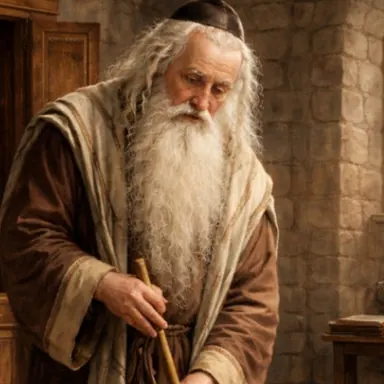
- Sweeping the sanctuary of God: Rabbi Yaakov used to sweep the floor of the study hall in front of the Holy Ark himself.[2, 4] A famous story relates that the young Rashi saw a white-haired old man engaged in this lowly task and was astonished to discover that this was the great head of the yeshiva.[4] Some even went further and said that he would sweep with his beard, a figurative expression of the desire to humble himself before the sanctity of the place.[2]
- Self-effacement: Rashi writes of him with admiration: "He made himself like dust and like a threshold on which everyone treads... and did not wish to take up the crown."[4] Rabbi Yaakov refused to pride himself on original Torah insights and chose to present himself as a mere "teacher of Scripture and Gemara," even though his generation regarded him as the greatest of the halakhic decisors.[4]
- Avoidance of office: when the community leaders asked him to head a delegation to the city's governor, he firmly refused. He argued that his role was not political but religious—to pray for the community—whereas the wealthy and well-connected should use the worldly means at their disposal.[4]
Influence on the Movement of the Ashkenazi Pietists
Rabbi Yaakov's practices were a direct inspiration for the movement of the "Hasidei Ashkenaz" (Ashkenazi Pietists) that arose a century later (Rabbi Shmuel HeChasid and Rabbi Yehuda HeChasid). The ideal of walking humbly, of abstaining from worldly pleasures and of total self-effacement found in Rabbi Yaakov its early and perfect model.[2]
Halakha in Practice: His Rulings and Customs
Despite his reluctance to issue formal rulings, Rabbi Yaakov's halakhic legacy was carefully preserved by his disciples. "Mahzor Vitry," "Sefer HaPardes" and "Sefer HaOrah"—all works that came out of Rashi's study hall—record dozens of cases in which Rabbi Yaakov decided burning questions.
The Episode of the Cow and the Awe of Ruling
A story that illustrates the relationship between authority and humility is the case of the cow that was slaughtered and in whose lung a suspicion of terefah (a disqualifying defect) was found. Rabbi Yaakov's colleague, Rabbi Eliezer the Great, ruled that it was terefah and threw away his share of the meat. Rabbi Yaakov, by contrast, held that it was kosher according to the tradition of his teachers. But when he heard that his colleague had been stringent, he ordered his own share to be thrown away as well, saying: "If such a Torah scholar threw it away, how can I eat it?"[4] This is a clear expression of deference to a colleague's ruling ("halakha ke-haver") and of the primacy of spiritual unity over legal dialectics.
The Question of the Wine and the Merchant
Another case shows his social sensitivity. A wine merchant faced bankruptcy and the loss of his daughter's dowry because of a suspicion of "yayin nesekh" (libation wine: a gentile's contact with the barrels). Rabbi Yaakov agonized over the question, weighed the needs of the hour against the prohibition, and in the end found grounds for permitting it and joyfully blessed the merchant.[4] This ruling shows that his humility was not a flight from responsibility, but a fear of Heaven that obliged him to find true solutions to the suffering of the members of his community.
His Last Days and Historical Legacy
Rabbi Yaakov ben Yakar died in the year 4824 (1064), a few years before Rashi returned to Troyes to establish his own yeshiva.[1, 2, 10] He was buried in the ancient Jewish cemetery of Mainz, the "Judensand," a site of pilgrimage to this day. His tombstone, rediscovered in modern times, is a rare physical remnant of the period in which Ashkenazi Jewry was shaped.[1, 6]
Influence on Later Generations
Rabbi Yaakov's path continued to pulse at the heart of Jewish creativity through two main channels:
- The exegetical channel: Rashi passed on his teacher's teaching to all the Jewish diasporas. Rashi's commentary became the "gateway" to the Torah and the Talmud, and through it the methods of study and the explanations of "Mori HaZaken" were immortalized.[10, 15]
- The moral channel: his image as a "hasid" who effaces himself before the Torah became an ideal for Ashkenazi Jewry throughout the Middle Ages. He is regarded as the quintessential representative of the "tam"—a person wholehearted in his Judaism who needs no outward embellishments.[4]
Beyond Rashi, his other disciples, such as Rabbi Shlomo ben Shimshon and Rabbi Elyakim ben Meshullam, continued to lead the Rhineland communities, thereby ensuring that the destruction of the centers in the wake of the impending Crusades would not erase the Torah that Rabbi Yaakov had labored so hard to plant.[2, 6, 9]
Conclusion: The Hidden Pillar of the World of Torah
Rabbi Yaakov ben Yakar is an example of a personality whose historical importance stands in inverse proportion to the explicit renown of his writings. He chose the path of "transmission" rather than "publicity," of "quiet leadership" rather than "dominion." Without his strenuous preparatory work—the emendation of texts, the refining of interpretations and, above all, the education of Rashi—the world of Torah as we know it today would look entirely different.
His figure teaches that the strength of a tradition is measured not only by the books it leaves behind but by the people it shapes. Rabbi Yaakov ben Yakar, "Mori HaZaken," remains in Jewish memory as a symbol of the perfect union of comprehensive scholarship and absolute humility, a man who lived the words of the prophet "walk humbly with your God" in all their splendor.[2, 4]
Sources15
- 1.יעקב בן יקר - ויקיפדיה, he.wikipedia.org/wiki/יעקב_בן_יקר
- 2.Jacob ben Yakar | Encyclopedia.com, encyclopedia.com/religion/encyclopedias-almanacs-transcripts-and-maps/jacob-ben-yakar
- 3.Untitled, ou.org/judaism-101/bios/leaders-in-the-diaspora/rabbeinu-gershom/#:~:text=His main disciples included Rabbi,by Rashi as “Mori Tzedek%2C
- 4.Rashi - Shulman Writer, shulman-writer.com/rashi.html
- 5.רבי שמעון בן יצחק – ויקישיבה, yeshiva.org.il/wiki/index.php/רבי_שמעון_בן_יצחק
- 6.Yaakov ben Yakar - Wikipedia, en.wikipedia.org/wiki/Yaakov_ben_Yakar
- 7.RABBEINU GERSHOM – ONE MAN ONE WIFE - Kotzk Blog, kotzkblog.com/2019/02/215-rabbeinu-gershom-one-man-one-wife.html
- 8.Gershom, Rabbeinu - Orthodox Union, ou.org/judaism-101/bios/leaders-in-the-diaspora/rabbeinu-gershom/
- 9.JACOB B. YAḲAR - JewishEncyclopedia.com, jewishencyclopedia.com/articles/8466-jacob-b-yakar
- 10.Rashi | History | Research Starters - EBSCO, ebsco.com/research-starters/history/rashi
- 11.הקווים המאפיינים של יהדות אשכנז - ישיבת הר ברכה, yhb.org.il/shiurim/ravzeev5122/
- 12.Pesachim 108b – פסחים קח: – Shas HaMeforash – AlHaTorah.org, shas.alhatorah.org/#!Pesachim/108b
- 13.בשר על גבי גחלים - ויקיפדיה, he.wikipedia.org/wiki/בשר_על_גבי_גחלים
- 14.מחזור ויטרי חלק א - Beurei Hatefila Home, beureihatefila.com/files/Machzor_Vitri_1.pdf
- 15.רבו האהוב של רש"י: סיפור חייו המרתק של רבי יעקב בר יקר - הידברות, hidabroot.org/article/1210715