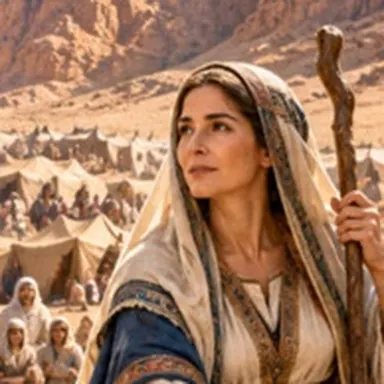
The Figure, Work, and Leadership of Miriam the Prophetess: Biblical, Rabbinic, and Kabbalistic-Hasidic Studies
17 min read3,497 words
Introduction: Foundations of Her Figure and the Historical-Biblical Context
Miriam the Prophetess, daughter of Amram and Jochebed and the elder sister of Aaron and Moses, is one of the most central and influential figures in the history of the people of Israel [cite: 1]. In the tradition of the Sages she is counted among the seven prophetesses who arose for Israel, and her historical and spiritual role extends from the days of the harsh bondage in Egypt to the prolonged journey in the wilderness [cite: 1].
An etymological and homiletical analysis of her name reveals a multilayered complexity that presents the stations of her life and the significance of her work [cite: 1]. In biblical and linguistic scholarship it is conjectured that the origin of the name rests on the ancient Egyptian word mry, meaning "beloved" [cite: 1]. By contrast, in rabbinic literature and in the work "Seder Olam," her name is expounded as an expression of the harsh historical reality into which she was born, from the language of "meirur" (embittering), because at the time of her birth the Egyptians began to embitter the lives of the Children of Israel with crushing labor [cite: 1]. Alongside the passive interpretation, there are homiletical approaches that link her name to the roots of "meri" (rebellion) and "harama" (raising up) [cite: 1]. These roots represent the active and moral rebellion that she led against Pharaoh's decrees, as well as the elevation and the spiritual and leadership exaltation that she reached and that she bequeathed to the entire nation [cite: 1]. Miriam's leadership is characterized by a unique combination of private moral initiative, communal prophecy, and the provision of existential and spiritual infrastructure for the nation [cite: 1, 2, 3].
Early Leadership and Prophetic Boldness in Egypt
The Intergenerational Experience and the Uprising Against Despair
The beginning of Miriam's leadership work is revealed already in her childhood, in the midst of Pharaoh's harsh decree that commanded: "Every son that is born you shall throw into the Nile" [cite: 1]. The Talmud in tractate Sotah describes a weighty theological and leadership confrontation between the young Miriam and her father, Amram, who was the greatest of the generation and its leader [cite: 1]. Out of despair over the cruel decree, Amram came to the conclusion that it was better not to bring any more children into the world, and decided to divorce his wife Jochebed [cite: 1]. As a result of his exalted standing, all the members of the generation stood up and divorced their wives as well, which threatened to cut off completely the continuity of the Hebrew nation [cite: 1].
The young Miriam presented a firm moral position and stood against her father's leadership, hurling at him a piercing argument cited by the Sages, namely, that his decree is harsher than Pharaoh's [cite: 1]. Her position rested on the distinction that Pharaoh decreed only against the males in order to undermine the future strength, whereas her father's decision to decree complete abstinence brings destruction upon the females as well and completely extinguishes the flame of life [cite: 1]. This argument was not merely a moral rebuke but an expression of a profound position of faith that rejects passive thinking and leadership despair [cite: 1]. Following Miriam's sharp words, Amram retracted and took his wife back, and in his wake all the Children of Israel did the same, a step that led directly to the birth of Israel's savior, Moses [cite: 1].
The Identification as a Midwife and the Initial Prophecy
The tradition of the Sages identifies Miriam with "Puah," one of the Hebrew midwives who defied the command of the king of Egypt in a distinct act of civil and moral disobedience [cite: 1]. The homiletical interpretation gives the name "Puah" two complementary layers [cite: 1]. On the practical-human level, she was called Puah because she was "po'ah" – speaking and murmuring to the newborn, in the manner of women who appease a crying baby and calm it at the time of its birth [cite: 1]. On the prophetic-intuitive level, she was called Puah because she was "po'ah" through the Holy Spirit, that is, she prophesied and told her mother that she was destined to bear a son who would save Israel [cite: 1].
This prophetic layer was put to a dramatic test when the decree intensified and Jochebed was compelled to place the infant Moses in an ark at the edge of the Nile [cite: 1, 2]. The Midrash describes that when Moses was placed in the water, Amram slapped Miriam on the head in astonishment and asked where her prophecy was [cite: 1]. In response, Miriam stationed herself at a distance [cite: 1, 2]. This stationing – formulated in the Bible as "And his sister stood afar off, to know what would be done to him" – is not understood in the tradition as passive and helpless waiting, but as an active prophetic stance whose purpose is to observe how the divine prophecy will be realized within the harsh reality [cite: 1, 2]. Her resourcefulness and swift initiative in approaching Pharaoh's daughter to offer his mother as a Hebrew nursemaid attest to political acumen and to an ability to translate the divine miracle into practical human action [cite: 2].
The Three Leaders: The Triple Conception of Leadership and Miriam's Well
The leadership of the wilderness generation is presented in the tradition of the Sages in tractate Ta'anit and in Tosefta Sotah as a three-headed structure composed of the three leaders: Moses, Aaron, and Miriam [cite: 2, 4, 5]. In correspondence with the merits and figures of these three leaders, three existential gifts were granted to the Children of Israel, which accompanied the people on their journey [cite: 2, 4, 5].
| Leader | The Miraculous Gift | The Essence of the Leadership and Its Functional Level | Social and Spiritual Influence |
|---|---|---|---|
| Moses our Teacher | The manna [cite: 2, 4, 5] | Sublime, constitutional, and Talmudic leadership; drawing down the Torah and the law from heaven [cite: 3] | Existential spiritual nourishment, shaping the identity of the collective, and theological abstraction [cite: 3] |
| Aaron the High Priest | The Clouds of Glory [cite: 2, 4, 5] | Institutional mediation, conciliation, and bridging; establishing peace between a man and his fellow [cite: 3] | Encompassing protection, the sanctity of the Tabernacle, and social inclusion [cite: 3] |
| Miriam the Prophetess | Miriam's Well [cite: 2, 4, 5] | Grassroots communal leadership, concern for foundational infrastructure, social cohesion, and leading religious emotion [cite: 3] | Basic existential welfare, an experiential echo of the miracle, and communal mobilization [cite: 2, 3] |
This leadership structure presents an organic and complete division of roles [cite: 3]. Whereas Moses represents the law and the heavenly nature of revelation, and Aaron represents the cultic and conciliatory system, Miriam represents the deep communal and existential infrastructure [cite: 3].
The Midrash of the Sages notes that upon Miriam's death in Kadesh, the channel of the well was withdrawn ("the well was withdrawn"), and the Children of Israel were left without water [cite: 2, 4, 5]. This event caused an infrastructural collapse that led to the severe leadership crisis at the Waters of Meribah [cite: 4, 5]. Miriam's absence exposed the fact that without the empathic, everyday, and nourishing infrastructure she provided, the exalted leadership of Moses and Aaron encountered difficulty in communicating with the basic distress of the people, which led to the striking of the rock [cite: 3, 4].
From the Kabbalistic and midrashic perspective, Miriam's Well is not merely a physical source of water but a portable spring that accompanied Israel on all their journeys [cite: 1, 2]. The sources note different traditions regarding the place where the well was hidden after the entry into the Land: in the Jerusalem Talmud and in Midrash Rabbah it is stated that it was hidden within the Sea of Tiberias (the Sea of Galilee), whereas in the Babylonian Talmud they hold that it is located in the Mediterranean Sea opposite Mount Carmel [cite: 1].
Miriam's Song and the Consciousness of Faith: Studies in Hasidism and Kabbalah
Early Faith and the Preparation of the Vessels
The splitting of the Red Sea is the culminating point of Miriam's prophetic and faith expression [cite: 2]. The Book of Exodus describes that after the Song of Moses, "And Miriam the prophetess, the sister of Aaron, took the timbrel in her hand; and all the women went out after her with timbrels and with dances" [cite: 1, 2].
Hasidic interpretation emphasizes a central textual fact already noted by Rashi, according to which the women did not happen to find timbrels at the moment of the miracle, but were confident, against all odds, that the Holy One, blessed be He, would perform miracles for them, and therefore prepared and brought timbrels with them out of Egypt [cite: 2]. The book "Sefat Emet" explains that whereas the song of the men ("Then Moses sang") arose as a reflection and reaction after the visible miracle occurred, the faith of Miriam and the women was so absolute, tangible, and clear that they prepared the musical instruments even in the midst of the bondage and the darkness [cite: 6, 7]. This is a level of faith that sees the future salvation as present in the present and prepares for it in advance the physical vessels [cite: 6, 7].
The Secret of the Returning Light and Itaruta de-Letata (Arousal from Below)
In Kabbalistic and Hasidic writings – in particular in Chabad teachings and in the writings of Rabbi Ze'ev Wolf of Zhitomir – it is explained that at the splitting of the Red Sea the women, led by Miriam, attained a unique level of consciousness [cite: 2, 8].
| Model of Consciousness | The Song of Moses and the Men | The Song of Miriam and the Women |
|---|---|---|
| Kabbalistic category | Direct Light (drawing down from above to below) [cite: 8] | Returning Light (arousal from low to high) [cite: 8, 9] |
| Spiritual mechanism | Itaruta de-Le'ela (arousal from above in response to the miracle) [cite: 2, 8] | Itaruta de-Letata (initiative, toil, and preparation of the vessels from below) [cite: 2, 8] |
| Nature of the vessel | Verbal and spoken expression (song by mouth) [cite: 8] | A combination of body, musical instrument (timbrel), and movement (dance) [cite: 2, 8] |
| Sweetening of the judgments | Drawing down of direct kindness [cite: 2] | Transmutation of the attribute of judgment and turning "the Rock" into mercy [cite: 2] |
The timbrel ("HaTof") symbolizes in Kabbalah the power of constriction and judgment [cite: 2, 9]. Through the active performance of playing and dancing, Miriam turned the attribute of judgment into mercy and raised the Divine light from below to above ("Returning Light") [cite: 2, 8, 9]. This dynamic opened the way to a future spiritual conception in which the aspect of Malkhut (the Nukva) is elevated to its peak and completes the Divine revelation in the world [cite: 8, 9].
The Episode of Miriam's Leprosy and the Issue of Evil Speech
The Events at Hazeroth and the Essence of the Sin
The Book of Numbers recounts, in the portion Beha'alotekha, the incident in which Miriam and Aaron spoke against Moses "concerning the Cushite woman whom he had taken" [cite: 1, 10]. Analysis of the verses and the midrashim teaches that Miriam saw that Zipporah, Moses' wife, had been wronged by his abstaining from marital relations [cite: 11]. Miriam, out of deep compassion for Zipporah and concern for the wholeness of the family, turned to consult with Aaron [cite: 11]. Their claim was that the Lord had spoken also with them, and nevertheless they were not required to abstain from family life [cite: 1, 10, 11].
The Sages and the commentators emphasized that Miriam's intention was for the sake of Heaven and for the good of her brother [cite: 11, 12, 13]. She did not speak disparagingly of Moses before many, nor even in his presence so as not to embarrass him, but discreetly, between herself and Aaron [cite: 12, 13, 14, 15]. Her critical error lay in not understanding Moses' unique prophetic level – direct prophecy "mouth to mouth" that requires constant availability before the Divine Presence and complete abstention from the corporeal, unlike all the other prophets, who prophesy in dreams and riddles [cite: 10, 11, 16].
The Interpretive and Halakhic Dispute: Maimonides (Rambam) Versus Nahmanides (Ramban)
The incident of Miriam's leprosy became a central moral and halakhic foundation in the rules of guarding one's speech [cite: 11, 14, 15]. Nevertheless, the great halakhic authorities differed regarding the normative and legal focus of this act [cite: 14, 15].
Maimonides (Rambam), at the end of the Laws of the Defilement of Leprosy, regards the leprous plague as a sign and wonder that is not part of the natural course of the world, intended to warn a person against evil speech [cite: 11, 16, 17]. Maimonides incorporates the incident of Miriam as a pedagogical a fortiori (kal va-chomer) argument [cite: 11, 16]. He instructs one to contemplate what happened to Miriam the prophetess, who spoke about her brother, though she was older than he, raised him on her knees, and endangered her life to save him, and nevertheless was immediately punished with leprosy because she erred and equated him with the other prophets [cite: 15, 16]. From this Maimonides derives a piercing a fortiori argument concerning people who speak disparagingly of their fellows [cite: 15, 16]. Maimonides did not count remembering the incident of Miriam as a separate positive commandment in his enumeration of the 613 commandments, but saw it as part of the prohibition of gossip and a general guidance to distance oneself from the speech of the wicked [cite: 14, 15, 16, 17].
In contrast, Nahmanides (Ramban), in his glosses to the Sefer HaMitzvot, determines that the verse "Remember what the Lord your God did to Miriam" constitutes a full positive biblical commandment (mitzvat aseh de-oraita) to remember orally and to take to heart the incident of Miriam [cite: 14, 15, 18]. In his view, this commandment parallels the commandments of remembering the Sabbath, remembering the Exodus from Egypt, and remembering what Amalek did [cite: 14, 15, 18].
The book "Shemirat HaLashon" ("Guarding the Tongue") breaks down the pedagogical structure of the commandment of remembering, according to Nahmanides, into four essential components [cite: 13, 14]. The first component is contemplation of "what was done," that is, of the severity of the punishment of leprosy and isolation [cite: 13, 14]. The second component is contemplation of "to whom it was done," namely, to a righteous woman as exalted as Miriam, whose good deeds did not protect her once she stumbled in speech [cite: 13, 14]. The third component is contemplation of "in what place," "on the way," to teach that the punishment was not delayed until they reached an encampment but was carried out immediately so that others would hear and fear [cite: 13, 14]. The fourth component is contemplation of "at what time," "when you came out of Egypt," in the midst of a time of favor and of great miracles [cite: 13, 14]. Analysis of these four details reveals that if a righteous woman like Miriam was punished so severely for speaking discreetly and for a good purpose, then an ordinary person who speaks disparagingly of his fellow in public will be punished by a fortiori reasoning [cite: 12, 13, 14, 15].
Miriam's Honor and the Delay of the Camp
Alongside the punishment, the Torah highlights Miriam's special standing and honor [cite: 13, 19]. Although she was stricken with leprosy and confined outside the camp for seven days, the entire people accorded her unprecedented honor, as it is said, "and the people journeyed not until Miriam was brought in again" [cite: 13, 19]. The entire camp, numbering six hundred thousand men, halted its progress in the wilderness and waited for her purification [cite: 13, 19]. The Sages explain that this delay was a divine reward measure for measure: just as Miriam waited for one hour at the bank of the Nile to see what would be done to Moses [cite: 1, 2], so God halted the clouds and the entire camp for seven days until Miriam was brought in [cite: 13, 19].
Her Death, Legacy, and Memory in Tradition
Miriam died in Kadesh in the wilderness of Zin [cite: 1, 5]. According to Seder Olam, Megillat Ta'anit Batra, and the Targum attributed to Jonathan, the date of her death falls on the 10th of Nisan, in the fortieth year after the Exodus from Egypt [cite: 1]. Like her brothers Aaron and Moses, Miriam died a "death by a kiss," by the mouth of the Lord [cite: 1]. The Sages note that the expression "by the mouth of the Lord" was not written explicitly regarding her, as it was written regarding Moses and Aaron, out of respect for the Divine Presence [cite: 1].
The exact place of her burial remained hidden [cite: 1]. The historian Josephus Flavius brings a tradition according to which she was buried on a rocky mountain near Petra [cite: 1]. Until the fourth century CE there were still testimonies of pilgrimage to this area, but this tradition was forgotten over the years [cite: 1].
Halakhic and customary interpretation preserved her memory on a daily basis [cite: 15]. In many prayer books, the passage on remembering the incident of Miriam was printed as part of the "six remembrances" recited every day after the morning prayer [cite: 15]. The Magen Avraham explains that the reason they did not institute a special public reading from the Torah scroll for the remembrance of Miriam (as they did for the portion of Amalek) is out of preserving the honor of Miriam the righteous, and therefore one fulfills the obligation through the annual reading of the portions Beha'alotekha and Ki Teitzei [cite: 15]. Likewise, according to the Ari, one should have in mind, in the blessing "Ahavah Rabbah," at the words "to thank You," the commandment of remembering the incident of Miriam – to recall that a person's mouth was created in order to give thanks and to unify the Name, and not to speak evil speech with it [cite: 14, 15].
Summary and Conclusions
The work and Torah legacy of Miriam the Prophetess constitute a multidimensional conceptual and leadership foundation in the Jewish tradition [cite: 1, 2, 3]. Her leadership grew out of active resistance to decrees of erosion and despair, combining prophetic boldness toward the leadership of her parents and the Egyptian monarchy with practical resourcefulness that led to the rescue of Israel's savior [cite: 1, 2]. As part of the triad of wilderness leadership, Miriam provided the social and existential infrastructure of the people, embodied in her miraculous well [cite: 2, 3, 4, 5]. Her absence upon her death exposed the deep dependence of the collective on her empathic leadership [cite: 3, 4].
Her unique theological contribution was expressed in leading the women in the Song at the Sea, a song that relied on timbrels prepared in advance in the depths of the bondage and that represents the level of the "Returning Light" and of "Itaruta de-Letata" – faith that bursts forth from below and sweetens the judgments [cite: 2, 6, 7, 8, 9]. Alongside this, the story of her leprosy became a moral and halakhic archetype for the gravity of evil speech, as her exalted standing and the fact that she was punished even though her intention was good establish the duty of guarding one's speech as a pillar of Jewish ethics throughout the generations [cite: 11, 14, 15, 16].
Sources19
- 1.מרים הנביאה - ויקיפדיה, he.wikipedia.org/wiki/מרים_הנביאה
- 2.מרים | מקורות מתוך ספריית ספריא, sefaria.org.il/topics/miriam
- 3.שלושה מימדים של מנהיגות, בלתי נפרדים - בינ"ה - הבית של היהדות הישראלית, bina.org.il/articles/leadership/
- 4.באורי אגדות תענית - מכון הלכה ברורה, halachabrura.org/agada/taanit09.htm
- 5.The Three Gifts in the Wilderness | האוסף של ספריא, sefaria.org.il/Sheet.8332
- 6.ההודאה קודם הישועה במשנתם של גדולי החסידות, rambish.org.il/journals/h/heichel_habesht/vol035/heichel_habesht_03581.pdf
- 7.טוב להודות - Kol Halashon, kolhalashon.com/PDF/Shiurim/34478/34478803.pdf
- 8.נפילתה ועלייתה של השכינה, nirmenussi.com/wp-content/uploads/2012/05/nefilata_pp1-45.pdf
- 9.זהר בהעלותך - Sifrei Meir Panim of Yehoshua Lifschitz, sifrei-meir-panim.com/wp-content/uploads/2021/05/זהר-בהעלותך.pdf
- 10.צרעת מרים - ויקיפדיה, he.wikipedia.org/wiki/צרעת_מרים
- 11.חומרת לשון הרע | הרה"ג זלמן ברוך מלמד שליט"א | בית המדרש - אתר ישיבה, yeshiva.org.il/midrash/49508
- 12.קטגוריה:דברים כד ט - ויקיטקסט, he.wikisource.org/wiki/קטגוריה:דברים_כד_ט
- 13.העמקה וביאור במצוות זכירת מרים - הללויה - פורטל היהדות והתורה | תהילים, הלכה ושיעורים, haleluya.co.il
- 14.פרשת כי תצא – שמירת הלשון – (פירוש הרמב"ן) - עולמות, olamot.net/shiurim/שמירת-הלשון/
- 15.זכירת מעשה מרים - ויקיפדיה, he.wikipedia.org/wiki/זכירת_מעשה_מרים
- 16.HebrewBooks.org - רמב"ם הלכות טומאת צרעת פרק טז הלכה י - פ' אור הישר, hebrewbooks.org/rambam.aspx?mfid=5763&rid=10283
- 17.לשון הרע - מרכז מורשת הרמב''ם, harambam.org.il/parashat-hashavua/לשון-הרע/
- 18.לזכור את מרים | הרב יובל שרלו | בית המדרש - אתר ישיבה, yeshiva.org.il/midrash/49937
- 19.זכור את אשר־עשה ה' אלהיך למרים בדרך בצאתכם ממצרים: ס (דברים פרק כד פסוק ט), mgketer.org/tanach/5/24/9