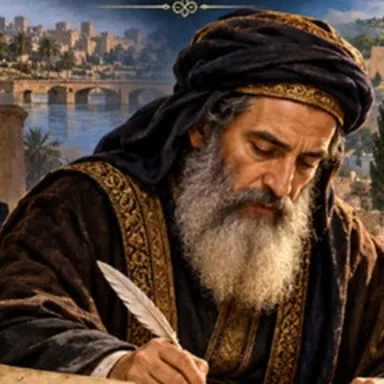
The Work, Torah Teaching and Legacy of Rav Achai Gaon of Shabha: A Historical, Textual and Halakhic Study
19 min read3,727 words
His Life, His Era and the Historical Background
Rav Achai of Shabha, one of the great sages of Babylonia in the first half of the eighth century (around the years 680–752 CE), was active in a formative period in Jewish history that historians and halakhic authorities define as the beginning of the geonic period [cite: 1, 2, 3, 4, 5, 6]. This era was marked by a clear historical transition from the concluding redaction of the Babylonian Talmud and from oral memorization, toward the beginning of written halakhic creativity and the editing of a literature that launches independent codices [cite: 5, 6, 7, 8, 9]. The dramatic geopolitical changes that took place in the Levant following the spread of the Islamic Caliphate created a new reality in which the Babylonian center sought to secure its supremacy and the uniformity of halakha throughout the Jewish dispersions [cite: 10, 11].
The center of Rav Achai's Torah activity in Babylonia was the Pumbedita yeshiva, where he was regarded as one of the leading reishei sidra ("heads of the rows") and sages [cite: 1, 2, 3, 11]. Rav Achai's life was marked by a dramatic institutional and political event in the world of the yeshivot: upon the death of the head of the Pumbedita yeshiva around the year 748 CE (4508), Rav Achai was the most outstanding, recognized and fitting candidate, by every Torah criterion, to be appointed Gaon of the yeshiva [cite: 3, 12]. However, because of a personal conflict and enmity that arose on the part of the exilarch of the time, Solomon bar Chasdai, the administrative power of the exilarch was used to disqualify Rav Achai from the office [cite: 3, 12]. In his place the exilarch appointed to the exalted position Rav Natronai Kahana bar Rav Amunah, who had been Rav Achai's disciple and attendant and was inferior to him in wisdom and merit [cite: 3, 12].
The blow to Rav Achai's standing and the diversion of the institutional appointment led to an unprecedented reaction on his part. Rav Achai decided to abandon his center of power in Babylonia and to move his residence to the Land of Israel around the years 750–753 CE (approximately 4508–4513) [cite: 3, 8, 12, 13]. This move from Babylonia to the Land of Israel brought back to the forefront the geographic and Torah connection between the two spiritual centers, and had a profound influence on the transmission of the Babylonian traditions of learning to the Land of Israel and on their dissemination throughout the Land of Israel [cite: 8, 11]. Rav Achai settled in the Land of Israel and was active there until the day of his death [cite: 3, 8].
The title "Gaon" attached to the name of Rav Achai of Shabha in later literature is a conceptual honorific and not an official institutional appointment [cite: 3, 4]. Since he was not in fact appointed to head either of the two great yeshivot of Babylonia (Sura or Pumbedita), his standing as a "Gaon" derived solely from his absolute Torah authority, from the esteem of his contemporaries and of the generations to come, and from his revolutionary work [cite: 3, 4, 7]. As for the origin of the epithet "Mishabcha," scholarship and the interpretive tradition propose two main paths: a geographic attribution to a city or region named Shabha (Shabḥa) in the vicinity of Nehardea and Pumbedita [cite: 3, 14], or an honorific derived from the Aramaic root sh-b-ch, meaning "the excellent sage" or "the celebrated one," as an expression of the immense esteem he enjoyed among the sages of the generation [cite: 3, 15, 16].
His Teachers, His Disciples and the Study-Hall Environment
Rav Achai of Shabha's Torah development drew nourishment from the Pumbeditan study hall, in which his Torah was shaped at the feet of the great figures of the yeshiva of the eighth century [cite: 1, 2, 12]. As the historical sources attest, Rav Achai's distinguished teacher and master was the head of the Pumbedita yeshiva who served until the year 4508 (748 CE), as, for example, Rav Mar bar Rav Shmuel [cite: 3, 12]. In this learning environment Rav Achai absorbed the complex traditions of talmudic discussion and the oral methods of halakhic ruling that were customary in the yeshivot of Babylonia before they were put into writing in a systematic way [cite: 5, 6, 9].
Rav Achai's relationship of learning with his disciples reflects the institutional complexity of his period. His most prominent disciple in Babylonia was Rav Natronai Kahana bar Rav Amunah, who grew up in Rav Achai's study hall and was subordinate to him in study and in serving sages [cite: 3, 12]. Although Natronai was appointed to the gaonate as a result of the political moves of the exilarch Solomon bar Chasdai – an appointment that caused Rav Achai's withdrawal to Babylonia – historiography has shown that Rav Achai's scholarly and talmudic standing remained absolutely superior to that of his disciple [cite: 3, 12].
With Rav Achai's ascent to the Land of Israel, a circle of local disciples and sages formed around him, who sought to learn the Babylonian tradition from his mouth [cite: 8, 11]. His presence in the Land of Israel made him a central conduit of the Babylonian Talmud, and his teaching was studied diligently by the sages of the Land of Israel [cite: 8, 11]. His influence on his disciples in the Land of Israel was evident in the introduction of the Babylonian methods of discussion into the local homiletical and halakhic creativity, creating a connection between the different communities [cite: 8, 10, 11].
A Historiographical Distinction: Between Rav Achai of Shabha and Rav Achai the Savora
In talmudic and post-talmudic literature there is extensive discussion of the question of the identity of the "Rav Achai" mentioned in the Babylonian Talmud, and of the generational relationship between the various sages who bore this name [cite: 14]. In the Babylonian Talmud the distinctive expression "parich Rav Achai" ("Rav Achai objects"), and sometimes "pashit Rav Achai" ("Rav Achai resolves"), appears in dozens of places, mainly in discussions that conclude talmudic passages [cite: 14]. In the words of the Tosafists in tractate Ketubot (2b), the opinion of Rabbenu Shmuel (the Rashbam) is cited, who held that the Rav Achai mentioned in the Talmud is none other than Rav Achai of Shabha, author of the "She'iltot" ("Questions"), who was among the Savoraic sages close to the closing of the Talmud, and for that reason his words and objections were inserted directly into the body of the talmudic text [cite: 14].
However, modern talmudic and historical scholarship, together with parallel scholars, distinguishes unequivocally between the two figures [cite: 14]. Rav Achai the Savora was active at the beginning of the sixth century (around the years 500–515 CE) and was among the sages of the first and second generations of the Savoraim, such as Rav Achai bar Rav Huna (who died in the year 506 or 515 CE) or Rav Achai the son of Rabbah bar Avuha (who died in the year 510 CE) [cite: 14]. By contrast, Rav Achai of Shabha, author of the She'iltot, lived and was active in the middle of the eighth century, about two hundred years after the closing of the Babylonian Talmud [cite: 3, 4, 8, 14].
A clear example of Rav Achai's standing among the sages of the Land of Israel is brought in the talmudic discussion of the "izza karkuz" (a species of animal about which there is doubt whether it is a domesticated animal or a wild animal with regard to the prohibition of eating forbidden fat, chelev) [cite: 14]. When the question was directed from the Land of Israel to Babylonia, Rav Shmuel ruled leniently, but the sages of the Land of Israel sent a respectful warning: "Be careful with Rabbenu Achai, for he illuminates the eyes of the Diaspora" [cite: 14]. This statement reflects the fact that Rav Achai was regarded in the eyes of his contemporaries – both in Babylonia and in the Land of Israel – as a supreme halakhic authority whose positions should not be belittled [cite: 14].
| Criterion of comparison | Rav Achai the Savora | Rav Achai of Shabha (author of the She'iltot) |
|---|---|---|
| Period of activity | Beginning of the 6th century (around 500–515 CE) [cite: 14] | 8th century (around 680–752 CE) [cite: 1, 3, 4] |
| Historical and biographical identification | Rav Achai bar Huna / Rav Achai the son of Rabbah bar Avuha [cite: 14] | A sage of the Pumbedita study hall who went up to the Land of Israel [cite: 1, 3, 12, 13] |
| Main appearance in the sources | Babylonian Talmud ("parich Rav Achai," "pashit Rav Achai") [cite: 14] | The book "She'iltot," the literature of the Geonim and the Rishonim [cite: 3, 5, 7, 8] |
| Nature of Torah activity | Glossing, formulating concluding objections and editing the talmudic passages [cite: 14] | Author of the first halakhic-homiletical work after the Talmud [cite: 5, 7, 8] |
| Position of scholarship and halakhic ruling | A Savoraic sage whose words were inserted into the Babylonian Talmud [cite: 14] | An independent Babylonian Gaon active in the post-talmudic period [cite: 3, 4, 8, 14] |
The Book She'iltot: Literary Genre, Architectural Structure and Pedagogical Methodology
The book "She'iltot de-Rav Achai" is the first complete Torah work that was written and has been preserved after the closing of the Babylonian Talmud [cite: 5, 7, 8]. The work was written in Babylonian Aramaic and contains about 190 independent units (she'iltot) [cite: 5, 6, 8]. The she'ilta is not merely a pure halakhic response, but a literary-pedagogical genre of public sermon delivered on Sabbaths and festivals before the broad public [cite: 5, 6, 7, 8, 9]. These sermons were intended to bridge between the complex and abstract talmudic discussion and the practical and moral world of the average person [cite: 5, 6, 7, 8, 9].
Every she'ilta in the book is built in a defined and fixed four-stage structure, composed of halakhic, moral and aggadic components [cite: 5, 6, 7, 9]. The discussion opens with the presentation of a commandment from the weekly Torah portion or a current halakhic topic, defining the obligation of the commandment in general terms ("Demimchayvim devei Yisrael…," that is, "that those of the House of Israel are obligated…") and explaining its reason or its basis in Scripture [cite: 5, 6, 7, 9]. Afterward the preacher presents a specific legal or practical question arising from the commandment, opening with the fixed idiom: "Barem tzarikh lemeimar…" (but it is necessary to say / to inquire), which presents a halakhic doubt that is not stated explicitly in Scripture [cite: 5, 6, 7, 9].
While the audience awaited the decision of the question, the preacher moved on to the third part, which includes a broad public sermon combining aggadic sayings, fear of Heaven, moral duties, honoring parents, giving charity and keeping the truth [cite: 5, 6, 7, 8, 9]. This part served as an educational and moral respite for the audience while the preacher prepared the legal answer [cite: 5, 6, 7, 8, 9]. At the end of the sermon the preacher returned to the original question and provided a short and clear halakhic ruling, opening with the idiom: "Ule'inyan she'ilta deshe'ilna kamaikhon… dekhakh asikna / dekhakh chazina" (and regarding the question that was asked before you… thus we concluded / thus we saw) [cite: 5, 6, 7, 9].
| Part of the she'ilta | Definition and main content | Typical opening wording | Pedagogical and normative function |
|---|---|---|---|
| 1. The halakhic opening | Presentation of the general obligation of the commandment from the Torah portion [cite: 5, 7, 9] | "Demimchayvin devei Yisrael…" ("that those of the House of Israel are obligated…") [cite: 5, 7, 9] | Establishing the scriptural source and the norm [cite: 5, 7, 9] |
| 2. The she'ilta (the question) | Raising the practical legal doubt [cite: 5, 7, 9] | "Barem tzarikh lemeimar…" ("but it is necessary to say…") [cite: 5, 7, 9] | Stimulating study and developing the discussion [cite: 5, 7, 9] |
| 3. The sermon and the aggadah | A collection of sayings on morals, aggadah and character traits [cite: 7, 8, 9] | "Berikh shemeih dekudsha berikh hu…" ("Blessed be the name of the Holy One, blessed be He…") [cite: 7, 8] | Educating the audience and connecting halakha with morality [cite: 7, 8] |
| 4. The halakhic answer | A short and final halakhic ruling [cite: 5, 7, 9] | "Ule'inyan she'ilta deshe'ilna… dekhakh chazina" ("and regarding the question that we asked… thus we saw") [cite: 5, 7, 9] | A practical decision for practice [cite: 5, 7, 9] |
His Halakhic and Interpretive Method
The halakhic teaching of Rav Achai of Shabha is characterized by a unique combination of the sacred preservation of the Babylonian talmudic tradition with independent interpretive analysis and practical ruling [cite: 5, 6]. Rav Achai saw the Babylonian Talmud as the supreme and exclusive authority for halakhic ruling, and the language of the work, its style and its manner of analyzing passages draw directly from the talmudic Aramaic of the Sura and Pumbedita yeshivot [cite: 5, 6]. Alongside the explicit talmudic sources, Rav Achai incorporated into his work anonymous interpretive traditions that were current orally in the yeshivot of the Geonim in his time, and thereby put into writing elements of the Oral Torah that had not been documented before [cite: 5, 6].
In contrast to later halakhic codices that focused on dry rules of law, Rav Achai's method regards halakha as an inseparable part of man's moral perfection [cite: 5, 6, 7, 8, 9]. In his book a central place is devoted to the duties of the heart and to social conduct – such as the prohibition of malicious speech (lashon hara), the duty to love truth, acts of loving-kindness and honoring father and mother – as an inseparable part of the Torah's commandment [cite: 8]. This integration gave his rulings a deep moral dimension, in which the observance of legal halakha is nourished by the duty of refining one's character traits [cite: 7, 8].
Although the She'iltot appear at first glance to be a simplistic presentation of known halakhot, the deep student finds in them far-reaching interpretive and halakhic innovations [cite: 5, 6]. These innovations are often embedded covertly in the wording of the answer or in the way the question is presented [cite: 5, 6]. Rav Achai at times alters the accepted talmudic position through subtleties of wording, or by deciding between differing opinions in the Talmud that were not explicitly decided in the body of the passage [cite: 5, 6].
Talmud scholars have pointed out that following Rav Achai's ascent to the Land of Israel, Land-of-Israel midrashim (such as Leviticus Rabbah, Ecclesiastes Rabbah and Tanchuma) seeped into his work, as did linguistic usages characteristic of Land-of-Israel Aramaic [cite: 8]. Nevertheless, on the plane of halakhic ruling Rav Achai remained absolutely faithful to Babylonian halakha, and was one of its prominent representatives who imparted the supremacy of the Babylonian Talmud over the ancient Land-of-Israel tradition [cite: 5, 6, 10, 11].
Influence, Reception of the Work and the Legacy of Study Across the Generations
The book "She'iltot" attained a formative standing in the history of halakha and exerted a decisive influence on all the ruling literature that came after it [cite: 5, 6, 7, 8, 9, 10, 11]. In the geonic period, the book "Halakhot Pesukot," attributed to Rav Yehudai Gaon (head of the Sura yeshiva), and the book "Halakhot Gedolot" (Behag) by Rabbi Shimon Kayyara relied extensively on the legal analyses and rulings brought in the She'iltot [cite: 2, 5, 6, 9, 10, 11]. The work became a foundation stone for the editors of the first codices, who drew from it both the evidentiary material and the methods of decision [cite: 5, 9, 11].
In the period of the Rishonim, the She'iltot served as a primary source for the greatest sages of the Middle Ages [cite: 3, 5, 8, 17]. Rav Sherira Gaon, Rav Hai Gaon, Rashi, the Rashbam, the Tosafists, Rabbi Yitzchak Alfasi (the Rif), Maimonides (Rambam) and Nahmanides (Ramban) frequently cite the She'iltot [cite: 3, 5, 8, 17]. The "Arukh" of Rabbi Nathan of Rome draws many linguistic and interpretive entries from the She'iltot [cite: 8]. The greatest of the Rishonim regarded the text of the Talmud preserved in the She'iltot as an exact and ancient version, reflecting the reading of the early Babylonian yeshivot, and used it to emend corrupted readings in the passages of the Talmud [cite: 8].
Over the generations comprehensive commentaries were written on the book She'iltot, which made it a permanent asset of Torah study. The commentary "Sheelat Shalom" by Rabbi Yeshayahu Pick Berlin (1786) offered a short explanation, textual emendations and talmudic sources [cite: 5, 8, 13, 18]. Later, the commentary "Ha'amek Sheela" by Rabbi Naftali Tzvi Yehuda Berlin (the Netziv of Volozhin), written and printed in Vilna (1861–1867), constituted the high point in the interpretation of the work [cite: 5, 6, 19, 20, 21]. This commentary, accompanied by its famous introduction "Kadmat HaEmek," offers a deep scholarly, philological and halakhic analysis that interprets Rav Achai's words according to its own talmudic approach [cite: 5, 6, 19, 20, 21, 22, 23].
In the 20th and 21st centuries the book She'iltot became a central focus of academic research on the literature of the Geonim [cite: 5, 8, 24, 25]. Prof. Shmuel Kalman Mirsky published a critical edition in 5 volumes, including textual variants according to ten manuscripts [cite: 5, 18, 24, 25]. In his wake, Prof. Yerachmiel (Robert) Brody, in his book "Letoldot Nusach HaShe'iltot" ("On the History of the Text of the She'iltot," 1991), carried out a textual-stemmatic analysis of the manuscripts and proved that the textual witnesses of the She'iltot divide into two main branches: branch A, which includes most of the manuscripts (which have a common ancestor), and, by contrast, branch B, represented by the "Sassoon manuscript" [cite: 5, 8].
| Type of work / edition | Author / editor | Year of publication / printing | Torah and scholarly features |
|---|---|---|---|
| First printed edition | Venice printing [cite: 5, 8, 26] | 5306 (1546 CE) [cite: 5, 8, 26] | The basic printed text of the book [cite: 5, 8, 26] |
| Sheelat Shalom | Rabbi Yeshayahu Pick Berlin [cite: 5, 8, 13, 18] | Dyhernfurth, 1786 CE [cite: 5, 8, 13, 18] | Short explanation, source references and textual emendations [cite: 5, 8, 13, 18] |
| Ha'amek Sheela / Kadmat HaEmek | The Netziv of Volozhin [cite: 5, 6, 19, 20, 21] | Vilna, 1861–1867 CE [cite: 5, 6, 19, 20, 21] | Comprehensive and deep commentary, historical and scholarly analysis [cite: 5, 6, 19, 20, 21, 23] |
| Critical edition | Prof. Shmuel Kalman Mirsky [cite: 5, 18, 24, 25] | 5720–5737 (1960–1977) [cite: 5, 18, 24, 25] | Comparison of ten manuscripts, introductions and notes [cite: 5, 18, 24, 25] |
| Research on the history of the text | Prof. Yerachmiel (Robert) Brody [cite: 5, 8] | 5752 (1991 CE) [cite: 5, 8] | Textual analysis, text branches and critique of the Sassoon manuscript [cite: 5, 8] |
Summary and Conclusions
The work and legacy of Rav Achai of Shabha constitute a cornerstone in the history of halakha and of Jewish literature [cite: 5, 6, 7, 8, 9]. As a sage who worked at the historical and spiritual seam between the period of the Savoraim and the period of the Geonim, and who personally experienced the transition from the center of Torah in Babylonia to the Land of Israel, he succeeded in shaping a primary, groundbreaking Torah work [cite: 1, 2, 3, 5, 6, 7, 8, 12, 13].
The book "She'iltot" laid the methodological foundation for the post-talmudic literature of halakhic ruling and homiletics [cite: 5, 6, 7, 8, 9]. Through the unique architectural structure of the she'ilta, Rav Achai succeeded in uniting the depth of the talmudic legal discussion with the education of the broad public in the values of morality, fear of Heaven and observance of the commandments [cite: 5, 6, 7, 8, 9].
The legacy of Rav Achai continues to be a central subject in yeshiva learning and in critical talmudic research [cite: 5, 6, 8, 19, 20, 25]. His rulings, his textual versions and his interpretive method continue to serve as a conduit for the pure talmudic tradition from generation to generation [cite: 5, 6, 8, 10, 11].
Sources26
- 1.חכמי בבל – ערוץ התורה – הרב יוסף שובלי, daily-torah.tv/tag/חכמי-בבל/
- 2.הלכה - ויקיפדיה, he.wikipedia.org/wiki/הלכה
- 3.Ahai of Shabha - Wikipedia, en.wikipedia.org/wiki/Ahai_of_Shabha
- 4.Achai Gaon | Texts from the Sefaria Library, sefaria.org/topics/achai-gaon
- 5.שאילתות דרב אחא - ויקיפדיה, he.wikipedia.org/wiki/שאילתות_דרב_אחא
- 6.שאילתות דרב אחאי גאון ג' כרכים - ספרי חיים, hbooks.co.il/product/שאילתות-דרב-אחאי-גאון-ג-כרכים
- 7.The Sefaria Library - Sheiltot d'Rav Achai Gaon, sefaria.org/Sheiltot_d'Rav_Achai_Gaon
- 8.She'iltot - Wikipedia, en.wikipedia.org/wiki/She'iltot
- 9.אנציקלופדיה יהודית דעת - גאונים, ספרות הגאונים ;, daat.ac.il/encyclopedia/value.asp?id1=50
- 10.גנזים בכריכות ספרים, magnespress.co.il/FileManager/Files/zion.pdf
- 11.דברי ימי עם עולם: כרך שלישי: מחורבן יהודה עד ירידת מרכזי המזרח / שמעון דובנוב / ברוך קרוא, benyehuda.org/read/16644
- 12.סדר הדורות הקצר - Portal Daf Yomi, files.daf-yomi.com/files/bookfiles/seder-hadorot-hakatsar/seder-hadorot-hakatsar.pdf
- 13.מחלקת רב סעדיה גאון ובן מאיר / חיים יחיאל בורנשטיין - פרויקט בן־יהודה, benyehuda.org/read/34348
- 14.רב אחאי - ויקיפדיה, he.wikipedia.org/wiki/רב_אחאי
- 15.פירוש הרקאנאטי על התורה, hebrew.grimoar.cz/rekanati_al_ha-torah.html
- 16.ראשית חכמה, שער האהבה י׳ | האוסף של ספריא, sefaria.org.il/Reshit_Chokhmah,_Gate_of_Love.10
- 17.פסקי הלכות עד ל"שולחן ערוך" / הרב מרדכי פוגלמאן, daat.ac.il/he-il/kitveyet/sinai/fogelman-piskey.htm?printview=true
- 18.ספריה וירטואלית - הלכה - ראשונים - מכון הלכה ברורה, halachabrura.org/library/library8b.htm
- 19.נפתלי צבי יהודה ברלין - ויקיפדיה, he.wikipedia.org/wiki/נפתלי_צבי_יהודה_ברלין
- 20.העמק שאלה על שאילתות דרב אחאי גאון | האוסף של ספריא, sefaria.org.il/Haamek_Sheilah_on_Sheiltot_d'Rav_Achai_Gaon
- 21.העמק דבר - ויקיטקסט, he.wikisource.org/wiki/העמק_דבר
- 22.העמק שאלה על שאילתות דרב אחאי גאון, קדמת העמק, קדמת הראשון א׳ | האוסף של ספריא, sefaria.org.il/Haamek_Sheilah_on_Sheiltot_d'Rav_Achai_Gaon,_Kidmat_HaEmek,_Part_I
- 23.שאילתות דרב אחאי גאון ג' כרכים - עם ביאור הנצי”ב - העמק שאלה / מוסד הרב קוק - אוצר הספרים, sefer.org.il/items/3732945-שאילתות-דרב-אחאי-גאון-ג-כרכים-עם-ביאור-הנצי-ב-העמק-שאלה-מוסד-הרב-קוק-הוצאה-לאור-מוסד-הרב-קוק
- 24.Sheiltot de-Rav Ahai Ga'on./ Sheeltot de Rab Ahai Gaon: A Critical and Annotated Edition Based on All Available Mss. with an Introduction on the Nature and Scope of this First Post-Talmudic Book. Three Volumes in Four - Hollander Books, hollanderbooks.com/pages/books/49319/ahai-gaon-samuel-k-mirsky/sheiltot-de-rav-ahai-gaon-sheeltot-de-rab-ahai-gaon-a-critical-and-annotated-edition-based-on-all
- 25.שמואל קלמן מירסקי - ויקיפדיה, he.wikipedia.org/wiki/שמואל_קלמן_מירסקי
- 26.Details on Sheʾiltot de-Rav Aḥai Ga'on - Footprints - Columbia University, footprints.ctl.columbia.edu/footprint/5729/