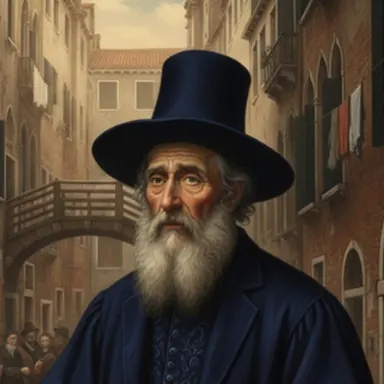
Between Halakhic Authority, Rationalism and Modernity: The Work, Writings and Torah Teaching of Rabbi Yehuda Aryeh of Modena (the Riam)
17 min read3,402 words
Summary
This text surveys the many-sided figure of Rabbi Yehuda Aryeh of Modena (the Riam), a key figure of Italian Jewry who bridged the world of tradition and the intellectual currents of the Renaissance. The article traces his complex personal biography, interwoven with family tragedies and daily struggles, alongside his impressive public work as a preacher, musician and rabbinic judge in Venice. The main discussion focuses on the rationalist criticism that the Riam directed at the wisdom of Kabbalah, and especially on his book "Ari Nohem", which challenges the antiquity of the Zohar out of a desire to defend the teaching of Maimonides. Alongside this, the source emphasises the Riam's role as a defender of orthodoxy, who struggled against the scepticism of former conversos and wrote apologetic works that made the Jewish way of life accessible to a Christian and educated readership.
Biography and Historical Background: A Young Prodigy in the Passages of the Renaissance
Rabbi Yehuda Aryeh of Modena (known in Torah and scholarly literature by the acronym Riam, and by his Italian name Leone Modena; 1571–1648) represents one of the most unique, complex and influential figures in the history of Italian Jewry at the beginning of the modern era.[1, 2] He was active within the ghetto of Venice – a vibrant spiritual and cultural centre in which diverse Jewish traditions met the intellectual currents of the late Italian Renaissance and the Christian Counter-Reformation.[1, 3, 4] The Riam was born in Venice on 28 Nisan 5331 (23 April 1571) to Yitzchak and Rachel Diana, a scion of a Jewish family with ancient roots in France, which had been expelled from there and moved to the city of Modena (after which they were named) and from there to various territories of the Republic of Venice.[1, 5, 6]
The Riam's childhood was marked by geographical wanderings and by the early discovery of a phenomenal genius.[1, 6] Eight months after his birth his family moved to Ferrara, and afterwards to Cologna, until it settled in Montagnana in 1578, where he grew up for about fourteen years until his return to Venice as a young man in 1592.[6] Already at the age of two and a half the Riam read the haftarah in the synagogue, at the age of three he knew how to translate the weekly Torah portions from Hebrew into Italian, and at the age of nine he was already preaching before an audience and arousing enormous admiration among his listeners and teachers, who predicted for him a brilliant future as a preacher and spiritual leader.[1, 6] His broad Torah education, which he acquired among other places in Padua from the age of ten, was combined with a comprehensive general training that included the Italian language and literature, music, dance and the art of the stage.[1]
The Riam's extreme complexity is expressed in the deep gap between his lofty standing in Torah and the twists and turns of his personal life, saturated with tragedies and crises, as he described them in detail in his pioneering autobiography, "Chayei Yehuda" ("The Life of Judah").[1] At the age of nineteen he married his cousin Rachel, who in time suffered from a severe mental illness.[1] Of his three sons, the eldest died young, the second was murdered in the course of a violent brawl in the ghetto, and the third was forced to emigrate to distant Brazil and returned to Italy only after his father's death.[1] Beyond these family disasters, the Riam struggled all his life with a severe addiction to gambling, and especially to card games – a human weakness that brought him constant financial loss and chronic economic distress.[1]
Much symbolism of his non-conformist character is found in his famous portrait, published in his Italian book in 1638, in which he is shown completely bareheaded and without a skullcap.[1] This appearance was not accidental, but relied on a reasoned halakhic ruling he himself wrote, according to which head covering for men is no more than an ancient custom of piety and a matter of choice, and not a formal halakhic obligation by the strict letter of the law.[1]
His Public, Rabbinic and Artistic Work
The Riam held central leadership posts that placed him at the junction of influence of Venetian Jewry.[1] He was the foremost student of the great masters of halakha and grammar in Italy, among them Rabbi Shmuel Yehuda Katzenellenbogen (the Maharshik) and Rabbi Shmuel ben Elchanan Yaakov Archivolti, author of the grammatical book "Arugat ha-Bosem".[1] At the age of 23 he was appointed a rabbinic judge and official preacher in Venice, and later served as head of the city's general yeshiva.[1] His sermons, characterised by brilliant Renaissance rhetoric and by the integration of classical sources, drew to the synagogue in the ghetto a diverse audience that more than once included high-ranking Christians, priests and noblemen.[1, 4] As a prolific teacher, the Riam taught Jewish and Christian students alike, and among his prominent students was Rabbi Shaul Levi Morteira, who later served as head of the famous rabbinic court in Amsterdam.[1] His practical halakhic work remains engraved in his collection of questions and answers, "Ziknei Yehuda", which was published from a single manuscript in the world by Prof. Shlomo Simonsohn, and attests to his great power in balanced and original halakhic ruling.[1]
Alongside his distinctly rabbinic roles, the Riam tried his hand at a variety of liberal professions, serving as director of a theatre and of an academy of music in the Venetian ghetto.[1] His deep affinity for music found expression in his serving as cantor in the synagogue in Venice for more than forty years.[5] He is considered the pioneer who introduced choral singing and polyphony (music in several voices) into the synagogue in Ferrara, and he even composed two comprehensive halakhic essays permitting this musical practice within Jewish prayer and celebrations.[5] The Riam, who was a close friend of the renowned Jewish composer Salamone Rossi, sought to prove that the development of religious song is not a matter of imitating the customs of the Church, but of restoring the crown to its former glory and reviving the splendour of the song that had been practised in the Temple in Jerusalem.[5]
His intellectual openness and his extensive ties with the Christian Hebraists of his time are attested by his monumental ethnographic work "The History of the Rites of the Jews" (Historia de' Riti Hebraici).[1, 2, 4] The book was written in Italian for Christian readers, with the aim of presenting to them the laws of the Torah and Jewish customs in a rational way, free of prejudice.[1, 4] The book, written apparently at the request of the English ambassador in Venice, Sir Henry Wotton, enjoyed enormous success in Europe, was translated into French, English and Hebrew, and became a foundational layer in the creation of a tolerant discourse and interreligious understanding at the beginning of the modern era.[1, 4] The Riam's respectful and sophisticated attitude towards Christianity was also reflected in his historical appreciation of Jesus, whom he described as a moral figure worthy of esteem, while firmly rejecting his divinity theologically.[4]
The Riam's Literary System: Chronology and Thematic Classification
The Riam's writing encompasses dozens of works extending over many fields, from practical guides and dictionaries, through poetry and drama, to theological polemical works and collections of halakha.[1, 2] His literary richness and versatility find concentrated expression in the following chronological table, which brings together his main works preserved in print and in manuscript:
His Religious Polemics and the Defence of Orthodoxy from Within and Without
Although the Riam was seen by many as an open and liberal figure, he saw himself first and foremost as a faithful defender of the walls of traditional rabbinic Judaism in the face of the great spiritual challenges of the 17th century.[1] This period was marked by intense demographic and spiritual upheavals, especially with the arrival of former conversos from the Iberian Peninsula in the communities of Italy and Amsterdam.[1, 5] These conversos, who had grown up in a Christian environment and did not know the world of the Oral Torah, often developed a severe scepticism towards the authority of the Sages and interpreted Scripture in a literal and critical manner.[1]
To confront this wave of scepticism, the Riam composed the work "Magen ve-Tzinnah" ("Shield and Buckler"), which is a direct response and an incisive answer to the claims of Uriel Acosta (da Costa).[1] Acosta challenged the immortality of the soul and the legitimacy of the Oral Torah, and the Riam, with the sharpness of his thought, dismantled Acosta's arguments and proved that without the interpretation of the Sages, the Written Torah remains incomprehensible and incapable of practical application.[1]
An even more complex project was the Riam's engagement with a mysterious book called "Kol Sakhal" ("The Voice of a Fool"; which he called "Kol Shachal", "The Voice of a Lion").[1, 2] This book presented an unprecedented radical criticism of the entire halakhic structure of the Mishnah and the Talmud, calling for a return to a simple biblical Judaism.[1] The Riam defended the rabbinic tradition in his book "Sha'agat Aryeh" ("The Roar of the Lion"), in which he answered each of the claims of "Kol Sakhal" and proved the eternity and historical continuity of the chain of halakhic transmission.[1] Modern research, led by scholars such as Talya Fishman, has placed a large question mark over this polemic; there is a hypothesis in scholarship that the Riam himself was the secret author of "Kol Sakhal".[7] According to this theory, he consciously created the figure of a fictitious "heretic" so that through it he could voice his most personal and radical doubts, and at the same time answer them as an orthodox rabbi in "Sha'agat Aryeh", thereby conducting a deep inner dialogue with the boundaries of faith and doubt.[1, 7]
Parallel to the internal polemics, the Riam waged a campaign against popular beliefs in which he saw a deviation from biblical and Talmudic rationalism.[1] In his book "Ben David" he came out against the belief in the transmigration of souls, which had gained enormous popularity with the spread of the Kabbalah of the Ari.[1] The Riam saw the idea of transmigration as a foreign doctrine originating in pagan or Platonic philosophy, which stands in absolute contradiction to the principles of divine justice, free will and individual reward represented in Scripture and in the teaching of Maimonides.[1]
His boldness also found expression in the interreligious polemic; in his book "Magen va-Cherev" ("Shield and Sword") he directly attacked the foundations of Christian theology, dismantled the proofs that the Christians adduced from the Bible, and set up a systematic and proud defence of the unique Jewish faith against the missionary pressure of the Church.[1]
The Riam's Attitude to Kabbalah and the Writing of "Ari Nohem"
The Background and the Motive for Writing the Work
Despite his personal interest in fields bordering on metaphysics, such as astrology, the Riam developed a deep, systematic and uncompromising opposition to the wisdom of Kabbalah and to the Zohar.[1] The climax of this opposition took shape in 1639 with the completion of the writing of the monumental work "Ari Nohem" ("The Roaring Lion").[1, 7] The research of Yaakov Dweck reveals that the deepest motive behind the writing of the book was the Riam's great anger at the kabbalists of his generation, who disparaged Maimonides (whom he called "the Great Eagle") and the other luminaries of rationalist Jewish philosophy.[7] The kabbalists used to claim that Maimonides "did not engage in Kabbalah and was not granted this wisdom" because he did not know the Zohar, or alternatively tried to appropriate him and claim that at the end of his days he "repented" and became a kabbalist.[7, 8] The Riam sought to rescue the honour of Maimonides and to prove that his rationalist conception, as expressed in the "Guide of the Perplexed", is the most authentic and purest Jewish way.[7]
In his letters and in his book, the Riam guided his foremost student R. Yosef Hamitz (who at that time had begun to incline towards mystical study) to study the chapters of the "Guide of the Perplexed" in depth.[7] The Riam sought to show Hamitz that there is an abysmal and unbridgeable gap between rationalist philosophy and kabbalistic theology.[7] Whereas philosophy strives to remove corporeality from God and emphasises His absolute unity, Kabbalah, in his view, produces multiplicity within the Godhead through the doctrine of the sefirot, thereby endangering the belief in God's unity.[7] A further external motive was the grave concern over the exploitation by Christian theologians (within the movement of "Christian Kabbalah") of the Zohar and of the concept of the "sefirot" in order to establish the idea of the Holy Trinity; the Riam sought to pull the ground out from under these arguments by challenging the holiness and antiquity of the Zohar itself.[1]
His Proofs against the Antiquity of the Zohar
In his book "Ari Nohem" the Riam presented a pioneering and exceptional philological, historical and literary analysis, which anticipated by centuries the conclusions of modern academic research on Kabbalah (such as that of Gershom Scholem and others).[1, 3] He proved systematically that the Zohar is not an ancient work from the period of the Tannaim and is not the product of the pen of Rabbi Shimon bar Yochai, but is a forgery and the handiwork of a later man of the Middle Ages.[1] His main proofs included:
- Linguistic (philological) evidence: the Riam pointed out that the Aramaic in which the Zohar was written is not the authentic Aramaic of the Talmudic period, but a corrupt Aramaic heavily influenced by translations from the Spanish language and by the philosophy of the Middle Ages.[1]
- Historical anachronisms: the Zohar explicitly mentions Amoraim and personalities who lived hundreds of years after the death of Rashbi, and refers to customs and historical events that did not exist in the period of the Tannaim.[1]
- Liturgical and halakhic evidence: the Zohar contains versions of prayers, religious customs and laws that developed only in the period of the Geonim and in the Middle Ages in Europe, and are not mentioned at all in the authentic literature of the Sages.[1]
- Absence of historical mention: the Riam wondered how it could be that so monumental and holy a work disappeared entirely from the eyes of all the great sages of Israel for more than a thousand years – including the Geonim, the Rif, Rashi and Maimonides – and none of them alludes to its existence until its sudden appearance in Spain in the 13th century.[1]
The Dissemination of His Writings and Their Influence for Generations
Because of grave fear of the reaction of the conservative community in Italy, in which Kabbalah had gained an almost complete hold, the Riam refrained from printing "Ari Nohem" in his lifetime, and the book circulated only in secret handwritten copies for some two hundred years.[7] Only in 1840 was the book printed for the first time in Leipzig by Julius Fürst, and its appearance caused a great storm and became a central axis in the culture wars of the modern era [1, 7]:
- Adoption by the Haskalah movement: the great maskilim of Europe saw in "Ari Nohem" a perfect weapon against Hasidism and against what they perceived as dark mystical traditions lacking historical basis.[1] The scholar Isaac Samuel Reggio (Yashar of Gorizia), who printed "Sha'agat Aryeh" in 1852, and Abraham Geiger, who printed "Magen ve-Tzinnah", used the Riam's arguments as a rabbinic authority confirming their scientific-critical approach.[1]
- Influence on Yemenite Jewry ("Dor De'ah"): through contacts with European maskilim, the Riam's polemical books reached the hands of Rabbi Yichya Qafih, one of the great sages of Sana'a in Yemen at the end of the 19th century.[1] The influence of "Ari Nohem" and "Ben David" on Rabbi Qafih was dramatic and led to the founding of the "Dor De'ah" movement (the Dardaim).[1] Rabbi Qafih composed his well-known book "Milchamot Hashem" ("The Wars of the Lord") against the Zohar and the kabbalists, relying to a great extent on the textual and chronological proofs laid down by the Riam three hundred years earlier.[1]
The Reactions and the Opposition to His Views in the Torah World
The Riam's bold challenge to the holiness of the Zohar and to accepted beliefs aroused fierce opposition and firm rebuttal on the part of the great Torah scholars and kabbalists throughout the generations, who saw in his views a grave blow to the foundations of tradition and to the authority of the esoteric wisdom [1]:
- Rabbi Moshe Chaim Luzzatto (the Ramchal): the Ramchal, who was active in Italy in the 18th century, saw in the Riam's views a great danger to faith.[1] He composed the books "Choker u-Mekubbal" ("The Philosopher and the Kabbalist"), "Ma'amar ha-Vikuach" ("The Essay of the Debate") and "Milchemet Moshe" ("The War of Moses").[1] Modern research has proved that these works were written as a direct and meticulous response to the claims raised by the Riam in "Ari Nohem", in an attempt to show that Kabbalah is not a fantasy but a profound and rational philosophical-divine system, which constitutes the inner soul of the Torah.[1]
- Rabbi Yitzchak Isaac Chaver: one of the great kabbalists of Lithuania and a foremost disciple of the school of the Gra in the 19th century, composed a complete and detailed book of defence called "Magen ve-Tzinnah".[1] In this book he went step by step through all of the Riam's historical, philological and halakhic objections, and presented counter-answers confirming the antiquity of the Zohar and its origin with Rashbi.[1]
- Rabbi Eliyahu Benamozegh: a prominent kabbalist and thinker from Livorno, answered the Riam in his book "Emat Mafgia al Ari" ("The Terror of the One Who Strikes the Lion"; where the name "Ari" is aimed, by way of euphemism, at Rabbi Yehuda Aryeh of Modena).[1] Benamozegh, who possessed a broad education, used the historical and linguistic research tools of his time to show that many of the words and concepts in the Zohar that according to the Riam were "late" did indeed exist in ancient secret traditions from the days of the Second Temple.[1]
- Rav Kook (the Ra'ayah): when Rav Kook received from Rabbi Yichya Qafih the book "Milchamot Hashem", based on "Ari Nohem", he replied to him that all these claims had already been voiced in the past by the Riam and had been dealt with by the great sages of the generations.[1] Rav Kook stressed that the nation's acceptance of the holiness of the Zohar outweighs historical casuistry, and that the esoteric wisdom had proved its spiritual vitality in reviving the soul of the nation, and therefore there is no place to reopen this old polemic.[1]
Summary
Rabbi Yehuda Aryeh of Modena constitutes an exceptional and singular bridge between the rigid world of halakha and the freedom of thought of modernity.[1] His figure reflects the constant struggle of the religious person in the modern era: a stern rabbinic judge and head of a yeshiva who defends the walls of the Oral Torah against heretics and sceptics, and who at the same time does not hesitate to investigate with critical and scientific tools the holiness of accepted books, to reject popular mystical beliefs, and to integrate into his life art, theatre and polyphonic music.[1, 5] His extensive and varied writing left an indelible mark, and his polemical writings became a formative source of inspiration for intellectual movements in Judaism hundreds of years after his death.[1, 7] His spiritual richness, his cultural openness and his innovative work assure his place as one of the shapers of Jewish thought and spirit in the transition between the Middle Ages and the modern era.[1]
Sources8
- 1.יהודה אריה ממודנה - ויקיפדיה, he.wikipedia.org/wiki/יהודה_אריה_ממודנה
- 2.Leone Modena (1571-1648) | The National Library of Israel, nli.org.il/en/a-topic/987007265574105171
- 3.The Scandal of Kabbalah: Leon Modena, Jewish Mysticism, Early Modern Venice [Course Book ed.] 9781400840007 - DOKUMEN.PUB, dokumen.pub/the-scandal-of-kabbalah-leon-modena-jewish-mysticism-early-modern-venice-course-booknbsped-9781400840007.html
- 4.Emotions and the Hidden Transcript: The Jewish Gospel Toledot Yeshu in Early Modern Italy *, oajournals.fupress.net/index.php/cromohs/article/download/12952/13151/26752
- 5.Rabbi Yehudah Aryeh Mi-modena - Tzadikim, dailyzohar.com/tzadikim/938-Rabbi-Yehudah-Aryeh-Mi-modena
- 6.Leon Modena's Kinah Shemor - Skenè. Texts and Studies, textsandstudies.skeneproject.it/index.php/TS/catalog/download/75/25/645?inline=1
- 7.MAIMONIDEANISM IN LEON MODENA'S ARI NOHEM Yaacob Dweck - Brill, brill.com/previewpdf/book/edcoll/9789047427964/Bej.9789004174504.i-440_010.xml
- 8.יחסו של הרמב"ם לקבלה (חלק א), orharambam.com/post/יחסו-של-הרמב-ם-לקבלה-חלק-א