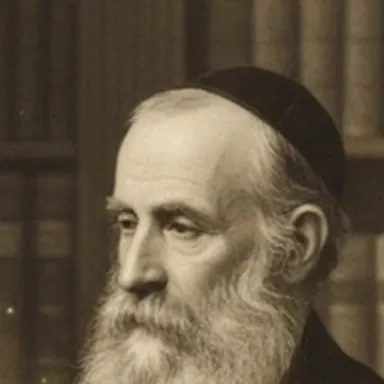
The Torah Teaching, Literary Work and the "Cheshbon ha-Nefesh" Storm of Rabbi Menachem Mendel Lefin of Satanov
16 min read3,211 words
Summary
This article surveys the figure of Rabbi Menachem Mendel Lefin of Satanov, a unique thinker who served as an intellectual bridge between the traditional world of Torah and the first buds of modernity and Haskalah in Eastern Europe. The text focuses on Lefin's sophisticated attempt to fortify Jewish life by adopting scientific and pedagogical methods, while waging a twofold struggle against Hasidism on the one hand and radical Haskalah on the other. The center of gravity of the article is devoted to his monumental work "Cheshbon ha-Nefesh", which "converted" Benjamin Franklin's system of thirteen virtues and turned it into a rationalist tool for the refinement of character traits that was surprisingly adopted at the heart of the Lithuanian yeshiva world. Through historiographical and literary analysis, the source shows how Lefin turned outside wisdom into a handmaiden of traditional divine service, and thereby left an indelible mark on the Mussar movement and on the spiritual structure of modern Judaism.
Introduction: The Mediator between the Modern Revolution and the Walls of the Beit Midrash
In the second half of the eighteenth century and the beginning of the nineteenth century, the Jewish street in Eastern Europe faced unprecedented spiritual and social upheavals. The stormy rise of the Hasidic movement on the one hand, and the first buds of the Haskalah movement on the other, created deep rifts within the traditional communities and threatened to dismantle the old communal structure.[1] In the midst of this historical storm worked Rabbi Menachem Mendel Lefin of Satanov (1749–1826), a unique and multidimensional figure who formed an extraordinary intellectual bridge between the conservative world of Torah and modern methods of science, philosophy and education.[2, 3]
Modern historiography, foremost the studies of Prof. Nancy Sinkoff, portrays Lefin not as a radical maskil seeking to tear down the walls of religion, but as a conservative reformer who sought to use the tools of modernity in order to fortify traditional Jewish life.[2] Lefin acted out of a deep belief that in order to save the young generation from completely casting off the yoke, the rabbinic leadership must adopt advanced pedagogical and scientific methods, while carefully preserving the spirit of the Torah and full commitment to traditional halakha.[3, 4] These attempts at mediation placed him at the center of fierce controversies that accompanied him during his lifetime and continued to occupy the world of Torah and scholarship for decades after his death.[1, 2]
Historical and Biographical Background: Galician Haskalah in the Shadow of Tradition
Rabbi Menachem Mendel Lefin was born in the town of Satanov in the region of Podolia, then part of the Kingdom of Poland and later under the rule of the Austro-Hungarian Empire in Galicia.[2] This geographic and cultural environment, which was fertile ground for the growth of Hasidism and, on the other hand, for the first influences of the Berlin Haskalah, shaped his dialectical worldview.[1, 2] In her comprehensive study of the transition of Jewish society to modernity in the Polish space, Nancy Sinkoff shows how Lefin developed sophisticated strategies of action, sometimes using political and intellectual maneuvers, in order to advance a moderate modernization that does not break the halakhic vessels.[2]
The historiographical and rabbinic dispute over the definition of Lefin as a "maskil" reveals the complexity of the period. While nineteenth-century maskilic historians, such as Avraham Ber Gottlober, tried to appropriate Lefin to the distinct Haskalah stream and claimed that he attached himself to Moses Mendelssohn and regarded him as his principal teacher, modern studies and various rabbinic opinions offer a far more reserved view.[1, 2] The Gaon Rabbi David Kamenetsky stresses that there is no historical evidence or real basis for the claim that Lefin was a disciple of Mendelssohn, and that Gottlober's testimony is tainted by its author's clear ideological bias.[1]
In those days, the figure of the maskilim of Galicia was different from that of the later maskilim of Berlin; most of them were Torah scholars and distinctly Torah-observant people, and Lefin himself was regarded as a Torah-observant man in all his ways.[1] Kamenetsky adds that the broad public at that time did not know about the theological problems in Mendelssohn's path, something that became clear only a generation later with the apostasy of all his children.[1]
The Literary and Translation Enterprise of Rabbi Mendel Lefin
In order to improve the economic, spiritual and cultural condition of the Jews of Eastern Europe, Lefin devoted a considerable part of his life to a wide-ranging enterprise of translation and writing.[3] His writing was divided along three central axes: making classical Jewish philosophy accessible, disseminating popular science, and translating books of Scripture into the language of the people.[2, 3]
On the philosophical axis, his most daring decision was his reformulation of Maimonides' book "The Guide of the Perplexed".[3] Lefin held that the translation of Rabbi Shmuel ibn Tibbon was too difficult to understand for the average student because of its florid language and its syntactic structure influenced by Arabic.[3] He reformulated the book in clear, fluent and eloquent Mishnaic Hebrew, with the aim of returning the thought of the Rambam to the center of Torah and maskilic discourse.[3] Although there were those who criticized the reformulation as less precise philosophically in comparison with the ibn Tibbon translation, the enterprise achieved its goal and made the work significantly more accessible.[3]
On the scientific and political axis, Lefin wrote and translated books of medicine and popular science into Hebrew and Yiddish, out of the conception that ignorance in these fields harms the physical and economic capacity of the Jews to survive.[3] Riety van Luit's study of the work "Essai d'un plan de réforme" (a political work that Lefin wrote in French) highlights how he tried to navigate between the Jewish community and the institutions of the Polish state, while trying to propose social reforms that would prevent heavy-handed government intervention in religious life.[2]
The fiercest controversy surrounding Lefin's translation enterprise arose following his decision to translate the books of Scripture, foremost the book of Ecclesiastes, into the spoken Yiddish language.[2] As the scholar Roland Gruschka analyzes, Lefin faced an inherent conflict: on the one hand, he was influenced by Moses Mendelssohn's enterprise of translation into German, but on the other hand, he understood that the Jews of Eastern Europe did not speak German and such a translation would leave them without direct access to the text.[2]
His decision to use a vital, popular Yiddish met with sharp opposition from conservative maskilim who regarded Yiddish as an inferior jargon to be eradicated in favor of German or pure biblical Hebrew.[2, 6] The famous maskil Tobias Feder even wrote against him the sharp satirical tract "Kol Mechatzetzim", in which he attacked in cutting language Lefin's decision to debase the holy Scripture, as it were, into the language of the masses.[6]
The Two-Front Struggle: The Battle against Hasidism and against the Radical Maskilim
The Torah enterprise of Rabbi Menachem Mendel Lefin was shaped to a great extent by his two-front war.[1, 3] On the one hand, he waged a sharp and uncompromising struggle against the Hasidic movement, in which he saw a danger to the world of Torah and to Jewish rationalism.[1, 3] His extreme opposition to Hasidism led to a sharp and harsh counter-ban on the part of the Hasidic communities in Galicia.[1]
Rabbi David Kamenetsky explains that the Hasidic ban on Lefin stemmed in part from tactical considerations of the communal politics of that period.[1] According to him, the way of the Hasidim in those days was automatically to label any rabbi or Torah scholar from Galicia who criticized them as a "maskil", thereby stripping him of his Torah authority and escaping the piercing arrows of criticism of the Mitnagdim.[1]
On the other hand, Lefin fought with all his strength against the radical maskilim who cast off the yoke of Torah and commandments and sought to lead to cultural assimilation.[3] In his view, the right way to deal with the ills of the time is neither total seclusion nor assimilation, but the presentation of an alternative of a deeply rooted halakhic Judaism, equipped with modern intellectual tools and clear science.[3, 4]
The Book Cheshbon ha-Nefesh: The Franklinian Method in the Service of Torah Ethics
In the year 5568 (1808) Lefin printed in Ulanów his monumental work "Cheshbon ha-Nefesh" (Accounting of the Soul).[2, 4] The book offers a systematic and practical guide to self-education and the refinement of the traits of the soul.[4] In a manner unprecedented in mussar literature, the methodological core of the book was based on the psychological model developed by the American scientist and statesman Benjamin Franklin in his autobiography.[4, 5] Franklin proposed a structured system of thirteen virtues, in which a person practices one virtue each week over a cycle of thirteen weeks, four cycles a year in all.[4, 5] This work is accompanied by keeping a meticulous daily notebook in which the student records his failures and successes.[7]
The historical studies of Shai Afsai deal extensively with Franklin's influence on the thought and practice of the Mussar movement, and show how a distinctly secular-American model seeped into the very heart of the Lithuanian yeshivot.[2] However, Lefin did not copy the method as it was.[7] As textual analysis proves, the changes Lefin made are not merely cosmetic, but reflect a profound theological transformation that moved the method from a utilitarian-secular conception to a distinctly religious, Torah-based one.[7]
Whereas Franklin saw the refinement of character traits as a means of achieving social success, peace of mind and personal gain in this world, Lefin defined the refinement of character traits as an inseparable and obligatory part of the divine service of the believing Jew.[7] Lefin utterly rejected foreign models and adapted the content of the traits to the sources of the Sages and of halakha.[7]
The Hasidic Doctrine of Character Traits versus Lefin's Rationalist Doctrine of "Nesirah"
The broad context in which the book "Cheshbon ha-Nefesh" was written is inseparably connected to Lefin's war against Hasidism.[1, 4] Many scholars argue that the book was deliberately written as a systematic and rationalist alternative to the Hasidic path in divine service and in the refinement of character traits.[4] In order to understand the depth of the rift and the difference between the methods, one must examine the conceptual differences between the Hasidic approach and Lefin's methodical approach.[8]
In the Hasidic conception, the refinement of character traits is an existential spiritual-mystical process.[8] The Hasid strives "to break the traits and offer them all up to the Holy One, blessed be He", on the assumption that moral good is a divine abundance flowing from the source of the soul.[8] The Hasidic aim is to transform every natural human trait in the soul into a divine trait, a process carried out out of fervor, attachment to the tzaddik and stormy religious emotion.[8] The doctrine of character traits is the spiritual life-point of the Hasid, and it does not rely on bookkeeping or analytical tools.[8]
In contrast, Lefin offered a rational, psychological and comprehensible method, based on two central principles of thought:
Clarification of the traits of the soul: This stage deals with the person's analytical ability to distinguish between good and bad in every trait, to divide the traits according to their watches and to stabilize them in the soul so that they will be available and ready for action at all times.[8]
Separation of the traits and their "sawing apart": Lefin coined the term "nesirah" (sawing) in the context of the traits.[8] In his view, the central problem in the refinement of character traits stems from the blurring of the boundaries between them because of superficial and imprecise images.[8] "Nesirah" is the ability to deepen and clarify each trait in a complete and isolated image, in order to prevent a harmful mixing – for example, between humility and cowardice, or between diligence and haste.[8]
This rationalist method offers the masses of the House of Israel a path, suited to every soul, of regular and controlled self-work, without any need for mystical experiences or self-nullification before a Hasidic tzaddik.[4, 8]
The Controversy over the Reception of "Cheshbon ha-Nefesh" in the Yeshivot of Lithuania
One of the astonishing phenomena in the history of Eastern European Jewry is the rapid and deep integration of the book "Cheshbon ha-Nefesh" into the heart of the conservative Lithuanian yeshivot, which were the stronghold of the "Mitnagdim" against Hasidism and Haskalah alike.[5, 7] As Prof. Immanuel Etkes analyzes in his study of "the return of the maskil to the bosom of the faithful of Israel", this penetration did not occur because the heads of the yeshivot were unaware of the book's sources or of its author's identity as a maskil.[2, 7]
The masters of mussar in Lithuania knew how to read a text precisely; they recognized the enormous educational value of the practical tool that Lefin offered, and understood that the book had undergone a full spiritual "conversion" and had been completely subordinated to the Torah outlook.[7]
The book's influence on Rabbi Israel Salanter, the founder of the Mussar movement, was decisive.[2] Rabbi Israel drew many ideas from the work, especially the method of the thirteen traits and the principle of keeping a notebook.[2, 5] According to the accepted historical narrative, Rabbi Israel was the driving force behind the printing of the second edition of the book in Vilna in the year 5605 (1845), while playing down Lefin's maskilic identity in order to prevent opposition to his ideas.[1, 2] Later, the book became an inseparable part of the curriculum in the mussar yeshivot, and was printed again and again.[5] An especially notable edition was printed in Keidan in the year 5697 (1937) by the association of Slabodka students, with the addition of a detailed philosophical introduction by the head of the yeshiva, Rabbi Yitzchak Isaac Sher.[2, 5, 7]
Nevertheless, the reception of the book did not pass without internal arguments that echo to this day.[1] In later halakhic and Torah literature, voices were heard questioning the uncompromising attribution of the book's printing to Rabbi Israel Salanter.[1] Rabbi David Kamenetsky notes that the only evidence of Rabbi Israel Salanter's direct connection to the 5605 printing is an oral tradition handed down by Rabbi Isaac Sher, and he doubts the reliability of traditions that are not anchored in contemporary written sources.[1]
In addition, Kamenetsky presents a position that seeks to limit the standing of the book in comparison with the classic mussar books.[1] In his view, "Cheshbon ha-Nefesh" does not stand in one row with holy books and mussar works such as "Mesillat Yesharim" or "Sha'arei Teshuvah", but is an excellent psychological-methodical "auxiliary book" offering technical tools for coping with oneself, similar to modern self-help literature.[1] In contrast, the masters of mussar in the yeshivot continued to see the work as a deep spiritual working tool capable of bringing a person to complete repentance.[7, 9]
Systematization of the Legacy of Rabbi Mendel Lefin
The intellectual enterprise of Rabbi Menachem Mendel Lefin of Satanov extends over various genres and expresses a single coherent worldview. In order to appreciate the specific weight of his teaching in historical research and in Torah discourse, it is fitting to examine the prominent research sources dealing with his work and teaching, which illuminate different angles of his personality and his works:
- Nancy Sinkoff: In her comprehensive studies, foremost the book Out of the Shtetl: Making Jews Modern in the Polish Borderlands, Sinkoff presents Lefin as the founder of the Eastern European Haskalah.[2] She analyzes the political and cultural strategies he adopted ("Strategy and ruse"), and stresses that he acted out of commitment to tradition in the face of the challenges of progress and the modern state.[2]
- Immanuel Etkes: In his leading article "The Return of the 'Maskil' Menachem Mendel Lefin to the Bosom of the Faithful of Israel", Etkes focuses on the dialectical process of the reception of "Cheshbon ha-Nefesh" within Lithuanian Orthodoxy.[7] He shows how the conservative world of Torah wisely separated the biographical figure of the author from the spiritual benefit of his method of traits.[7]
- Shai Afsai: Afsai's studies focus on uncovering the Franklinian roots of "Cheshbon ha-Nefesh" and on analyzing the dynamics of the adoption of the American model.[2] He discusses the historical misunderstandings that accompanied the introduction of Franklin's thirteen virtues into the world of Jewish mussar, and stresses the philosophical uniqueness of the adaptation Lefin carried out.[2]
- Roland Gruschka: Analyzes the linguistic and translational aspect of Lefin.[2] His study of the Yiddish translations of the Bible reveals the inherent tension in which Lefin was caught between Mendelssohn's rationalist principles of translation and the practical need to make Scripture accessible to the masses in their natural language.[2]
- Riety van Luit: Examines the political and sociological aspects of Lefin's reform proposals.[2] She sheds light on the ways in which Lefin tried to maneuver between Hasidim, Mitnagdim and the central authorities in Poland and Galicia in order to secure the stability of the Jewish community.[2]
Summary and Conclusions
Rabbi Menachem Mendel Lefin of Satanov stands as one of the most fascinating, complex and influential figures at the threshold of the modern era in the history of the Jewish people.[2] His Torah and literary work eludes simplistic dichotomous definitions that seek to paint him in the black-and-white colors of a secular "maskil" or an extreme "conservative".[1, 4] Lefin was a pioneering thinker who understood that the methodical tools of the new world – scientific analysis, linguistic clarity, systematic pedagogy and practical psychology – need not lead to the destruction of religious life.[3, 4] On the contrary, he proved that they can be enlisted to breathe new life into the walls of the beit midrash and to offer a deep intellectual alternative to the spiritual crises of his generation.[4, 8]
The book "Cheshbon ha-Nefesh", with the historical transformations it underwent, constitutes the conclusive proof of the success of his dialectical outline.[5, 7] The ability of the great figures of the Mussar movement to identify the deep Torah spark hidden in a method borrowed from Benjamin Franklin, and to integrate it into the core of the curriculum of the most conservative yeshivot, expresses the eternity of the philosophical principle that "wisdom among the nations, believe it" – provided that it passes through a melting pot of holiness, halakhic commitment and true divine service.[7] Rabbi Mendel Lefin not only laid the foundations for a structured psycho-didactic method for the refinement of character traits, but also contributed indirectly to the structural and social shaping of the modern world of Torah, a legacy that continues to guide students of mussar and seekers of self-perfection to this day.[7]
Sources9
- 1.למה החסידים החרימו את החכם לפין? "נמלטו מביקורת" - כיכר השבת, kikar.co.il/haredim-news/410220
- 2.מנדל לפין - ויקיפדיה, he.wikipedia.org/wiki/מנדל_לפין
- 3.מורה הנבוכים - ויקיפדיה, he.wikipedia.org/wiki/מורה_הנבוכים
- 4.חשבון הנפש | ספריית ספריא, sefaria.org.il/Cheshbon_HaNefesh
- 5.בנג'מין פרנקלין - ויקיפדיה, he.wikipedia.org/wiki/בנג'מין_פרנקלין
- 6.קול מחצצים - פדר, טוביה, 1760-1817 (page 1 of 28) - HebrewBooks, hebrewbooks.org/pdfpager.aspx?req=34821&pgnum=1
- 7.בואו חשבון - צריך עיון, iyun.org.il/maremakom/mendel-lefin/
- 8.מידות טובות - ויקיפדיה, he.wikipedia.org/wiki/מידות_טובות
- 9.ח - חרדתו ודקדוקיו של רבי ישראל מסלנט באהבת ישראל | אשובה, ashoova.co.il/ask/k/ח-חרדתו-ודקדוקיו-של-רבי-ישראל-מסלנט-בא/