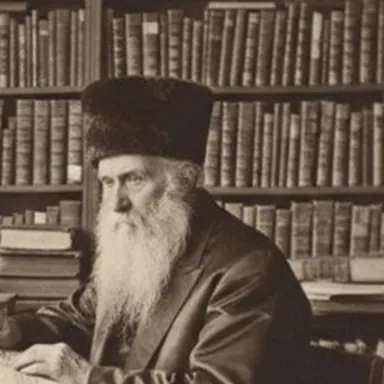
Illuminating Consciousness and the Secret of Human Contraction: The Work, In-Depth Biography and Torah Teaching of Rabbi Tzadok HaKohen of Lublin
20 min read3,993 words
Summary
The source under review offers a comprehensive and in-depth analysis of the figure and revolutionary thought of Rabbi Tzadok HaKohen of Lublin, from his beginnings as a Lithuanian prodigy in the "Mitnagdim" camp to his becoming one of the greatest figures of Hasidic thought. The text surveys the events of his personal and spiritual life, focusing on his dramatic move to Izbica Hasidism and on the unique theological system he developed, which emphasizes a divine determinism in which free choice is narrowed to man's inner consciousness alone. Through a broad bibliographical survey and a discussion of concepts such as "a transgression for the sake of Heaven" and the channeling of the drives, the work reveals how Rabbi Tzadok succeeded in fusing sharp analytical scholarship with a deep mystical psychology. Ultimately, the article seeks to shed light on his spiritual legacy and his influence on central thinkers such as Rav Kook, presenting a figure who combines, in a wondrous manner, rigorous asceticism with broad-horizoned intellectual openness.
The Dawn of His Life, His Scholarly Growth and the Spiritual Turning Point
Rabbi Tzadok HaKohen Rabinowitz of Lublin was born on 22 Shevat 5583 (4 February 1823) in the town of Krustpils (Kreuzburg) in the Vitebsk province of the Russian Empire, in the area of present-day Latvia.[1, 2, 3] He grew up at the heart of the scholarly establishment of the "Mitnagdim" camp.[3] His father, Rabbi Yaakov HaKohen, served as rabbi of the local community, and his mother was a descendant of the holy Shelah.[3] When he was only about six years old, Rabbi Tzadok was orphaned of his father, and his upbringing was entrusted to his uncle, Rabbi Yosef HaKohen Rabinowitz.[3] His uncle, who served as rabbi of Krynki and won lasting renown as the author of the book "Kapot Zahav" (Golden Spoons), recognized the sparks of genius in the child, who soon became known throughout Lithuania by the epithet "the prodigy of Krynki."[3] Clear evidence of the early recognition of the boy's exceptional genius is found in a profound halakhic correspondence that the renowned decisor Rabbi Yosef Shaul Nathanson, author of the responsa "Sho'el U-Meshiv," conducted with him.[3]
Rabbi Tzadok's personal life was deeply affected by a complex family and halakhic tragedy.[3] His first wife was the daughter of R. Shmuel Hirsch of Vladovka.[3] Following a rumor that reached his ears, according to which his wife had shaken the hand of a nobleman who visited her shop, Rabbi Tzadok decided that he must divorce her at once.[3] The woman, for her part, protested vigorously, claimed her complete innocence and refused to accept the bill of divorce.[3] Rabbi Tzadok's determination to bring about the dissolution of the marriage led him on a long and exhausting journey throughout Poland and Ukraine in order to collect the signatures of the great rabbis of the generation for a "Heter Me'ah Rabbanim" (permission of a hundred rabbis) to marry a second wife.[3] During his journey he met prominent Torah leaders, among them Rabbi Yitzchak Elchanan Spektor of Kovno and the Rebbe Rabbi Aharon of Chernobyl.[3] The Rebbe of Chernobyl agreed to sign the permission, but warned Rabbi Tzadok that, as a punishment for divorcing his wife against her will, he would not merit to have offspring.[3] Despite the warning, Rabbi Tzadok completed the collection of the signatures, and although at the last moment the permission became unnecessary because his wife agreed to accept the bill of divorce, the curse of barrenness was fulfilled and he remained childless until the day of his death.[3] Deep remorse over the hasty act accompanied him all his life, and some interpret the writing of his work "Poked Akarim" (He Who Remembers the Barren) as a spiritual attempt to act in Heaven for the annulment of that decree.[3] Later in life he married a second time, Chana Devorah Friedenthal, with whom he lived about forty years, and after her death he married a third time, the daughter of Rabbi Pinchas of Shtekshin, who was a granddaughter of Rabbi Moshe Biderman and of the "Holy Jew" of Peshischa.[3]
Rabbi Tzadok's dramatic move from the heart of the Mitnagdic world into the Hasidic movement is considered one of the most fascinating crossroads of his generation.[1, 3, 4] In the course of his spiritual searching he came to the court of Rabbi Mordechai Yosef Leiner, the Rebbe of Izbica and author of "Mei HaShiloach."[3] The final turning point came following a formative night dream that he dreamt while staying in Izbica, which he later recorded in his work "Divrei Chalomot" (Words of Dreams).[3] In this dream it was revealed to him that the souls of the last generation before the coming of the Messiah are the souls of the generation of the wilderness.[3] This theological revelation bound him firmly to Izbica Hasidism, and he became the foremost disciple of the "Mei HaShiloach," while at the same time absorbing deep influences from the teaching of Chabad and from the writings of Breslov Hasidism, and he even studied under Rabbi Shalom Rokeach of Belz.[1, 3]
For decades Rabbi Tzadok firmly refused to accept any official rabbinic post.[1, 3] He lived in Lublin in abject poverty, while his wife barely supported the household by running a small second-hand clothing shop.[1, 3] Only in 5648 (1888), after the death of Rabbi Yehuda Leib Eiger, the first Rebbe of Lublin, who had been his close friend, did he yield to the entreaties of the Hasidim and agree to serve as the second Rebbe of Lublin Hasidism.[3] Even after he took upon himself the yoke of leadership and began to receive a salary from the community, he refused to use the money for his personal welfare and devoted all of it to purchasing rare books and manuscripts.[3] In his home he established a vast Torah library that specialized in ancient manuscripts.[3] Rabbi Tzadok was known as a world authority on the identification and appraisal of manuscripts, and Torah scholars and researchers from all corners of the earth turned to him for an expert opinion.[3] This splendid library, together with all his personal notes, was burned completely during the Holocaust.[3]
Rabbi Tzadok led an ascetic way of life and was phenomenally diligent.[3, 5] He used to shorten his prayers in order to free as much time as possible for Torah study.[5] During the visit of the Rebbe Rabbi Yaakov of Biala to Lublin, when hundreds of Hasidim gathered around them, Rabbi Tzadok complained of the neglect of Torah study involved in the distraction, and answered those who criticized the brevity of his prayers with the well-known saying: "The time for Torah is one thing and the time for prayer is another."[5] Every day he would not taste any food until he had completed a whole tractate of the Babylonian Talmud and held a se'udat mitzvah (a festive meal marking a completion).[3] His diligence did not cease even when he grew weak, and on waking each day at five in the morning he refused to go back to bed, saying that from the day he had reached the age of understanding he had never gone back to sleep after first waking.[5] Besides his genius in all parts of the Torah, Rabbi Tzadok had mastery of the exact sciences, and in his bookcase he kept a special shelf for secular books, displaying expertise in astronomy, geometry and algebra.[3, 5] His health declined in 5660, and he died on 9 Elul 5660 (3 September 1900) at the age of 77.[1, 2, 3, 5]
The following is a summary of the main biographical data of Rabbi Tzadok HaKohen of Lublin:
The Teaching on Foreknowledge and Free Choice: Izbica Determinism in Scholarly Garb
The thought of Rabbi Tzadok HaKohen of Lublin moves the religious and spiritual struggle from the physical and practical arena into the inner recesses of human consciousness.[6] Following his teacher of Izbica, Rabbi Tzadok developed a radical determinist position that sets the principle of divine providence in an uncompromising light.[6, 7] According to this conception, man's free choice in his physical actions is in fact a cognitive illusion, and in the truth of things "everything is in the hands of Heaven, and man's choice is no more than a garlic peel."[6] The physical deed performed in the world, from its beginning to its end, is determined and brought into effect by the power of the Creator's will, and is not subject to man's real control.[6]
The resolution of the intellectual paradox between this determinism and the principle of reward and punishment lies, according to Rabbi Tzadok, in the distinction between the physical deed and the consciousness and awareness that accompanied it.[6] The sinner's guilt does not lie in the very performance of the physical act of the transgression, since the act itself is driven by the power of the Creator and is part of His primordial plan.[6] The guilt consists in the fact that at the moment of the sin, the person consciously chose to cut himself off from the awareness of God, and thereby constituted a point of darkness in which the light of God does not shine.[6] The sinner fails through the illusion of "my power and the might of my hand," believing that he is the independent entity that decides upon and carries out the action, instead of understanding that the power to act – even at the moment of the transgression – belongs entirely to the Creator.[6]
Rabbi Tzadok interprets in a revolutionary way the saying of the Sages, "If your sins be like scarlet (ka-shanim) – these are the ones that are set in order and come from the six days of Creation."[6] He explains that the sins themselves were arranged in advance in the original thought of Creation, as part of those "kavshei de-Rachmana" (the secrets of the Merciful One).[6] In the time to come, when these "letters of the thought" are revealed, the divine source of everything that happens in the world will become clear, and then "all the sins of Israel shall be made white as snow," since it will be made clear retroactively that all the deeds were part of the absolute divine providence.[6]
This determinist outlook also finds expression in Rabbi Tzadok's attitude to the interpretation of dreams.[1] In his view, a person's dreams are not merely a chance phenomenon, but an exact reflection of who he truly is, serving as a tool that makes it possible to discern his aspirations, the root of his values and the things dearest to his heart.[1] Free choice is limited solely to the fear of Heaven, in the words of the Gemara in Niddah: "Everything is in the hands of Heaven except the fear of Heaven."[8, 9] However, this term too receives a new definition in Rabbi Tzadok's thought: the fear itself is the way in which a person relates to the Creator within his consciousness, and the choice is solely whether to instill this faith and awareness into his deeds.[6]
The Doctrine of Sin and Repentance and the Paradox of "a Transgression for the Sake of Heaven"
A direct derivative of Rabbi Tzadok's conception of choice is his unique doctrine of repentance.[6] Since the physical act of the sin is done by the will of God and does not constitute the real point of the flaw, repentance does not require erasing the past or annulling what actually took place.[6] The rectification of the sin takes place entirely within the chambers of a person's heart and consciousness.[6] Repentance is defined as "returning the deed to God, blessed be He."[6] The sinner is required to reach a clear and complete recognition that it is the Holy One, blessed be He, who gave him the power to act, and that even at the moment of committing the transgression his power was driven by the divine source.[6] This understanding brings a person to deep faith, and as a result God enlightens his eyes and his willful sins become for him as merits.[6, 10]
At the center of Rabbi Tzadok's teaching stands a deep existential paradox concerning the subject of "a transgression for the sake of Heaven" and its connection to the "hidden root" of a person's soul.[7, 11] On the one hand, Rabbi Tzadok argues that every person has a predetermined soul-root that fixes his essence as righteous or wicked, a position that expresses a rigid religious determinism.[7] On the other hand, he presents a dynamic position according to which a person is able, through his deeds, to change, shape and create "the hidden root of his soul" retroactively.[7] It is a person's deeds that ultimately decide what the root of his soul is, and thereby the definitiveness of the prior decree is broken.[7]
It is out of this tension that the Talmudic concept of "a transgression for the sake of Heaven" is explained.[7, 11] The Talmud states that "a transgression for the sake of Heaven is greater than a commandment not for its own sake."[11] Clear examples of this are the deeds of Tamar, who lay with Judah in order to raise up offspring, of Lot's daughters, who lay with their father in the belief that the world had been destroyed, and of Yael the wife of Heber the Kenite, who lay with Sisera in order to save Israel.[11] The Sages distinguish between these sins and the deed of Zimri son of Salu.[11] The essential difference does not lie in the outward act – both were forbidden acts – but in the inner intention.[11] Whereas Tamar acted for the sake of Heaven in order to bring forth kings and prophets, Zimri acted solely out of the gratification of his personal lust.[11]
Rabbi Tzadok uses these foundations to show that it is precisely a person's sins, failures and negative choices that ultimately pave the way to personal growth and deep spiritual insights.[12] The Creator is present both in the light and in the darkness, both in moral deeds and in those that appear immoral.[12] When a person understands this and raises the sin up to its root, he uncovers the divine spark within it.[6, 12] As part of this conception, Rabbi Tzadok sees a special holiness in the speech of a Jew.[8] He argues that "mundane speech habitually in a person's mouth... is actual words of Torah," and that even in the simplest everyday conversations of an ordinary Jew there are hidden secrets and ideas that are complete words of Torah, just as the Sages of the Talmud learned laws and verses from popular proverbs that were current on people's lips.[8]
Spiritual Psychology and the Channeling of the Drives
Rabbi Tzadok's approach to the human soul does not advocate the suppression or castration of the natural forces and drives, but rather their direction, channeling and elevation into holy courses.[1, 13] He offers a religious psychology based on a deep understanding of desire, will and psychic energy.[13]
His original interpretation of the sin of the Tree of Knowledge illustrates this principle.[1] In his view, the Tree of Knowledge was not a physical tree or a particular kind of food.[1] The "Tree of Knowledge" represents a mode of eating and an existential experience.[1] Whenever a person takes pleasure from the world selfishly, out of a separate self-awareness cut off from the awareness of God, at that moment he falls from the consciousness of divine unity and eats from the Tree of Knowledge.[1] The sin of Adam and Eve was not the act itself, but the fact that they ate out of a pursuit of separate and subjective sensual pleasure.[1] Hence the rectification is not abstaining from eating but sanctifying eating, as he explained in his treatise "Et HaOchel" (The Time of Eating), which deals with the holiness of eating and the moderation of human appetite.[4]
The power of the drive and the need to channel it are explained at length through the biblical struggle between Jacob and Esau.[13] Jacob cooks a bubbling pottage of lentils, which symbolizes inner burning, heat, anger and determination.[13] These forces, which apparently characterize Esau and are perceived as negative, were taken by Jacob and channeled into "ritcha de-oraita" (the fervor of Torah).[13] Torah study demands passion, intellectual warfare and resolute debate.[13] Jacob teaches the generations how to take the instinctual energy, which seems destructive, and harness it to self-sacrifice and perseverance in the service of God.[13] Rabbi Tzadok states that "the victory of one person over another is according to the magnitude of a person's desire to win," and hence a person's real decision always takes place on the psychological and conscious plane.[13]
This categorical difference between the various forces of the soul is expressed in the following table, which compares the two types of energy according to Rabbi Tzadok:
In order to help a person control these forces and direct them, Rabbi Tzadok sees blessings as a critical cognitive mechanism.[13] In his book "Tzidkat HaTzaddik" he explains that the blessing is a necessary preface to every act of a commandment.[13] The purpose of the blessing is to awaken in a person a deep awareness of "Know the God of your father," and to prevent him from performing the commandment or enjoying the world automatically and without intention.[13] The blessing turns the physical act into a conscious action directed straight toward the Creator.[13]
The Corpus of Rabbi Tzadok's Writings and Books
Rabbi Tzadok HaKohen was one of the most prolific authors in the history of the Hasidic movement.[1, 4] He wrote dozens of personal notebooks that were not intended for immediate publication, and only after his death did his disciples and Hasidim begin the work of editing and printing the many manuscripts he left behind.[1, 3, 4]
The following is a detailed and structured survey of all the works of Rabbi Tzadok HaKohen of Lublin, which span the fields of Hasidism, faith, Kabbalah, halakha and Talmudic scholarship:
Reception, Legacy and Intellectual Interfaces
The thought of Rabbi Tzadok HaKohen of Lublin broke through the boundaries of the traditional Hasidic beit midrash in Poland, and deeply influenced prominent thinkers and leaders in various streams of the Torah world in the 20th century.[1, 5]
The Intellectual Interface with Maran Rav Kook
One of the most fascinating examples of Rabbi Tzadok's influence is the spiritual regard in which he was held by Maran Rabbi Abraham Isaac HaKohen Kook.[5] Rav Kook was 42 years younger than Rabbi Tzadok, and was exposed to the books of the Rebbe of Lublin at a relatively late stage of his life, when he was about sixty.[5] Despite the age gap and the different background, Rav Kook was exceptionally impressed by the depth of the words and the broad scope of Rabbi Tzadok's books, and even remarked that in many areas of thought their words meet and complement one another.[5]
Nevertheless, Rav Kook pointed out a subtle and fundamental difference between their approaches, and defined Rabbi Tzadok as more "radical" than himself.[5] This difference is expressed chiefly in the understanding of the mechanism by which sin is erased.[5] Rabbi Tzadok, out of his determinist conception, argues that with the passing of the years and the historical progress of the generations, the sins are forgiven and dissolve of themselves as part of the general divine governance.[5] Rav Kook, by contrast, stresses that the erasure of sins and the elevation of the world do not take place passively, but require an active movement of repentance and active human partnership.[5]
Practical evidence of Rav Kook's enormous esteem for Rabbi Tzadok is found in his surprising recommendation to the great scholar Rabbi Yehuda Gershuni of blessed memory, who was known as the extraordinary Lithuanian prodigy from Grodno.[5] When the prodigy immigrated to Jerusalem and joined the "Merkaz HaRav" yeshiva, Rav Kook suggested that he study the books of Rabbi Tzadok HaKohen of Lublin.[5] This suggestion aroused astonishment among the Lithuanian scholars of that period, for whom the world of Hasidism was entirely foreign.[5] Rav Kook explained that Rabbi Tzadok's acuity, his flashes of brilliance and his deep grounding in varied sources from all parts of the Torah would succeed in captivating the heart of the sharp Lithuanian scholar.[5] Through this scholarly connection, Rav Kook hoped, the prodigy would open up to the inner dimension of the Torah and ascend the levels of divine service out of inner love and awe.[5]
Influence on Other Thinkers and Modern Research
Besides Rav Kook, Rabbi Tzadok's thought left a deep mark on other leaders, among them the great scholar Rabbi Yitzchak Hutner, author of "Pachad Yitzchak," who absorbed much of his teaching on consciousness, and Rabbi Moshe Tuvia Lieff, who frequently gives lectures on his writings.[1] One of the few disciples of Rabbi Tzadok who survived was Rabbi Michael Mokotovsky, whose son was the father of the renowned writer and thinker Rabbi Avraham Eliyahu Mokotovsky (known by his literary name Eliyahu Ki Tov).[1]
In recent decades Rabbi Tzadok's teaching has become fertile ground for comprehensive academic and philosophical research.[1, 3] Prominent scholars have analyzed his theology and mysticism, among them Alan Brill in his book "Thinking God," which deals with the mysticism of Rabbi Tzadok, Prof. Yaakov Elman in his studies of the place of prophecy and of the history of halakha in his teaching, and Dr. Avichai Tzur in his doctoral dissertation and his articles dealing with the paradox of foreknowledge and free choice and the existential dimension in the thought of the Rebbe of Lublin.[1, 3] At the same time, edited anthologies have been published that make his teaching accessible to the general public, such as "Otzar HaMachshava" by D. Werner, the Passover Haggadah "Pri Tzaddik" edited by Avraham Shabtai Lifshitz, "Chai Go'ali" by Rabbi Chaim Hirsch, which deals with his doctrine of redemption, and the book "Tevel BeTzedek" by Chanoch Ben Arzeh, which explains the matter of the ages of the world according to his thought.[3]
The following is a concise comparison presenting the distinctiveness of Rabbi Tzadok's system as against the traditional Lithuanian stream and the thought of Rav Kook:
Summary
The work, thought and Torah teaching of Rabbi Tzadok HaKohen of Lublin constitute an intellectual foundation that artfully bridges rigorous Lithuanian scholarship and the depths of Kabbalah and Hasidism.[3] By shifting the religious center of gravity to human consciousness and psychology, Rabbi Tzadok resolved age-old theological paradoxes and opened new gates to the understanding of the human soul, its forces and its drives.[1, 6] His dynamic conception of the development of the Oral Torah and of the relativity of good and evil over the generations lends a fascinating historical-evolutionary dimension to traditional Judaism, and explains the interface with him and the enormous esteem in which he was held by the great thinkers of the following generations, foremost among them Rav Kook.[3, 5] His figure remains a model of the combination of holiness and asceticism with broad-horizoned intellectual and scientific openness.[3, 5]
Sources15
- 1.Zadok HaKohen - Wikipedia, en.wikipedia.org/wiki/Zadok_HaKohen
- 2.מחבר:צדוק הכהן מלובלין - ויקיטקסט, he.wikisource.org/wiki/מחבר:צדוק_הכהן_מלובלין
- 3.צדוק הכהן מלובלין - ויקיפדיה, he.wikipedia.org/wiki/צדוק_הכהן_מלובלין
- 4.חסידות, ר' צדוק הכוהן | ספריית ספריא, sefaria.org.il/texts/Chasidut/R' Tzadok HaKohen
- 5.מורשתו הרוחנית של ר' צדוק - ישיבת הר ברכה, yhb.org.il/shiurim/revivim-1735/
- 6.מעיינותיך. אתה קיים ואתה בוחר, toratchabad.com/אתה-קיים-ואתה-בוחר
- 7.סתירה המזינה את עצמה: ידיעה ובחירה במשנת ר' צדוק הכהן מלובלין - מקור ראשון, makorrishon.co.il/judaism/article/279500
- 8.עיון בכתבי רב צדוק לפסח / לימוד עם הרבנית אור בילט | חיבורים בספריא, sefaria.org.il/sheets/397284
- 9.ביאור:בראשית - שכר ועונש ובחירה חופשית - ויקיטקסט, he.wikisource.org/wiki/ביאור:בראשית_-שכרועונש_ובחירה_חופשית
- 10.צדוק הכהן מלובלין - ויקיציטוט, he.wikiquote.org/wiki/צדוק_הכהן_מלובלין
- 11.עבירה לשמה - ויקיפדיה, he.wikipedia.org/wiki/עבירה_לשמה
- 12.מה יהיה? בין דטרמיניזם לבחירה חופשית - התבוננות - ד"ר יחיאל הררי, hitbonenut.net/archives/4288
- 13.לאור רבי צדוק הכהן מלובלין - פרופ' אבי וינרוט - ספרים, aviweinrothbooks.com/wp-content/uploads/2020/11/רבי-צדוק-לדפוס-סופי.pdf
- 14.ספרי ר' צדוק מלובלין ג' כרכים - אוצר הספרים, sefer.org.il/items/3732013-ספרי-ר-צדוק-מלובלין-ג-כרכים-הוצאה-לאור-ישיבת-הר-ברכה
- 15.ישראל קדושים - עם שיחת מלאכי השרת / רבי צדוק הכהן מלובלין זצוק"ל - אוצר הספרים, sefer.org.il/items/7969047-ישראל-קדושים-שיחת-מלאכי-השרת-רבי-צדוק-הכהן-מלובלין-הוצאה-לאור-ישיבת-הר-ברכה