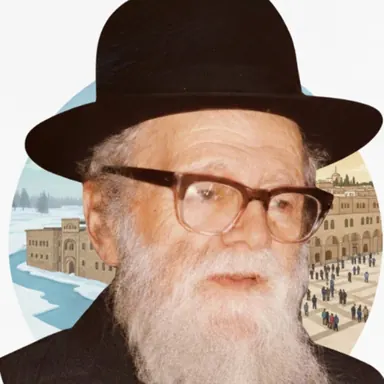
The Torah Teaching, State-Oriented Rulings and Public Work of the Gaon Rabbi Shaul Yisraeli
21 min read4,143 words
Summary
This survey presents the life and teaching of Rabbi Shaul Yisraeli, defined as the halakhic architect of Jewish sovereignty in the modern era. The text follows the course of his fascinating life, from his underground studies in the Soviet Union to his leadership of the "Mercaz HaRav" yeshiva and his service on the Supreme Rabbinical Court, highlighting his pioneering rulings that combine Torah and state. The heart of the survey deals with his revolutionary innovations, such as defining the State of Israel as a "Kingdom of Israel" with halakhic validity, resolving complex agricultural questions through the "otzar beit din," and formulating a moral doctrine of war and security. The aim of the article is to shed light on the figure of the rabbi as a living bridge between classical Lithuanian learning and the practical needs of a sovereign people in its land.
The Gaon Rabbi Shaul Yisraeli (5669–5755 / 1909–1995) stands as one of the pillars of halakhic ruling and of religious-Zionist thought in the twentieth century.[1, 2, 3] His many-sided figure bridged geographical, historical and ideological gaps: from the Lithuanian Torah world immersed in underground study under the yoke of communism, through pioneering spiritual leadership in the agricultural village, to the summit of state-oriented halakhic ruling as a judge on the Supreme Rabbinical Court and as head of the "Mercaz HaRav" yeshiva.[1, 3, 4] His Torah teaching was not confined to solving specific problems, but laid down a complete theoretical-halakhic foundation, a kind of sovereign "meta-halakha," that enables the Torah of Israel to serve as a practical and political guide for a Jewish people returning to its land.[3]
Childhood, Youth and the "Miracle of the Aliyah": From the Lithuanian Torah World to the Mercaz HaRav Yeshiva
Shaul Yisraeli was born on 25 Tammuz 5669 (14 July 1909) in the city of Slutsk in Belarus, to Rabbi Binyamin Izraelit, who served as rabbi and av beit din of the town of Kovindov in the Minsk province, and to Rebbetzin Chava.[1, 4] His childhood and youth were shaped in the shadow of the harsh and oppressive communist regime.[4] His father, who insisted on continuing to teach Torah despite the severe prohibitions of the authorities, was caught and sent by the Soviets to Siberia, where all trace of him was lost, while his mother was later murdered by the Nazis.[4]
Despite the difficult conditions, he studied in the Talmud Torah and the yeshiva ketana in Slutsk under the leadership of the great Lithuanian Torah scholars, the Gaon Rabbi Yechezkel Abramsky and the rosh yeshiva, the Gaon Rabbi Isser Zalman Meltzer.[4] When the yeshiva in Slutsk was closed by the Yevsektsiya, he moved to Minsk and studied underground with Rabbi Yehoshua Tsimbalist of Grodno.[4] In this period a government order was applied in Minsk allowing only "tradesmen" to remain in the city; in order to survive and continue his studies, Rabbi Yisraeli learned the craft of shoemaking, while his head and his thoughts remained immersed in the world of the Gemara ("the discussions of Abaye and Rava").[4] Later he joined a group of young men who studied underground in the "Maskil le-Eitan" synagogue with Rabbi Avraham Eliyahu Maizes (who later became one of the leaders of Neturei Karta in Jerusalem).[4] Rabbi Yisraeli attributed decisive importance to this period, noting that it was Rabbi Maizes who "set him on his feet" in terms of learning and method.[4]
In the year 5690 (1930), as the Soviet noose tightened, he moved to Moscow in an attempt to emigrate legally.[4] When the attempts failed, he began to plan a secret, illegal escape together with his study companion from Minsk, Rabbi David Solomon (later the rabbi of Kfar Avraham), and Rabbi Avraham Shadmi (later head of the "Beit Zevul" kollel and son-in-law of the Gaon Rabbi Yaakov Moshe Charlap).[4] Because of the mortal danger involved in crossing the border, the three turned to the Gaon Rabbi Yaakov Klemes in Moscow to decide for them by performing the "Goral HaGra" (the lottery of the Vilna Gaon).[4] The lot fell on an explicit biblical verse from the book of Deuteronomy:
"Turn and take your journey, and go to the hill country of the Amorites and to all their neighbours, in the Arabah, in the hill country and in the lowland, and in the Negev and by the seashore, the land of the Canaanites, and Lebanon, as far as the great river, the river Euphrates" (Deuteronomy 1:6) [4]
Following this dramatic resolution of their doubt, the three set out, and on 23 Shevat 5693 (1933), in the dead of night, wrapped in white sheets as camouflage against the snow, they crossed the frozen Prut River on the Polish border.[4] They were caught by the Polish border guard and taken into detention under threat of deportation back to the Soviet Union, a certain death sentence.[4] In the midst of the crisis, they wrote a letter to Maran Rabbi Abraham Isaac HaKohen Kook in Jerusalem.[4] Rav Kook acted at once, appealed personally to the British High Commissioner and obtained certificates (entry permits) for them.[4] Until their actual aliyah, Rabbi Yisraeli studied in the illustrious Mir yeshiva in Poland.[4]
At the beginning of the year 5694 (1934) he immigrated to the Land and began his studies at the Mercaz HaRav yeshiva.[4] Rav Kook immediately recognized his phenomenal genius and chose him to be one of the three select young men (together with Rabbi Yehuda Gershuni and Rabbi David Chanzin) before whom he would deliver and prepare his general lecture before giving it to the yeshiva.[4] At the same time, a deep spiritual and scholarly bond formed between him and the Gaon Rabbi Yaakov Moshe Charlap, who studied with him as a regular study partner.[4] In the year 5698 (1938) Rabbi Yisraeli received rabbinic ordination from Rabbi Charlap, and in the same year he travelled to Poland and married his cousin, Bat Sheva née Burgansky.[4]
The Kfar HaRoeh Period: Pioneering Halakha and Charting the Way of Torah in the Soil of the Land
Upon his ordination, Rabbi Yisraeli was appointed rabbi of the pioneering agricultural moshav Kfar HaRoeh (named after Rav Kook).[4] Rabbi Yisraeli settled in the village and served there for about 28 years.[4] During this period he developed an unprecedented model of communal Torah life interwoven with productive agricultural work.[4]
Modern agriculture in the Land of Israel raised pioneering and intricate halakhic questions for which no explicit answer was found in the traditional literature of the halakhic authorities in the Diaspora.[3] Rabbi Yisraeli worked diligently to solve the problems from the primary sources, combining practical scientific understanding with close consultation with agronomists and experts.[4] Among the main subjects he resolved were:
- Milking on the Sabbath: finding halakhic and technological solutions that avoid the Torah-level prohibition of mefarek (extracting), while preventing cruelty to animals and the economic collapse of the religious dairy.[4]
- Mixed seeds and the grafting of trees: dealing with modern sowing methods, such as the question of sowing vetch and oats together as fodder.[3, 4]
- The laws of Shemitah: formulating practical solutions for maintaining Jewish agriculture during the Sabbatical year without bringing down the new settlement.[3, 4]
He set down his historic lectures and rulings on these matters in his pioneering book "Eretz Chemdah."[1, 3, 4] The first part of the book was symbolically signed on 5 Iyar 5708 (the day the State was proclaimed), as an expression of the recognition that political rebirth requires a sovereign halakhic-agricultural code.[3, 4] Thanks to these rulings, Rabbi Yisraeli was recognized as the leading authority in the State of Israel on the commandments dependent on the Land, and for many years he headed the Chief Rabbinate's dedicated committee on this subject.[3, 4]
Alongside his agricultural work, he served as a ram and taught the senior class at the Kfar HaRoeh yeshiva, founded in 1940.[4] At that time, Rabbi Yehoshua Yagel, head of Midrashiyat Noam, approached him with a request to establish the subject of "Machshevet Yisrael" (Jewish Thought) as a worthy intellectual alternative for religious youth in the face of the winds of socialism, Marxism and national secularization of those days.[3, 4] Rabbi Yisraeli took up the challenge, defined the curriculum, worked to have the Ministry recognize it as a compulsory matriculation subject, and compiled for it the leading anthology "Perakim be-Machshevet Yisrael" (Chapters in Jewish Thought), which serves to this day as a foundational educational work.[1, 3, 4]
A unique and less familiar chapter of this period was Rabbi Yisraeli's intention to found a practical agricultural yeshiva, out of a vision of creating a complete organic connection between the highest theoretical learning and the work of the soil and frontier settlement.[5]
Return to Jerusalem: Rabbinic Judgeship, Heading the Yeshiva and National Leadership
At the beginning of the winter term of 5719 (1959), in view of a significant growth in the number of students at the Mercaz HaRav yeshiva and the death of the ram Rabbi Yaakov Kalab, the students of the yeshiva approached the rosh yeshiva, Rabbi Zvi Yehuda HaKohen Kook, with a request to reinforce the teaching staff.[4] Rabbi Zvi Yehuda sent the students to Kfar HaRoeh to entreat Rabbi Yisraeli to come and teach in the yeshiva.[4] Rabbi Yisraeli hesitated at first, out of humility and reverence, saying: "For years I have been occupied with halakha; a general lecture in a yeshiva is something else, that is learning...".[4] In the end he agreed, and for 36 years he delivered the main general lecture in the yeshiva.[4]
His deep humility and the holy trembling he felt toward his teachers were expressed in his first lecture in the yeshiva (in its old building in "Beit HaRav").[4] When the students asked him to go up to the lectern beside the holy ark, Rabbi Yisraeli climbed three steps, kissed the curtain, and then went down one step, saying: "Where Rav Kook stood I cannot stand."[4]
In the year 5725 (1965) he was appointed a judge on the Supreme Rabbinical Court of Appeals in Jerusalem, and consequently moved to live in the city.[4] On the Supreme Court he served alongside the Torah giants Rabbi Yosef Shalom Elyashiv and Rabbi Ovadia Yosef, and earned their enormous esteem.[3] The great Haredi Torah scholars saw him as a halakhic authority of rare stature and even tried to lead a move to have him appointed Chief Rabbi of Israel.[3, 5] Rabbi Yisraeli served as a judge until his retirement in the year 5740 (1980).[4] At the same time, he served as a member of the editorial board of the scientific-Torah commentary on the Bible "Daat Mikra."[4]
After the death of Rabbi Zvi Yehuda Kook in the year 5742 (1982), Rabbi Yisraeli was appointed head of the Mercaz HaRav yeshiva alongside the Gaon Rabbi Avraham Elkana Kahana Shapira.[4] During this period he became known for his national talks and sermons at the Jerusalem Day assemblies, which expressed a firm and uncompromising religious-Zionist outlook.[4]
His National Doctrine: Defining the State as the "Kingdom of Israel"
Rabbi Yisraeli's public work gained special momentum with the establishment of the State in the year 5708 (1948).[4] Together with a group of prominent rabbis, he founded "the Rabbinical Association of HaPoel HaMizrachi," intended to provide an authoritative halakhic answer to the practical questions of the new state.[1, 4] He served as the organization's spokesman and edited its famous journal "HaTorah ve-HaMedinah" (The Torah and the State), which became the main platform for clarifying the laws of public affairs, internal security, coalition and taxation.[1, 3] In addition, it was he who shaped the text of the prayer for Independence Day and led the "Yarchei Kallah" gatherings.[4]
At the heart of his national doctrine stood a revolutionary halakhic definition of the modern State of Israel [3]:
The Transition from a Private Community to an All-Israel Framework
Rabbi Yisraeli stressed that the establishment of the State marked the departure of the people of Israel from the dogmatic communal frameworks of the Diaspora into a sovereign all-Israel framework.[3] Therefore, the commandment of settling the Land and of applying sovereignty over it is not merely a private personal commandment, but a public commandment belonging to the national public domain.[3]
The Status of Democratic Government
In his seminal article of 5708, Rabbi Yisraeli determined that the State of Israel is halakhically defined as a "Kingdom of Israel" in every respect.[3] In his view, there is no need for an anointed king in order to apply the laws of kingship, since an elected democratic government draws its state and halakhic powers from the consent of "Klal Yisrael" (the community of Israel as a whole).[3] This article guides to this day the halakhic authorities and scholars who discuss the halakhic authority of government in Israel.[3]
Multi-Disciplinary Ruling
Rabbi Yisraeli was endowed with a comprehensive capacity for halakhic ruling in all areas of the Torah.[3] In an article by Rabbi Yaakov Ariel, Rabbi Yisraeli was compared to a "country doctor": one who must have complete command, at one and the same time, of general medicine, surgery, diagnosis and treatment, without the privilege of narrow specialization.[3] Thus Rabbi Yisraeli mastered Talmudic analysis, monetary law, the laws of the Sabbath and of the forbidden and permitted, alongside the commandments dependent on the Land and the laws of the army and the state.[3]
A clear symbol of his multi-disciplinary national rulings was his leading the ruling of principle (joined by the Chief Rabbis Rabbi Avraham Shapira and Rabbi Mordechai Eliyahu) that accepts the definition of brain-respiratory death as complete death according to halakha.[3] This bold, medically grounded ruling made possible the removal of organs for transplantation to save critically ill patients, and constituted a dramatic bridge between classical halakha and modern medical science.[3]
The Laws of Shemitah: Otzar Beit Din as the "Royal Road" from the Outset
One of the subjects in which Rabbi Yisraeli's agricultural-national doctrine was expressed most clearly was the attitude to Shemitah, and in particular the historic dispute between the mechanism of the "heter mechirah" (the sale permit) and the institution of the "otzar beit din."[6, 7]
Whereas the heter mechirah is based on a legal stratagem that temporarily removes the Jew's ownership of the land in order to circumvent the prohibitions of Shemitah (which drew sharp halakhic criticism from authorities such as the Netziv and the Chazon Ish because of the prohibition of "lo techanem" and of selling land in the Land of Israel) [6], Rabbi Yisraeli saw the institution of the otzar beit din as the proper solution, preferable from the outset.[7]
Rabbi Yisraeli based his ruling on several theoretical and practical principles:
Defining the Essence of Shemitah
The basic principle of the Shemitah year is the negation of private ownership and the application of the concept of ownerlessness (hefker) to the Land.[7] This principle is fulfilled fully and in the finest manner when the farmer transfers the management of his fields to the beit din, acting as the agent of the public.[7] The beit din does not trade in the produce (which is forbidden in Shemitah), but collects from the consumers only the costs of expenses and handling.[7] Therefore, Rabbi Yisraeli determined that "the otzar beit din is the only answer for fulfilling the commandment in practice... it is not a strained solution, but the royal road from the outset."[7]
Exemption from Bi'ur
Basing himself on the view of the Ramban, Rabbi Yisraeli ruled that produce gathered in an otzar beit din is not subject to the obligation of bi'ur (removal), which applies to private produce once it has ceased for the animals of the field, since this produce is already defined as removed from the house and is in the public domain.[7]
Thanks to his strenuous activity and halakhic explanation, a significant change took place in religious agricultural settlement [7]:
In past Shemitah years religious kibbutzim tended to sign the "heter mechirah" for fear of economic losses, but under his guidance 10 leading religious kibbutzim joined the framework of the "otzar beit din."[7]
This trend brought about a great sanctification of God's name and led to lower prices for fruit and vegetables in the Shemitah year, contrary to the claims of the private marketers.[7]
The Qibya Affair and the Ethics of War in Halakha
The Qibya incident in 1953 (Operation Shoshana), carried out in response to the murder of a Jewish family in Yehud by Arab infiltrators, aroused a broad international and public controversy because of harm to the civilian population and to small children.[8] Rabbi Yisraeli published in the collection "HaTorah ve-HaMedinah" a monumental halakhic study entitled "The Qibya Incident in Light of Halakha," which remains to this day the most fundamental and comprehensive work on the law of war and Jewish combat ethics in the modern period.[3, 8]
Rabbi Yisraeli carried out a gradual and incisive analysis of the question of harm to innocent civilians, drawing a sharp distinction between criminal and personal law and the law of war and of the state [8]:
A. The Responsibility of a Population That Encourages and Assists Terror
Rabbi Yisraeli examined whether collective criminal responsibility can be imposed on the population of a village that supports terrorists.[8] He discussed the midrash Bereshit Rabbah (34:19), which states that under the Noahide laws there is agency for a transgression in the case of murder (that is, one who hires or sends another to murder is liable to death by the court).[8] He explained the dispute between the author of "Mishpat HaMelukha" (Rabbi Isser Zalman Meltzer) and the "Mishneh LaMelekh," who discuss whether the liability is by virtue of actual "agency" or by virtue of "indirect causation."[8]
Rabbi Yisraeli decided in accordance with the view of the Rambam, who disagreed with the midrash and held that there is no agency for a transgression among the Noahides.[8] Therefore, a civilian population that merely encourages terror passively may not be made liable to death.[8] He also discussed the dispute between the Rambam and the Ramban concerning the obligation of "dinim" (establishing courts of justice) among the Noahides (the episode of Shimon and Levi in Shechem).[8] The Rambam held that the people of Shechem were liable to death because they did not judge Shechem son of Hamor, whereas the Ramban held that one is not put to death for neglecting the obligation of dinim, but that they were killed because they were wicked and idolaters.[8] Rabbi Yisraeli ruled as halakha that a civilian population may not be harmed merely because it refrained from rooting out the terrorists from its midst, since this refraining may stem from coercion and fear for their lives.[8]
However, when the population gives active assistance and shelter to the attackers, the law of a "rodef be-gerama" (an indirect pursuer) applies to them (based on the reasoning of the "Or Same'ach").[8] The entire adult population that gives physical and military assistance is considered halakhically a pursuer and may be harmed to save the public, but this definition does not in any way apply to children.[8]
B. Harm to the Innocent under Private Law versus State Law
Rabbi Yisraeli discussed the Gemara in tractate Bava Kamma dealing with King David's question of whether one may save oneself with one's fellow's property.[8] According to Rashi this is forbidden, and according to the Tosafot and the Rosh it is permitted (and it was ruled in the Shulchan Arukh, section 359, that one may save oneself but must pay for the damage).[8] In principle, a person may not save his own life by murdering his fellow ("Who says your blood is redder?").[8] Therefore, in a private action, it is permitted to harm terrorists (under the law of the pursuer), but there is no halakhic permission whatsoever to harm innocent children who are in their vicinity, since harming these children constitutes direct murder under duress.[8]
The approach changes completely when the action is defined as an official military action of the state [8]:
The Legality of War ("Dina de-Malkhuta")
The permission to wage war (which by its very nature entails bloodshed and harm to civilians) derives from an international legal agreement between nation and nation, defined halakhically as "dina de-malkhuta" (the law of the kingdom).[8]
Obligatory War and War of Vengeance
Rabbi Yisraeli determined emphatically that war against attackers and terrorists who are in constant attack against us (even if they take pauses for their convenience) is defined as a "milchemet mitzvah" (obligatory war) according to all opinions.[8] War against the enemies of Israel who retreat in order to return and strike again is defined as a "war of vengeance," which is a commandment and to which the full laws of war apply.[8]
The Law of the Innocent in War
In war there is no obligation to be meticulous about operational niceties that would endanger the combatants in order to prevent indirect harm to enemy civilians, since it is the nature of war that "the righteous perishes with the wicked."[8] The moral responsibility for the lives of the civilians and children harmed indirectly falls entirely on the attackers who use them as a human shield.[8]
A Grave Limitation on the Ethics of Combat
Rabbi Yisraeli stressed unambiguously that even within the framework of war, there is a grave prohibition against harming children and little ones directly and with premeditation, and therefore there is a moral and operational duty to strive to avoid this as far as possible.[8]
His Students, His Institutions and the Honors He Received
Alongside his many books, Rabbi Yisraeli's legacy lives and pulses through his distinguished students who serve as heads of yeshivot, rabbinic judges and city rabbis, and continue to lead the world of halakha and of state law.[1, 3]
His Prominent Students
- Rabbi Yaakov Ariel: formerly rabbi of Ramat Gan and one of the senior halakhic authorities of religious Zionism.[1]
- Rabbi Dov Lior: formerly rabbi of Kiryat Arba-Hebron and one of the leading halakhic authorities.[1]
- Rabbi Yosef Carmel: head of the "Eretz Chemdah" kollel and av beit din.[1, 9]
- Rabbi Yehuda HaLevi Amichai: head of the Torah VeHaAretz Institute.[1]
- Rabbi Moshe Harari: author of the popular series of halakhic books "Mikraei Kodesh."[1]
- Rabbi Yehoshua Magnes: one of the ramim of the Mercaz HaRav yeshiva.[1]
The "Eretz Chemdah" Institute
In the year 5747 (1987) Rabbi Yisraeli founded the "Eretz Chemdah" kollel and institute for the training of rabbinic judges in Jerusalem, and was its president and the shaper of its spiritual path.[4, 9] The institute was founded with the blessing of the rosh yeshiva Rabbi Avraham Shapira, with the aim of bringing together the prodigies of religious Zionism and raising them into great Torah scholars and rabbinic judges who would lead the rabbinical courts in Israel.[9] Rabbi Yisraeli placed on the institute's staff first-rank Torah scholars, among them the Gaon Rabbi Zalman Nechemia Goldberg, Rabbi Nachum Eliezer Rabinovitch, Rabbi Mordechai Greenberg, Rabbi Menachem Burstein and Rabbi Yisrael Rozen.[9] After his death, Rabbi Zalman Nechemia Goldberg and Rabbi Nachum Rabinovitch held the presidency of the institute, and later his student Rabbi Yaakov Ariel was appointed to head it, while Rabbi Yosef Carmel serves as head of the kollel.[9]
Public Recognition and Honors
For his tremendous work and his extensive Torah creativity, Rabbi Yisraeli received prestigious prizes and state honors.[1, 4]
Summary and Conclusions
The Gaon Rabbi Shaul Yisraeli will be remembered in the halakhic history of the people of Israel as the legal architect of renewed Jewish sovereignty.[3] Whereas exile had forced the world of halakha to withdraw into the four cubits of the individual and the local community, Rabbi Yisraeli led a profound change in thought and ruling that restored to the Torah its national-state dimension.[3]
His threefold contribution, the development of modern agricultural halakha through the "otzar beit din" and the commandments of the Land [3, 7], the legal establishment of the status of the State and its authorities as a "Kingdom of Israel" [3], and the formulation of a consistent doctrine of combat ethics and national defence [8], laid the foundations for a creative and sovereign religious-national life in the Land of Israel. His written legacy, his institutions and his many students are a living testimony to the work of a spiritual giant who knew how to join heaven and earth, deep Lithuanian learning and practical Zionist pioneering.[1, 3, 4, 5]
Sources9
- 1.שאול ישראלי - ויקיפדיה, he.wikipedia.org/wiki/שאול_ישראלי
- 2.ארץ חמדה חלק א' - מוסד הרב קוק, mosadharavkook.com/shop/ארץ-חמדה-חלק-א/
- 3.מודל לרב בישראל: 30 שנה לפטירת הרב שאול ישראלי - מקור ראשון, makorrishon.co.il/judaism/people-judaism/article/173232
- 4.הרב שאול ישראלי - Mercaz Harav | מרכז הרב, mercazharav.org.il/רבותינו/הרב-שאול-ישראלי/
- 5.הפרק הנשכח בחייו של הרב שאול ישראלי - מקור ראשון, makorrishon.co.il/judaism/people-judaism/article/173239
- 6.היתר מכירה - ויקיפדיה, he.wikipedia.org/wiki/היתר_מכירה
- 7.אוצר בית דין - ויקיפדיה, he.wikipedia.org/wiki/אוצר_בית_דין
- 8.תקרית קיביֶה לאור ההלכה - הבינה היהודית Jewish intelligence - הרב ..., hamachon.org.il/תקרית-קיביֶה-לאור-ההלכה/
- 9.ארץ חמדה (כולל) - ויקיפדיה, he.wikipedia.org/wiki/ארץ_חמדה_(כולל)