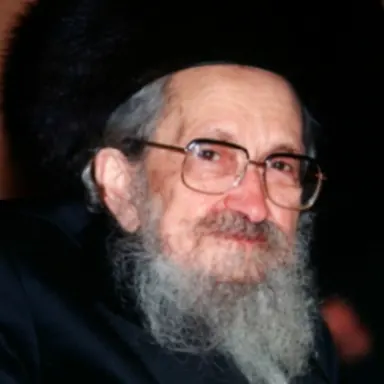
An educational "atmosphere" as a builder of identity; faith and trust as a force that creates reality in the generation of rebirth.
Biography
A rebbe and educator who rebuilt a Hasidic world after the Holocaust, and developed an accessible spiritual language of faith, atmosphere and education.
Migration
PolandTiberiasTel AvivJerusalem
The Road to Sinai
The archive doesn’t yet record The Slonimer Rebbe’s teachers, so the road to Sinai can’t be drawn yet.
The Life and Teaching of the Author of "Netivot Shalom": From Baranovichi to Jerusalem
19 min read·3,774 words
1. Introduction: The Figure Who Rebuilt a World from Its Ruins
Rabbi Shalom Noach Berezovsky (5671–5760, 1911–2000) was not merely a spiritual leader in a generation of upheavals; he was the chief architect and the educational compass of the revival of Slonim Hasidism in the 20th century. While the destruction of Europe threatened to leave the Slonim dynasty as a mere historical memory, the "Netivot Shalom" stood forth as a living bridge of fire, connecting the ruins of Baranovichi with the renewed flowering of Jerusalem.
In his figure two worlds merged harmoniously: that of a rosh yeshiva delving into the depths of "lomdus" (analytical scholarship), and that of a Rebbe leading his community in the ways of "avodah" (divine service) and "devekut" (cleaving to God). His pedagogical influence crossed sectors and made him one of the most influential figures in the world of contemporary Jewish thought. He who began his path as a young student in the nurseries of Poland and Lithuania ended his life as a spiritual shepherd whose words are studied in batei midrash and in academia alike.
✦
2. Roots in Baranovichi: The Nursery of Leadership
Baranovichi at the beginning of the 20th century was a unique crossroads—a geographical and cultural border between Poland and Lithuania. Its Jewish landscape was marked by a rare combination: on the one hand, the cool and incisive Lithuanian "lomdus," and on the other, the warmth and "hitlahavut" (fervor) of Slonim Hasidism. This environment shaped Rabbi Berezovsky's personality as one who combines rigorous intellectualism with the Hasidic goals of the service of the heart.
Figure / Connection
Description of the connection and its pedagogical influence
His father
Head of the community of Slonim Hasidim in Baranovichi, a public figure who connected him with leadership.
His mother
A granddaughter of the brother of the "Yesod HaAvodah" (the first Rebbe), a deep family root in the dynasty.
Rabbi Avraham Weinberg (the "Beit Avraham")
His principal teacher and spiritual guide, who shaped his inner world.
Rabbi Moshe Midner
His chief teacher in Talmudic scholarship; a gaon who imparted to him the analytical method of the "Torat Chesed" yeshiva.
Shlomo David Yehoshua
The Rebbe's son and his study partner (chavruta), his deep personal link to the heart of the dynasty.
The historian's insight: The "Torat Chesed" yeshiva was a revolutionary institution. It replaced the "emotional storm" that was sometimes identified with Hasidism with an approach of self-discipline and rigorous analytical study in the Lithuanian style. Rabbi Berezovsky learned there that Hasidism is not a substitute for Torah, but the soul and inner motivation of scholarship.
✦
3. Immigration and Rescue: The Miracle of 5693
In 1933 (5693), the wondrous turning point occurred that ensured the continuity of the dynasty. Rabbi Berezovsky accompanied his teacher, the "Beit Avraham," on a visit to the Land of Israel. During their stay in Tiberias, it was decided to marry him to the daughter of Rabbi Avraham Weinberg (later the "Birkat Avraham").
This marriage was not merely a family event, but a "double miracle" of physical rescue and of the strategic preservation of the nucleus of the Slonim leadership. While his entire family—his parents and his sisters—was utterly wiped out in the ashes of the Holocaust, Rabbi Berezovsky survived to re-establish the kingdom.
The formative stations of his life in Israel:
Tiberias: the center of the old Slonim community, where he became versed in the Land-of-Israel tradition of the Hasidism.
Tel Aviv: he served as rosh yeshiva of the Chabad "Tomchei Temimim" yeshiva. Although he was not a Chabad Hasid, he was appointed to the post thanks to his wondrous "lomdus" lectures, which testifies to an appreciation of his genius that crossed camps.
Jerusalem: the city in which he chose to establish his central life's work, which rebuilt the Hasidism.
✦
4. Establishing the "Center": Building the Beit Avraham Yeshiva
In 1943 (5704), at the height of the darkness of the Second World War, Rabbi Berezovsky made a decision that seemed entirely "irrational": to leave a secure and respected position in Tel Aviv in order to establish a Slonim yeshiva in Jerusalem.
While reports of the destruction of his community in Europe were streaming in, and without a budget or financial backing, he gathered a group of refugees and a few survivors. This was a yeshiva born out of ashes, with a burning faith in national resurrection.
The educational designer's insight: Contrary to the traditional model, in which a Rebbe establishes a yeshiva for his Hasidim, in Slonim the reverse process took place—the yeshiva built the Hasidism. Rabbi Berezovsky created an institution that shaped the children and the refugees into leaders, and it was they who, at the end of the day, asked him to take upon himself the yoke of the Rebbe's office.
✦
5. The Teaching of the "Atmosphere": The Pedagogy of the Hidden
The core of the educational teaching of the "Netivot Shalom" lies in the concept of "atmosphere" (Ovirah). He did not see education as a series of techniques or punishments, but as the creation of a metaphysical-spiritual sphere that envelops the student and influences his soul covertly.
The three pillars of the educational "atmosphere":
1.The home as the underlying background: Education begins with harmony between the parents. The absence of tension at home creates a "healthy substrate" for the child's soul, enabling him to grow without emotional deficits.
2.The purity of the educator: The educator is not a "lecturer" but a "radiator." The teacher's inner sincerity and devotion influence more than any word that is spoken. If the teacher truly "believes," the student will sense it in his soul.
3.The "of itself" effect (Automatic): When the atmosphere in the yeshiva is suffused with warmth, light and holiness, discipline problems dissolve of their own accord. Instead of fighting the darkness, one adds light, and the change happens "of itself" (mimeila).
The "atmosphere" according to Slonim is an educational space in which the student grows out of inner freedom and a natural attraction to the good, and not out of fear or coercion.
✦
6. The Literary Revolution: A Synthesis of "Lomdus" and Soul
Rabbi Berezovsky's literary legacy represents the rare combination of Lithuanian structure and Hasidic feeling. His "lomdus" was not merely academic; it served as the structural and systematic skeleton on which its emotional power was built.
Netivot Shalom: a series of books that became a worldwide consensus. The book excels in a modern psychological sensitivity, emphasizing inner motivation and mental health over an outward fear of punishment. It is studied today in academic circles because of its profound understanding of the depths of the human soul.
Emunah VaDaat: a series of scholarly lectures of the highest level. This is a rare phenomenon—a Hasidic Rebbe whose books of Talmudic analysis are considered "foundational books" in the Lithuanian yeshiva world, testifying to his absolute mastery of the language of scholarship.
✦
7. "He Stands Behind Our Wall": The Land of Israel and Jerusalem
Rabbi Berezovsky's love for the Land of Israel was total. He firmly refused to leave the country even for medical treatment, a devotion that passed also to his daughter, who refused to go abroad for life-saving treatment, saying: "Father did not leave, and I too will not leave."
During the period of the Six-Day War, he developed the bold metaphor of "Raglei Mashiach" (the feet of the Messiah):
The "feet": the State was established through its physical and secular aspects (just like a "breech birth," which begins with the feet).
The "head": the role of the world of Torah is to pour the soul and the spiritual content into the national body that has been built.
The day after the liberation of the Western Wall, while snipers still threatened the area, the rabbi hurried to the holy remnant.
"We stand astonished at the great revelations... The Western Wall is the place where a Jew feels that he stands before the face of God and pours out his heart like water. This is a revelation of divine love that can be answered only by adding holiness."
✦
8. Conclusion: The Legacy of the Educator of the Generation
The author of "Netivot Shalom" was the living bridge that rebuilt the "world of yesterday" of Europe within the vibrant reality of modern Israel. He proved that it is possible to combine incisive scholarship with Hasidic warmth, and that a traumatic past can become a source of building and faith.
His "secret" was the ability to live on the level of an "angel" detached from matter, while at the same time understanding deeply the soul of "the simple person." He left behind him not only buildings and books, but an entire generation that educates its children in the light of the conception that holiness begins with love, with the right atmosphere and with uncompromising faith in the human spirit.
Rabbi Shalom Noach Berezovsky, Author of "Netivot Shalom": His Life, Teaching and Thought
Executive Summary
Rabbi Shalom Noach Berezovsky (5671-5760, 1911-2000), known after his series of books as the "Netivot Shalom," was the seventh Rebbe of Slonim Hasidism and an influential spiritual figure of the 20th century. After the overwhelming majority of Slonim Hasidism was annihilated in the Holocaust, he took upon himself the task of rebuilding it in the Land of Israel. He founded the "Beit Avraham" yeshiva in Jerusalem, which became the center of life of the renewed Hasidism, in a unique model of "a yeshiva that builds a Hasidism."
His teaching, embodied in his clear and accessible books, won enormous popularity extending far beyond the bounds of his community. It focuses on the foundations of faith and of active trust (bitachon) in God, emphasizing a person's responsibility to awaken salvation through his absolute trust. His uniqueness was expressed also in his consistent engagement with the historical events of his time—the Six-Day War, the Yom Kippur War and the Holocaust—and in his analysis of them from a deep spiritual perspective, which sees in them divine messages and stations in a complex process of redemption ("Raglei Mashiach," the feet of the Messiah).
In addition, Rabbi Berezovsky developed an original and comprehensive educational thought, in which the educational "atmosphere" stands at the center as the principal means of influence. In his view, shaping a moral and spiritual environment enables the student to internalize values naturally and indirectly ("mimeila," of itself), out of inner freedom and without coercion. His personality, which combined greatness in Torah and absolute asceticism with human warmth and an exceptional sensitivity to the human soul, made him one of the most revered and influential figures in the Jewish world in the last generation.
✦
Biography
Early Years in Baranovichi
Rabbi Shalom Noach Berezovsky was born on 14 Av 5671 (1911) in the city of Baranovichi in Belarus (then part of Poland). His father, Rabbi Moshe Avraham, was head of the community of Slonim Hasidim in the city, and his mother, Tzivia, was a granddaughter of the brother of the founder of the Hasidism, Rabbi Avraham Weinberg the First. The city of Baranovichi was an important Torah center with a distinctly "Lithuanian" character, and its Jewish community was divided between Lithuanians (Litvaks) and Hasidim.
In his youth he studied at the "Torat Chesed" yeshiva of Slonim Hasidism, which was distinguished by its emphasis on scholarship and diligence in the Lithuanian style. There he studied as a chavruta with a boy of his own age, Shlomo David Yehoshua Weinberg, the son of the Rebbe of the time, the "Beit Avraham," and the one who was destined to succeed him. He received rabbinic ordination at the age of 17 from Rabbi Meir Karelitz, the brother-in-law of the Chazon Ish. Central figures who influenced him were his teacher, the Rebbe the "Beit Avraham," and also one of the elder Hasidim, Rabbi Moshe Midner (the "RaMaM").
Immigration to the Land of Israel and Rescue from the Holocaust
In 5693 (1933), he accompanied his teacher, the "Beit Avraham," on a visit to the Land of Israel. During the visit, the Rebbe arranged his match with Chava, the daughter of his cousin, Rabbi Avraham Weinberg (later the Rebbe the "Birkat Avraham"), who was one of the leaders of the Slonim community in Tiberias. He married her in 5695 (1935), remained in the Land and lived in Tiberias, where he taught at the "Or Torah" yeshiva. This decision saved his life; his entire extended family that remained in Europe, including his parents and his sisters, perished in the Holocaust.
Rebuilding Slonim Hasidism
In 5700 (1940) he was appointed to serve as rosh yeshiva of the Chabad "Tomchei Temimim" yeshiva in Tel Aviv. When the first reports reached the Land of the annihilation of European Jewry and the liquidation of the Slonim communities, including the murder of the Rebbe (his study companion), he said: "If it is not in our power to save the bodies, let us save the spirit." In the month of Cheshvan 5702 (1941), he left his senior post and, with great toil and under the unbearably difficult economic conditions of the days of the Second World War, founded in Jerusalem the "Beit Avraham" yeshiva, named after his teacher. The yeshiva, which began with a handful of students, became the nucleus from which the whole of Slonim Hasidism was rebuilt.
After the passing of the interim successor, Rabbi Mordechai Chaim Slonim, in 5714 (1954), democratic elections were held for the office of Rebbe (a rare thing in the Hasidic world), in which his father-in-law, Rabbi Avraham Weinberg, author of the "Birkat Avraham," was chosen. Under his father-in-law's leadership, Rabbi Berezovsky served as head of the "Beit Avraham" yeshiva for 39 years and was his right hand in rebuilding the Hasidism. He shaped an entire generation of students, who were provided for at his table and learned Torah and conduct from him personally and constantly.
The Period of His Leadership as Rebbe
On 2 Iyar 5741 (1981), exceptionally, Rabbi Berezovsky was crowned Rebbe while his father-in-law was still alive. After his father-in-law's passing, the court split, with most of the Hasidim following him and a minority establishing a separate court in Bnei Brak. He served as Rebbe for about 20 years, until his passing on 7 Av 5760 (8 August 2000), his 89th birthday. During this period he continued to build and consolidate the Hasidism, which under his leadership became one of the largest and most splendid courts, numbering about 2,500 families. He was buried in the Perushim section on the Mount of Olives.
✦
His Thought and Teaching
The main points of Rabbi Berezovsky's thought are concentrated in his series of books "Netivot Shalom," which became an enduring treasure of the entire Torah world, far beyond Slonim Hasidism.
The 'Netivot Shalom' Series of Books
The series comprises several parts:
On the Torah: five volumes of Hasidic commentary on the weekly Torah portions, based on his talks at the "tish" as Rebbe.
On divine service and the festivals: two volumes on the foundations of Judaism and on the holidays, based on his talks as rosh yeshiva.
Pamphlets and booklets: talks and writings on specific subjects, such as Hanukkah, Purim, the Holocaust ("HaHaruga Alecha"), education ("Netivei Chinuch"), and more.
Additional volumes: after his passing, additional volumes of talks ("Divrei Shalom VeEmet") and of letters ("Michtevei Kodesh") were published.
On the Talmud (Shas): his scholarly lectures on tractates of the Babylonian Talmud were published in the series "Shiurei Netivot Shalom."
The books won great popularity thanks to their clear and modern Hebrew, unlike many Hasidic books, and thanks to their ability to touch the depths of the human soul and to offer spiritual guidance relevant to our generation.
Faith and Trust
A central foundation of his teaching is the distinction between faith (emunah) and trust (bitachon). While faith is the intellectual recognition that everything comes from God, trust is an active force, which draws salvation down into reality. In his famous talk after the Yom Kippur War, he presented his teaching with direct reference to the conception of the Chazon Ish.
The approach of the Chazon Ish
The approach of the 'Netivot Shalom' (Hasidic)
Trust is the application of faith.
Trust is a force that creates reality.
Its meaning is that a person knows that there is no chance, and everything is from God, and therefore he has nothing to fear.
Its meaning is that a person trusts in God that He will help him, like a son who trusts in his father.
It does not guarantee a good outcome, but grants courage and a possibility of rescue.
Trust itself draws down salvation. The stronger the trust, the greater the salvation.
"Who can say that it will be so, and did he have a prophecy that it will be good?".
"Through trust in God, one thereby draws down His salvation, may He be blessed." Against trust, there are no accusers.
In his view, trust is the trial of the generation. In times of crisis, when it seems that prayers are not answered ("He shuts out my prayer"), only absolute trust, stemming from a son's feeling of closeness and love for his father, can break through the barriers.
Engagement with Historical Events
Unlike many other Rebbes, Rabbi Berezovsky consistently addressed the central events that shaped the life of the people of Israel in his generation.
The Yom Kippur War: He saw in the war and in the "failures" revealed in it a direct divine message. In his words, "Heaven showed us" that one must not trust in the IDF, in sophisticated weaponry or in the great powers, but rather "that we have none to lean on but our Father in Heaven." The war was a call for personal and national soul-searching, and for a return to pure trust in God.
The Six-Day War and the liberation of Jerusalem: He saw in the liberation of the Western Wall a "double miracle": the miracle of military rescue from the enemy who had risen to destroy, and above all, "the revelation of His love, may He be blessed, for His people Israel," which returned to the people "the remnant of our Holy Temple." He emphasized the duty of immense thanksgiving for this, and from then on instituted in Slonim Hasidism not to recite Tachanun on Jerusalem Day.
The conception of redemption: He interpreted the events of the generation, including the establishment of the State and the wars, as a process of "Raglei Mashiach." He explained this as a parable of a birth in which the feet come out before the head—a dangerous, non-ideal birth, in which the order is reversed (forces that are not holy lead the process), but which is still the beginning of the birth of redemption. Therefore, one should anticipate salvation out of the difficulties, but also understand that this is not the complete redemption.
Love of the Land of Israel and Its Settlement
His love for the Land of Israel was burning. From his immigration in 5695 he did not leave its borders even once, and he even refused to travel abroad for medical purposes. He was an enthusiastic supporter of the settlement of the Land of Israel, encouraged the establishment of Hasidic communities in Beitar and Emmanuel, and maintained close ties with public figures from the Yesha Council. He had a special bond with Jerusalem and the Western Wall. He deliberately located his yeshiva as close as possible to the Old City, and used to walk there with his Hasidim in song every Friday night.
✦
His Educational Thought: The 'Atmosphere' as the Central Means
Rabbi Berezovsky, as a great educator, developed an ordered educational teaching whose central foundation is the atmosphere.
Feature
Description
The essence of the atmosphere
A powerful, gentle and indirect educational means. Its aim is to create a substrate in which the educational idea germinates in the student "mimeila" (of itself), out of a sense of freedom and without confrontation.
Creating the atmosphere
An ongoing process that begins at home (the qualities of the parents, the social and cultural environment) and continues in the educational institution. The responsibility rests on all levels of leadership: the Rebbe, the rosh yeshiva and the educator. It is built through stories of tzaddikim, the repetition of principles and, above all, through the awareness and inner state of the educator.
The role of the student
The condition for the success of the atmosphere is the student's receptiveness. He must want to be influenced and must remove his resistance, out of "complete submission" to the values of the place and of the educators.
The goals of education
Rabbi Berezovsky presents a hierarchy of four stages of education: physical (manners and order), emotional (control of the will), spiritual (preferring the spirit to matter), and the education of the soul (the connection to the Divine). The supreme goal is "going out of the bounds of the self" into the expanses of Torah, prayer and kindness.
"Education on a high level"
An additional level of influence, which takes place through a deep spiritual bond between the educator and the student, to the point that the educator's thoughts about his student act upon him directly, "through the channels of thought."
✦
His Character and Personality
Many testimonies describe a personality that combined opposite extremes:
Gaon and tzaddik: He was an outstanding scholar, who composed analytical lectures on the Talmud, and at the same time a man of Hasidic thought and ethics. He lived in complete separation from this world; it is told that as a result of spiritual work in his youth, he completely lost his sense of taste and his appetite for food.
An "angel" and a sensitive man: Despite his remoteness from worldly vanities, he was endowed with an unusual sensitivity and a deep empathy for the difficulties and dilemmas of the simple person. He was "an exceedingly warm-hearted man," pleasant and accessible, who gave personal and warm attention to everyone.
An educator through his deeds: His educational power stemmed not only from his talks, but above all from his personal example. He shaped an entire generation of Hasidim who lived in his presence in the yeshiva, watched his conduct in every detail, and adopted his way in an inward and profound manner.
It is this combination of sublime spiritual greatness with a deep understanding of the human soul that made Rabbi Shalom Noach Berezovsky and the teaching of the "Netivot Shalom" a source of inspiration for tens of thousands of Jews from all circles and communities.
Document 2/2
Restorative Leadership, Educational Thought and the Merging of Worlds: The Teaching and Work of the Slonimer Rebbe, Author of "Netivot Shalom"
21 min read·4,185 words
Summary
This article surveys the life and thought of Rabbi Shalom Noach Berezovsky, the Slonimer Rebbe known as the author of **"Netivot Shalom," who led the Hasidism out of the ruins of the Holocaust to a renewed flowering in the Land of Israel. The text traces the unique merger he created between Lithuanian scholarship and mussar and Hasidic devotion, with emphasis on the refinement of character traits, the importance of faith in times of crisis and the holiness of the Sabbath. The author emphasizes the Rebbe's pedagogical contribution, as one who championed education out of love and adaptation to the spirit of the generation, and his wide-ranging influence, which broke through the boundaries of the Haredi court and reached the heart of the religious-Zionist public thanks to his clear Hebrew style. Alongside this, the article examines his national positions regarding the integrity of the Land** and his theological conception, which sees the perpetuation of the spirit and the continuity of the generations as the central response to the destruction of European Jewry.
The Historical and Theological Background: The Rupture of the Destruction and the Move to the Land of Israel
Slonim Hasidism, which arose in the mid-19th century in the town of Slonim in western Belarus, is an exceptional test case of a Hasidic court that grew up in the heart of Torah Lithuania and was deeply influenced by the scholarly and ethical environment that surrounded it.[1] The roots of the dynasty draw on the teaching of the great figures of Lithuanian Hasidism, from Rabbi Shlomo of Karlin, through his disciple Rabbi Mordechai of Lechovitch and his son Rabbi Noach of Lechovitch, to Rabbi Moshe Polier of Kobrin.[1] In 5618 (1858), upon the passing of Rabbi Moshe of Kobrin, most of the Hasidim turned to his foremost disciple, Rabbi Avraham Weinberg the First, known as the author of the "Yesod HaAvodah," and crowned him as the founding Rebbe of the dynasty.[1] Over its generations the Hasidism was led by four Rebbes on the soil of Lithuania and Belarus and three Rebbes in the Land of Israel, consistently combining Lithuanian analytical scholarship with Hasidic fervor and devotion.[1, 2]
The glorious history of the Hasidism in Europe was cut off at a stroke during the Second World War.[1, 2] The physical and spiritual destruction struck its central courts in Baranovichi and Slonim, and in its course the sixth Rebbe, Rabbi Shlomo David Yehoshua Weinberg (called "the young Rebbe"), was murdered; he had given up many opportunities to escape so as not to abandon his Hasidim, and met his death in the liquidation of the Koldichevo concentration camp on 6 Cheshvan 5704.[1] This day was later established in the Hasidism as the general day of remembrance for the destruction of the Slonim communities in Europe.[1]
When the first reports arrived of the dimensions of the physical and spiritual catastrophe taking place in Europe, Rabbi Shalom Noach Berezovsky understood that the old world of Torah had been destroyed, and that the historic duty of rebuilding the dynasty from the ashes rested upon him.[1, 2] In the month of Cheshvan 5702 (1942), in the midst of the war, Rabbi Shalom Noach left his Torah post in Tel Aviv and founded in Jerusalem the "Beit Avraham" yeshiva of the Slonim Hasidim.[1, 2] He saw the founding of the yeshiva not merely as a local educational institution, but as a formative act of the "victory of the spirit" over the Nazi enemy and as the spiritual channel that would ensure the continuity of the dynasty in the Land of Israel.[1, 2]
✦
Biography and Institutional Milestones of the Author of "Netivot Shalom"
Rabbi Shalom Noach Berezovsky was born on 14 Av 5671 (8 August 1911) in the town of Mosh to Rabbi Moshe Avraham Berezovsky, head of the community in Baranovichi, and to Tzivia, the daughter of Rabbi Asher Weisstein.[1, 3] His family lineage connected him directly with the founders of the dynasty, since his grandfather, Rabbi Asher, served as head of the "Anaf Etz Chaim" yeshiva in Slonim and was the son-in-law of Rabbi Hillel Weinberg, the brother of the author of the "Yesod HaAvodah."[1] Already in his youth Rabbi Shalom Noach stood out as an exceptional Torah prodigy, and in later days the Slonim Hasidim prided themselves that a tremendous gaon was growing up in their court.[1, 4] He studied at the "Torat Chesed" yeshiva in Baranovichi under the leadership of the Rebbe, the author of the "Beit Avraham," and was even entrusted with the task of writing down and editing his teacher's talks and teachings.[1, 3] During these years he received rabbinic ordination from Rabbi Meir Karelitz, and became a close chavruta of Rabbi Shlomo David Yehoshua Weinberg.[1, 3]
In 5693 (1933) he married Chava Miriam, the daughter of Rabbi Avraham Weinberg the Third (the "Birkat Avraham").[1] In 5695 (1935) or 5696 (1936) he immigrated to the Land of Israel and settled in Tiberias, where he taught at the "Or Torah" yeshiva at the tomb of Rabbi Meir Baal HaNes.[1, 2, 4] In 5700 he was called to serve as head of the Chabad yeshiva "Tomchei Temimim" in Tel Aviv.[1, 4] After founding the "Beit Avraham" yeshiva in 5702, he stood at its head for about fifty years and raised up prominent students who became the spearhead of the world of Torah and Hasidism.[1, 4]
In Iyar 5741 (1981), while his father-in-law the "Birkat Avraham" was still alive, Rabbi Shalom Noach was crowned Slonimer Rebbe by most of the Hasidim of the court.[1, 3, 4] This move aroused opposition from a minority group, which claimed an affront to the honor of the serving Rebbe and contested the letter of coronation, which led to a historic split and to the establishment of a separate court under the name of "Slonim" Hasidism (spelled "סלאנים").[1] Rabbi Shalom Noach served as a member of the Council of Torah Sages of Agudat Yisrael, and presided over public enterprises such as Chinuch Atzmai (the Independent Education network), the Vaad HaYeshivot (Yeshiva Committee) and the Ofakim yeshiva.[1, 3] In the 1980s, in the wake of the fierce disputes that broke out between the Lithuanians and the Hasidim, he chose to resign from the Council of Torah Sages in order to keep away from the dispute.[1, 3] He passed away on 7 Av 5760 (8 August 2000) and was buried in the cemetery on the Mount of Olives.[3, 5]
✦
The Torah and Theological Teaching of the Author of "Netivot Shalom"
The Synthetic Merger of Hasidism and the Lithuanian Way: "The Greatness of Man" and Mystical Devotion
The spiritual teaching of the "Netivot Shalom" constitutes a profound integration of the world of Hasidic thought with the world of the Lithuanian yeshivas.[1, 2] Whereas classical Hasidism placed great emphasis on spontaneous devotion and mystical attachment to the tzaddik, Rabbi Shalom Noach demanded of his students order and strict self-discipline, values identified with the culture of the Lithuanian mussar yeshivas and with the idea of "the greatness of man" from the school of Slabodka.[1, 2] This Torah legacy found clear expression in the character of the "Beit Avraham" yeshiva, which combines the study of Gemara in profound Lithuanian analysis with Hasidic divine service based on lengthy Sabbath prayers and meticulous introspection.[1, 2]
The Axis of Faith and the Clarification of Trials: Refinement in the Face of Darkness
At the center of the theological system of the "Netivot Shalom" stands the concept of faith, which is perceived not as a dogmatic premise but as an active and experiential spiritual force.[6] Faith is the Jew's central working tool in situations of "hiding of the Face" (hester panim) and darkness.[7, 8] Rabbi Shalom Noach relies on the Talmudic and Midrashic saying that "by the merit of faith our fathers were redeemed from Egypt, and by the merit of faith they are destined to be redeemed" (Yalkut Shimoni, Hosea 519), and explains that the word "zechut" (merit) derives from the words "zach" (pure) and "bahir" (clear).[9] Redemption—both collective and individual—is conditional on the existence of a faith that is pure, clean and clear of any dross.[9, 10]
His teaching offers deep consolation to the individual who dwells in spiritual exile, in darkness and in distress.[10] The "Netivot Shalom" emphasizes that even when it is dark for a Jew and it seems to him that everything is closed before him, the duty rests upon him to act and to go out of his own private Egypt.[10] He proves this from the journey of the Children of Israel in the wilderness, "a land of drought and of the shadow of death," in which they walked for forty years by the power of the existential awareness that "the Lord your God is with you," and hence cleaving to God enables a person to pass through the darkest abysses without lacking anything.[10]
The Refinement of Character Traits as the Foundation of Torah and "Holiness"
Rabbi Shalom Noach set the refinement of character traits as a necessary precondition for receiving the Torah and transmitting it.[11] In his books he cites the words of Rabbi Chaim Vital in the book "Sha'arei Kedusha," who wonders why the matter of character traits and their refinement was not written explicitly in the Torah, even though the Sages placed it at such a high level.[12] His explanation is that the Torah was given only after the refinement of the character traits, since refined traits are the chariot for the indwelling of the Shekhinah and of the Torah in the human soul.[12] As a model of refined leadership he presents Moses our teacher, who was extremely careful about the honor of each and every one of Israel, and even about the honor of his students.[11] In the first gate of his commentary on Tractate Avot, the "Netivot Shalom" emphasizes the duty to believe that every Jew has a share in the World to Come, a belief that expresses the recognition that every soul has the power and the inner capacity to reach the highest of the levels for which it is destined.[12]
Alongside his concern with the traits of the heart, the "Netivot Shalom" developed a sharp and demanding teaching in matters of personal holiness and sexual abstinence.[2] This line finds expression in the pamphlets intended for the days of Shovavim, which deal with the rectification of the "yesod" (sexual holiness) and the struggle against the forces of evil through inner mortifications and fasts.[2, 13, 14] He determined that a day on which a Jew does not perform an action contrary to his natural will in order to break the power of evil is not considered a true day in his life.[10] These instructions are conveyed in his books in a refined, allusive and indirect manner, which enables the modern reader to approach the ascetic demands without feeling alienation or linguistic aversion.[2]
The Holiness of the Sabbath as a Heavenly Revelation of Renewal
The Sabbath is another central axis in the thought of Rabbi Shalom Noach.[6] The Sabbath is perceived not merely as a day of abstention, but as a fixed heavenly revelation granted to the Jew once every seven days.[10] The Sabbath is in the category of "heaven," a time in which a person is able to return to his spiritual root and be renewed as a new creature, in keeping with the idea of renewal contained in the commandment "This month shall be unto you."[10] The "Netivot Shalom" distinguishes between the body and the soul of every commandment, emphasizing that the outward action of the commandment is the body, while the good inner will and cleaving to God are the soul that breathes life into it.[10]
✦
The Memory of the Holocaust as a Theological and Practical Imperative
Rabbi Shalom Noach's grappling with the Holocaust shaped his later thought to a great extent, and it is presented in detail in the famous pamphlet "HaHaruga Alecha" ("Slain for Your Sake") and in the essay "BeSod Kedoshim."[1, 6, 8] The "Netivot Shalom" offered a profound analysis of the terrible catastrophe, focusing on two central aspects:
The Breaking of the Chain of Transmission ("Mekablin Dein Min Dein")
The great tragedy of the Holocaust, in his view, does not consist solely in the physical loss of millions of people, but in the severing of a critical link in the chain of transmission of the Torah and the tradition from generation to generation.[8] The process of transmitting the Torah in the people of Israel rests on the mechanism of "mekablin dein min dein" (each generation receiving from the generation before it).[8] The obliteration of an entire generation that was a whole world of holiness and Torah life created a metaphysical void that threatened to cut off the continuity of the generations.[8] The answer to this severance, according to the "Netivot Shalom," rests upon the surviving remnant, which is obliged to serve as a living channel for transmitting the light and the spirit of the generations that perished to the generation of the future.[8]
Spiritual Commemoration versus Passive Memory
Rabbi Shalom Noach utterly rejected ways of commemoration based on external ceremonies or silent memorial monuments.[8] He determined that the memory of the destruction imposes a practical duty on the survivors: if it was not in our power to save the bodies of the holy martyrs, then it is our duty to save at least their spirit, by learning from their spiritual way and continuing their religious life.[8]
He linked the memory of the Holocaust directly to the commandment to remember the deed of Amalek, defining Amalek as the eternal force of evil in creation, which changes its form in every generation and which was incarnated in our generation in the figure of the Nazis, may their name be blotted out.[8] He spoke out forcefully against the rapid forgetting of the catastrophe, and warned that a new generation was growing up that did not know the spiritual wealth of the destroyed communities and the glorious figures of those who perished.[8] Mourning over the destruction, in his view, is not a weeping of despair and brokenness, but "a weeping of hope, of longing, not for what has passed but for what will be."[10] The meaning of mourning is the refusal to be reconciled with the present and with the current situation, and out of this grows the commitment to build the future.[10]
✦
National, Political and Public Leadership
The Sermon on the Liberation of Jerusalem and the Attitude to Handing Over Territories
Rabbi Shalom Noach held a deep, inward national outlook, which emphasized the metaphysical virtue of the Land of Israel.[3, 15] He was firmly and uncompromisingly opposed to handing over parts of the Land of Israel to the Arabs.[1, 3] After the liberation of Jerusalem in the Six-Day War, he delivered a special and fervent sermon on the duty to give thanks to God for the great miracle of rescue and for the goodness of God in returning the Western Wall into the hands of Israel.[1, 3] Following his sermon and his direct instruction, it became the custom in Slonim Hasidism not to recite Tachanun on Jerusalem Day—a unique and exceptional ruling in the conservative Haredi sphere.[1, 3]
His Theological Response to the Yom Kippur War
In talks he delivered in the wake of the Yom Kippur War (1973), the "Netivot Shalom" presented an uncompromising teaching regarding the meaning of national crises.[15] He saw in the war a deep spiritual shock and an unprecedented rupture intended to shake the hearts of the people of Israel and to awaken them from their spiritual slumber.[15] In his view, national troubles and crises are not chance events stemming from tactical failures, but a direct divine call to return to simple faith and to recognize that only God is the true protector of the people.[15]
Rabbi Shalom Noach's sharpest criticism was directed at the Israeli security conception that relies on military and technological power alone.[15] Relying on the verse "Assyria shall not save us; we will not ride upon horses," he explained that the crisis of the Yom Kippur War came to shatter the illusion of "our power and the might of our hand" and to make clear to the people of Israel that salvation does not depend on flesh and blood.[15] He rejected attempts to conduct rational inquiries or to seek complex "heavenly calculations" regarding the causes of the catastrophe, and demanded instead a turning to simple and wholehearted faith that everything is done for the good by God.[15]
The Land of Israel, according to his thought, is under direct and constant Providence that depends on the deeds of its inhabitants, and is not subject to the ordinary laws of nature or to the rule of the heavenly princes and the constellations, as are the other lands.[15] Therefore, troubles and miracles in the Land come tangibly and directly in order to direct the people to strengthen themselves in faith and in trust in Him.[15]
The Approach of "The Prudent Shall Keep Silent at That Time" in the Public Arena
Alongside his firm positions, he displayed political and pragmatic wisdom when he sought to prevent internal fratricidal wars.[1, 3] In the 1980s, in view of the bitter dispute that erupted between the Lithuanians and the Hasidim, he resigned his membership in the Council of Torah Sages of Agudat Yisrael so as not to take part in the quarrel.[1, 3] In 5749, with the founding of the "Degel HaTorah" party, he instructed his Hasidim not to intervene in the stormy election campaign, and coined the slogan "the prudent shall keep silent at that time" in order to preserve the peace of the community.[1, 3]
✦
The Pedagogical Teaching of the Author of "Netivot Shalom"
As an educator who stood at the head of a yeshiva for nearly forty years, Rabbi Shalom Noach left behind a profound pedagogical teaching, presented in his book "BeNetivei Chinuch" and in the pamphlet "BeNetivei Olam HaYeshiva."[1, 4, 6] The central principles of this pedagogy are based on an understanding of the student's soul and on adapting it to the challenges of the period:
The leader-educator as a father figure: The "Netivot Shalom" rejected educational approaches that are alienated or based on coercive authority alone.[2] He determined that the educator must relate to the student with love, appreciation, support and absolute devotion, "as if he were his own child."[2] True education cannot take place without complete confidence in the student's abilities and in the purity of his soul.[2]
"Train a lad according to his generation": In a famous pedagogical stroke of genius, Rabbi Shalom Noach replaced the word "na'ar" (lad) in the well-known biblical verse with the word "dor" (generation).[2] He understood that a significant part of the uniqueness of every youth stems from the characteristics of the generation in which he lives.[2] The educator must study and become acquainted with the inclinations, challenges and language of the modern generation, and adapt the spiritual tools and contents to them, instead of trying to impose outdated methods that are no longer relevant to the student's soul.[2]
The duty of personal example: Education, according to this teaching, does not amount to the transmission of information in the classroom, but is directly influenced by the personality of the educator himself.[2] The teacher's inner integrity, his conduct in private and his refined character traits are what most influence the student's soul.[2]
Around the leadership of the "Beit Avraham" yeshiva a whole communal system took shape, combining special halakhic customs of the Old Yishuv in Tiberias and Jerusalem, as detailed in the following table of customs and influences [1]:
✦
The Sociology of Reception: The Slonim Paradox
The unprecedented reception of the "Netivot Shalom" books among broad and diverse circles, first and foremost the religious-Zionist public in the Land of Israel, is a fascinating sociological phenomenon that has been analyzed in depth in modern research [2]:
The Secret of the Linguistic and Structural Charm
One of the central explanations for the book's success outside the bounds of the closed Haredi community is its unique writing style.[2, 6] Unlike most classical Hasidic books, which are written in a florid, archaic or complex Hebrew that requires prior kabbalistic knowledge, the "Netivot Shalom" books are written in a living, fluent and clean Hebrew ("Israeli in its idioms") accessible to all.[2, 6]
The systematic structure of the essays, which usually present a focused question followed by a magnificently constructed answer, makes it easy for the reader to follow the line of thought and to apply it in his personal life.[2, 5] The book has become an enduring treasure in the religious-Zionist batei midrash; it stands on the shelves alongside the books of Rav Kook and the Ramchal, and is studied in chavrutot and in study groups of women and men alike.[2]
The Paradoxical Gap between the Work and Its Creator
In this reception lies a deep paradox: Slonim Hasidism is considered one of the most conservative, closed and stringent courts in the Haredi world, upholding the ideal of the Lithuanian society of learners and extremely strict safeguards in matters of personal abstinence.[2] Despite its institutional closedness, it is precisely this court that brought forth "the new Hasidic gospel," which became the most accessible and popular gateway into the world of Hasidism for the modern learner.[2]
Living testimony to this institutional conservatism and to the uncompromising commitment to the leadership of the Rebbes can be found in the activity of his son and successor, the present Rebbe Rabbi Shmuel Berezovsky, who led his community during the Emmanuel affair in 2010.[1] The Rebbe actively supported the parents of the girls of the Hasidic track who refused to obey the ruling of the High Court of Justice regarding the integration of the pupils, accompanied the fathers on their way to prison, and declared that in the struggle for the sanctification of God's Name and the purity of education they would not compromise even in the face of a firing squad.[1]
Some of the Slonim Hasidim themselves are well aware of this gap, and there are those among them who believe that the religious-Zionist and general public that studies the book does not fathom the author's true intent.[2] In their view, these readers are captivated by the charm of the clear language and the psychological accessibility, but miss the most radical and stringent demands in the realms of holiness and guarding the covenant that are encoded between the lines.[2] Nevertheless, whatever the interpretation may be, the work broke through the walls of the court and became a spiritual guide for tens of thousands of Jews in the modern world.[2]
✦
Summary and Conclusions
The work and teaching of Rabbi Shalom Noach Berezovsky, the author of "Netivot Shalom," represent one of the most impressive chapters in the rebuilding of the world of Torah and Hasidism after the Holocaust.[1, 2] Out of an unprecedented geographical and cultural rupture, Rabbi Shalom Noach succeeded not only in re-establishing the "Beit Avraham" yeshiva and the destroyed Slonim Hasidism, but also in creating a literary-theological corpus that constitutes an exceptional bridge between opposing Torah worlds.[1, 2]
The thought expressed in his books offers a unique synthesis between Lithuanian scholarship and mussar and Hasidic devotion and faith, and presents a religious language that is accessible, clear and relevant to modern man.[2, 6] His educational teaching, which emphasizes the duty to educate "according to the generation" and out of an attitude of love and appreciation for the student, sets forth an advanced pedagogical model that combines rigorous tradition with deep psychological understanding.[2]
On the public and national plane, his work moved between careful preservation of the peace of the community and the prevention of disputes, and a firm stand on the holiness of the Land and the duty to give thanks for its miracles.[1, 3, 15] The success of the "Netivot Shalom" books among diverse audiences beyond the bounds of Haredi society highlights the potential latent in Hasidic thought that succeeds in addressing the heart of the human soul, and thereby ensures the continued spiritual influence of Rabbi Shalom Noach for generations to come.[2]