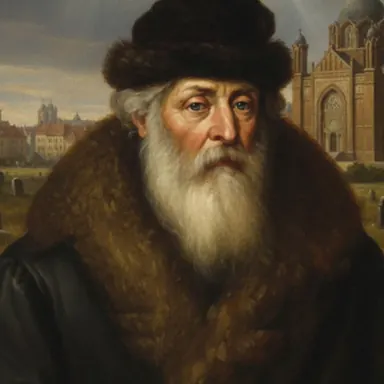
Rabbi Akiva Eger (Rak"a): His Work, His Torah Teaching and the Shaping of European Talmudic Scholarship in the 19th Century
17 min read3,389 words
Summary
This work surveys the figure and influence of Rabbi Akiva Eger, one of the leading Torah scholars of Central Europe in the 19th century, presenting his work as that of a pioneer of modern analytical scholarship. The text sketches the course of his life and his wide-ranging connections, and emphasizes the unique fusion of his extraordinary Torah genius with deep humility and spiritual openness toward currents such as Chabad Hasidism. The center of gravity of the article is his study methodology, and especially his work "Gilyon HaShas," which exemplifies his use of linguistic precision and of the posing of conceptual difficulties ("tzarikh iyun," "requires further study") that encourage independent inquiry. Finally, the article examines his public and halakhic legacy, which includes humanistic rulings on saving life (pikuach nefesh) and the raising of disciples who became leaders of the mussar movement and of Religious Zionism.
I. The Historical Context and Rabbinic Biography (1762–1837)
A. Rabbi Akiva Eger: His Life, His Family and His Period of Office
Rabbi Akiva Eger (Rak"a) stood as one of the central pillars of Torah and halakha in Central Europe in the decisive period between the end of the 18th century and the middle of the 19th century. This period was characterized by a sharp transition from traditional communal structures to coping with the forces of modernization, emancipation, and the emergence of religious Reform and the Haskalah. Rabbi Akiva Eger, who was a rabbi, a halakhic decisor and a rosh yeshiva, provided the intellectual and spiritual framework for preserving Orthodoxy in the geographical region of Posen, which was under Prussian rule.[1]
Rabbi Akiva Eger was born in the town of Eisenstadt, Hungary, on the 11th of Cheshvan 5522 (1762). He came from a distinguished rabbinic family; his father was Rabbi Yaakov Moshe Ginz, and his mother, the Rebbetzin Gittel, was known for her righteousness and wisdom and was the daughter of the first Rabbi Akiva Eger, rabbi of Pressburg, after whom he was named.[1] This family lineage conferred upon him Torah standing from birth. He acquired the foundations of his scholarship in the yeshiva of his uncle, Rabbi Wolf Eger, in Breslau, where he shaped his Lithuanian-Prussian approach to the study of the Talmud.[1, 2] His first marriage was to the daughter of Rabbi Yitzchak Margalioth of Lithuania, a wealthy man of distinguished lineage, by whom he had two sons and two daughters before she died at a young age.[1]
Rabbi Akiva Eger served as rabbi first in Friedland, and afterwards for decades (5569–5598, 1809–1837) as chief rabbi and rosh yeshiva of the community of Posen.[2, 3] This tenure in the heart of the modern Prussian realm placed him at the center of halakhic decision-making in his time, and this was reflected also in the urban structure: the ancient synagogue in which he served in Posen, on Żydowska Street, stood on the site where a modern residential building stands today.[4] Rabbi Akiva Eger died on the 13th of Tishrei 5598 (1837).[1]
Beyond his official duties, Rabbi Akiva Eger forged a halakhic-familial alliance with Rabbi Moshe Sofer, the "Chatam Sofer," after this son-in-law of his married, as his second wife, Rabbi Akiva Eger's daughter Sarah.[1, 2, 5] This alliance, between Posen and Pressburg, was critical to the consolidation of Orthodoxy in Central Europe. The mutual admiration was deep; Rabbi Akiva Eger addressed the Chatam Sofer with the titles: "My son-in-law, my friend, and my teacher dear to me as my own soul, the great and renowned rabbi and gaon, lamp of Israel, the right-hand pillar, the mighty hammer."[5] This union of halakhic forces, expressed in the comparison of their rulings on central halakhic subjects such as the laws of niddah [6], created a unified authoritative front in the face of the forces of religious fragmentation.
B. Humility as a Guiding Principle in His Leadership
Rabbi Akiva Eger's extraordinary scholarship was always accompanied by exceptional personal and public humility, which was an integral part of his identity and of his model of leadership.[7] This humility was expressed most distinctly in his will and in the way in which he chose to be remembered.
After the death of his wife, the Rebbetzin Brandel, in 5596, Rabbi Akiva Eger's health declined.[2] In his will, Rabbi Akiva Eger asked that he be eulogized only at his grave and that praises and exaggerations be avoided.[2] Beyond this request, the text that he asked to have inscribed on his tombstone constitutes a moral declaration about the role of the leader: "Here lies buried R. Akiva Eger, servant of the servants of the Lord, in the holy community of Friedland and in the holy community of Posen."[2] His choice of the expression "servant of the servants of the Lord" reflects a conception of leadership in which the highest rank of Torah genius is to serve as subordinate to the public, out of moral responsibility and self-effacement.
C. His Unique Ties with the Mitteler Rebbe (Chabad)
One of the most fascinating aspects of Rabbi Akiva Eger's biography is his open attitude toward the Hasidic movement, and in particular toward Chabad Hasidism. Rabbi Akiva Eger was active in the heart of the Lithuanian-Misnagdic world, yet maintained respectful and open relations.
The historic meeting with the Mitteler Rebbe (Rabbi Dovber Schneuri) took place between the years 5581 and 5585, when the Rebbe was staying at the healing springs in Karlsbad.[1] Rabbi Akiva Eger accorded him extraordinary honor, going out from the doorway of his house with a lit candle in his hand to receive him, remarking "Light is sown for the righteous."[1] This dialogue continued with a Torah comment by the Mitteler Rebbe: "Akiva spelled with a heh is kosher, and the verse 'Light is sown for the righteous, and gladness for the upright in heart'—the final letters of its words—spell Akiva."[1]
Although the Mitteler Rebbe stated in advance that he did not wish to converse with Rabbi Akiva Eger about study, since Rabbi Akiva Eger is a "mechalek" (one who draws sharp distinctions) whereas he himself "does not know distinctions" (chiluk lo yeda'na) [1], they discussed the matters of the controversy between the Hasidim and the Misnagdim. Rabbi Akiva Eger declared honestly that he inclines to neither side and that he regards all of them as righteous.[1] This openness, which was not typical of classical Misnagdic rabbis of that period, was reinforced by the fact that the foundational book of Chabad Hasidism, the Tanya, lay constantly on Rabbi Akiva Eger's desk, as his son-in-law attested.[1] During the meeting, the Mitteler Rebbe recited before him a Hasidic discourse ("Do not harass Moab") and the novellae of his son-in-law, the Tzemach Tzedek, from which Rabbi Akiva Eger derived pleasure.[1] The ability to combine purist scholarship with spiritual openness, and even engagement with an inward-looking kabbalistic text such as the Tanya, sets Rabbi Akiva Eger forth as a balancing figure who saw the overall Torah picture.
II. The Bodies of Torah Work: Survey and Classification (The Torah Architecture)
Rabbi Akiva Eger's Torah work is characterized by a combination of practical halakhic ruling, expressed in the responsa and glosses literature, together with theoretical analytical scholarship focused on the novellae on the Shas and on the Gilyon.
A. The Responsa Literature and Practical Halakha
As one of the greatest decisors of his generation, Rabbi Akiva Eger's halakhic work is documented in the Responsa of Rabbi Akiva Eger, a collection of halakhic responsa dealing with communal matters, monetary law and practical halakha.[8] This collection appeared in three main parts, including responsa published in his lifetime, as well as posthumous collections such as the Responsa of Rabbi Akiva Eger, Part Two (Tinyana; published in 1889) and the New Responsa of Rabbi Akiva Eger (published in 1938).[2, 8] The responsa literature constitutes a primary source for his rulings on communal and modern halakhic matters.
In addition, Rabbi Akiva Eger made a decisive contribution to halakha through his brief comments. The Glosses of Rabbi Akiva Eger on the Shulchan Arukh and his glosses on other halakhic codices, such as the Mishneh Torah of the Rambam [8], are used by decisors to this day. These comments are especially vital in areas that required adaptation under pressure of time, such as the laws of niddah, a central subject in his rulings that has been studied extensively in comparison with the rulings of the Chatam Sofer.[6]
B. Novellae on the Shas and the Study Material
The study side of his work includes the Novellae of Rabbi Akiva Eger on the Shas, the expanded composition in which he developed his Talmudic analyses in depth. These volumes, which were printed in various editions (such as the six volumes of Ha-Ma'or [9] or the Zikaron editions [10]), include compilations from his manuscripts, his responsa and his glosses, as well as materials from manuscripts that were not printed until the later editions.[11] These works, together with the Additions to the Mishnah [2] and further novellae, embody his pure and analytical method of study.
III. "Gilyon HaShas": An Analysis of the Method, the Distillation and the Cross-Referencing (The Study Methodology)
Gilyon HaShas is the pinnacle of Rabbi Akiva Eger's methodological contribution to the study of the Talmud, and it became an indispensable tool on the margins of every standard page of Gemara.
A. Gilyon HaShas as a Methodological Work and as an Expression of a Philosophy of Study
Gilyon HaShas contains extremely brief and concise comments, which were originally written in the margins of the Gemara from which Rabbi Akiva Eger studied.[3, 8] These comments include indications, references and cross-references to topics of interest relevant to understanding the local topic, or to places that apparently contradict it.[3] The comments first appeared in the Prague edition (5590–5595) under the title "Glosses and References by the Gaon, our teacher, Akiva Eger, Chief Justice of the Holy Community of Posen," and later, significantly expanded, in the Romm and Grodno editions, and became fixed as the "Gilyon of the Vilna Shas."[3]
Rabbi Akiva Eger explained that the choice of brevity and precision stems from a philosophical-logical conception: "Just as nature always attains its purpose by short, simple and straight paths, so the simple cause, by paths that are not long, which leads to the end, is the true one."[3] This statement establishes precision and concision not only as a technical requirement but as a sign of the truth of the Torah and of its comprehension. His terseness often obliges students to compare the Gilyon with his other works, such as Derush ve-Chiddush, in order to understand the exact analytical nuances, and for this reason the complete Gilyon HaShas was printed, displaying the full texts to which it refers.[3]
B. Eger's Keys to Decoding and the Method of Linguistic Precision
Rabbi Akiva Eger's method is characterized by the ability to derive profound halakhic conclusions from a precise analysis of Talmudic and rabbinic language. A clear example is his analysis of fixed linguistic patterns, such as his comment on Tractate Shabbat (folio 55, side a), where he discusses the expression "There is no..." and shows how the intention is a minority that does not apply to the majority, which allows for the existence of exceptions (such as four who did not sin).[12] This analysis attests to his striving for categorical precision.
Another tool is the placing of references to apparent contradictions.[3] The Gilyon is not merely an index but an analytical generator, which compels the student to reconcile the contradictory sources and to discover the hidden conceptual distinctions (the "chilukim"), which are the building blocks of modern scholarship.
C. Defining the Analytical Limit: "Tzarikh Iyun" and "May the Lord Enlighten My Eyes"
A central pedagogical aspect of the Gilyon is the use of notations that represent the boundaries of logical analysis:
- "Tzarikh iyun" (Tz"A; "requires further study"): this is a notation of an analytical difficulty, representing a contradiction or conflict between sources that Rabbi Akiva Eger places before the student but leaves without a final resolution.[12] An example is his question regarding the ability of the Sages to uproot a Torah law because of the enslavement of laborers.[12] The frequent use of "Tz"A" reflects a pedagogical approach that encourages independent thinking and does not present the Torah as a closed dogma. Rabbi Akiva Eger in effect makes the student a partner in the difficulties of the analysis, and turns the study of Gemara into an ongoing process of inquiry.
- "And may the Lord enlighten my eyes": this is a sharper methodological code.[13] When Rabbi Akiva Eger appends this closing phrase to a difficult question, it indicates that the difficulty puts a fundamental concept to the test, and that it has no simple or fully logical solution rooted in ordinary human logic. The hanging of the solution on "higher illumination" [13] constitutes an acknowledgment of the limitations of narrow logic in the face of the depth of the Torah, and serves as a kind of "conceptual stalemate (teiku)" placed before future generations.
Rabbi Akiva Eger's emphasis on the short and precise path as the true path [3] forms the conceptual basis for the approach of the later Lithuanian and Brisker scholars, who preferred pure conceptual analysis (the "gedarim," definitions) over the branching traditional pilpul.[14]
IV. His Halakhic and Analytical Teaching (Ruling and Pilpul)
A. The Egerian Method of Pilpul: In-Depth Conceptual Analysis
Rabbi Akiva Eger is regarded as the great shaper of analytical pilpul. His pilpul is not an intellectual flourish for the sake of brilliance, but a precise (analytical) analysis aimed at sharpening the distinctions between similar concepts and thereby defining the halakhic categories.[8] The sharpness of his thought serves as a model for the analysis of fundamental reasonings and for striving to reach the heart of the topic. In this way, he shifted pilpul from a rhetorical method to a logical-categorical one.
The comparison of his rulings, for example on matters of niddah, with the rulings of the Chatam Sofer [6] sketches the dialogue between two leading halakhic approaches that operated in parallel to consolidate European Orthodoxy. While both were rigorous, the Egerian analysis at times exemplified a more rational approach, grounded in the principle of logical clarity.
B. Rulings on Saving Life (Pikuach Nefesh): The Saving of Life as an Intrinsic Value
One of Rabbi Akiva Eger's most important rulings concerns the law of pikuach nefesh, and it reflects social sensitivity and a broad view of the "seed of Israel" in an era of secularization. Rabbi Akiva Eger presented a fundamental halakhic position holding that the life of a Jew has an inherent and unconditional value in itself.[15]
He challenged the common reasoning for permitting the desecration of the Sabbath for the sake of saving a life, "Desecrate one Sabbath for him so that he may observe many Sabbaths," and argued that this reasoning is not the essential one in halakha. Instead, he argued that "the Torah has pity on a soul of the seed of Israel," irrespective of future observance of the commandments.[15] This ruling significantly expanded the obligation to save lives, even in cases of Jews who publicly desecrate the Sabbath, and established that the saving of a life is the essence of the law.[15] This ruling is a foundational example of how Rabbi Akiva Eger, by means of a rigorous halakhic method, provided a humanistic and broad response to the challenges of the Haskalah and assimilation, and thereby strengthened the communal bond with all parts of the Jewish people.
C. Responsa and Examples of Innovative Rulings
Rabbi Akiva Eger's responsa literature, such as that appearing in the tract Milei d'Nezikin [2] and in his central responsa collection, reflects a response to the challenges of commerce and the modern economy of Posen. His rulings in monetary law and torts were vital for regulating legal relations in the community, and required innovative thinking in the face of new civil and economic challenges.
V. The Legacy of the Generations: His Disciples and His Continuing Influence
The influence of Rabbi Akiva Eger is evident in the way his disciples spread his avant-garde analytical method to various ideological branches, thereby making his scholarship the basis for all the later Torah movements.
A. The Inner Circle of Disciples and the Dissemination of the Method
Rabbi Akiva Eger raised many diverse disciples, which attests that his analytical method was flexible enough to serve different purposes and did not impose a single ideological mold.[2, 16] Among his principal disciples one may count:
- Rabbi Yosef Zundel of Salant: regarded as one of the fathers of the mussar movement.[2, 16] He applied the Egerian precision of defining concepts not only to halakha but to the study of human character traits.
- Rabbi Zvi Hirsch Kalischer: one of the leaders of practical Religious Zionism.[2, 16] He used the analytical tools he had acquired to engage with public and political issues and to develop radical conceptions regarding redemption.
- His halakhic continuators: his sons, Rabbi Shlomo Eger and Rabbi Bunem Eger [2, 16], as well as Rabbi Israel Lipschitz (author of Tiferet Yisrael on the Mishnah).[2]
- Others: Rabbi Eliyahu Guttmacher, Rabbi Yaakov Zvi Mecklenburg, and Rabbi Shmuel of Apta.[2, 16]
The fact that his disciples created the two major later currents—mussar and Religious Zionism—teaches that Rabbi Akiva Eger's method provided powerful intellectual tools of inquiry that enabled the development of independent Torah thought, even when it led in new ideological directions.
B. Rabbi Akiva Eger as a Model for Emulation and Study
Rabbi Akiva Eger remains a paragon of true scholarship combined with exceptional righteousness. He is regarded as the rabbinic ideal that combines Talmudic genius with extreme humility, as he emphasized in his will ("servant of the servants of the Lord").[2] Although his place of office was in Germany/Prussia, his method of study, focused on analytical sharpness and concision, became a formative component in study in the yeshivot of Lithuania and continues to influence modern scholarship.
Below is a table analyzing the analytical keys in Rabbi Akiva Eger's method:
Analytical Keys in Rabbi Akiva Eger's Method
VII. Concluding Conclusions
Rabbi Akiva Eger stood at the crossroads of traditional scholarship and modern pedagogy. He was a pioneer of focused conceptual analysis, which charted the path for the analytical methods of study that dominated the later world of the yeshivot. His rabbinic work in Posen and his strategic ties with the Chatam Sofer consolidated the standing of halakha in the face of the religious challenges of his time. Beyond his analytical genius, his influence is rooted in the rare fusion of sharpness of thought and breadth of horizons, as reflected in his openness toward Hasidism. His rulings, and especially the one that recognizes the intrinsic value of the life of a Jew, even at the price of desecrating the Sabbath, establish him as a decisor of humanistic and communal vision who sought to embrace all parts of the Jewish people within the protection of halakha. Rabbi Akiva Eger, as a "servant of the servants of the Lord," left behind a legacy whose essence is the combination of intellectual rigor and practical modesty, which to this day is an ideal for every rabbi and leader.
Sources16
- 1.עקיבא איגר - חב"דפדיה, chabadpedia.co.il/index.php?title=עקיבא_איגר&mobileaction=toggle_view_desktop
- 2.רבי עקיבא איגר - גינז - MyTzadik, mytzadik.com/m/tzadik.aspx?id=1271
- 3.גליון הש"ס השלם ב' כרכים לרעק"א (רבי עקיבא איגר) - אוצר הספרים, sefer.org.il/items/3728060-גליון-הש-ס-השלם-ב-כרכים-לרעק-א-רבי-עקיבא-איגר-
- 4.פוזנן: מסע אל עירו של רבי עקיבא איגר - המקום, hamakom.social/פוזנן-מסע-אל-עירו-של-רבי-עקיבא-איגר/
- 5.ר' עקיבא איגר – הרב יצחק שפירא - ישיבת עוד יוסף חי, odyosefchai.co.il/2019/07/ר-עקיבא-איגר-הרב-יצחק-שפירא
- 6.דעת ישראל: פסקי רבותינו רבי עקיבא איגר, חתם סופר, כתב סופר, על הלכות נדה ... - Google Books, books.google.com/books/about/דעת_ישראל.html?id=uhNRzQEACAAJ
- 7.סיפורי צדיקים הרב יואב חנו: רבי עקיבא איגר "עקב ענווה יראת חטא" - YouTube, youtube.com/watch?v=jKs8LLin76s
- 8.עֲקִיבָא אֵיגֶר | טקסטים ודפי מקורות מן התורה, התלמוד וספריית המקורות של ספריא., sefaria.org.il/topics/akiva-eiger
- 9.תורת רבי עקיבא איגר על הש"ס ו' כרכים המאור - אוצר הספרים, sefer.org.il/items/3733967-תורת-רבי-עקיבא-איגר-על-הש-ס-ו-כרכים-המאור-הוצאה-לאור-מכון-המאור
- 10.חידושי רבי עקיבא איגר על הש"ס ג' כרכים / הוצאת זכרון - אוצר הספרים, sefer.org.il/items/6499400-חידושי-רבי-עקיבא-איגר-על-הש-ס-ג-כרכים-הוצאת-זכרון-הוצאה-לאור-זכרון-יעקב
- 11.חידושי רבי עקיבא איגר | אחרונים על הש''ס - למדן - בית הספרים, lamdanbooks.co.il/product/חידושי-רבי-עקיבא-איגר-1
- 12.69081.docx, daf-yomi.com/Data/UploadedFiles/Forums/69081.docx
- 13.צריך עיון - המכלול, hamichlol.org.il/צריך_עיון
- 14.שיחה:רבי עקיבא איגר/ארכיון - המכלול, hamichlol.org.il/שיחה:רבי_עקיבא_איגר/ארכיון
- 15.י"ג תשרי: רבי עקיבא איגר - חילול שבת על מי שלא ישמור אותה, toraland.org.il/מאמרים/תורת-חכמי-ישראל/יג-תשרי-רבי-עקיבא-איגר-חילול-שבת-על-מי-שלא-ישמור-אותה/
- 16.קטגוריה:תלמידי רבי עקיבא איגר - המכלול, hamichlol.org.il/קטגוריה:תלמידי_רבי_עקיבא_איגר