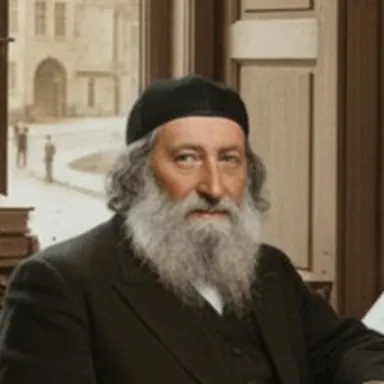
Between Messianic Activism and Halakhic Conservatism: The Torah Thought and Public Work of Rabbi Zvi Hirsch Kalischer
11 min read2,273 words
Summary
The text surveys the multifaceted figure of Rabbi Zvi Hirsch Kalischer, a conservative dayan who was among the pioneering heralds of Zionism in the nineteenth century thanks to a rare combination of traditional halakhic scholarship and modern philosophical thought. The central axis of the work presents the Rabbi's conception of natural redemption, which held that the people's return to its land must begin with human activism—including the purchase of land, agricultural settlement and diplomatic activity—and not with passive waiting for a miracle from heaven. The author details his literary output, with emphasis on his foundational book "Derishat Tzion," and examines the stormy Torah controversies he aroused around issues such as the removal of the barrier of the "Three Oaths" and his revolutionary attempt to renew the sacrificial service. In sum, the source emphasizes how Kalischer's practical vision laid the conceptual groundwork for modern religious Zionism and shaped the transition from a religion of prayer alone to a movement of national action.
Biographical Background and Historical Context
Rabbi Zvi Hirsch Kalischer (8 Nisan 5555, 24 March 1795 – 5 Cheshvan 5635, 16 October 1874) was one of the prominent Torah giants of Central Europe in the nineteenth century, who inscribed his name in Jewish history as one of the most central "heralds of Zionism."[1] He was born in the town of Lissa (Leszno) in the Posen region, an area of a distinctive cultural character that passed from Polish control to Prussian rule following the partition of Poland, to Rabbi Shlomo Kalischer and his wife Rachel.[1] This geographic and cultural environment placed him at the meeting point between the conservative and talmudic world of Torah in Eastern Europe and the processes of modernization and Enlightenment that swept through Germany and Western Europe.[1] His son, Alfred Christlieb Kalischer, continued to be active in Germany in a variety of fields.[1]
Rabbi Kalischer acquired the core of his Torah from two spiritual giants and prominent Orthodox leaders: Rabbi Yaakov Lorberbaum of Lissa (author of "Netivot ha-Mishpat" and "Chavot Da'at") and Rabbi Akiva Eger, who became his distinguished teacher.[1] Alongside his exceptional diligence in the study of the Talmud and the halakhic authorities, Rabbi Kalischer was endowed with a broad intellectual thirst for the sciences and for philosophy.[1] He had a firm command of the writings of the Jewish philosophers of the Middle Ages and also delved into the thought of general and modern philosophers such as René Descartes, Baruch Spinoza, Moses Mendelssohn and Immanuel Kant.[1] This unique combination of deep traditional scholarship alongside intellectual and philosophical openness enabled him to form a broad-minded worldview that often challenged the accepted conventions of his generation.[1]
In 1825, at the age of 29, Rabbi Kalischer was appointed rabbi and dayan in the city of Thorn in Prussia.[1] He served in this position without pay for decades, his family's livelihood resting entirely on a small shop run by his wife.[1] This independent position prevented communal pressures and enabled him to wage stubborn struggles in defense of Orthodoxy.[1] Like his teacher, Rabbi Akiva Eger, Rabbi Kalischer went to war head-on against the early Reformers and the extreme maskilim who sought to undermine the foundations of halakha and Jewish tradition.[1]
The Literary and Intellectual Work
Rabbi Kalischer's writing extends over a wide range of fields in the Jewish library, from classical halakhic decision-making in Choshen Mishpat, through philosophical and kabbalistic thought, to biblical interpretation and national thought.[1] His literary work began to take tangible form in 1843, when he published the pamphlet "Even Bochan" on section 89 of Choshen Mishpat, which forms part of his large halakhic work "Moznayim la-Mishpat," which was published at a later stage.[1] In that very same year the first part of his book "Emunah Yesharah" was also published, in which he set out his philosophical and kabbalistic views on the Torah.[1] In addition, his scholarly notes under the title "Tzvi la-Tzaddik" on the Shulchan Arukh appear in a large part of the accepted printings of the Shulchan Arukh today, evidence of his central halakhic standing.[1] In the field of interpretation and the festivals, he published in 1864 in Warsaw the "Seder Haggadah shel Pesach with an Explanation of the Exodus from Egypt," which connects the historical miracles with the processes of modern redemption.[1]
The crowning achievement of his intellectual-national writing is the book "Derishat Tzion," which was first printed in Lyck in 1862.[2] The work enjoyed enormous resonance and was printed in many editions over the years, including a special expanded edition published in 2002 by Mossad Harav Kook, edited by Yehuda Etzion.[2] This edition, which marked 140 years since the first printing and 65 years since the founding of the religious kibbutz Tirat Zvi (which bears the Rabbi's name), combined with "Derishat Tzion" also the works "Shalom Yerushalayim" and the historic letter of appeal to the philanthropist Asher Anshel Rothschild.[2]
The following is a compilation of his main writings and their fields of engagement:
The Doctrine of Redemption: The Shift from Passive Expectation to National Activism
Rabbi Kalischer's doctrine of redemption is based on the rejection of the passive messianic conception that was very widespread among the Orthodox communities of his generation.[3] In his book "Derishat Tzion," Rabbi Kalischer rejected the assumption that redemption would occur in a wholly sudden and miraculous manner from above, without any human involvement.[3] In his view, redemption is not a one-time event but a gradual process that takes place "little by little" over time.[3] This understanding is firmly anchored in the verses of the Prophets, in the sayings of the Sages and in the Zohar literature, which indicate that it is the spiritual and practical awakening of human beings that prepares the ground for divine intervention.[3]
Rabbi Kalischer's messianic model divides redemption into two successive dialectical stages.[3] The first stage is natural redemption, based on independent and initiating human action ("the awakening of the spirit of the generous").[3] At this stage, the people of Israel is required to display a strong desire to return to its land, to mobilize financial resources, to turn to the kingdoms of the world for diplomatic authorizations, to go up to the Land of Israel and to settle its desolation.[3] Only after the completion of this stage, in which the people proves its practical loyalty to the land through agricultural manual labor and the offering of sacrifices, will the second stage begin—miraculous redemption.[3] In the second stage, God will be pleased to rest His spirit upon His people and to fulfill the metaphysical promises of the Prophets.[3]
A central part of this plan required a practical appeal to people of wealth and influence in order to realize the vision.[3] In the Hebrew year 5596 (1836), Rabbi Kalischer turned in a historic letter to Asher Anshel Rothschild, in which he presented his doctrine regarding the importance of purchasing the Land of Israel, or parts of it, from the Ottoman authorities.[3] In 1839 he expanded his efforts and also turned to Sir Moses Montefiore with a similar request for assistance in purchasing land.[1] Rabbi Kalischer saw the wealthy and the philanthropists among the Jews of his time as divine emissaries destined to bring the plan from potential to actuality.[3]
The structure of the book "Derishat Tzion" accurately reflects the conceptual transition from halakha to practice, as detailed in the following table:
Dismantling the Theological Barrier: The Controversy over the "Three Oaths"
The main opposition to Rabbi Kalischer's ideas among the conservative streams rested on a halakhic and aggadic midrash that appears in tractate Ketubot (folio 111, side a), which specifies the "Three Oaths" that God adjured the people of Israel and the nations of the world.[4] These oaths forbade Israel to go up to the Land of Israel in an organized manner and with a strong hand ("that they not go up as a wall"), to rebel against the rule of the gentiles, or to leave exile and hasten the End.[4] In the eyes of the opponents of national activism, any initiated activity to settle the Land or to establish a political movement constituted a grave violation of these oaths, and was therefore perceived as a spiritual and physical existential danger.[4]
In response to these arguments, and especially as a later answer to the massive use that opponents of Zionism (such as the Satmar Rebbe) made of this midrash, the thinkers of religious Zionism—in direct continuation of the line of thought paved by Rabbi Kalischer—developed a complex system of halakhic and conceptual answers that challenge the binding force of the oaths in the present time.[4]
The central arguments against the halakhic validity of the Three Oaths are summarized below:
The Halakhic Controversy over Renewing the Sacrificial Service
The third part of the book "Derishat Tzion," known as the "Treatise on the Service," was devoted to an unprecedented halakhic clarification regarding the permissibility of offering sacrifices in the present time, even before the building of the Temple and the revelation of the Messiah.[3] Rabbi Kalischer sought to prove that according to the rules of halakha, the sanctity of the Temple site exists forever ("the first sanctification sanctified it for its time and sanctified it for the future to come"), and therefore "one offers sacrifices even though there is no Temple." In order to realize this idea, Rabbi Kalischer initiated a series of letters and halakhic discussions with the great figures of the generation, headed by his distinguished teacher Rabbi Akiva Eger and his son-in-law, the Chatam Sofer.[1, 3, 5]
Rabbi Akiva Eger raised three central halakhic objections against the practical possibility of renewing the service [5]:
- Identifying the site of the altar: The absence of a precise geometric tradition regarding the exact location of the altar on the Temple Mount, which prevents a valid offering.
- The lineage of the priests: The fact that in recent generations the genealogical lines of the priests have been lost, and there is today no "priest of established lineage" on whom one can clearly rely.
- Priestly garments: The essential need for priestly garments that include a thread of tekhelet and argaman, materials whose original method of production from the chilazon was lost during the long years of exile.
Rabbi Kalischer responded in detail to his teacher's letters and sought to prove that these difficulties do not prevent the offering after the fact.[5] In his view, one can rely on the presumptive priestly status that exists today with regard to communal sacrifices, and there is no absolute need for a priest of established lineage.[5] He also proposed various halakhic solutions and measurements for identifying the location of the altar.[5] After Rabbi Kalischer presented his solutions, Rabbi Akiva Eger refrained from continuing the discussion due to his old age and weakness, and passed the clarification of the question to his son-in-law, Rabbi Moshe Sofer (the Chatam Sofer).[5]
In his reply, the Chatam Sofer surprised by siding in principle with Rabbi Kalischer's halakhic analysis.[5] He agreed that ritual impurity is permitted for the community, and that the absence of a priest of established lineage or the need for communal shekels do not prevent the offering of the Paschal sacrifice.[5] However, the Chatam Sofer imposed a practical veto on the plan for geopolitical reasons.[5] He explained that the governor of Jerusalem on behalf of the Ottoman Empire is a "great stickler" who zealously guards the Temple Mount and would in no way allow a non-Muslim to approach the Temple site.[5]
Rabbi Kalischer's revolutionary proposal aroused a wave of sharp opposition in the Torah world, from both the halakhic point of view and the conceptual and mystical point of view.[5] The following details the positions of the opponents and supporters in this controversy:
Summary and Legacy of the Pioneer of Religious Zionism
Rabbi Zvi Hirsch Kalischer embodied in his person a rare and exceptional combination of deep Torah scholarship and uncompromising religious conservatism on the one hand, alongside a revolutionary spirit, intellectual originality and bold national activism on the other.[1, 3] His stubborn struggle against Reform and the extreme maskilim did not prevent him from adopting modern philosophical tools to establish his faith, and, more importantly, from translating the traditional messianic expectation into a comprehensive political and practical plan of action.[1, 3]
His insistence on turning the Land of Israel into an "inhabited land" and on its agricultural and economic development served as a firm basis upon which the "Hovevei Zion" movement was later built.[1, 3] His pioneering appeals to Asher Anshel Rothschild and Moses Montefiore marked the beginning of modern Zionist diplomacy.[1, 3] Although his far-reaching plan to renew the sacrificial service did not come to fruition due to the opposition of most of the great figures of the generation, the controversy he opened enriched the halakhic discussion and strengthened the understanding that the redemption of Israel depends on practical steps and on "itaruta de-letata" (an awakening from below).[3, 5]
Rabbi Kalischer's legacy continues to beat at the heart of religious Zionism and of settlement in the Land.[1] Kibbutz Tirat Zvi in the Beit She'an Valley, founded in the Hebrew year 5697 (1937) and proudly bearing his name, is a living and resounding testimony to the realization of his vision, which combines Torah, productive agricultural work and pioneering activism in the Holy Land.[2]
Sources5
- 1.צבי הירש קלישר – ויקיפדיה, he.wikipedia.org/wiki/צבי_הירש_קלישר
- 2.דרישת ציון ; שלום ירושלים ; איגרת הפניה אל אנשל רוטשילד : נספחים / הרב צבי הירש קלישר, nli.org.il/he/books/NNL_ALEPH990022988750205171/NLI
- 3.דרישת ציון - ויקיפדיה, he.wikipedia.org/wiki/דרישת_ציון
- 4.שלוש השבועות - ויקיפדיה, he.wikipedia.org/wiki/שלוש_השבועות
- 5.חידוש עבודת הקורבנות - ויקיפדיה, he.wikipedia.org/wiki/חידוש_עבודת_הקורבנות