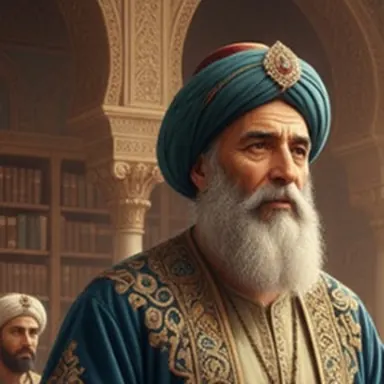
Hasdai ibn Shaprut: Architect of the Golden Age in Muslim Spain
14 min read2,862 words
Summary
The text surveys the multifaceted figure of Hasdai ibn Shaprut, who is considered the architect of the Golden Age and who brought about a historic revolution by shifting the Jewish center of gravity from Babylonia to Muslim Spain. The article presents his work as a rare combination of political excellence at the court of the caliph with religious and cultural leadership, with an emphasis on his contribution to Torah independence through the founding of yeshivas and the cultivation of the study of the Hebrew language. Through a description of his diplomatic activity, his ties with the Khazar kingdom and his support for the sciences, the text illustrates how Hasdai shaped the model of Andalusian Judaism, which combines broad learning with loyalty to the community. In conclusion, the source seeks to illuminate Hasdai's legacy as a humanist leader who used his political power to secure the spiritual freedom and physical security of the people of Israel in exile.
The Political and Torah Leadership of Hasdai ibn Shaprut: Architect of the Golden Age in Muslim Spain
The figure of Hasdai ibn Shaprut (c. 915–975) stands as one of the most significant turning points in the history of the Jewish people in the Middle Ages. He was not only a senior statesman and court physician, but the central figure who brought about the historic shift of the Torah and cultural center of gravity from the East, the yeshivas of Babylonia and North Africa, to Muslim Spain.[1, 2, 3] Hasdai's work took place under the rule of the caliph Abd al-Rahman III in Cordoba, in a period when Spain became the world center of science, economy and culture.[4, 5] To a great extent, it was Hasdai who laid the foundation for the "Andalusian" model, which combines halakhic excellence with broad scientific learning and extensive political activity, a model that shaped the character of Spanish Jewry for centuries.[5, 6]
Roots, Education and the Formation of a Multidimensional Personality
Hasdai was born in the city of Jaén in Andalusia to a family steeped in both Torah values and wealth. His father, Yitzchak ben Ezra, was a prominent figure in the Jewish community, a highly learned man who used his fortune to support institutions of learning and men of the spirit.[7, 8, 9] This environment enabled the young Hasdai to acquire an education that was exceptional even by the high standards of the period. He studied Talmud in depth, but at the same time trained in languages and the sciences, a step that was vital to his future rise at the royal court.[8]
Hasdai's command of languages was a strategic asset. Alongside Hebrew and Arabic, he acquired a thorough knowledge of Latin, a language that was then the almost exclusive domain of the senior churchmen of Christian Spain.[3, 6, 7] In addition, he mastered Romance languages and, with the help of professionals, even engaged in translation from Greek.[7] This linguistic background, together with his medical training, made him a living cultural bridge between the Muslim, Christian and Jewish worlds.[2, 5]
Hasdai's broad learning was not merely for personal purposes but reflected a Torah-humanist worldview. He saw the combination of "Torah and wisdom" (secular knowledge) as an indispensable tool for Jewish leadership in the modern world of the tenth century.[4, 9] This is the beginning of his "Torah teaching": not as a narrow halakhic code, but as a philosophy of leadership that sees human knowledge as an aid to deepening the understanding of the Torah and to strengthening the standing of the people of Israel among the nations.[12]
The Political Ascent: From Court Physician to "Minister Without a Title"
Hasdai's entry into the court of the caliph Abd al-Rahman III came through the door of medicine. His skills were so outstanding that he was appointed the ruler's personal physician.[5, 8] However, his sharp intellect and organizational ability quickly drew the caliph's attention to affairs of state as well. Hasdai was first put in charge of collecting the customs and taxes in the port of Cordoba, a post that required deep economic understanding and absolute integrity, since this was the economic lifeline of the Umayyad empire.[3, 7, 10, 13]
Hasdai's political standing was unique of its kind. Although he did not formally bear the title "vizier" (minister), he in fact acted as foreign minister and as the most senior adviser on diplomatic affairs.[3, 7, 10] The caliph trusted him completely and entrusted him with the most sensitive missions vis-à-vis foreign powers. Hasdai's ability to negotiate with Christian and Byzantine rulers stemmed not only from the languages he spoke, but also from a deep political insight into the balance of power in the Mediterranean.[2, 3, 4]
In his political activity, Hasdai contributed directly to the prosperity of Spain. He mediated peace between Muslim Spain and Christian Spain and helped develop the economy.[1, 14] The fact that a Jew held the key to the state treasury and to its foreign policy was a testimony to the relative tolerance of the Golden Age, but also to Hasdai's phenomenal talent for preserving the ruler's trust in an environment full of political intrigue.[7, 13]
The Diplomatic Revolution and Its Effect on the Prestige of the Jews
One of Hasdai's most famous diplomatic missions was the negotiation with the kingdoms of León and Navarre. Queen Toda of Navarre asked for the caliph's help in restoring her grandson, Sancho I "the Fat," to the throne of León after he had been deposed because of his excessive obesity.[3, 7] Hasdai was sent to the Christian court and through his wisdom succeeded in persuading the proud queen to come to Cordoba and bow before the Muslim caliph, an achievement considered a tremendous diplomatic victory.[3, 7]
During his stay there, Hasdai did not content himself with diplomacy; he cured Sancho of his obesity, which enabled the king to return and lead his army.[7, 10] This combination of physician and statesman created around Hasdai an aura of a man of extraordinary powers. As a Jewish poet of that period described it, Hasdai subdued his adversaries by "the magic of his words, the power of his wisdom and the force of his cunning."[3, 6]
Further missions included receiving delegations from the Holy Roman Empire (Otto I) and from the Byzantine Empire.[3, 7] In all these contacts, Hasdai acted outwardly as a defender of the honor of Islam, but at the same time took care to highlight the standing of the Jews. Foreign envoys who met him were deeply impressed by his brilliant intelligence and reported to their kings that at the court of Cordoba there was "a Jew without equal in wisdom."[3, 7, 8, 10]
His Work as "Nasi": Worldwide Intercession and the Protection of the Communities
In parallel with his political posts, Hasdai was appointed by the caliph as "Nasi" or "Nagid" of all the Jews of Spain (al-Andalus).[4, 8, 14, 15] In this role he was officially responsible for the security, legal affairs and welfare of the Jews vis-à-vis the government. Hasdai saw his high standing as a basis for wide-ranging intercession. He always asked the envoys of the lands who came to Cordoba about the condition of the Jews in their countries.[3, 16, 17]
When he learned of persecutions of Jews in other places, he did not hesitate to use his diplomatic power. A prominent example is his appeal to the Empress Helena of Byzantium, in which he asked her to guarantee freedom of worship to the Jews of her empire.[6, 7] He presented a sophisticated argument: just as the Muslim caliph in Spain treats the Christians with respect (thanks to Hasdai), so the Christian empress is expected to treat the Jews.[6, 7] This activity made Hasdai the most influential Jewish leader in the world in his time, a man in whom distant communities saw the "prince of Israel" who could save them.[4]
The Torah Revolution: Spain's Independence from the Babylonian Center
Hasdai's greatest achievement, the one that shaped the future of the Jewish people, was the liberation of the Torah center in Spain from its total dependence on the yeshivas of Babylonia.[3, 7, 13] Until his time, the Jews of Spain were considered a Torah "periphery." Every complicated halakhic question, every question of the calendar or the sanctification of the new month, was sent to Baghdad, to the Geonim of Sura and Pumbedita.[3, 6, 7, 13]
Hasdai recognized that the center in Babylonia was in a process of decline, while the community in Spain was growing in wealth and political power.[13] In cooperation with the interest of the Umayyad caliphate (which wished to sever any connection between its subjects and the Abbasid caliphate in Baghdad), Hasdai worked to create spiritual independence.[7, 13] The move was carried out on several levels:
- Import of books and manuscripts: Hasdai invested a fortune in acquiring sacred books and copies of the Babylonian Talmud from the East and distributing them in Spain, so that the local sages could issue rulings without needing emissaries.[3, 6, 7, 14]
- Economic support: he extended full patronage to Torah scholars and enabled them to devote themselves to study and teaching without worries about their livelihood.[5, 8]
- Founding yeshivas: Hasdai initiated the founding of Torah academies in Cordoba that rivaled those of Babylonia in their level.[8, 14, 15]
The symbolic and practical turning point of this revolution is connected with the story of the "Four Captives." According to the tradition (cited in Sefer ha-Kabbalah of the Ra'avad), four great sages from Babylonia were captured by pirates and ransomed in different communities.[8, 18] One of them, Rabbi Moshe ben Hanoch, reached Cordoba. Hasdai, who recognized his exceptional greatness in Torah, appointed him head of the yeshiva and chief rabbi of the community.[6, 7, 13, 18] This appointment made Spain an independent halakhic center that no longer needed "approvals" from Babylonia.[3, 7, 13] The caliph Abd al-Rahman welcomed the move, since it ensured that the religious authority of the Jews of his kingdom would be local and not under the influence of his enemies in the East.[6, 7, 13]
Patronage of Language and Grammar: The Struggle Between Menachem and Dunash
Hasdai's Torah teaching also included the revival of the Hebrew language. He believed that a free and educated people must master its national language at the highest level.[5, 13] Under his patronage, Cordoba became a linguistic laboratory in which the rules of scientific Hebrew grammar developed.[3, 5, 7]
The two central scholars whom Hasdai gathered into his house were Menachem ben Saruq and Dunash ben Labrat.[3, 5, 19, 20] Menachem, who served as Hasdai's secretary for Hebrew correspondence, composed the Machberet, the first comprehensive dictionary of Scripture written in Hebrew rather than in Arabic.[3, 4, 19] However, Dunash ben Labrat, who came from Fez and was a disciple of Rav Saadia Gaon, attacked Menachem's system, claiming that it was inaccurate.[20, 21] Dunash introduced Arabic meter into Hebrew poetry, an innovation that aroused strong opposition among Menachem's disciples but was ultimately adopted by most of the poets of Spain.[20]
The controversy between the two was sharp and was accompanied by severe personal tensions. Hasdai, influenced by Dunash's criticism, turned against Menachem ben Saruq and even treated him very harshly: he stripped him of his property and imprisoned him.[7, 19, 20] Despite Menachem's personal tragedy, this controversy laid the foundations for the discovery of the nature of the triliteral root in Hebrew (by Yehuda Hayyuj, a disciple of Menachem) and for the flowering of medieval Spanish poetry.[19, 20] Here Hasdai acted as a demanding patron who required absolute scientific excellence, even at the price of fierce internal conflicts.[5, 20]
The Connection with the Khazar Kingdom: An Aspiration to Jewish Sovereignty
One of the most fascinating moments in Hasdai's biography is his correspondence with Joseph, king of the Khazars. Hasdai, despite his wealth and standing at a Muslim court, suffered from the disgrace of exile.[8, 17] The rumors of an independent and powerful Jewish kingdom in southern Russia kindled in him a great national hope.[6, 8, 17] He saw this kingdom as proof that the people of Israel was still capable of governing itself and that the divine blessing had not departed from it.[8, 17, 22]
In his letter to King Joseph, Hasdai describes in detail the condition of the Jews in Spain but declares that he is ready to give up all his high offices in order to see with his own eyes an independent Jewish king.[6, 13, 17] He sent messengers (Yitzchak ben Natan and Yitzchak ben Eliezer) by complicated and dangerous routes through Byzantium and Russia to reach the Khazar capital, Itil.[8, 22]
The letters that were exchanged, in which King Joseph told of the conversion of his people to Judaism in the days of King Bulan, are a historical document of supreme importance.[2, 6, 8, 22] For Hasdai, this connection was part of his political-messianic teaching: linking all parts of the Jewish people and creating a network of mutual support that would strengthen national pride in exile.[4, 13] He did not see the Khazars merely as a historical curiosity, but as potential political partners who could balance the forces of the Christian and Muslim powers.[8, 16]
His Contribution to Science: The Translation of Dioscorides and Intercultural Dialogue
Hasdai's work in the field of science and medicine is a classic example of the role of the Jews as transmitters of knowledge between cultures.[7, 12] In 949 the Byzantine emperor sent the caliph a gift: a splendid illustrated copy of the book of the Greek physician Dioscorides on medicinal herbs.[3, 7] The book was in Greek, a language that was almost unknown in Cordoba.[3, 7, 11]
Hasdai, in coordination with the Greek monk Nicholas, who was sent especially from Constantinople, assembled a team of experts to translate the book into Arabic.[6, 7, 11] The work of translation was an enormous botanical and philological task; they had to identify the plants described in Greek and find corresponding names for them in the flora of Spain and in the Arabic language.[3, 11] The success of this project made Spain a center of pharmacology and advanced medicine, and this knowledge was later transmitted to Christian Europe.[3, 7, 11, 12]
This contribution reinforces the understanding of Hasdai as a polymath. For him, science was not opposed to religion but a tool for understanding Creation and improving the human condition.[12] He saw in the external wisdoms (of Greece, Rome and Arabia) a means through which the people of Israel could display its wisdom among the nations and attain a political standing that would serve the Jewish community.[12]
Summary and Legacy: Hasdai's Model for the Generations
Hasdai ibn Shaprut died around 975 in Cordoba, after having also faithfully served Abd al-Rahman's son, al-Hakam II.[2, 6, 7] His legacy was multidimensional:
- On the political level: he was the first Jew in Spain to reach the rank of a de facto minister of foreign affairs and security, and he proved that loyalty to the state does not contradict commitment to the Jewish people.[4, 5, 13]
- On the Torah level: he freed Spain from its dependence on Babylonia and established an independent Talmudic center that would lead the Jewish world for centuries.[3, 6, 7, 13]
- On the cultural level: he was the father of the Golden Age, the patron who enabled poets, grammarians and scientists to flourish under his protection.[5, 6, 9]
Hasdai's Torah teaching was a teaching of strength and integration. He did not see Judaism as a religion of seclusion but as a culture of leadership. His work created the conditions in which figures such as Shmuel ha-Nagid, Yehuda ha-Levi and Maimonides (Rambam) could later grow.[8, 9, 18, 23] Hasdai ibn Shaprut remains in historical consciousness as the exemplary figure of the "Nasi": the leader who unites in himself the crown of Torah, the crown of science and the crown of kingship.
Sources23
- 1.חסדאי אבן שפרוט | הספרייה הלאומית, nli.org.il/he/a-topic/987007262470705171
- 2.Ḥisdai ibn Shaprut | Court Physician, Jewish Diplomat, Scholar - Britannica, britannica.com/biography/Hisdai-ibn-Shaprut
- 3.Ḥasdai, ABU YUSUF (BEN ISAAC BEN EZRA) IBN SHAPRUT - JewishEncyclopedia.com, jewishencyclopedia.com/articles/7304-hasdai-abu-yusuf-ben-isaac-ben-ezra-ibn-shaprut
- 4.Hasdai Ibn Shaprut - Morasha, morasha.com.br/en/prophets-and-wise-men/hasdai-ibn-shaprut.html
- 5.Hasdai Ibn Shaprut: The Jewish Prime Minister of Muslim Spain - The Milli Chronicle, millichronicle.com/2025/03/hasdai-ibn-shaprut-the-jewish-prime-minister-of-muslim-spain.html
- 6.Hasdai ibn Shaprut Facts for Kids, kids.kiddle.co/Hasdai_ibn_Shaprut
- 7.Hasdai ibn Shaprut - Wikipedia, en.wikipedia.org/wiki/Hasdai_ibn_Shaprut
- 8.Hasdai Ibn Shaprut - (circa 4675-4735; 915-975) - Chabad.org, chabad.org/library/article_cdo/aid/112514/jewish/Hasdai-Ibn-Shaprut.htm
- 9.Hasdai ibn Shaprut, Scholar and Translator - Kosher River Cruises, kosherrivercruise.com/hasdai-ibn-shaprut-scholar-and-translator/
- 10.The Caliph's Favorite - The University of Chicago, oi.uchicago.edu/sites/default/files/uploads/shared/docs/The Caliph's Favorite.pdf
- 11.STUDIES ON DE MATERIA MEDICA OF DIOSCORIDES IN THE ISLAMIC ERA - Revista Asclepio, asclepio.revistas.csic.es/index.php/asclepio/article/download/542/557/572
- 12.The Contribution of the Jews of Spain to the Transmission of ..., cambridge.org/core/journals/european-review/article/contribution-of-the-jews-of-spain-to-the-transmission-of-science-in-the-middle-ages/7276B7F2F0E890A094E991A9364C1E1B
- 13.חסדאי-בן-שפרוט | מורשת יהדות מרוקו, moreshet-morocco.com/tag/חסדאי-בן-שפרוט/
- 14.חסדאי אבן שפרוט - ויקיפדיה, he.wikipedia.org/wiki/חסדאי_אבן_שפרוט
- 15.Lecture 17.1: The Golden Age? Jewish Life in Medieval Islamic Spain - The Colby College Community Web, web.colby.edu/js181/files/2016/07/17.1.pdf
- 16.סיפור ההתגיירות במכתבים הכוזריים - ויקיפדיה, he.wikipedia.org/wiki/סיפור_ההתגיירות_במכתבים_הכוזריים
- 17.The Medieval Jewish Kingdom of the Khazars, 740-1259 - Internet History Sourcebooks Project, sourcebooks.web.fordham.edu/source/khazars1.asp
- 18.The Four Captives - (circa 4720; 960) - Chabad.org, chabad.org/library/article_cdo/aid/111839/jewish/The-Four-Captives.htm
- 19.Menahem ben Saruq - Wikipedia, en.wikipedia.org/wiki/Menahem_ben_Saruq
- 20.DUNASH BEN LABRAṬ - JewishEncyclopedia.com, jewishencyclopedia.com/articles/5359-dunash-ben-labrat
- 21.תור הזהב המוסלמי - גילי חסקין, gilihaskin.com/תור-הזהב-המוסלמי/
- 22.Khazar Correspondence - Wikipedia, en.wikipedia.org/wiki/Khazar_Correspondence
- 23.Shmuel Hanagid - (993-1056; 4753-4816) - Chabad.org, chabad.org/library/article_cdo/aid/111854/jewish/Shmuel-Hanagid.htm