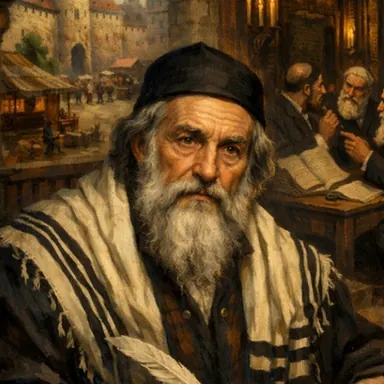
The Work and Torah Teaching of Rabbi Shemaria of Speyer: A Historical and Scholarly Examination of the Torah Centre in Ashkenaz in the 12th Century
14 min read2,720 words
Summary
This article draws the historical and Torah portrait of Rabbi Shemaria of Speyer, a key figure in 12th-century Ashkenazi Jewry who was active at the height of the flowering of the Speyer community. The text examines how Rabbi Shemaria grew up in the study hall of the Riva and became a living bridge between the conservative tradition of the sages of the Rhine and the dialectical pilpul method of the Tosafists in France. Beyond his interpretive and halakhic contribution, the source emphasises his role as a public and spiritual leader who faced severe persecutions, as reflected in the lament (kinah) he composed and in his involvement in fortifying the legal and social standing of the community. In conclusion, the article presents his teaching as a fundamental foundation for shaping the scholarly and liturgical identity of Ashkenazi Jewry, whose influence has remained engraved in the world of the yeshivot and in halakhic literature for generations.
The Jewish community of Speyer stood at the heart of the spiritual and public activity of Ashkenazi Jewry in the Middle Ages, as an inseparable part of the alliance of the ShUM communities. Within this historical fabric, the figure of Rabbi Shemaria ben Mordechai of Speyer stands out as one of the central links in the chain of transmission of the teaching of the Tosafists in Ashkenaz. His work, which extended over the 12th century, forms a bridge between the foundations of study he received from his teachers, chief among them the Riva (Rabbi Yitzhak ben Asher HaLevi), and the development of the Tosafist dialectic that was then spreading from France to the rest of Europe. The figure of Rabbi Shemaria is not only that of a decisor or commentator, but of a spiritual leader who faced the challenges of the hour, both at the scholarly level and at the existential level of a community subject to persecution and political pressure.[1, 2, 3]
The Historical Foundations of the Speyer Community
To understand the power of Rabbi Shemaria's influence, one must delve into the circumstances of the founding and growth of the Speyer community. The community's beginnings date to the second half of the 11th century, a period of deep structural change in feudal Europe. In 1084 Bishop Rüdiger (Ruediger) of Speyer invited a group of Jews from the city of Mainz to settle in his city. The motive behind this invitation was distinctly economic and political: the bishop sought to turn the village of Altspeyer into a flourishing town, and believed that a Jewish presence "would increase the honour of the city a thousandfold".[1]
The privilege granted to the Jews on 13 September 1084 was unprecedented in its scope. It included the allocation of a special quarter surrounded by a wall for protection, the granting of complete freedom of trade in the ports and markets, and, most important of all, broad legal autonomy. The "archisynagogos", later called "the bishop of the Jews", received full judicial authority in internal disputes between Jews, relying on Jewish law.[1, 4] This environment of legal and economic security allowed the growth of a Torah centre of the first rank, in which Rabbi Shemaria ben Mordechai was active several decades later.
The growth of Speyer as a Torah centre reached its peak in the 12th century. Despite the trauma of the Crusades, and especially the persecutions of 4856 (1096), in which ten of the city's Jews were murdered and the community was largely saved thanks to the bishop's protection in his palace, the community recovered quickly.[1] In this period sages began to be active there who laid the foundations of the method of the Tosafot in Ashkenaz, and Rabbi Shemaria became one of the most prominent of them.
The Circle of the Riva and the Growth of the Method of the Tosafot
Rabbi Shemaria ben Mordechai grew up in the study hall of Rabbi Yitzhak ben Asher HaLevi (the first Riva), who is considered the founder of the teaching of the Tosafot in Ashkenaz.[3] The Riva, who was a disciple of Rashi and of Rabbi Yitzhak HaLevi of Mainz, brought to Speyer the study tradition of the yeshivot of the Rhineland, but refined it into a new dialectical method. Rabbi Shemaria was not only a disciple of the Riva, but was defined as a "talmid-chaver" (disciple-colleague), a fact attesting to his high level of learning and to his active involvement in forming the Torah novellae of the study hall.[3]
The distinctiveness of this circle in Speyer was its ability to deal independently with the Talmudic text. While Rashi focused on a continuous explanation of the plain sense, the Riva and his disciples, Rabbi Shemaria among them, began to compare distant passages, to raise difficulties and resolve them, and to try to create a coherent halakhic system free of contradictions. Historical sources note that many tosafot "were founded before the Riva HaLevi", that is, were written in his presence and in cooperation with his leading disciples, with Rabbi Shemaria at their centre.[3]
The dynamic in the study hall of Speyer in the 12th century was one of collective creation. Rabbi Shemaria, together with his fellow students such as Rabbi Ephraim of Regensburg and Rabbi Yitzhak ha-Lavan, were partners in the interpretive revolution that changed the face of Jewish learning.[3] They were not content with memorising the tradition, but turned Talmudic discussion into a living laboratory of halakhic clarification. Rabbi Shemaria's work on this plane was critical to the taking root of the method of the Tosafot in the soil of Ashkenaz, a method that survived and became the basis of study in the yeshivot to this day.
His Torah Teaching: Halakha, Commentary and Prayer
The Torah teaching of Rabbi Shemaria ben Mordechai has been preserved mainly through quotations in the writings of the Rishonim who came after him and in remnants of manuscripts that survived the vicissitudes of time. His fields of activity were broad and included commentary on the Talmud, halakhic ruling, and deep engagement in the order of prayers and blessings.[5]
The Tosafot to the Various Tractates
Rabbi Shemaria composed tosafot to a number of tractates of the Babylonian Talmud. His writing was marked by extreme brevity and by an attempt to reach the root of the Talmudic passage. He tended to reconcile contradictions between the Bavli and the Yerushalmi, and his rulings reflected the Ashkenazi tendency to be stringent in places where local custom was deeply rooted.[5] His contribution to the interpretation of the Talmud was so significant that the great figures of the next generation, such as Rabbi Simcha ben Shmuel of Speyer, relied on his rulings as a supreme authority.[6]
The Book on the Text of the Blessings
One of Rabbi Shemaria's unique works, most of which has been lost, was a book devoted to the text of the blessings.[5] In 12th-century Ashkenaz the text of the prayers was not entirely uniform, and there were many disputes about linguistic precision in the various blessings. Rabbi Shemaria, in the spirit of the early sages of Ashkenaz, attached immense importance to every word and every letter of the prayer. He tried to form a uniform text based on Talmudic sources and on the received tradition of the sages of Mainz and Worms. The surviving remnants of this work testify to meticulous learning and to a desire to protect the Jewish liturgy against changes and corruptions.
Mutual Relations with Rabbenu Tam and the Sages of France
Rabbi Shemaria maintained an extensive correspondence with Rabbi Yaakov Tam (Rabbenu Tam), Rashi's grandson and the greatest of the sages of France at the time.[1, 2] This correspondence is evidence of Rabbi Shemaria's international standing. Rabbenu Tam, who was known for his firmness and his criticism of other sages, held Rabbi Shemaria in great respect and treated his rulings seriously.
The dialogue between Speyer and Ramerupt (Rabbenu Tam's place of residence) represents the integration of the European Torah world. While Ashkenaz was more conservative and adhered to ancient custom, France was more innovative and dialectical. Rabbi Shemaria served as a mediating factor: he adopted the scholarly tools of the Tosafists in France, but used them to establish and strengthen the Ashkenazi traditions of halakhic ruling.[1, 3]
The Historical Events and the Liturgical Response
Rabbi Shemaria's life was not spent only in the tranquillity of the study hall. His period was filled with religious and social tensions that reached their peak in riots and blood libels. The most formative event for him and for his community was the blood libel in Speyer in 1195 (4956).
In that year the body of a Christian was found under a bridge in the city, and the Jews were accused of murdering him for ritual purposes. The incited mob attacked the community, and many were murdered. One of the most shocking cases was the murder of the daughter of the Riva (Rabbi Shemaria's teacher). Her body was taken out of its grave and desecrated in the town square, and only in return for a heavy payment did the authorities agree to return the body for burial.[4]
Rabbi Shemaria responded to this event by writing a harrowing kinah (lament), which has been preserved in manuscript to this day.[5] In this lament he does not only mourn the dead, but formulates a theological conception of the acceptance of divine judgement (tziduk ha-din) and of the sanctification of God's name. The lament reflects the spiritual world of the Ashkenazi Pietists (Hasidei Ashkenaz), who saw suffering and persecutions as an instrument for purifying faith. Rabbi Shemaria's poetic writing attests that he was also a religious poet of stature, combining halakha with deep religious feeling.
His Public Work and the Communal Enactments
Beyond his Torah creativity, Rabbi Shemaria was deeply involved in the leadership of the ShUM communities. Although the great synods of the ShUM enactments (takkanot) are identified more with the generation of Rabbi Simcha of Speyer (the 13th century), Rabbi Shemaria was among the first shapers of this organisational infrastructure.[1, 6]
The need for enactments arose from the changing reality in which the Jews lived. The community had to regulate matters of taxation, laws of inheritance, the protection of women (the enactments of Rabbeinu Gershom) and rules for conduct towards the Christian authorities. Rabbi Shemaria was part of the supreme council of the sages of Speyer that set the moral and legal standards of the community. His public rulings resonated for generations afterwards as well, when the Maharam of Rothenburg cites responsa and decisions of Rabbi Shemaria on matters of communal leadership.[6]
The Question of the Maimonidean Controversy and the Ashkenazi Context
An interesting question that arises in the study of Rabbi Shemaria's teaching is his attitude (or the attitude of his circle) to the philosophy of Maimonides (Rambam). The famous controversy over the "Guide of the Perplexed" and "Sefer HaMadda" (the Book of Knowledge) broke out with force in France and Provence in the 1230s, a period in which Rabbi Shemaria was no longer active.[7, 8] Nevertheless, the roots of the dispute lie in an earlier period, when the "Mishneh Torah" began to spread in Europe.
The sages of Ashkenaz, Rabbi Shemaria among them, tended towards methodological conservatism. They greatly appreciated the halakhic achievements of Maimonides, but had reservations about the omission of the Talmudic sources in the "Mishneh Torah", as the Raavad expressed in his critical glosses (hasagot).[9] For Rabbi Shemaria, Torah study had to remain bound to Talmudic pilpul (the dialectic of the Tosafot) and not to an absolute halakhic summary that might lead to the neglect of study from the sources. The opposition to philosophy that developed later among the sages of Speyer (such as Rabbi Simcha) drew on the conservative foundation laid by Rabbi Shemaria, which saw in the study of the Gemara and in the custom of the fathers the only path to knowing the will of God.[10, 11]
Linguistic and Stylistic Aspects of His Writings
A linguistic analysis of the remnants of Rabbi Shemaria's writings reveals a rich rabbinic Hebrew, combining Talmudic Aramaic with the medieval Hebrew of the piyyut. In his tosafot he uses short, sharp expressions characteristic of the style of the "early sages of Ashkenaz". In contrast to Rashi, who is marked by explanatory ease, Rabbi Shemaria writes for students thoroughly familiar with the raw Talmudic material, and he focuses on cracking logical difficulties.
In his piyyut on the riots of (4)956 the style changes dramatically. Here he uses language rich in biblical allusions, especially from the Book of Lamentations and Psalms, in order to create a parallel between the destruction of the Temple and the suffering of the community in Speyer.[5] This ability to move between strict halakha and emotional poetry is a hallmark of the great figures of that generation, who saw the Torah as a whole that encompasses all the layers of the soul.
His Influence on the Generations and His Place in Historiography
Rabbi Shemaria of Speyer is considered one of the most influential figures in shaping the character of Ashkenazi Jewry, even though his name is not on everyone's lips like Rashi or Rabbenu Tam. His influence was deep and internal:
- Shaping the method of study: he was among the first to apply the method of dialectical discussion (the Tosafot) within the study halls of Ashkenaz, and thereby ensured the scholarly independence of the community vis-à-vis the centre in France.[3]
- Preserving custom: his book on the blessings and prayer contributed to preserving the liturgical identity of the ShUM communities, which in time became the Ashkenazi rite (nusach Ashkenaz) familiar to us.[5]
- Leadership in a time of crisis: his lament and his public work served as a model of spiritual leadership in times of persecution, and gave the community tools for coping morally and religiously with suffering.[4, 5]
His quotations appearing in the book "Hagahot Maimoniyot" (on Maimonides) and in the responsa of the Maharam of Rothenburg attest that his teaching continued to live and exert influence even a hundred years after his death.[6] He was perceived as an ancient and sacred authority whose rulings are an inseparable part of the binding halakhic tradition.
Summary: Rabbi Shemaria as a Symbol of the Golden Age of Speyer
The story of Rabbi Shemaria ben Mordechai is the story of the Speyer community in its days of glory. It is the story of a community that succeeded, under the protection of imperial and episcopal privileges, in establishing an empire of the spirit in the heart of Christian Europe.[1] Rabbi Shemaria, as an outstanding product of the study hall of the Riva, embodied in his personality the perfect combination of intellectual acuity and deep loyalty to tradition.
His Torah teaching, which includes the tosafot, the halakhic rulings and the piyyutim, is living testimony to a vibrant and complex spiritual world. He did not act in a vacuum, but was part of an extensive network of ties linking Speyer, Mainz, Worms and France. Through his figure we gain a rare glimpse of the dynamics of the creation of the Oral Torah in the Middle Ages: a process of discussion, argument, correspondence and writing that ultimately shaped the face of the Jewish people throughout its generations.
Rabbi Shemaria has remained in historical memory as "the sage of Speyer", a title that expresses the inseparable connection between the personality and the spiritual centre in which it acted. His work is a central layer in the edifice of the Torah of Ashkenaz, an edifice that stood firm against the decrees of the times and has continued to illuminate the Jewish world to this day.[2, 3, 6]
Sources11
- 1.Speyer | Encyclopedia.com, encyclopedia.com/religion/encyclopedias-almanacs-transcripts-and-maps/speyer
- 2.קהילת יהודי שפייר | Family Wiki | Fandom, danielventura.fandom.com/he/wiki/קהילת_יהודי_שפייר
- 3.יצחק בן אשר הלוי - ויקיפדיה, he.wikipedia.org/wiki/יצחק_בן_אשר_הלוי
- 4.SPEYER - JewishEncyclopedia.com, jewishencyclopedia.com/articles/13951-speyer
- 5.יהודה בן קלונימוס משפיירא - ויקיפדיה, he.wikipedia.org/wiki/יהודה_בן_קלונימוס_משפיירא
- 6.Simha of Speyer - Wikipedia, en.wikipedia.org/wiki/Simha_of_Speyer
- 7.When They Burned Maimonides' Books: The Controversy behind The Guide for the Perplexed | Aish, aish.com/when-they-burned-maimonides-books-the-controversy-behind-the-guide-for-the-perplexed/
- 8.Maimonidean Controversy - Wikipedia, en.wikipedia.org/wiki/Maimonidean_Controversy
- 9.Maimonidean Controversy - Jewish Virtual Library, jewishvirtuallibrary.org/maimonidean-controversy
- 10.Maimonidean Controversy | David A. Wacks, davidwacks.uoregon.edu/tag/maimonidean-controversy/
- 11.Maimonides and the Maimonidean Controversies - ResearchGate, researchgate.net/publication/401186306_Maimonides_and_the_Maimonidean_Controversies