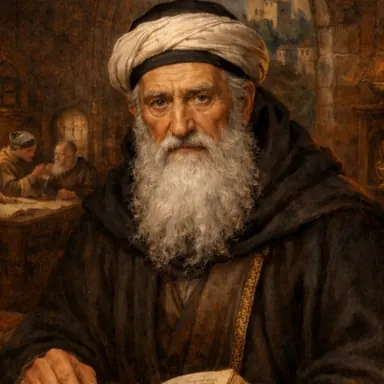
The Architecture of Dialectics and the Leadership of the Generation: The Torah Teaching and Work of Ri HaZaken of Dampierre
15 min read3,000 words
Summary
This work sketches the fascinating portrait of Rabbi Yitzchak ben Shmuel of Dampierre (Ri HaZaken), who is regarded as the central architect of the Tosafist movement in the 12th century. The text surveys the institutional revolution he brought about through the founding of a yeshiva based on collective research, in which sixty students specialized in different tractates in order to create a textual harmonization of the entire Talmud as a single organic unit. Beyond his immense scholarly contribution, the article emphasizes his figure as a humble and sensitive public leader who acted in times of crisis, and as a spiritual personality who combined sharp logic with mystical inclinations and deep piety. The aim of the survey is to illustrate how Ri turned individual pilpul into a systematic and sustainable method that shaped the study of the Gemara and the ruling of halakha for later generations.
Introduction: The Pinnacle of the Tosafists' Creation
Rabbi Yitzchak ben Shmuel of Dampierre, known by the epithet Ri HaZaken, represents the most splendid point of encounter in the history of medieval Jewish thought between individual scholarly genius and large-scale academic institutionalization.[1, 2] In a period when the Jewry of France and Ashkenaz experienced an unprecedented spiritual flourishing in the face of complex political and religious challenges, Ri stood as the unifying figure who shaped the way the Babylonian Talmud is studied to this very day.[3, 4] His work is not summed up merely in writing notes on the pages of the Gemara; he created an entire methodology of "textual harmonization," which sought to see the entire Talmud as a single organic unit, free of contradictions, in which every passage illuminates its fellow, even if they are separated by hundreds of pages.[2, 5]
The historical analysis of his teaching shows that Ri was not merely a commentator but the architect of a system of thought.[2] He turned the charismatic and stormy dialectic of his uncle and teacher, Rabbenu Tam, into a systematic, collective and sustainable enterprise, which enabled many more students to approach the depth of the passage.[2, 5] This report will survey in depth all aspects of his life, the revolutionary academic model that he established in Dampierre, his distinctive scholarly method, his halakhic rulings and his spiritual figure, which combines piety and mysticism.[2, 5]
The Roots of Identity: A Genealogy of Spiritual Power
Ri HaZaken was born around the year 4860 (about 1115) into a lineage that was to a great extent the "royal family" of the Torah world in France.[1, 6] His family origin is not merely a biographical detail but the key to understanding the intellectual tools that were at his disposal and the natural authority with which he led the generation.[2, 5]
Ri's development took place at the very heart of the Torah center in Ramerupt, where he studied with his uncle Rabbenu Tam.[2, 6] The relationship between them was unique; Ri was a student entirely subordinate to his teacher, served as his secretary and was engaged in drafting Rabbenu Tam's extensive correspondence with the sages of the generation.[5] Nevertheless, within this subordination a rare intellectual independence grew, which found expression in its full force only after the death of Rabbenu Tam in 1171, when the scepter of leadership passed to Ri, who moved the center of activity to the town of Dampierre.[2]
The Dampierre Yeshiva: The Institutional Revolution and Collective Research
Whereas Rabbenu Tam led the Torah world by virtue of his erupting genius and his charismatic personality, Ri HaZaken understood that in order for the Tosafist method to become the property of the public and a stable system, it had to undergo a process of institutionalization.[2] In his yeshiva in Dampierre he established what may be called "the first academy for collective Talmudic research."[2]
The Model of the Sixty Students and Professional Specialization
One of the most fascinating testimonies about the conduct of the yeshiva relates that Ri had sixty regular students, each of whom was entrusted with one tractate of the Babylonian Talmud.[6] The student was obligated to know that tractate thoroughly, including all the nuances, the versions and the midrashim related to it.[2, 6] This structure enabled Ri to operate a network of "living databases" in real time:
- Rapid cross-referencing: while studying a passage in tractate Kiddushin, Ri could turn to the student who was the expert in tractate Zevachim and ask whether there was a contradiction or support for a particular claim within the enormous corpus of the Talmud.[2]
- Synchronization of knowledge: this model turned the Talmud, with its 2,711 pages, into a text that can be scanned and searched (Searchable) in a human yet precise manner.[2]
- Discovery of hidden contradictions: precisely the focused expertise of each student made it possible to raise problems that in the linear thinking of a single individual might have disappeared.[2]
This insight teaches that Ri saw the yeshiva as one whole body. If Rabbenu Tam was the "prodigy" who knew everything himself, Ri created a "collective intelligence."[2] This method made Tosafist dialectic one that does not rely only on local flashes of insight but on a broad infrastructure of cross-cutting comparison among all the tractates of the Shas.[2, 5]
Ri's Methodology: The Architecture of Textual Harmony
The heart of Ri HaZaken's Torah teaching lies in the basic conception that the Babylonian Talmud is not a collection of separate passages edited at different times, but a single harmonious unit, "one body" of the Oral Torah.[2] This conception, instilled by Rabbenu Tam, was refined and became an everyday working tool in Ri's hands.[2, 5]
The Principle of Resolving Contradictions (Harmonization)
The most distinctive characteristic of the Tosafot of Ri is the refusal to accept contradictions without an essential explanation.[2] When a contradiction appears between a passage in tractate Shabbat and a passage in tractate Bava Kamma, Ri is not content with answers such as "this is a dispute among Tannaim" or "the Gemara here is speaking of a different case" without proving it from the legal mechanics of the passage.[2] He developed a methodology of "distinctions" (Distinctions)—precise definitions that resolve the contradiction by revealing a deeper layer of the law.[2, 3]
Ri's influence was so decisive that his method of study influenced, hundreds of years later, the Lithuanian "Brisk" method, which is based on distinctions between "two laws."[3] Ri taught his students not to seek only the local plain meaning (as in Rashi's approach), but to build a "system" (System) that would be consistent throughout the expanses of the Talmud.[2, 5]
Clarifying the Text and Textual Criticism
Like his grandfather Rashi, Ri too attached supreme importance to establishing the correct text of the Talmudic passage.[3] His approach, however, was at times bolder; he did not hesitate to propose textual emendations based on logical analysis or on comparisons with early manuscripts and with halakhic midrashim such as the Tosefta and the Yerushalmi.[3] For Ri, the text is not merely a dry tradition but a tool that must fit the logical structure of the passage.[2, 3]
The Literature of the Tosafot: Ri's Imprint on the Pages of the Gemara
The "Tosafot" printed today in the margins of the Babylonian Talmud are the product of later editing, but their hard and most influential core is the teaching of Ri HaZaken.[1, 5]
The Process of Editing and Dissemination
Ri HaZaken is mentioned on almost every page of the printed Tosafot.[1, 5] He is regarded as the "mainstay" of the entire movement, and his interpretive rulings became binding among the learners.[5] The method of work in his yeshiva included the recording of "shittot" (Interpretations) by the students, with Ri himself going over the notes, correcting, improving and giving them his personal imprint.[5]
Halakhic Leadership: Ruling between Genius and Humility
Beyond his interpretive activity, Ri HaZaken was the supreme decisor and leader of the Jewry of France and Ashkenaz in the second half of the 12th century.[5, 9] His halakhic personality was characterized by a rare combination of halakhic boldness on the one hand, and humility and human sensitivity on the other.[2, 5]
The Style of the Responsa and the Attitude toward Authority
Whereas Rabbenu Tam was known for a forceful, polemical and at times even sharp style in his responsa, Ri was characterized by a gentle, apologetic and respectful approach.[2, 5] He tended to belittle himself, and often suggested to the questioner not to rely on his opinion alone but to add the opinion of another sage.[2] Nevertheless, when the subject required a decision, Ri did not hesitate to disagree with the great men who preceded him, including Rashi and Rabbenu Tam, although he always did so with immense reverence and in an apologetic tone.[2]
Social and Public Ruling in a Period of Decrees
Ri was active in a difficult period under the rule of King Philip Augustus, who instituted a policy of confiscating Jewish property and local expulsions.[6] His rulings reflected deep concern for the economic and moral resilience of the community:
- Protection of confiscated property: Ri categorically forbade Jews to buy property that had been confiscated from their fellows by the authorities, and ruled that it must be returned to its original owners at any cost.[6] This ordinance was intended to prevent the exploitation of the community's distress by individuals.[6]
- Laws of marriage and divorce documents: near the end of his life he composed the "Laws of the Get," a systematic work intended to regulate the complex process of divorce and to prevent serious halakhic mishaps.[5]
- Sensitivity to the status of women: like his grandfather Rashi, Ri displayed special sensitivity to the status of women in legal processes, and sought halakhic solutions that would prevent the creation of an agunah or harm to their rights.[10]
Ri was regarded as the supreme source of authority, and many of the sages of the generation, including the sages of Provence and Italy, turned to him with difficult questions.[2, 5] His words were cited as "the words of the living God," and Rabbi Yeshayah of Trani (the Rid) testified about him that his authority is like that of a king.[2]
His Inner World: Piety, Asceticism and Inclination to Mysticism
The figure of Ri HaZaken would not be complete without his extraordinary spiritual-pietistic dimension. He was called by his students "Our Holy Rabbi," a title that reflected not only his genius but his abstinent and ascetic way of life.[2]
Way of Life and Pietistic Practices
Tradition tells of Ri's stringent practices, which became a model for emulation for the Ashkenazi Pietists:
- Asceticism and fasts: Ri used to fast every Sunday throughout the year.[2]
- Stringencies on Yom Kippur: out of fear of Heaven and concern about an error in determining the day, Ri fasted two consecutive days on Yom Kippur.[2]
- Prayer in public: he was careful not to leave the synagogue until all the worshippers, including the last of them, had finished their prayer, so as not to leave a person alone in the synagogue.[2]
The Connection to Sefer Yetzirah and the Hidden Torah
Despite being the "man of logic" and of Talmudic dialectic, Ri had a distinct inclination toward early Jewish mysticism.[5] There is evidence that he was in contact with Rabbi Shmuel HeChasid, one of the fathers of the Ashkenazi Pietists movement, and engaged in the teaching of the "Merkavah" and the "Shiur Komah."[5, 11]
One of the fascinating testimonies is the commentary of his student, Elchanan ben Yakar of London, on Sefer Yetzirah.[5, 12] Elchanan notes that his words are based on what he heard from his teacher, Ri HaZaken.[5, 11] Sefer Yetzirah, which deals with the divine technology of the creation of the world through letters and numbers (the 32 wondrous paths of wisdom), was a central text in Ri's thought.[12, 13]
This combination of "common sense" and sharp dialectic with deep mysticism is the hallmark of the Jewry of France and Ashkenaz at that time, and Ri HaZaken was the preeminent representative of this synthesis.[11]
The Family Tragedy: The Death of His Son Rabbi Elchanan
Ri's life reached a tragic breaking point in the year 4944 (1184), when his distinguished son and right-hand man, Rabbi Elchanan, was murdered in sanctification of God's name during an antisemitic pogrom.[2, 6] Elchanan was not only a son but an active partner in the Tosafist enterprise and served as the "scientific secretary" of the yeshiva in Dampierre.[2]
The loss of Elchanan, who was meant to continue the dynasty of leadership, shook Ri HaZaken.[2] He accepted the judgment with love and raised in his home his orphaned grandson, Shmuel.[2] The death of Elchanan perhaps explains the epithet "the Holy" that attached to Ri—not only because of his personal piety, but as one who experienced the ultimate sacrifice for his faith.[6] Despite the disaster, Ri continued to lead the yeshiva and the public until his death around the year 4950 (about 1190).[6, 7]
The Disciples of Ri: The Dissemination Network of the Teaching of Dampierre
Ri's power is measured also by the quality and the scope of the activity of his students, who became the next generation of the Tosafists and spread his teaching throughout Europe and even in the Land of Israel.[3, 5]
Rabbi Shimshon of Sens (the Rash): the greatest of his students, who edited the "Tosafot of Sens" and was the most prominent commentator on the Mishnah of his generation.[5] He led the group of the "aliyah of the 300 rabbis" to the Land of Israel at the beginning of the 13th century.[3]
Rabbi Yitzchak ben Avraham (Ritzba / Ri HaBachur): the brother of the Rash of Sens, who inherited Ri's place as head of the Dampierre yeshiva.[7, 11]
Rabbi Baruch ben Yitzchak (Baal HaTerumah): author of "Sefer HaTerumah," which was one of the most influential books on the ruling of halakha in Ashkenaz.[6]
Rabbi Yitzchak ben Moshe (author of Or Zarua): author of the book "Or Zarua," one of the great decisors of Ashkenaz, who cites Ri as the supreme authority on every matter.[6, 11]
Rabbi Avraham ben Natan HaYarchi: author of "Sefer HaManhig," which served as a linking element between the sages of France and the Jewry of Provence and Spain.[5]
The geographic spread of his students created a scholarly and halakhic unity in the Jewish world, with the "teaching of Dampierre" serving as a common language for all learners.[2, 3]
Influence on Codification and Halakha for Generations
Although Ri HaZaken worked mainly on the interpretive and dialectical plane, his influence on the world of halakhic ruling is enormous. Through his students and the students of their students, his rulings and his method of study seeped into the foundational books of Jewish halakha.[3, 14]
From the Tosafot to the Shulchan Arukh
The connection between Tosafist discussion and final ruling operates along several axes:
- The Tur (the Four Turim): Rabbi Yaakov ben Asher relied extensively on Ri HaZaken's decisions as they appear in the Tosafot and in the book "HaTerumah."[15]
- The Glosses of the Rema: Rabbi Moshe Isserles, who fortified the status of Ashkenazic custom and halakha within the Shulchan Arukh, draws the main part of his strength from the Tosafist tradition of Ri.[15]
- Decisions in matters of piety: many customs that Ri instituted because of his piety (such as the prohibition on buying confiscated property) became binding communal ordinances.[6]
Ri created a situation in which scholarship is not detached from life; the logical "distinction" in a Talmudic passage translates directly into practical guidance in Jewish life.[3]
Summary and Conclusions
Rabbi Yitzchak ben Shmuel of Dampierre, Ri HaZaken, was much more than another Tosafist. He was the architect who gave the Tosafist movement its deep structure, its systematic character and its ability to survive and exert influence over generations.[2, 5] By combining a revolutionary yeshiva model, an uncompromising dialectical methodology, a radiant pietistic personality and courageous public leadership, he established himself as one of the most influential figures in the history of the Oral Torah.[2, 5]
His conception of the Talmud as a single harmonious unit shaped the learning Jewish mind.[2] He taught us that difficulties and contradictions are not a reason for despair or for giving up on the truth, but an opportunity to reveal a deeper layer of the unity of the Torah.[2] His legacy continues to live in every "page of Gemara" studied in yeshivas, in study halls and in Jewish homes around the world, as the figure of "Our Holy Rabbi" of Dampierre accompanies learners in their search for pure truth.[2, 3]
Ri's work is testimony that true genius does not shut itself away in an ivory tower of intellectualism, but harnesses the sharpest intellectual tools for the repair of society, the defense of the weak and the building of a bridge of holiness between heaven and earth.[2, 6] His achievements in the fields of interpretation, halakha and mysticism constitute to this day the pinnacle of the creation of European Jewry in the Middle Ages.[5]
Sources15
- 1.רבי יצחק הזקן – ויקישיבה, yeshiva.org.il/wiki/index.php/רבי_יצחק_הזקן
- 2.Ri Hazaken: The Great Developer of Tosafot - Chabad.org, chabad.org/library/article_cdo/aid/7121100/jewish/Ri-Hazaken-The-Great-Developer-of-Tosafot.htm
- 3.בעלי התוספות - הספרייה הלאומית, nli.org.il/he/discover/judaism/figures/tosafists
- 4.היצירה התוספותית - BeitChabad.com - בית חבד, he.chabad.org/library/article_cdo/aid/3206280/jewish/-.htm
- 5.Isaac ben Samuel of Dampierre | Encyclopedia.com, encyclopedia.com/religion/encyclopedias-almanacs-transcripts-and-maps/isaac-ben-samuel-dampierre
- 6.Isaac ben Samuel - Wikipedia, en.wikipedia.org/wiki/Isaac_ben_Samuel
- 7.Isaac ben Samuel of Dampierre (Ri HaZaken) | Texts from the Sefaria Library, sefaria.org/topics/isaac-ben-samuel-of-dampierre
- 8.תוספות ר"י הזקן על קידושין | ספריית ספריא, sefaria.org.il/Tosafot_Ri_HaZaken_on_Kiddushin
- 9.ISAAC OF DAMPIERRE (RI HA-ZAQEN) AND HIS RESPONSA - Bar ..., cris.biu.ac.il/en/publications/isaac-of-dampierre-ri-ha-zaqen-and-his-responsa/
- 10.רש"י - ויקיפדיה, he.wikipedia.org/wiki/רש"י
- 11.Isaac ben Abraham of Dampierre - Wikipedia, en.wikipedia.org/wiki/Isaac_ben_Abraham_of_Dampierre
- 12.Sefer Yetzirah: From Philosophy to Mysticism - Rabbi Laura Duhan-Kaplan, sophiastreet.com/theology/sefer-yetzirah/
- 13.Sefer Yetzirah | Sefaria Library, sefaria.org/Sefer_Yetzirah
- 14.Was the Shulchan Aruch Intended to Be a Code of Jewish Law? - Hakirah, hakirah.org/Vol33Storch.pdf
- 15.א ןמיס היברו הירפ תוכלה רזעה ןבא אוה ךורב שודקה לש ומש ךרבתי , 1) ויתוירב בוטב ץפח אוהש ודבל תויהל םדאל בוט ןיאש עדיש ודגנכ רזע ול השע ןכ לעו - Rayanot Yaakov, rayanotyaakov.wordpress.com/wp-content/uploads/2015/09/lichtenstein-marriage-unit-5-tur-shulchan-aruch.pdf