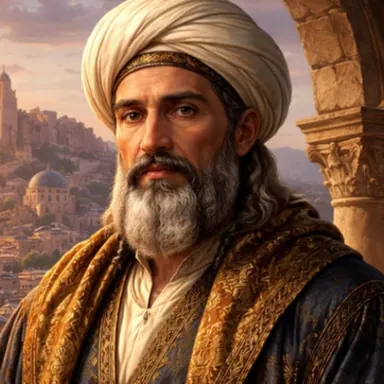
Rabbi Yosef ben Yehuda ibn Shimon
13 min read2,696 words
Summary
This text surveys the life and spiritual contribution of Rabbi Yosef ben Yehuda ibn Shimon, a key figure in medieval Jewish thought and the beloved disciple of Maimonides (Rambam). The article traces the course of his life from his childhood in the shadow of the Almohad persecutions in North Africa, through his studies in Egypt that led to the writing of the "Guide of the Perplexed" for him, to his becoming a leader of the Aleppo community and a vigorous fighter for the spread of the Maimonidean approach. At the center of the work stands the tension between religious tradition and philosophical inquiry, with a presentation of Ibn Shimon's original works in metaphysics and biblical commentary, as well as a clarification of the scholarly distinction between him and his contemporary, Yosef ibn Aknin. The main aim of the text is to highlight his importance as a pioneer who shifted the intellectual center of gravity from the old Geonic establishment toward philosophical rationalism, thereby shaping the face of Judaism for generations.
The Work and Torah Teaching of Rabbi Yosef ben Yehuda ibn Shimon
The figure of Rabbi Yosef ben Yehuda ibn Shimon, also known as Yosef ha-Ma'aravi (the Westerner) or Yosef of Ceuta, constitutes a decisive intellectual and historical juncture in the development of medieval Jewish philosophy and halakha. His importance goes beyond his being the "beloved disciple" of Maimonides; he was the driving force behind the writing of the most important philosophical work in Jewish history, the "Guide of the Perplexed," and served as a pioneer in spreading the Maimonidean teaching in the eastern Torah centers of Syria and Babylonia.[1, 2, 3] Understanding his teaching requires a deep dive into the reality of Maghrebi Jewry under Almohad rule, an analysis of the unique pedagogical relationship between him and Maimonides, and an examination of his political and religious struggles against the old Geonic establishment in Baghdad.[4, 5, 6]
The Historical Background: Maghrebi Jewry under Almohad Rule
The beginning of Yosef ibn Shimon's life is rooted in one of the stormiest and most complex periods for North African Jewry. He was born in Ceuta in Morocco in the middle of the 12th century, around 1160.[1, 5, 7] This period was marked by the rise of the Almohad dynasty (Almohad Caliphate), a radical Islamic movement that advocated an extreme doctrine of the unity of God and a literalist interpretation of the Qur'an, while pursuing a policy of forced conversion toward religious minorities.[4, 8]
For roughly the first twenty-five years of his life, Yosef lived under the rule of Abd al-Mu'min in a reality of "forced conversion" (Crypto-Judaism). Outwardly Yosef and his family were compelled to behave as Muslims, to refrain from the public observance of commandments and perhaps even to study the Qur'an, while in secret they continued to cleave to their Jewish identity and to the traditional study of Scripture and the Oral Torah.[2, 4] This double reality, in which what exists and is seen stands in total contradiction to the inner truth, shaped Yosef's early consciousness and laid the foundations for the intellectual "perplexity" that would accompany him later.[2, 4]
The need to integrate into the educated Muslim environment led Yosef to study with Muslim teachers in the subjects of logic, mathematics, astronomy and medicine.[2, 4, 5] He acquired a thorough command of literary Arabic and wrote fine Hebrew poetry, which later won praise from poets such as Yehuda al-Harizi.[4, 10] However, the gap between the scientific and philosophical knowledge he had accumulated and the religious tradition he had inherited created in him a deep inner tension, which drove him to seek answers in the open Torah centers of Egypt.[4, 10]
The Encounter with Maimonides and the Studies in Fustat
The encounter between Yosef ibn Shimon and Rabbi Moshe ben Maimon was not accidental, but the result of a deliberate search. After arriving in Alexandria, Yosef began to correspond with Maimonides, who was already known then as a leader and philosopher of world stature.[1, 2] Yosef sent Maimonides some of his poems and early works (such as "Sayeth Tubiyyah ben Sidqiyyah"), expressing his strong desire to deepen his studies under his guidance.[4, 5]
Maimonides, who at first regarded the poetic quality of his disciple's poems with a certain scepticism, soon recognized the rare intellectual potential inherent in Yosef.[1, 4] He valued not only the scientific knowledge that the disciple brought with him from the West, but above all his "great thirst" for metaphysics and his mental capacity to understand abstract subjects.[1, 3, 4]
Yosef moved to Fustat (Cairo) and stayed in Maimonides' company for a relatively short period, apparently between 1182 and 1184, or somewhat later.[1, 3, 5] During this period the two studied together the principles of logic and mathematics, and also went deeply into astronomy, studying the book of the Maghrebi scientist Ibn Aflah.[5] An interesting testimony indicates that the two even edited together a manuscript of this astronomical work, although disputes arose between them over its interpretation, which attests to the level of Yosef's independence of thought already at this early stage.[5]
The most decisive study in Fustat dealt with the writings of the Prophets. Yosef laid before Maimonides his difficulties in reconciling the plain meaning of Scripture, which attributes human and bodily qualities to God (anthropomorphism), with the philosophical conclusions that require the abstractness of God and His absolute unity.[4, 10] Maimonides perceived that Yosef was "perplexed": he was not willing to abandon tradition, but his intellect did not allow him to accept the plain sense of things literally.[4, 10]
The Writing of the "Guide of the Perplexed": The Work Dedicated to the Disciple
Yosef's departure from Egypt for the purposes of trade and settlement in Aleppo did not interrupt the relationship of study, but raised it to a new level. Maimonides began to write the "Guide of the Perplexed" (Dalalat al-Ha'irin) explicitly as a series of letters, or as a work intended to complete Yosef's education.[1, 2, 3] In the introduction to the book, Maimonides turns directly to Yosef and describes him as a disciple with an understanding capable of grasping hints and esoteric matters.[1, 4]
The dedication to Yosef served a double purpose. On the one hand, it allowed Maimonides to circumvent the halakhic restriction on teaching "Ma'aseh Merkavah" (metaphysics) to more than one disciple at a time.[1, 3] By defining the book as a work addressed to an individual, Maimonides could claim that he was acting within the permitted bounds.[1] On the other hand, Yosef served as a defined "target audience" that helped Maimonides calibrate the level of the discussion. The fact that Yosef had already mastered the sciences allowed Maimonides to focus on the most intricate interpretive and philosophical problems.[1, 3]
Despite the dedication of the book, Yosef did not always agree with all his teacher's determinations. There is a famous correspondence in which Yosef writes to Maimonides in allegorical language that he had "taken to wife" "his daughter Kimah" (Maimonides' method of reconciling theology and philosophy), but that she had "turned her face away from him."[4, 10] Yosef hinted that the study had perhaps deepened his perplexity instead of resolving it, especially regarding the explanation of prophecy.[4, 10] Maimonides answered him with a loving rebuke, defended his method and argued that the disciple should be more modest and patient in the process of attainment.[4, 10]
The Work of Yosef ibn Shimon in Aleppo
After leaving Egypt, Yosef settled in Aleppo in Syria, a city that was then a flourishing commercial and cultural center under Ayyubid rule.[4, 5] Here Yosef revealed himself not only as a man of books but as a man of action with many accomplishments. He engaged in international trade, his journeys reached as far as Babylonia and India, and he amassed great wealth that gave him complete economic independence.[2, 5] This independence was critical in the eyes of Maimonides, who preached against receiving payment for Torah study.[4, 5]
In Aleppo Yosef built a veritable "fortress" for the teaching of Maimonides. He served as "Rosh Seder" in the community, founded a study hall in which Maimonides' halakhic work, the "Mishneh Torah," was studied, and became the supreme Torah authority in the region.[5, 10] His reputation as a physician preceded him, and he was appointed court physician to Sultan al-Zahir Ghazi.[2, 7] This closeness to the royal court gave him great political power, which he used to protect the interests of the Jewish community and to fortify the standing of Maimonides against opponents.[4, 10]
The poet Yehuda al-Harizi, who visited Aleppo in 1217, described Yosef at the height of his glory. He called him "the Western Lamp" (Ner ha-Maaravi) and applied to him the verse "And Joseph was the governor over the land; he it was that sold to all the people of the land."[4, 5, 10] This description is not merely poetic rhetoric but a testimony to Yosef's authoritative standing, as he served as a patron of the sciences and of Torah in Syria.[5, 10]
The Struggle with the Babylonian Establishment and the "Epistle of Silencing"
One of the formative moments in Yosef ibn Shimon's Torah work was his involvement in the beginning of the "Maimonidean controversy." During his visits to Baghdad, Yosef encountered fierce opposition to the writings of Maimonides from the traditional leadership headed by Shmuel ben Eli, Gaon of the Baghdad yeshiva.[1, 5] Shmuel ben Eli, who saw Maimonides as a threat to the old authority of the Geonim, attacked his rulings in the "Mishneh Torah" and claimed that Maimonides denied the resurrection of the dead in its plain sense.[1, 6]
Yosef ibn Shimon, in unreserved loyalty to his teacher, did not remain indifferent. He wrote a sharp polemical work entitled the "Epistle of Silencing" (Ar. Risalat al-Iskut / Heb. Iggeret ha-Hashtaqa).[1, 3] In this work Yosef attacked Shmuel ben Eli's pretension to criticize Maimonides, using his rhetorical and philosophical skills to prove that the opposition stemmed from ignorance and narrow-mindedness.[1] Yosef even sent the Gaon's writings to Maimonides and urged him to respond officially.[1]
Although Maimonides appreciated his disciple's zealous fervour, he voiced a certain criticism of Yosef's sharp style and advised him to act with moderation toward a sage older than himself.[4, 10] Nevertheless, Yosef's struggle was critical; it represented the transition from a hierarchical leadership based on inheritance and office (the Gaonate) to a leadership based on philosophical education and intellectual authority.[6] The "Epistle of Silencing" is considered the first swallow of the Maimonidean controversy that would convulse the Jewish world for hundreds of years.[1]
His Philosophical and Torah Teaching: An Analysis of His Works
Ibn Shimon's teaching is a synthesis between Aristotelian rationalism and Jewish religious faith, as these were charted by Maimonides, but with original emphases of his own.
Treatise on the Necessary Existent (Ma'amar bi-Me'uyyav ha-Mezi'ut)
This is the most distinctly philosophical of Yosef's works to have survived (in a Hebrew translation by M. Levi). The work deals with three fundamental problems in metaphysics [2, 4, 10]:
The nature of God as "the Necessary Existent": Yosef uses the proofs of Ibn Sina (Avicenna) to distinguish between a being that is necessary in itself and beings whose existence is merely possible.[10]
- The emanation of the world: a discussion of the way in which multiplicity proceeds from the simple unity of God.[4, 10]
- The creation of the world: Yosef examines the arguments for the eternity of the world as against its creation. Unlike Aristotle, he reaches the conclusion that the theological arguments for the creation of the world in time (Ex Nihilo) are logically stronger and more convincing, since they better explain the existence of a divine will that differentiates between created beings.[10]
The Commentary on the Song of Songs (Inkishaf al-Asrar)
Yosef wrote a comprehensive allegorical commentary on the Song of Songs in Judeo-Arabic.[9] In this commentary he presents three levels of understanding: the literal level (linguistic plain sense), the national level (the relationship between Israel and God as it appears in the midrashim), and the philosophical level.[9] On this level the Song of Songs is understood as a description of the longing of the human intellect (the soul) to unite with the Active Intellect.[4, 9] This interpretation is a direct development of the Maimonidean theory of knowledge and metaphysics, which sees intellectual communion as the supreme purpose of man.[4]
Talmudic and Halakhic Works
Despite his image as a philosopher, Yosef was deeply immersed in the world of halakha. He wrote an "Introduction to the Talmud" (Mevo ha-Talmud) as well as a work on the measures and weights in the Torah.[4, 9] These works were intended to make the methodology of the Babylonian Talmud accessible to the public of students in Syria, using scientific and precise tools for measuring the commandments.[4]
His Poetry and Liturgical Verse
Yosef's poems, although most of them have been lost, were an inseparable part of his identity. In his famous poem of praise to Maimonides, he compares his teacher to the biblical Moses our teacher: "The sages of the time... the discerning are afraid... and Moses goes up to God."[7] This poetry is not merely a personal gesture but an expression of his conception of the philosopher-prophet as a figure mediating between the Godhead and humanity.[7]
The Question of Identity: Yosef ibn Shimon versus Yosef ibn Aknin
For many generations, scholarship confused Yosef ben Yehuda ibn Shimon with Yosef ben Yehuda ibn Aknin of Barcelona.[7, 9, 10] The confusion stemmed from the similar names, the shared Maghrebi origin, and the fact that both were philosophers and physicians who were active in the second half of the 12th century.[7, 11]
Modern studies (such as those of Sarah Stroumsa) have proved beyond all doubt that these are two different people.[1] Yosef ibn Aknin lived and worked in Morocco (Fez) as a forced convert for most of his life, and composed "Tibb al-Nufus" (The Healing of Souls), an important book of ethics and psychology.[9, 11] By contrast, Yosef ibn Shimon is the disciple who moved to Egypt and Syria, and to whom the "Guide of the Perplexed" was dedicated.[1, 10] The distinction between them is critical for understanding the internal dynamics of the circle of Maimonides' disciples.[1, 7]
His Legacy and Influence for Generations
Yosef ibn Shimon died in Aleppo in 1226, leaving behind him a legacy of combining the world of action with the world of the spirit.[7] His Torah influence is expressed on three main levels:
- Fortifying Maimonideanism: through his leadership in Aleppo, he ensured that the teaching of Maimonides would not remain the possession of a few individuals in Egypt, but would become the educational foundation of entire communities in Syria and northern Mesopotamia.[5]
- Polemical defence: his firm stand against Shmuel ben Eli marked the beginning of the transition from traditional Geonic authority to rationalist authority, a move that changed the face of Jewish leadership in the Middle Ages.[1, 6]
- Original philosophy: his work on "the Necessary Existent" constitutes an important contribution to Jewish metaphysics, attempting to bridge between the tools of Ibn Sina and faith in the creation of the world and in the freedom of the divine will.[2, 10]
The figure of Yosef ibn Shimon remains a symbol of the disciple who challenges his teacher, of the leader who combines medicine and commerce with Torah, and of the one thanks to whose perplexity the whole generation merited the light of the "Guide of the Perplexed." He demonstrated how a life of persecution and forced conversion can become a source of mighty spiritual creativity that influences generations of the perplexed seeking the way to the truth.[1, 4, 5]
Sources11
- 1.Ibn Simeon, Judah ben Joseph - Brill Reference Works, referenceworks.brill.com/doi/10.1163/1878-9781_ejiw_SIM_0011180
- 2.Shim'on, Joseph ben Judah Ibn | Encyclopedia.com, encyclopedia.com/religion/encyclopedias-almanacs-transcripts-and-maps/shimon-joseph-ben-judah-ibn
- 3.(PDF) Daniel J. Lasker, “Ibn Simeon, Judah ben Joseph,” in Norman ..., academia.edu/37434456/Daniel_J_Lasker_Ibn_Simeon_Judah_ben_Joseph_in_Norman_A_Stillman_ed_Encyclopedia_of_Jews_in_the_Islamic_World_vol_2_Leiden_Brill_2010_546_547
- 4.JOSEPH BEN JUDAH IBN 'AḲNIN - JewishEncyclopedia.com, jewishencyclopedia.com/articles/8853-joseph-ben-judah-ibn-aknin
- 5.Reconstructing the story of a Maimonidean student - Kotzk Blog, kotzkblog.com/2023/12/454-reconstructing-story-of-maimonidean.html
- 6.Maimonidean Controversy - Jewish Virtual Library, jewishvirtuallibrary.org/maimonidean-controversy
- 7.יוסף בן יהודה אבן שמעון - ויקיפדיה, he.wikipedia.org/wiki/יוסף_בן_יהודה_אבן_שמעון
- 8.Maimonides by his Own Hand - Cairn, cairn.info/load_pdf.php?download=1&ID_ARTICLE=AHDLM_081_0007
- 9.Joseph ben Judah ibn Aknin - Wikipedia, en.wikipedia.org/wiki/Joseph_ben_Judah_ibn_Aknin
- 10.Joseph ben Judah of Ceuta - Wikipedia, en.wikipedia.org/wiki/Joseph_ben_Judah_of_Ceuta
- 11.יוסף בן יהודה אבן עקנין - ויקיפדיה, he.wikipedia.org/wiki/%D7%99%D7%95%D7%A1%D