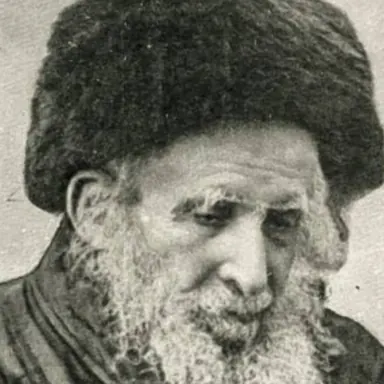
Rabbi Shmuel Salant (1816–1909)
15 min read3,073 words
Summary
The text surveys the monumental work of Rabbi Shmuel Salant, who served as rabbi of Jerusalem for about seven decades and became the architect of the modern Ashkenazi community in the Land of Israel. The article traces his figure from his beginnings as a prodigy in Lithuania to his becoming a political and religious leader of great stature, who steered the Old Yishuv with halakhic pragmatism and profound social sensitivity. Through the founding of fundamental institutions such as the Etz Chaim yeshiva and the Va'ad ha-Kelali Knesset Yisrael, the author stresses how the rabbi succeeded in uniting fragmented communities, establishing advanced systems of welfare and education, and encouraging the move outside the walls of the Old City. In conclusion, the source presents his Torah teaching, based on phenomenal erudition and "koach de-hetera" (the power of leniency), and describes a leadership that combined uncompromising fidelity to tradition with an impressive diplomatic ability that shaped the public infrastructure of Jerusalem to this day.
Leading the Transformation in Jerusalem: The Institutional Work and Torah Teaching of the Gaon Rabbi Shmuel Salant (1816–1909)
The 19th century in Jerusalem was marked by a radical transformation in the social, economic and religious structure of the Jewish Yishuv. At the heart of these processes stood the figure of the Gaon Rabbi Shmuel Salant, who served as rabbi of Jerusalem for about 70 years and was in effect the chief architect of the modern Ashkenazi community in the Land of Israel. Rabbi Salant's leadership was not only religious-halakhic in the narrow sense, but a wide-ranging political and institutional leadership that succeeded in steering a poor and fragmented community toward organizational consolidation, geographical expansion outside the walls of the Old City, and the creation of systems of education and welfare that constitute to this day the infrastructure of the world of Torah and welfare in Jerusalem.[1, 2, 3]
Lithuanian Roots and the Shaping of the "Prodigy of Keidan"
The rise of Rabbi Shmuel Salant took place within the scholarly cradle of Lithuanian Jewry at the beginning of the 19th century, a period in which the Volozhin yeshiva reached the height of its glory and the influence of the Vilna Gaon (the Gra) was more dominant than ever. He was born on 2 Shevat 5576 (1816) in the town of Volkonik (Valkininkai) near Białystok, in a home steeped in Torah and the rabbinate.[4, 5, 6] His father, Rabbi Tzvi, served as rabbi in the towns of Volkonik and Trakai, and was an influential figure in young Shmuel's early years. Upon his father's early death, Shmuel moved to live in the town of Keidan, where he soon became famous as a Torah child prodigy and earned the epithet "the prodigy of Keidan."[1, 4, 6]
Rabbi Salant's course of study reflects the summit of the yeshiva world of his time. He studied in the town of Salant with Rabbi Tzvi Hirsch Broida, a figure who instilled in him the foundations of profound Lithuanian scholarship, and later moved to the famous Volozhin yeshiva, where he studied under the guidance of Rabbi Yitzchak of Volozhin, the son of the yeshiva's founder.[1, 5, 6] This period shaped his Torah teaching, which rests on wide-ranging erudition, adherence to the plain sense of the Talmud and a textual critical sense that keeps away from idle pilpul, a tradition handed down to him from generations of the Gra's disciples.[1, 6]
Rabbi Salant's personal life in his early years knew upheavals: at the age of thirteen he married the daughter of Rabbi Avraham Shimon Traub, but the marriage ended in divorce after three years.[1, 6] The great turning point in his life came when his father met, in the town of Salant, Rabbi Yosef Zundel of Salant, an exemplary figure who was a principal disciple of Rabbi Chaim of Volozhin and one of the spiritual leaders of Lithuanian Jewry.[1, 7] Rabbi Yosef Zundel asked for Shmuel as a bridegroom for his daughter, Tova (Yona), and thus Rabbi Salant became connected to one of the most distinguished and influential families in the Lithuanian Torah world, a connection that provided him with the spiritual and social basis for his future leadership in Jerusalem.[1, 3, 7]
The Influence of Rabbi Yosef Zundel of Salant on His Son-in-Law
Rabbi Yosef Zundel was not only a father-in-law, but Rabbi Salant's spiritual and educational model. As one who was called a "third mouth of the Gra," Rabbi Yosef Zundel handed down to his son-in-law the modest approach, devotion to the customs of the Gra and the conception of charity and loving-kindness as an existential component of communal life.[6, 7] When Rabbi Yosef Zundel immigrated to Jerusalem in 1837, he laid the foundations for the community of the "Perushim" (the disciples of the Gra) in the city. Rabbi Salant himself did not at first plan to immigrate to the Land, but health circumstances (a severe lung disease and the need for a warm climate) led him to the decision to immigrate to Jerusalem in 1840, in a step that proved fateful for the whole Yishuv.[1, 2, 3]
The Immigration to Jerusalem and the Connection with Sir Moses Montefiore
Rabbi Salant's journey to Jerusalem passed through Constantinople (Istanbul), where a historic meeting took place that shaped the political and economic future of the Old Yishuv. Because of the war between Muhammad Ali and the Ottoman Sultan, Rabbi Salant was forced to wait in Constantinople for several months.[1] At that time Sir Moses Montefiore was also staying in the city, on his way to help the Jews of Damascus in the wake of the blood libel.[1, 2, 8] The friendship that developed between the young rabbi and the famous English philanthropist became a central axis of public activity in Jerusalem; Montefiore saw Rabbi Salant as an honest, shrewd and knowledgeable man, and began to consult him on all matters concerning the distribution of funds and the establishment of his enterprises in the Land of Israel.[1, 8] This connection gave Rabbi Salant an enormous diplomatic and economic advantage when he came to establish his leadership vis-à-vis the existing institutions and the Turkish authorities.
On arriving in Jerusalem in Adar 5601 (1841), Rabbi Salant joined a small and impoverished Ashkenazi community numbering only about 500 souls, most of them poor Torah scholars who lived in terrible overcrowding within the walls of the Old City.[2, 6, 8] He made his home in a small, meagre apartment in the "Hurva" compound (the ruin of Rabbi Yehuda HeChasid), where he lived all his life in conditions of poverty and voluntary asceticism, consistently refusing every offer to move to a more spacious apartment or to a house in the new neighbourhoods.[1, 6, 8]
Institutional Architecture: The "Etz Chaim" Yeshiva and the Pedagogical Revolution
One of Rabbi Salant's most impressive achievements was the founding and consolidation of the "Etz Chaim" yeshiva. Until the establishment of the institution, the Ashkenazi education system in Jerusalem was in a state of complete chaos: fathers hired a "melamed" privately, and the children studied in crowded rooms without division into levels, ages or an orderly curriculum.[8, 10] In 1841 Rabbi Salant initiated the founding of the "Etz Chaim" Talmud Torah, out of a vision of creating a holistic educational system that would accompany the student from childhood until marriage and beyond.[10, 11]
The pedagogical innovations that Rabbi Salant introduced at Etz Chaim were ahead of their time:
- Division by ability levels: unlike the method of the "cheder," in which children of different ages studied together, Etz Chaim was divided into classes according to levels of skill, which allowed prodigies to advance and weaker students to receive a suitable response.[8, 10]
- A multi-stage track: the institution included a Talmud Torah for children, an intermediate yeshiva called "Itur Rabbanim," and a senior yeshiva that in effect served as a kollel for married scholars, in which Torah scholars studied for decades.[10]
- Vocational training: in an exceptional step for an Orthodox leader of his time, Rabbi Salant directed that students who did not find "blessing in their studies" be sent to learn a trade so that they could support themselves honourably and not become a burden on the public.[3]
- Social assistance: the institution provided clothing, shoes and food to the poorest students, thereby ensuring basic equality of opportunity in Torah study.[3]
The Etz Chaim yeshiva became the spiritual center of Jerusalem, and in 1900 it numbered close to 1,000 students.[6] Rabbi Salant himself stood at the head of the yeshiva and served as its president, raising funds for it on his journeys in the world and working for its physical consolidation, including the purchase of land for building branches of the yeshiva outside the walls of the Old City.[3, 10]
"Ha-Va'ad ha-Kelali Knesset Yisrael": Uniting the Community and Managing the "Chaluka"
To understand Rabbi Salant's work, one must be acquainted with the system of the "chaluka," the system of raising donations from the diaspora that financed the Jewish Yishuv in the Land of Israel. The central problem was the fragmentation of the Ashkenazi community into separate "kollelim" according to countries of origin (Vilna, Poland, Horodna and others), which led to internal struggles, inefficiency and an unfair distribution of resources.[9]
In 1866, following the severe cholera epidemic that struck Jerusalem and left behind it orphans and abject poverty, Rabbi Salant and Rabbi Meir Auerbach understood that there was a need for a unified umbrella organization.[6, 9] Thus the "Va'ad Kol ha-Kollelim" (Committee of All the Kollelim) was founded, whose name was later changed to "Ha-Va'ad ha-Kelali Knesset Yisrael."[5, 9] Rabbi Salant stood at the head of the committee and made it the central institution that managed all areas of life in the Yishuv:
- Welfare and charity: systematic support for the poor, widows and orphans.[9]
- Health and sanitation: dealing with epidemics, cleaning water cisterns and sewage, and establishing medical institutions.[9]
- Diplomacy: representing the community before the foreign consulates and the Ottoman government.[9]
- Construction and development: establishing new neighbourhoods (such as "Knesset Yisrael") and purchasing properties that served as endowments (hekdesh) for the benefit of the public.[9]
The establishment of the Va'ad ha-Kelali under Rabbi Salant's leadership gave the Ashkenazi Yishuv unprecedented political and economic stability, and made it the dominant factor in Jerusalem.[5, 9]
His Torah Teaching: Ruling by Plain Sense, Erudition and Koach de-Hetera
Rabbi Salant's halakhic leadership was characterized by a realistic, moderate approach and profound pragmatism, which were essential for the existence of a poor community in harsh living conditions. His Torah teaching was not perpetuated in books he wrote himself (it is claimed that he refrained from writing because of technical difficulties or excessive humility), but through thousands of responsa and rulings that he gave orally, and which were later collected by his disciples and descendants.[1]
Ruling from Memory and the Absence of Books
One of Rabbi Salant's most astonishing characteristics was his phenomenal memory. He used to rule on extremely complicated questions without consulting books, citing sources from the Talmud and the halakhic decisors with the utmost precision.[1] Even in his old age, when his sight had weakened almost to blindness, the masses of Jerusalem continued to frequent his home and to hear his rulings, which were based on complete mastery of the sea of the Talmud.[1, 3]
"Koach de-Hetera" and Social Sensitivity
Rabbi Salant was known as a decisor inclined to leniency ("koach de-hetera"), out of an understanding that excessive stringencies could lead to heavy financial loss for the destitute poor.[1] He did not see stringency as an end in itself, but always sought the halakhic way that would make the existence of the Yishuv possible. Famous examples of his shrewdness and his lenient inclination:
- A mixture of meat and milk: when a poor woman came before him with a pot of meat into which milk had fallen, Rabbi Salant knew that the local milkman used to dilute the milk with water. He checked this quietly, and on the basis of the knowledge that the milk had been diluted, he ruled that the actual quantity of milk was nullified in sixty and permitted the meat.[1, 8]
- The heter mechira (permit of sale): in the affair of the sabbatical year of 5649 (1889), Rabbi Salant at first opposed the heter mechira.[1] However, in the following sabbatical years (5656 and 5663), when he saw that the situation of the moshavot was dire and the agricultural Yishuv was in danger of collapse, he changed his position and supported the permit, cooperating with Rabbi Yehoshua Leib Diskin in carrying out the sale in practice.[1]
The Etrog Controversy and Political Leadership
Rabbi Salant also displayed leadership on "agricultural-halakhic" issues of economic significance. He supported the use of etrogim grown in the Land of Israel (such as those from the village of Umm al-Fahm) over etrogim imported from Greece and Corfu, out of a desire to strengthen the economy of the Land and to ensure the kashrut of etrogim that are not grafted.[3]
Relations between Communities and Inter-Communal Diplomacy
One of the great challenges of the 19th century in Jerusalem was the tension between the Sephardic community, which was the community officially recognized by the Turkish government (a "millet") and was headed by the "Chacham Bashi," and the Ashkenazi community, which was steadily growing but remained without official status.[2] Rabbi Salant, in his great shrewdness, succeeded in building bridges between the communities and preventing unnecessary friction.
He worked in close cooperation with his Sephardic counterpart, the Rishon LeZion Rabbi Yaakov Shaul Elyashar, and the two jointly signed ordinances and agreements for the benefit of the whole public.[3, 5] An especially significant achievement was bringing about an equal distribution of charity funds between Sephardim and Ashkenazim, after many years in which the Sephardim had enjoyed a larger share.[1, 2] Rabbi Salant made sure that every donation that came through him was distributed fairly, and thereby won the trust of all the factions of the city.
Opposition to Modern Changes and Guarding the Walls of Tradition
Despite his relative moderation and his connections with figures such as Montefiore, Rabbi Salant was a firm guardian of the walls in everything concerning changes in the spirit of religion and tradition. He stood at the forefront of the struggle against attempts to introduce secular education or foreign influences into Jerusalem:
- The struggle against the mission: the establishment of the Bikur Cholim hospital and of the Ashkenazi educational institutions was intended, among other things, to provide a proper Jewish alternative and to prevent poor Jews from turning to the aid institutions of the Christian mission.[3]
- A ban on foreign libraries and schools: the rabbi signed bans against the establishment of the first library in Jerusalem and against the schools of the "Kol Yisrael Chaverim" society (Alliance Israélite Universelle), out of concern that this would undermine the traditional world of Torah.[1]
- A balanced approach to bans: nevertheless, he refrained from joining extreme bans led by more zealous circles. Thus, for example, he opposed the ban imposed on Yechiel Michel Pines by the circle of Rabbi Diskin, thereby demonstrating his moderate conception, which sought to prevent a deep internal rift in the Yishuv.[1]
"The Agreement of 5641": Tension and Peace between Rabbi Salant and Rabbi Diskin
In 1877 "the Seraph of Brisk," the Gaon Rabbi Yehoshua Leib Diskin, arrived in Jerusalem. The arrival of a Torah giant of such magnitude created potential tension in the leadership of the city. Rabbi Diskin represented a more zealous and uncompromising line, while Rabbi Salant represented the establishment, organized and pragmatic line.[1] To prevent a dispute, "the Agreement of 5641" (1881) was formulated, which divided the powers of leadership: Rabbi Salant continued to manage public, economic and administrative affairs (through the Va'ad ha-Kelali and Etz Chaim), while Rabbi Diskin took over supervision of matters of religion and kashrut (such as the slaughterhouse).[1, 13, 14] This cooperation, despite the differences of approach, allowed Jerusalem to enjoy a double and strong leadership that coped with the challenges of the period.
The End of His Path and His Legacy for Generations
In his last years, when he was already past the age of 80 and his eyesight was failing him, Rabbi Salant sought to ensure the continuity of the leadership. He turned to Rabbi Eliyahu David Rabinowitz-Teomim (the Aderet), rabbi of Mir and Ponevezh, to come to Jerusalem and serve as his assistant and future successor.[4, 5] The Aderet immigrated to Jerusalem in 1901, but tragically he died in 1905, while Rabbi Salant was still alive.[4]
Rabbi Shmuel Salant died on 29 Av 5669 (1909), at the age of 93, after a generation of undisputed leadership.[3, 4, 5] His death marked the end of an era in the Old Yishuv. The extent of his influence is evident in the fact that his funeral was postponed until the light of morning (a rare departure from the customs of Jerusalem) in order to allow the tens of thousands of mourners to take part safely.[3]
Rabbi Salant's legacy lives and breathes in the Jerusalem of the 21st century:
- The institutions: the "Etz Chaim" yeshiva and the "Va'ad ha-Kelali" continue to exist and to support Torah students and the poor.
- Urban development: the neighbourhoods and institutions he founded formed the nucleus for the development of the modern city outside the walls.
- Rabbinic leadership: the model of a city rabbi who combines complete Torah erudition with political shrewdness and concern for all public affairs became an example for the rabbis of the Land of Israel in later generations.
In sum, Rabbi Shmuel Salant was the figure who connected the old Torah world of Lithuania with the new and emerging reality of the Land of Israel. Through his shrewdness, his modesty and his complete devotion, he succeeded in turning a community of "guardians of the walls" into a flourishing, organized and vibrant Yishuv, which constitutes the foundation of Jerusalem as the world center of Torah.[2, 5, 8]
Sources14
- 1.הרב שמואל סלנט – ויקישיבה - אתר ישיבה, yeshiva.org.il/wiki/index.php/הרב_שמואל_סלנט
- 2.January 2: Chief Rabbi of Jerusalem in the 19th Century - Jewish Currents, jewishcurrents.org/january-2-chief-rabbi-of-jerusalem-in-the-19th-century
- 3.Shmuel Salant - Wikipedia, en.wikipedia.org/wiki/Shmuel_Salant
- 4.ר' שמואל סלנט - אהבת ירושלים, jerusalem-love.co.il/?page_id=2777
- 5.שמואל סלנט - ויקיפדיה, he.wikipedia.org/wiki/שמואל_סלנט
- 6.Rabbi Shmuel SALANT - Tzadikim, dailyzohar.com/tzadikim/289-Rabbi-Shmuel-SALANT
- 7.,תולדות שושלת סלנט-מאת "מ.ירושלמי" - המולטי יקום של אלי אשד, no-666.com/2009/09/03/תולדות-שושלת-סלנט/
- 8.Sage Advice - Hadran, hadran.org.il/beyond-the-daf/sage-advice/
- 9.הוועד הכללי כנסת ישראל – ויקיפדיה, he.wikipedia.org/wiki/הוועד_הכללי_כנסת_ישראל
- 10.ישיבת עץ חיים - ויקיפדיה, he.wikipedia.org/wiki/ישיבת_עץ_חיים
- 11.מבחנים בתלמוד תורה "עץ חיים" - אהבת ירושלים, jerusalem-love.co.il/?page_id=21364
- 12.הִילּוּלָא קַדִּישָׁא • רבי שמואל סאלנט זי"ע - JDN, archive.jdn.co.il/breakingnews/1193447/
- 13.Untitled, he.wikipedia.org/wiki/יהוע_לייב_דיסקין
- 14.Untitled, yeshiva.org.il/wiki/index.php/הרב_יהושע_לייב_דיסקין