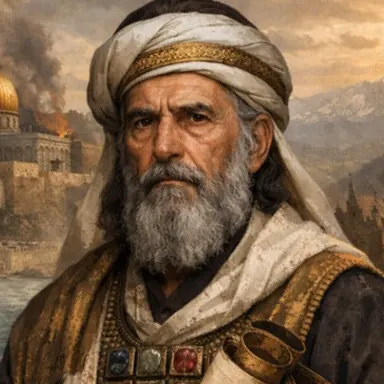
The Center in the Land of Israel in Its Decline: The Work, Teaching and Struggles of Rav Evyatar ben Eliyahu HaKohen Gaon
17 min read3,348 words
Summary
This survey deals with the figure of Rav Evyatar ben Eliyahu HaKohen, the last leader to bear the title "Gaon" in the Land of Israel during the decline of its spiritual center in the 11th century. The text focuses on the struggle for the legitimacy of the yeshiva of the Land of Israel against rival forces from Egypt and Babylonia, stressing the exclusive authority of the sages of the Land in fixing the Hebrew calendar and in the ordination of sages. Through an analysis of the "Scroll of Evyatar" and of findings from the Cairo Genizah, the author describes the upheavals of the leadership and the forced wanderings from Jerusalem to Tyre and to Damascus in the wake of political upheavals and the Crusades. In the end, the source seeks to illuminate the spiritual legacy of Rav Evyatar, who preserved the ember of "Gaon Yaakov" ("the Pride of Jacob") and influenced the world of halakha for generations, despite the physical collapse of the center at whose head he stood.
The Historical Setting: The 11th Century and the Upheavals of Jewish Leadership
The eleventh century CE marked one of the most turbulent and complex periods in the history of the Land of Israel in general and of the Jewry of the Land of Israel in particular. In the space between the decline of the Fatimid Caliphate and the rise of the Seljuks, and before the outbreak of the First Crusade, Rav Evyatar ben Eliyahu HaKohen Gaon stands as the last central figure to hold the title "Gaon" on the soil of the Land of Israel and in its vicinity.[1, 2] Rav Evyatar's work is not limited to leading the institution of learning of the "Gaon Yaakov" yeshiva; it is an expression of a heroic effort to preserve the independence of the center in the Land of Israel against the expansionist ambitions of rival centers, foremost among them the center in Egypt under the leadership of David ben Daniel.[3, 4]
Understanding the figure of Rav Evyatar requires a deep dive into the institutional structure of the period. The yeshiva of the Land of Israel, which was also called the "Yeshiva of the Land of the Deer," saw itself as the legal and exclusive heir of the institution of the Sanhedrin.[5, 6] Its authority stemmed not only from its scholarly ability but from the very fact of its seat in the Holy Land, which gave it the exclusive right to the "ordination of elders" and to fixing the Hebrew calendar—the sanctification of the new month and the intercalation of the year.[5] Rav Evyatar was born into a dynasty of kohanim that had led the yeshiva for decades, and he inherited from his father, Rav Eliyahu HaKohen Gaon, not only a leadership role but an existential struggle over the very legitimacy of this center in the eyes of the Diaspora.[3, 5]
The main sources of information about him were dramatically revealed in the Cairo Genizah, foremost among them the "Megillat Evyatar" (Scroll of Abiathar), a document written in 1094 that combines historical report, religious polemic and political manifesto.[1, 3] The scroll reflects the turmoil of soul of a generation of transition, a generation that saw Jerusalem conquered by the Seljuks in 1073 and was forced to move its center of gravity to Tyre in Lebanon.[3, 5]
The Timeline of the Yeshiva's Leadership and Wanderings in the 11th Century
In order to understand the dynamics that led to Rav Evyatar's rise, one must examine the chain of leadership and the geographical moves of the yeshiva of the Land of Israel throughout the 11th century, a period characterized by extreme political instability.
The Priestly Dynasty and the Legitimation of the Leadership
Rav Evyatar grew up in a family that saw the priesthood not only as a religious status in the Temple but as a basis for political and legal leadership in the period of exile. The priestly Sijilmasi family, which originated in the Maghreb, held the positions of power in the yeshiva of the Land of Israel from the end of the 10th century.[5] For Rav Evyatar, the priesthood was the decisive answer to the claims of "Davidic lineage" raised by his opponents, foremost among them David ben Daniel.[3]
The conception underlying Rav Evyatar's teaching is that the leadership of Israel after the destruction of the Temple was handed over to the Torah sages who sat in the Land of Israel, and it is they who constitute the continuation of "Gaon Yaakov."[5, 6] In the Scroll of Evyatar he takes pains to stress the chain of ordination that passed from his father to him, as an expression of an authority that cannot be challenged by outside parties, even if they claim to be a scion of the royal house.[3, 5]
The institutional aspect of the yeshiva was highly structured and formal. At its head stood the Gaon, who was sometimes called "the Nasi," and under him functioned the "Av Beit Din" (head of the court) and seven members who formed the "small Sanhedrin."[5] Rav Evyatar served as the "right hand" of his father Rav Eliyahu for many years and was an active partner in the management of public affairs even before his official appointment in 1083.[3] This partnership allowed him to accumulate much political and halakhic experience, which was to serve him in the hard struggles that befell the yeshiva upon his father's death.
The Hierarchical Structure of the Gaon Yaakov Yeshiva in the Time of Evyatar
The organizational structure of the yeshiva reflected the attempt to preserve orders of Torah governance even in exile. The following table details the central roles as they are reflected in the Genizah writings and in the Scroll of Evyatar.
The Forced Wanderings: From the Destruction of Jerusalem to the Relative Stability in Tyre
The dramatic turning point in the life of Rav Evyatar and of his yeshiva took place in 1073. Jerusalem, the seat of the yeshiva, was conquered by the Seljuk forces led by Atsiz ibn Uvaq. Although the initial conquest did not lead to the immediate destruction of the Jewish community, after a revolt by the city's inhabitants in 1077 the Seljuks responded with a terrible massacre of the city's notables and with widespread looting.[5]
In the wake of these events, Rav Eliyahu HaKohen, Evyatar's father, was forced to move the yeshiva to the city of Tyre in Lebanon. Tyre was at that time under Fatimid rule and enjoyed relative security and extensive economic ties with the Jewish communities in Egypt.[3, 5] The move to Tyre was not perceived as surrender but as a strategic necessity to keep the institution alive and functioning. In Tyre the yeshiva continued to operate for decades, and there the figure of Rav Evyatar as a leader was formed.[1, 5]
In 1083 Rav Eliyahu HaKohen passed away in Tyre. The description of the funeral in the Scroll of Evyatar is one of the most moving passages and one of the most important for understanding the standing of the Gaon. Evyatar relates that "all Israel carried him on their shoulders, and not on horses, a journey of three days to the mountain of Galilee, to Dalton, and he was buried at the top of the mountain beside Rabbi Yose the Galilean."[2] This journey, which crossed wide areas under security threat, illustrated the community's deep loyalty to its leader and the unbreakable bond between the yeshiva and the soil of the Galilee.[2] With his father's death Rav Evyatar inherited the seat of the Gaonate, but he was at once caught up in the hardest struggle of his life—the confrontation with David ben Daniel.
The Great Controversy: Rav Evyatar versus David ben Daniel
The struggle between Rav Evyatar and David ben Daniel was not merely a personal dispute between two leaders but a clash between two worldviews concerning the source of Jewish authority in the Middle Ages. David ben Daniel, a descendant of the family of the Exilarchs of Babylonia, arrived in Egypt in 1078 in difficult financial circumstances, but with the help of charisma and political connections he succeeded in amassing enormous power in Fustat and in Cairo.[3, 4]
David's ambition was to become "Exilarch" of all the Jews of the Fatimid Empire, including subjecting to his authority the communities in the Land of Israel, in Syria and in Lebanon.[3, 4] This step posed a direct threat to the independence of the yeshiva of the Land of Israel and to Rav Evyatar's standing as Gaon. David ben Daniel was described by Evyatar as a tyrannical and zealous figure, a description that is corroborated by other letters found in the Genizah.[3]
The Focal Points of the Conflict and the Methods of Struggle
The conflict extended over several fronts, as can be seen from the historical analysis of the period:
- The political front: David ben Daniel exploited his connections with the Fatimid government to depose the Nagid Mevorakh ben Saadia, who supported Rav Evyatar. In this way he succeeded in blocking the flow of funds and donations from Egypt to the yeshiva in Tyre.[3, 4]
- The ideological front: David claimed authority by virtue of being a scion of the House of David. Against this, Rav Evyatar argued in his scroll that the leadership of the Land of Israel and the priesthood are the only legitimate authorities after the destruction of the Temple.[3, 5]
- The communal front: David sent representatives, such as Avraham ben Natan, to undermine Evyatar's authority within the city of Tyre itself and in other coastal communities such as Ashkelon.[3, 7]
- The Hebrew calendar: One of the sharpest points of contention was David's attempt to interfere in fixing the year and its intercalation, an authority that had always been the "Holy of Holies" of the center in the Land of Israel.[3, 5]
The struggle reached its peak in the years 1093–1094. David ben Daniel succeeded for a short time in imposing his authority on many communities, using informing and brute force against his opponents. Rav Evyatar was forced to flee from Tyre and found temporary refuge in Damascus and in Tripoli.[1, 5] Yet David's fall was almost as swift as his rise. In 1094, following political changes at the Fatimid court and the return of the Nagid Mevorakh to power, David ben Daniel was removed from all his posts.[3, 4] This victory was commemorated by Rav Evyatar in the writing of the "Scroll of Evyatar," which was sent to all the communities as an expression of the restoration of justice and order.[3]
An Analysis of the "Scroll of Evyatar": Structure, Content and Significance
The "Scroll of Evyatar" (1094) is not merely a dry report of events but a sophisticated literary and halakhic work meant to establish the worldview of the yeshiva of the Land of Israel. The scroll was written in rich biblical Hebrew, weaving in verses from Scripture as an allegory for the contemporary struggles.[1, 3]
The Central Themes of the Scroll
The scroll is divided into several conceptual layers that complement one another. Rav Evyatar builds his arguments gradually, from the historical aspect to the theological justification.
One of the fascinating discoveries of modern research is that the copy of the scroll found in the Genizah was apparently copied by Rabbi Yehuda HaLevi, which attests to the wide echoes the scroll aroused and to its importance in the eyes of the great men of the following generation.[3] The scroll also served as a source of inspiration for Maimonides (Rambam) in his discussions of the standing of the Land of Israel and of the authority of its leadership.[3]
The Torah Teaching and Halakhic Rulings of Rav Evyatar
Beyond being a political leader, Rav Evyatar was a halakhic decisor of stature. His halakhic responsa, some of which were preserved in the Genizah, attest to adherence to the distinctive tradition of the Land of Israel, which at times stood in contrast to the Babylonian custom that had begun to spread in the Jewish world.[5]
The Connection with Ashkenazi Jewry and the Machzor Vitry
A surprising and highly significant connection has been revealed between Rav Evyatar and the early sages of Ashkenaz. In the "Machzor Vitry," one of the pillars of Ashkenazi halakha, questions are brought that were sent from northern Europe to the "lions who dwell in Jerusalem"—the designation for Rav Eliyahu HaKohen and his son Rav Evyatar during their stay in Tyre.[5, 8]
These responsa deal with a variety of subjects, among them:
- Laws of prayer and synagogue customs: The preservation of ancient Land-of-Israel rites that penetrated the Ashkenazi custom and distinguished it from the Sephardi-Babylonian custom.[5]
- Laws of marriage and divorce: Documents from the Genizah attest to Evyatar's rulings on matters of the ketubah and the get, with an emphasis on protecting the rights of the woman in accordance with the custom of the Land of Israel.[9]
- Laws of kashrut and salting: Specific references to the questions of milk milked by a gentile and the salting of meat, which are quoted in his name in the writings of Rashi's students.[8]
The fact that the sages of Ashkenaz chose to turn specifically to the yeshiva of the Land of Israel, despite the existence of strong Torah centers in Babylonia and in Egypt, attests to the spiritual and authoritative aura that still surrounded Rav Evyatar and the Gaonate of the Land of Israel in the eyes of European Jewry.[5]
The Authority of the Hebrew Calendar: The Beating Heart of His Teaching
For Rav Evyatar, the authority to fix the Hebrew calendar was far more than a technical and mathematical matter; it was the very essence of the yeshiva of the Land of Israel as heir of the Sanhedrin. He saw in the sanctification of the new month and the intercalation of the year the living bond between the people and its land and between the Torah and reality.[5, 6]
The Scroll of Evyatar describes at length the journey of his father, Rav Eliyahu, to Tyre and to Haifa in 1083 in order to sanctify the year.[5] This act was meant to declare before the entire Jewish world that despite the Seljuk conquest and the wanderings, the authority remained in the hands of "Gaon Yaakov."[5] Rav Evyatar continued this line with determination, coming out sharply against every attempt by the sages of Egypt or Babylonia to fix the calendar independently.[3, 5]
The institutional aspect of fixing the calendar included traditional ceremonies of the ordination of elders, which Rav Evyatar was careful to maintain even in the hardest periods of distress. He believed that as long as an authorized leadership existed in the Land of Israel (or near it), no other center had the right to interfere in the Jewish ordering of time.[5, 6]
Rav Evyatar and the Crisis of the First Crusade
The last days of Rav Evyatar were marked by one of the great tragedies of the Middle Ages—the First Crusade. The Crusader conquest of Jerusalem in 1099 and the horrifying massacre of its Jews and Muslims put an end to any hope of a quick return of the yeshiva to the Holy City.[2]
At that time Rav Evyatar was staying in Tripoli in Lebanon. A letter found in the Genizah describes the excitement and messianic expectation that these events aroused among the Jewish communities.[2] Menachem ben Eliyahu writes to Rav Nissim of "a great awakening toward the redemption" and of testimonies of miracles and of the revelation of Elijah.[2] Amid this turmoil it is mentioned that Rav Evyatar sent a letter from Tripoli to Constantinople, whose exact content has not reached us, but the context indicates an attempt to coordinate positions with the Byzantine Empire and with possible messianic developments.[2]
The Siege of Tripoli and the Flight to Damascus
Tripoli, which was Rav Evyatar's last refuge in Lebanon, was under a prolonged Crusader siege between 1102 and 1109. Rav Evyatar was trapped in the besieged city and suffered from harsh living conditions and a sense of isolation.[1] Despite the distress, he continued to keep in contact with other communities, as far as the situation allowed.
In the end Rav Evyatar succeeded in escaping from Tripoli and finding refuge in Damascus.[1] It seems that his exalted standing as a recognized religious leader allowed him to obtain "safe passage" through enemy lines, a fact that attests to the respect accorded to him even by the non-Jewish authorities in the region.[1] Damascus became the last station in the life and activity of Rav Evyatar. There he tried to rebuild the remnants of the yeshiva of the Land of Israel, but the physical center in the Land of Israel no longer existed.[5]
The Legacy and Commemoration: From Then to Today
Rav Evyatar ben Eliyahu HaKohen Gaon died around 1112.[2] With his death a glorious but tormented period of the Gaonate of the Land of Israel came to an end. He was the last to bear the title "Gaon" out of a sense of sovereignty and exclusive authority over the Holy Land.[1]
His memory has been preserved in various ways:
- The Cairo Genizah: Thanks to the thousands of documents found, the figure of Rav Evyatar is one of the best documented among the sages of the Middle Ages, which makes possible in-depth historical research into his leadership and his teaching.[10, 11]
- Mount Evyatar: In the Upper Galilee a mountain is named after him, commemorating the historic funeral journey he described in his scroll and his courage in the face of persecution.[2]
- Halakha and custom: His influence on the customs of Ashkenaz and on the conceptions of Maimonides is evidence that even if the physical center collapsed, the spiritual and ideological legacy that Rav Evyatar created continued to pulse in the Jewish world for many generations afterward.[3, 5]
Summary: The Figure of a Leader at a Historical Crossroads
Rav Evyatar Gaon represents the type of leader forced to act under conditions of a historical "twilight." He was deeply rooted in the past tradition of the Sanhedrin and the Gaonate, but he was forced to cope with a new reality of refugeehood, political persecution and dramatic geopolitical changes.
His struggle against David ben Daniel was not merely a struggle for power but a war for the very existence of an independent Jewish identity of the Land of Israel.[3] The "Scroll of Evyatar" that he left behind is a testimony to the victory of the spirit over brute force, and his halakhic rulings are a bridge that connected the Land of Israel of the Middle Ages with the Diaspora in Europe and in Egypt.[3, 5] Rav Evyatar remains in historical memory as the one who kept the ember of "Gaon Yaakov" alive to its last moments, and thereby ensured that the legacy of the Land of Israel would never be forgotten.
A note on the scope of the report: This study encompasses all the historical, halakhic and biographical information known about Rav Evyatar Gaon from the Genizah sources and from modern research. The analysis focuses on the combination of the political reality and the spiritual aspirations of the last leader of the yeshiva of the Land of Israel on its own soil. The absence of complete halakhic works from his pen (apart from the scroll and the few responsa) makes every fragment of information from the Genizah a cornerstone in reconstructing his monumental figure.
Sources11
- 1.Abiathar ben Elijah ha-Cohen - Wikipedia, en.wikipedia.org/wiki/Abiathar_ben_Elijah_ha-Cohen
- 2.רבי אביתר גאון - ויקיפדיה, he.wikipedia.org/wiki/רבי_אביתר_גאון
- 3.Megillat Evyatar (Scroll of Abiathar) - Brill Reference Works, referenceworks.brill.com/display/entries/EJIO/SIM-0015000.xml
- 4.David ben Daniel | Encyclopedia.com, encyclopedia.com/religion/encyclopedias-almanacs-transcripts-and-maps/david-ben-daniel-0
- 5.ישיבת ארץ ישראל (ימי הביניים) – ויקיפדיה, he.wikipedia.org/wiki/ישיבת_ארץ_ישראל_(ימי_הביניים)
- 6.הסנהדרין - גילי חסקין, gilihaskin.com/64069-2/
- 7.Abraham ben Nathan son of Nathan ben Abraham - Brill, referenceworks.brill.com/doi/10.1163/1878-9781_ejiw_SIM_0000220
- 8.מחזור ויטרי חלק א, beureihatefila.com/files/Machzor_Vitri_1.pdf
- 9.Scholarship on Letter: T-S 10J15.9 - The Princeton Geniza Project, geniza.princeton.edu/en/documents/7886/scholarship/
- 10.The Cairo Genizah and Its Contribution to the Study of Midrash Aggadah - TheTorah.com, thetorah.com/article/the-cairo-genizah-and-its-contribution-to-the-study-of-midrash-aggadah
- 11.Cairo Geniza - Wikipedia, en.wikipedia.org/wiki/Cairo_Geniza