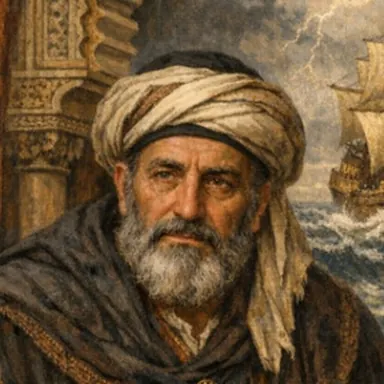
The Torah Teaching, Public Work and Legacy of Rav Maimon the Dayyan: A Link Between Generations
19 min read3,812 words
Summary
This source surveys the figure of Rabbi Maimon the Dayyan, the father and principal teacher of Maimonides (Rambam), and describes him as a vital link between the Golden Age of Spanish Jewry and the generations that followed. The text details his illustrious lineage as the seventh generation of dayyanim (rabbinic judges) in Córdoba and his being a disciple of the Ri Migash, while emphasizing his activity during the period of the Almohad persecutions that led to his family's wanderings. At the center of his legacy stands the "Epistle of Consolation," in which he proposed a rational and compassionate leadership for the communities forced to live as anusim (forced converts), alongside his deep scientific engagement in astronomy and mathematics. Ultimately, the article seeks to show how his worldview, his halakhic works and his educational devotion laid the spiritual and methodological foundation for his son's monumental enterprise.
The Figure of Rav Maimon the Dayyan in the Mirror of the Generations
Rabbi Maimon ben Yosef the Dayyan, known in Jewish history first and foremost as the father and principal teacher of Maimonides, stands as a weighty Torah and spiritual figure in his own right. His activity took place in one of the most turbulent and dramatic periods in the history of the Jewry of Spain and the Maghreb – the transition from the Golden Age of the communities of Andalusia to the days of harsh persecution under the rule of the Almohad dynasty.[1, 2] Rav Maimon was not only a dayyan in the important rabbinic court of Córdoba but a distinguished representative of the classical Spanish tradition of learning, a disciple of the Ri Migash, and the transmitter of the halakhic and philosophical tradition to the next generation.[1, 3, 4]
Historical and Torah analysis of his figure shows that Rav Maimon served as a living bridge between the world of the Rif and the Ri Migash and the monumental enterprise of his son, Maimonides. He combined in his personality profound Talmudic scholarship, courageous public leadership in times of crisis, and broad expertise in the sciences of the age, with an emphasis on astronomy and mathematics.[1, 2] His most famous surviving work, the "Epistle of Consolation," is a moving human and religious document that offers a unique view of the ways in which the leadership of the generation coped with the phenomenon of the anusim and with religious persecution.[5, 6, 7]
The Family Background and the Dynasty of Dayyanim in Córdoba
Rav Maimon was born around the year 1110 in Spain, to a family whose Torah and social lineage was among the most illustrious in Spanish Jewry.[1] This family held a tradition of serving as dayyanim in Córdoba for seven consecutive generations, a fact that attests to its stability and centrality in the local Jewish community.[1, 5, 8] The family's lineage, as noted in later sources and in the words of Maimonides himself, reached back to Rabbi Yehuda HaNasi, the redactor of the Mishnah, and through him to King David.[2, 3, 5]
The fact that he was the seventh generation of dayyanim is not merely a matter of family prestige; it reflects the socio-religious structure of Spanish Jewry at that time. Communal and spiritual leadership was often passed down by inheritance within elite families that preserved rich libraries, distinctive traditions of legal ruling, and political ties with the Muslim government.[8] Twelfth-century Córdoba was a world cultural center, and Rav Maimon worked within an intellectual atmosphere that combined pure halakha with broad general learning in the natural sciences and philosophy.[1, 8]
The Period of Study with the Ri Migash and the Shaping of the Halakhic Methodology
One of the most significant junctures in the shaping of Rav Maimon's Torah personality was his years of study with Rabbi Yosef HaLevi ibn Migash (the Ri Migash), who was head of the yeshiva in Lucena and the designated successor of the Rif.[3, 4, 9] The Ri Migash is regarded as one of the greatest scholars in Spain of all generations, and Maimonides himself testified of him that the level of his understanding of the Talmud was so high that anyone who studied his words might be filled with awe.[4]
Rav Maimon was one of the distinguished and close disciples of the Ri Migash, and through him he absorbed the method of study of the "sages of Andalus," characterized by a striving for conceptual clarity, exemplary logical order, and adherence to the plain meaning of the Talmud and of settled halakha.[1, 3, 4] This connection created the exegetical and halakhic chain that ultimately led to the enterprise of Maimonides. Although Maimonides was a child of only six when the Ri Migash died (1141), he regarded him as his principal teacher, since he received the core of his teaching and his methodology of study from his father, Rav Maimon, who was the direct transmitter of the tradition.[4]
The methodology that Rav Maimon absorbed in the yeshiva of Lucena included not only intensive study of Gemara but also the writing of halakhic responsa and legal rulings based on rational analysis of the Tannaitic and Amoraic sources.[4, 5] Rav Maimon passed on to his son the Torah library he had amassed and his detailed study notes, which formed the textual foundation on which the Commentary on the Mishnah and the composition of the "Yad ha-Hazakah" were later built.[5] Maimonides states explicitly that he gathered everything that had reached him of his father's commentaries, a fact that attests that Rav Maimon was actively involved in documenting and preserving the teaching of his masters.[5, 9]
The Almohad Crisis and the Cultural Destruction of Andalusia
In the year 1148 the life of Rav Maimon and his family changed completely as a result of a geopolitical event that shook the Jewish and Muslim worlds alike. The Almohad dynasty (al-Muwahhidun), a zealous and aggressive Muslim movement that arose in the Atlas Mountains of Morocco, invaded the Iberian Peninsula and conquered Córdoba.[2, 5, 10] Unlike the previous Muslim rulers of the Almoravid dynasty, who had been relatively tolerant toward religious minorities, the Almohads confronted the Jews with a cruel and unequivocal choice: conversion to Islam, death by the sword, or immediate abandonment of all their property and exile.[2, 5, 11]
Rav Maimon, as a spiritual leader and dayyan, chose the hard path of exile. He left Córdoba with his family, among them his son Moshe (Maimonides), who was then about 13, and began a long and exhausting period of wandering.[2, 3] These wanderings lasted more than ten years, during which the family moved throughout Spain, hiding in various cities and trying to preserve their Jewish identity and the routine of Torah study under constant threat.[2, 3] Despite the conditions of instability and the hovering danger, Rav Maimon continued to serve as a spiritual support for his family and as a teacher to his sons, Moshe and David, taking care to transmit the Torah and scientific tradition to the next generation.[2, 3]
In the year 1159 the family arrived in the city of Fez in Morocco. The surprising choice of Fez, which was an important seat of Almohad government, has raised many questions among scholars. It seems that Rav Maimon believed that in the large urban center it would be easier to blend in and hide than in the periphery, or that he wished to learn from the sages of Fez who had remained there.[6, 10] In Fez the young Maimonides studied with Rabbi Yehuda HaKohen ibn Susan, who was renowned for his piety and erudition.[6] This period, in which many Jews lived as anusim (accepting the religion of Islam outwardly only), was the background to the writing of Rav Maimon's most significant work.
The Epistle of Consolation: A Theological and Psychological Response to the Crisis of Forced Conversion
The "Epistle of Consolation" (Risalat al-Ta'aziya) is the only work of Rav Maimon that has reached us in its entirety, and it is a foundational document for understanding the ways in which the leadership of the generation coped with the Almohad persecutions.[1, 5, 9] The epistle was written in Judeo-Arabic around the year 1160, while Rav Maimon was staying in Fez, and it was intended for the Jews of North Africa who suffered spiritual oppression and lives of duplicity under the yoke of Islam.[5, 6, 12]
The Structure of the Content and the Interpretation of Psalm 90
The epistle does not content itself with general words of encouragement; it is constructed as a profound exegetical and theological work. Nearly half of the epistle is devoted to a detailed interpretation of Psalm 90, "A prayer of Moses, the man of God."[13] Rav Maimon chose this psalm out of the understanding that the prayer of Moses reflects the existential situation of the people of Israel in the wilderness – a period of wanderings, sins and divine grace.[13] He used the psalm as a tool for strengthening faith in the coming of the Messiah and in the imminent redemption, emphasizing that the present distresses are "the birth pangs of the Messiah," intended to purify the people.[12]
Rav Maimon recommended that Jews caught in the distress of forced conversion recite this psalm every morning in the Shacharit prayer, as a way of preserving the bond with the Creator and the national hope.[13] He emphasized that the redemption does not depend only on the merits of the present generation but is a consequence of the eternal covenant that God made with the Patriarchs and with Moses our teacher.[12]
The Attitude toward the Anusim and the Doctrine of Kiddush Hashem
The most revolutionary and humane aspect of the epistle is its inclusive and embracing approach toward Jews who had been forced to accept Islam outwardly. Rav Maimon drew a sharp distinction between voluntary conversion and conversion under absolute compulsion (duress).[6, 7, 11] He came out against zealous voices of that generation who disqualified the anusim and claimed that their prayer and their commandments were not accepted in Heaven.[6, 7, 13]
Rav Maimon encouraged the anusim to continue to hold fast to the Torah and the commandments in secret as far as they were able, even if these were small and symbolic acts. He argued that whoever prays even the shortest prayer (an abridged form of the Shemoneh Esreh) and does good deeds remains a Jew in his soul, and his reward is preserved for him.[6, 7] This approach was intended to prevent the spiritual despair that could have led to a final abandonment of Judaism and complete assimilation into Muslim society.[5, 6]
The continuity between Rav Maimon and his son on this issue is fascinating. Whereas the father focused on the emotional and pastoral side of consolation, Maimonides, several years later, in the "Epistle on Forced Conversion" (or "Treatise on Kiddush Hashem"), provided the detailed halakhic foundation for that very same position.[13, 14] Both acted out of a deep sense of leadership responsibility for preserving the unity of the people and preventing the severance of those who had stumbled at the hour of the hardest trial.[7, 10]
The Scientific Work and Rationalist Worldview of Rav Maimon
One of the most important insights emerging from modern research on Rav Maimon is the depth of his scientific learning. This worldview was not detached from his Torah but interwoven with it as an inseparable part of the education required of a Jewish sage in the period of the Rishonim in Spain.[1, 2]
The Commentary on al-Farghani and the Engagement with Astronomy
Rabbi Azariah de' Rossi (min ha-Adummim), in his book "Me'or Einayim," notes a historical fact of great importance: Rav Maimon composed a commentary on the book of the famous Muslim astronomer al-Farghani (Al-Farghani).[1] Al-Farghani was one of the most influential scientists of the Middle Ages, and his book served as an abridgment and popularization of Ptolemy's "Almagest," dealing with the motion of the heavenly bodies, the structure of the universe and complex mathematical calculations.[1]
The fact that Rav Maimon devoted his time to writing so detailed a scientific commentary shows that he saw the sciences as an essential tool for understanding creation and for strengthening rational faith. For Rav Maimon, knowledge of the laws of nature was a kind of "external wisdom" serving the sacred. This influence is clearly evident in the education of Maimonides, who received from his father the scientific and mathematical foundation that later served him in composing the Laws of the Sanctification of the New Moon in the "Mishneh Torah" and in writing the "Guide of the Perplexed."[2]
Rationalism as a Tool of Public Leadership
Rav Maimon's rational approach also found expression in his public leadership. In the 1120s, while he was still in Spain (or at the beginning of his wanderings), he came out against a false messiah named Rabbi Moshe al-Dar'i who had appeared in Morocco.[1] Al-Dar'i foretold the coming of the Messiah at a near date and advised the Jews to sell their possessions.[1] Rav Maimon warned the community against these false visions and stressed the need for caution and sound judgment in the face of spontaneous messianic movements not anchored in reality or in halakha.[1] This stance reflects the constant struggle of the rationalist sages of Spain against dangerous messianic mysticism in times of distress.
His Halakhic Work and Biblical Exegesis
Although most of Rav Maimon's writings were lost during the wanderings and the historical upheavals, the scope of his work can be reconstructed through quotations in the writings of others and through fragments discovered in the Cairo Genizah.[3, 5, 9]
- Commentary on the Torah: Rav Maimon composed a comprehensive commentary on the Torah in Judeo-Arabic. His grandson, Rabbi Avraham son of Maimonides, quotes from it many times in his own commentary, which attests that the work existed and served as an authoritative source in the family for generations.[5, 9]
- Commentary on the Talmud: He composed commentaries on various tractates of the Babylonian Talmud, apparently in the spirit of the yeshiva of Lucena. Maimonides notes in his introduction to the Commentary on the Mishnah that he relied on his father's commentaries and gathered them into his own work.[5, 9]
- Halakhic responsa: Rav Maimon was an active halakhic decisor who sent responsa to many communities. Some of these responsa were printed by Rabbi Yehuda Leib Maimon in his book "Hayyei ha-Rambam" (The Life of Maimonides) and were later appended to the editions of the "Epistle of Consolation" published by Mossad HaRav Kook.[5]
- Works on the festivals and prayer: He wrote books dealing with the laws of festivals and prayers. Fragments of them, dealing for example with the preservation of customs and with the laws of Passover, have been preserved in the writings of the Rishonim in Spain and Morocco.[1, 3, 9]
- Laws of ritual slaughter: Maimonides quotes his father's ruling on the laws of slaughter (chapter 11 of the "Laws of Slaughter"), which shows that Rav Maimon was a practical halakhic authority of the first rank for him.[5, 9]
Rav Maimon's halakhic responsa are characterized by a healthy conservatism on the one hand, seeking to preserve the ancient customs of Andalusia, and by adaptation to changing circumstances on the other. He is regarded as one of the central sources for the customs of "al-Andalus," which Maimonides sought to preserve and spread throughout the Jewish world after the destruction of the communities in Spain.[1]
The Figure of the Father as Educator and Shaper of Personality
Rav Maimon's influence on his son, Maimonides, goes far beyond the biological bond or the transmission of dry knowledge. Maimonides refers to his father with reverence and with the title "my lord and father, of blessed memory," an expression reflecting the deep respect and self-effacement customary in the relation of a disciple toward his principal teacher.[5] Rav Maimon was Maimonides' only teacher during most of the years of his wanderings in Spain and Morocco, and it was he who shaped his spiritual world in the critical period of adolescence.[3, 15]
This influence found expression on several planes:
- The scholarly plane: imparting the precise analytical method of the Ri Migash and the striving for absolute and clear halakhic ruling.[3, 4]
- The linguistic plane: the use of pure and precise Judeo-Arabic as a tool for expressing complex Torah and scientific ideas.[2, 12]
- The philosophical plane: the harmonious combination of Torah and science and the rationalist approach characteristic of all the thought of the Maimon family.[1, 2]
- The leadership plane: the model of a sage involved in public life, concerned for the welfare of the community and not shrinking from writing words of consolation and guidance even in conditions of flight and danger.[5, 7]
The next generation too, Rabbi Avraham son of Maimonides, continued to hold his grandfather's teaching in reverence. In his commentaries he quotes Rav Maimon as an exegetical authority of the first rank, which shows that Rav Maimon's tradition of learning remained an "inalienable asset" within the dynasty of the Negidim in Egypt for hundreds of years.[5, 9] In addition, the prayer reforms that Rabbi Avraham instituted in Egypt rested in part on liturgical traditions that his father had received from Rav Maimon, which attests to the vitality of his legacy even generations later.[7]
The Ascent to the Land of Israel and the Final Station
In the year 1165, after the life of the Jews in Fez had become too dangerous following an escalation of the Almohad persecutions and the execution of R. Yehuda HaKohen ibn Susan, Rav Maimon decided to leave Morocco for good.[2, 6] The family boarded a ship bound eastward, a journey that involved enormous mortal danger because of sea storms and the pirates who swarmed the Mediterranean. On the eve of the festival of Shavuot the family arrived in the city of Acre in the Land of Israel, which was then under Crusader rule.[2, 5]
Rav Maimon's arrival in Acre was received with great excitement by the local Jewish community, which had heard of the eminent scholar who had come from the West.[2] During his stay in the Land of Israel, Rav Maimon and his sons (Moshe and David) visited Jerusalem and prayed on the Temple Mount (which then had a Christian building on it, but access was possible). They went on to Hebron, to the Cave of Machpelah, to visit the graves of the Patriarchs.[2, 5]
However, the security and economic situation in the Land of Israel under Crusader rule did not allow the permanent settlement of Jewish sages of the stature of Rav Maimon and his sons. Because of the incessant wars between the Christians and the Muslims and the lack of an adequate communal infrastructure, the family was compelled to continue its wanderings to Egypt.[2, 5] Egypt under the rule of the Fatimids (and afterwards the Ayyubids led by Saladin) was then regarded as a relative "land of enlightenment and freedom" for Jews.[2]
In Egypt the family settled first in Alexandria and afterwards in Fustat (Old Cairo).[2] There Rav Maimon experienced the great family tragedy of the drowning of his younger son, David, a successful gem merchant who supported his father and brother financially.[2, 5] David drowned in the Indian Ocean with all his property, an event that caused Rav Maimon and Maimonides heavy mourning and prolonged illness.[2, 5]
The End of His Days and the Place of Rav Maimon's Burial
There is an age-old historical dispute concerning the date of death and the place of burial of Rav Maimon the Dayyan. The two main versions are:
- The Land of Israel version: according to which Rav Maimon died in the Land of Israel (in Jerusalem or in Tiberias) very shortly after the family's arrival in 1165/1166, and did not continue with his sons to Egypt.[1, 5] This version relies on the fact that Maimonides notes that his father was privileged to see the Land and to visit the holy places.
- The Egyptian version: according to which Rav Maimon arrived with his family in Egypt and died in Fustat around the year 1170.[1, 2, 3] Some sources even note that he was buried first in Egypt and only later were his bones brought up to Tiberias together with those of his son Maimonides.[3]
Today, his accepted and traditional burial place is in the city of Tiberias, in a burial plot shared by him and Maimonides (and near the grave of the holy Shelah and of Rabbi Yochanan ben Zakkai).[3] Despite the historical doubts, this site has become a focus of pilgrimage and a symbol of the continuity of the generations between the founding father and his son the leader.
Summary and Legacy for the Generations
Rabbi Maimon the Dayyan represents in his figure the ideal of the Spanish sage at its peak: a profound man of halakha, a courageous public leader, a scientist of broad horizons and a sensitive thinker. His historical importance is not limited to his being "the father of Maimonides," but lies in his decisive role as a connecting link that saved the Andalusian tradition of learning from final destruction at the hands of Muslim zealotry.[1, 2, 3]
Through his "Epistle of Consolation," he gave the Jewry of the Maghreb the moral and theological tools to survive the period of the anusim without losing their identity and their hope for redemption.[5, 6, 13] In his commentaries and rulings he laid the methodological foundation on which the edifice of the "Yad ha-Hazakah" was built.[5] Rav Maimon proved that even in a period of wandering, poverty and persecution it is possible to preserve the highest intellectual and spiritual level, and to raise a generation of sages who would change the face of Jewish history forever.[1, 2] His legacy continues to resonate in every page of the writings of Maimonides, which are living testimony to the Torah the son received from his father in the ways of Spain and the Maghreb.
Sources15
- 1.מיימון הדיין - ויקיפדיה, he.wikipedia.org/wiki/מיימון_הדיין
- 2.Rambam (Maimonides) - 1135-1204 - Chabad.org, chabad.org/library/article_cdo/aid/111832/jewish/Rambam-Maimonides.htm
- 3.20 עובדות ש(כנראה) לא ידעתם על הרמב"ם - BeitChabad.com - בית חבד, he.chabad.org/library/article_cdo/aid/5783107
- 4.יוסף אבן מיגאש | מקורות מתוך ספריית ספריא, sefaria.org.il/topics/joseph-ibn-migash
- 5.רבי מיימון בן יוסף – ויקישיבה, yeshiva.org.il/wiki/index.php/רבי_מיימון_בן_יוסף
- 6.Maimonides | Encyclopedia.com, encyclopedia.com/people/philosophy-and-religion/judaism-biographies/maimonides
- 7.ABRAHAM MAIMUNI'S PRAYER REFORMS CONTINUATION OR REVISION OF HIS FATHER'S TEACHINGS? Mordechai A. Friedman The affinity of e - Brill, brill.com/downloadpdf/book/edcoll/9789047426790/Bej.9789004173330.i-358_007.pdf
- 8.הרמב"ם | Family Wiki | Fandom, danielventura.fandom.com/he/wiki/הרמב"ם
- 9.MAIMON (MAIMUN) BEN JOSEPH - JewishEncyclopedia.com, jewishencyclopedia.com/articles/10299-maimon-maimun-ben-joseph
- 10.POLEMICS IN THE AGE OF RELIGIOUS PERSECUTIONS ... - SAV, sav.sk/journals/uploads/091911113_Boušek.pdf
- 11.Medieval Jewish Perspectives on Almohad Persecutions ... - Brill, brill.com/display/book/edcoll/9789004416826/BP000007.pdf
- 12.File:Beginning of the Arabic text (in Hebrew letters) of Maimon Ben Joseph's Epistle of Consolation to the Jews of Fes.png - Wikimedia Commons, commons.wikimedia.org/wiki/File:Beginning_of_the_Arabic_text_(in_Hebrew_letters)_of_Maimon_Ben_Joseph's_Epistle_of_Consolation_to_the_Jews_of_Fes.png
- 13.מסע שורשים בעקבות המִימוּנָה | תרבות יהודית-ישראלית, tarbuty.org.il/page/11578
- 14.(PDF) 36. A Letter of Maimonides about Conversion and Martyrdom, Attributed to Moshe ben Maimon (Maimonides) - ResearchGate, researchgate.net/publication/349346306_36_A_Letter_of_Maimonides_about_Conversion_and_Martyrdom_Attributed_to_Moshe_ben_Maimon_Maimonides
- 15.תוכן השיעור על הרמב"ם - אביטה, abita.co.il/lessons/הרמבם/content/תוכן-השיעור/