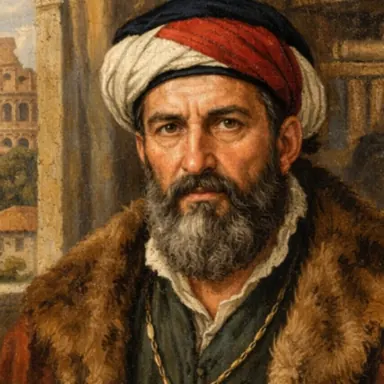
Rabbi Yechiel ben Yekutiel Anav: A Comprehensive Historical and Halakhic Study
13 min read2,681 words
Summary
The article surveys the work of Rabbi Yechiel ben Yekutiel Anav, one of the prominent sages of Rome in the 13th century, who combined Torah scholarship, the science of medicine and the preservation of traditions. His principal work, the book "Ma'alot ha-Middot," presents a moral and didactic teaching that examines the human soul as a microcosm and the refinement of character traits as an essential basis for the service of God. Alongside this, the text deals with his halakhic contribution in the work "Tanya Rabbati," which reflects the customs of Italian Jewry, and with his monumental historical enterprise of copying the Leiden manuscript of the Jerusalem Talmud. The aim of the source is to illuminate the figure of Rabbi Yechiel as a bridge between worlds, representing the "Golden Age" of Roman Jewry through a union of halakha, ethics and textual precision.
The Torah Teaching and Literary Enterprise of Rabbi Yechiel ben Yekutiel Anav: A Comprehensive Historical and Halakhic Study
The Historical and Cultural Background of Roman Jewry in the 13th Century
The 13th century in Italy, and especially in the city of Rome, marked a period of extraordinary intellectual flourishing for the local Jewish community, a period in which patterns of study and traditions of halakhic ruling took shape that influenced the Jewish world for generations. At the heart of this flourishing stood the Anav family (Anav), one of the four distinguished families of Rome, which according to tradition had been exiled from Jerusalem by Titus at the time of the destruction of the Second Temple.[1] The Anav family was not merely a dynasty of lineage but a center of vibrant scholarship that produced rabbis, halakhic decisors, liturgical poets, philologists and physicians.[1, 2] Rabbi Yechiel ben Yekutiel ben Binyamin the Physician Anav, who was active in the second half of the 13th century, represents the perfect figure of the Italian sage of this period – a man combining deep halakhic commitment, engagement in medicine and science, and a striving for the refinement of character traits and for the precise preservation of the Torah text.[2, 3]
The Jewish community of Rome in those days enjoyed relative stability compared with the communities of Ashkenaz, which suffered severe persecution, or the communities of Spain, which were subject to the influences of extreme rationalist philosophy. Roman Jewry preserved a unique traditional continuity, in which the yeshivot and houses of study functioned as centers for preserving local custom alongside a certain openness to controlled outside influences.[1] In this environment Rabbi Yechiel grew up, studying Torah from his uncle, Rabbi Yehuda ben Binyamin (the Ribevan), who was one of the greatest sages of the generation and a commentator on tractate Shekalim.[1, 2] These family ties are not mere biographical details; they are the key to understanding the work of Rabbi Yechiel, which regarded the preservation of ancestral custom and the meticulous study of the sources as a supreme value.[1, 4]
The Lineage of the Anav Family and Its Influence on Rabbi Yechiel's Work
To understand Rabbi Yechiel's work, one must consider the structure of the Anav family, which was a kind of "spiritual aristocracy" in Rome. Members of the family served as heads of yeshivot and as halakhic decisors, and many of them engaged at the same time in medicine and liturgical poetry.[1] Especially notable is the connection to Rabbi Tzidkiyahu ben Avraham Anav, author of "Shibbolei ha-Leket," who was a cousin of Rabbi Yechiel's father.[1, 4] This family closeness explains the deep affinity of content between Rabbi Yechiel's works and the halakhic traditions preserved in "Shibbolei ha-Leket."[4]
The family tradition combined the wisdom of Torah with the wisdom of the body (medicine). Rabbi Yechiel's grandfather, Rabbi Binyamin the Physician, and his father, Rabbi Yekutiel the Physician, were central figures in the community.[1, 4] This engagement in medicine filtered into Rabbi Yechiel's work, especially in his book "Ma'alot ha-Middot," in which he uses anatomical and biological concepts to describe spiritual and moral processes.[6] In this he continues the characteristic Italian line that sees no contradiction between science and religion but uses science as a tool for deepening religious understanding.[7, 8]
The Book "Ma'alot ha-Middot": A Phenomenology of Jewish Ethics
The crowning achievement of Rabbi Yechiel's original work is the mussar book "Ma'alot ha-Middot" (The Virtues of Character), written in the year 5037 (1277).[9, 10] The book, sometimes printed under the name "Beit ha-Middot," became one of the most widespread and beloved works of mussar in all the Jewish diasporas, and was highly esteemed by great Torah figures such as Rabbi Yaakov Emden and the Chida.[3, 9]
Theoretical Structure and Methodology
The book is made up of 24 chapters, each devoted to a particular "virtue" (a good trait). Rabbi Yechiel follows an orderly didactic method: he begins by defining the trait on the basis of biblical verses, moves on to the homilies of the Sages, and incorporates insights from mussar works that preceded him.[3, 9] The discussion is not limited to praise of the good trait but also includes an in-depth analysis of its opposite ("the disgrace of the opposite trait"), and in this way he draws a complete moral map of the human soul.[3]
Rabbi Yechiel arranges the traits in a graded order: he opens with the basic intellectual and religious traits (knowledge of God, love of God, fear of Heaven) and continues to social and personal traits (compassion, charity, humility, proper conduct).[9, 11] In his view, the refinement of character traits is a necessary condition for attaining intellectual and spiritual perfection. He is greatly influenced by the Maimonidean approach, which sees the "middle way" as the ideal goal of the human being, but he embeds these conceptions in a rabbinic-midrashic language accessible to a broad public.[3, 7, 12]
The 24 Virtues of "Ma'alot ha-Middot" in Detail
The table below presents the structure of the virtues as they appear in the work, highlighting the relation between the positive trait and its limits or its opposite:
The Concept of the "Small World" and the Connection to Medicine
In the book Rabbi Yechiel incorporates the philosophical-scientific conception of the human being as a "small world" (microcosm).[6, 7] In his view, the human body reflects the structure of the entire world, and the human soul resembles its Creator in its capacity to influence and to govern.[6] He describes at length how traits such as pride take control of the various limbs of the body – from the head and the throat ("with outstretched necks") to the feet and the hands.[6] This analysis attests to his training as a physician, for he does not content himself with an abstract description of the trait but examines its physiological and behavioral expressions in concrete reality.[6]
He stresses that the refinement of character traits is not merely a preparation for the commandments but is itself the heart of the service of God. In the chapter on the fear of Heaven, he discusses the "inner war" between the different parts of the soul, and explains that gaining mastery over one's traits is the only way in which a person can resemble his Creator in his actions.[6, 7]
The Book "Tanya Rabbati": The Codex of Halakha and Custom of Italian Jewry
Another work attributed to Rabbi Yechiel ben Yekutiel is the book of halakha and custom "Tanya Rabbati" (originally "Sefer ha-Tanya").[4] It is a foundational book that gathers the customs of Italian Jewry and was intended to serve as a practical guide for daily life, frequently accompanying the prayer book.[4, 13]
The Question of Authorship and the Historical Controversy
The identity of the author of the "Tanya" has been a subject of research and dispute for hundreds of years. The first printings did not name the author explicitly, and the distributor, R. Shimon Levi, attributed this to the writer's exceptional humility.[4] Over the years two main hypotheses have been raised:
Rabbi Yechiel ben Asher (brother of the Tur): this tradition appeared in many printings and was supported by sages such as Rabbi Eliyahu Shapira.[4] However, later scholars such as the Chida and Rabbi Shimon Horowitz rejected this identification outright. They pointed out that the author mentions his grandfather "Rabbi Binyamin," whereas the grandfather of Rabbi Yechiel son of the Rosh was Rabbi Yechiel (the father of the Rosh).[4] In addition, the Ba'al ha-Turim quotes many halakhot in the name of his brother Yechiel that do not appear at all in the Sefer ha-Tanya.[4]
Rabbi Yechiel ben Yekutiel Anav: this identification is accepted today by almost all scholars.[4] The evidence for it is strong: the author states his personal name "Yechiel" within the text (section 19); the book reflects the distinctive customs of Italy (the people of Rome); and the linguistic and substantive connection to the "Shibbolei ha-Leket" of his relative, Rabbi Tzidkiyahu Anav, is unmistakable.[1, 4]
The Connection to "Shibbolei ha-Leket" and the Originality of the Work
Many have held that the "Tanya" is in fact an abridgment or adaptation of the book "Shibbolei ha-Leket."[4, 13] The Chida and the Maharam di Lonzano argued that this is the reason the author's name was not written at the head of the book – since he regarded himself as a summarizer of his relative's words.[4] However, in-depth analysis shows that Rabbi Yechiel added much material that does not exist in "Shibbolei ha-Leket," including local rulings and family traditions he had received from his uncle, the Ribevan.[4] Accordingly, the "Tanya" is regarded as an independent work that uses "Shibbolei ha-Leket" as a structural framework.[4]
The Structure of the Book and Its Name
The book is divided into 100 "sections" (inyanim), organized according to broad halakhic categories.[4] The name of the book, "Tanya," derives from the first word of the text, which quotes a baraita from the Gemara.[4] The designation "Tanya Rabbati" (or "Tanya Rabbata") was given to it only from the year 5560 (1800), in order to distinguish it from the Tanya of Rabbi Shneur Zalman of Liadi (the foundational book of Chabad Hasidism), which had been printed several years earlier and won enormous popularity.[4]
The Preservation of the Jerusalem Talmud: The Leiden Manuscript
Rabbi Yechiel's most impressive enterprise in the field of textual preservation is his copy of the Jerusalem Talmud, known as the "Leiden manuscript" (Cod. Or. 4720).[2, 5] This work, completed in the year 5049 (1289), is regarded as one of the most important assets of Jewish culture.[5, 15, 16]
The Unique Status of the Manuscript
The Leiden manuscript is the only complete manuscript of the Jerusalem Talmud that has survived to our day (it includes all the orders except the order of Kodashim, which constitutes evidence that a Yerushalmi on Kodashim did not exist or was not widespread).[15, 16] Its importance goes beyond its antiquity; it served as the direct basis for the first printed edition of the Yerushalmi in Venice (1522-1523) by Daniel Bomberg.[5, 15] Since all the other modern printings of the Yerushalmi were based on the Venice edition, the text of the Yerushalmi studied today throughout the world is a direct result of Rabbi Yechiel's work of copying.[15, 16]
Rabbi Yechiel as Philologist and Editor
Rabbi Yechiel was not merely a technical copyist. In the colophon of the manuscript he testifies that he copied the text from an ancient manuscript that was riddled with errors and corruptions.[5, 16] In the course of his work he exercised critical judgment, tried to correct the text on the basis of other sources, and added glosses in the margins.[5, 15] Although modern scholars such as Zecharias Frankel argued that the manuscript still contains corruptions, other scholars, foremost among them Jacob Nahum Epstein, saw it as a source of supreme importance for reconstructing the original text of the teaching of the Land of Israel.[15, 16]
In the 16th century the manuscript came into the hands of the humanist scholar Joseph Justus Scaliger, and after his death it was transferred to the library of Leiden University, where it is kept under the name "Scaliger 3."[15, 16] In 2018 the manuscript was scanned in its entirety and placed online, which makes possible in-depth research into Rabbi Yechiel's method as a scribe and as a textual scholar.[16]
Philosophical and Intellectual Conceptions in Rabbi Yechiel's Teaching
Beyond his halakhic and moral work, Rabbi Yechiel's teaching reveals a philosophical depth that combines the mystical approach with the rationalist approach.
The refinement of character traits as the foundation of the Torah: Rabbi Yechiel holds the view that the refinement of character traits is the ground on which the whole of the Torah stands.[8] He is influenced by the conception that "proper conduct (derekh eretz) preceded the Torah," and therefore he devotes the first chapters of "Ma'alot ha-Middot" to intellectual traits that influence halakhic obedience.[6, 11]
- Man and God: knowledge of God, in his view, is not merely intellectual recognition but a moral experience. The person who likens himself to his Creator in the trait of compassion and peace attains the highest level of knowledge.[7, 11]
- The universality of morality: Rabbi Yechiel stresses that there are universal good traits (wisdom, kindheartedness, courage) that exist in all human beings, but the Torah raises them to the level of holiness.[7]
The influence of the Ashkenazi Pietists (Hasidei Ashkenaz): although he was Italian, in the chapter on repentance in "Ma'alot ha-Middot" he brings the "doctrine of repentance" of the Hasidei Ashkenaz (the repentance of equal measure, the repentance of the fence, etc.), which attests to his being a bridge between different Jewish traditions of that period.[6]
Legacy and Influence for the Generations
The influence of Rabbi Yechiel ben Yekutiel Anav on later generations was manifold and profound. His books did not remain within the borders of Italy but became part of the worldwide Jewish canon.
- In mussar literature: "Ma'alot ha-Middot" served as a basic text for the study of mussar in Sephardic and Ashkenazi communities alike.[3] The simplicity of its language enabled even a non-scholarly public to become acquainted with the principles of Jewish ethics.[3]
- In halakhic ruling: "Tanya Rabbati" remained an authoritative source for the customs of Rome and Italy, and was quoted by the great Acharonim when they came to clarify the roots of ancient customs.[4]
- In the study of the Talmud: every edition of the Jerusalem Talmud found today on bookshelves is living testimony to Rabbi Yechiel's enterprise.[15, 16] Without his meticulous work of copying and correcting, it is possible that extensive parts of the Yerushalmi would have been lost forever, as other manuscripts that served the Venice printings were lost.[5, 15]
Summary
Rabbi Yechiel ben Yekutiel Anav represents the "Golden Age" of Roman Jewry. In his work he succeeded in uniting the three domains of the Jewish spirit: the halakhic domain (in "Tanya Rabbati"), the moral domain (in "Ma'alot ha-Middot") and the domain of research and preservation (in the copying of the Yerushalmi).[2, 4, 5] As a physician, a halakhic decisor and a scribe, he saw Judaism as a holistic system in which the health of the body, the refinement of character traits and the precision of the Torah complement one another.[1, 6, 7] His legacy continues to live in every beit midrash where a page of the Yerushalmi is studied and in every heart that seeks to perfect its traits through the classic works of mussar.
Sources16
- 1.משפחת הענוים - ויקיפדיה, he.wikipedia.org/wiki/משפחת_הענוים
- 2.רבי יחיאל בן יקותיאל הרופא | מקורות מתוך ספריית ספריא, sefaria.org.il/topics/yechiel-ben-yekutiel
- 3.יחיאל בן יקותיאל - ויקיפדיה, he.wikipedia.org/wiki/יחיאל_בן_יקותיאל
- 4.תניא רבתי – ויקישיבה, yeshiva.org.il/wiki/index.php/תניא_רבתי
- 5.ג. אוניברסיטת ליידן : כתב היד של התלמוד הירושלמי עלה לרשת | Safranim's Blog, safranim.com/גיליון-ב/ג-אוניברסיטת-ליידן-כתב-היד-של-התלמוד-ה/
- 6.ספר המידות השלם/הכל - ויקיטקסט, he.wikisource.org/wiki/ספר_המידות_השלם/הכל
- 7.מידות טובות - ויקיפדיה, he.wikipedia.org/wiki/מידות_טובות
- 8.תיקון המידות - ויקיפדיה, he.wikipedia.org/wiki/תיקון_המידות
- 9.מעלות המדות | ספריית ספריא, sefaria.org.il/Ma'alot_HaMiddot
- 10.ספר מעלות המידות / ר' יחיאל ב"ר יקותיאל ב"ר בנימין הרופא - מכון אורות חיים - אוצר הספרים, sefer.org.il/items/3730849-ספר-מעלות-המידות-ר-יחיאל-ב-ר-יקותיאל-ב-ר-בנימין-הרופא-מכון-אורות-חיים
- 11.ספר מעלות המידות - ויקיטקסט, he.wikisource.org/wiki/ספר_מעלות_המידות
- 12.רחמנא לבא בעי (עקבי דרך, אגרת הרמב”ן) - עולמות, olamot.net/shiurim/רחמנא-לבא-בעי-אגרת-הרמבן-עקבי-דרך/
- 13.מכירה חלק פריטים נדירים ומיוחדים - Fastly, bidspirit-images.global.ssl.fastly.net/kedem/auctionDocs/514/catalog/catalog_92_-1-2-_unified.pdf
- 14.מבנה ספר התניא | חב"ד - אור אין סוף, abc770.org/article_node_4537/
- 15.כתב יד ליידן - ויקיפדיה, he.wikipedia.org/wiki/כתב_יד_ליידן
- 16.כתב יד ליידן | Family Wiki | Fandom, danielventura.fandom.com/he/wiki/כתב_יד_ליידן