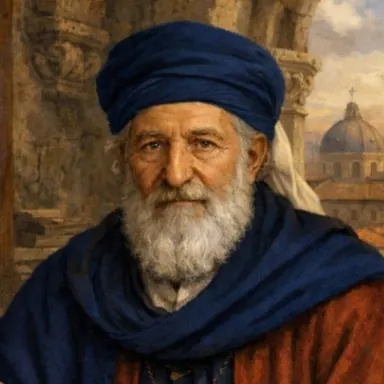
Italian Codification and Its Roots in Jerusalem: The Torah Teaching and Work of Rabbi Tzidkiyah ben Avraham ha-Rofe
16 min read3,130 words
Summary
The source surveys the figure and work of Rabbi Tzidkiyah ben Avraham ha-Rofe (the Physician), a 13th-century Italian halakhic decisor belonging to the distinguished Anavim family, whose monumental work "Shibbolei ha-Leket" is regarded as the first attempt at a systematic codification of halakha on Italian soil. The text describes how the author created a scholarly synthesis of the traditions of Ashkenaz, France and Italy, while integrating a rationalist-scientific approach that stemmed from his practice of medicine and from a recognition of the importance of anatomical and logical precision in halakhic rulings. The structure of the book, which combines matters of prayer and the festivals with civil and medical fields, reflects an outlook of "dwarfs on the shoulders of giants," which honors the early authorities but permits independent decision for the sake of halakhic practice. Rabbi Tzidkiyah's legacy is presented as a cultural bridge that deeply influenced the later pillars of halakhic instruction, such as the "Beit Yosef," and gave the Jewish community in Italy a comprehensive aid that unites the sacred and the profane with humility and clarity.
The thirteenth century in Italy marked a spiritual and cultural golden age for the Jewish communities of the peninsula, chief among them the community of Rome. Within the rich social and scholarly fabric of this period stands the figure of Rabbi Tzidkiyah ben Avraham ha-Anav, known by the appellation "ha-Rofe" (the Physician), as a pillar bridging diverse halakhic traditions. His monumental work, "Shibbolei ha-Leket," is not merely a collection of laws but constitutes the first comprehensive attempt on Italian soil at a systematic codification of Jewish law, combining in a rare way Ashkenazi scholarship, ancient Italian tradition, and a scientific rationalism that stemmed from his practice of medicine.[1, 2]
The Aristocratic Roots: The Dynasty of the Anavim Family and Its Standing in Rome
Understanding Rabbi Tzidkiyah's work requires a close look into the genealogy of his family, the Anavim family (Min Ha-Anavim), which was one of the "four families" of the most distinguished lineage in Rome.[1, 3] This family tradition, handed down from generation to generation, held that their ancestors were brought from Jerusalem by Titus after the destruction of the Second Temple in 70 CE.[1] This lineage gave the members of the family a sense of mission and historical continuity, which found expression in continuous spiritual and public leadership throughout the Middle Ages.
The members of the Anavim family, also known by the vernacular names Anau, De Mansi or Piatelli, were interwoven in every major juncture of Jewish creativity in Italy.[3] Rabbi Tzidkiyah worked within an environment in which Torah excellence was a family norm.
Key Figures in the Anavim Dynasty and Their Connection to Rabbi Tzidkiyah
Rabbi Tzidkiyah was born in Rome at the beginning of the 13th century (between 1210-1225), at a time when the Jewish community enjoyed relative economic and cultural flourishing.[1, 6] The intellectual climate in his family's home was multidisciplinary; alongside the in-depth study of Talmud and halakha, the members of the family engaged in grammar, liturgical poetry, the exact sciences and medicine.[5] The practice of medicine was so dominant that the title "ha-Rofe" (the Physician) became an inseparable part of Rabbi Tzidkiyah's identification in the literature of the generations.[7, 8, 9]
Journeys of Study: The Synthesis of Ashkenazi Torah and Italian Tradition
In his youth Rabbi Tzidkiyah left Rome and set out on a journey of study that shaped his figure as a decisor of broad horizons. He turned north to the great yeshivas of Germany (Ashkenaz), where he was exposed to the method of study of the Tosafists, which was then at its height.[4, 7] His principal teacher in Ashkenaz was Rabbi Yaakov of Würzburg, who was a disciple of Rabbi Shimshon of Sens, one of the greatest of the Tosafists.[1, 2, 7]
There is significant evidence that Rabbi Tzidkiyah studied with, or at least maintained close halakhic contact with, the great men of the generation in Ashkenaz and Austria, among them Rabbi Meir ben Baruch of Rothenburg (the Maharam) and Rabbi Avigdor Katz of Vienna.[1, 4, 10] This exposure to the Ashkenazi centers instilled in his writings scholarly precision, the importance of custom and the tendency toward rulings based on an analytical examination of the words of the Talmud and the Rishonim.[1, 2]
On his return to Rome, he completed his education with his uncle, Rabbi Yehuda ben Binyamin ha-Anav (the Rivevan), who was the supreme halakhic authority in the city at that time.[7, 11] It was this combination of the casuistic Torah of Ashkenaz with the conservative Italian tradition of rulings that gave rise to the need for a work that would summarize and organize the great body of halakhic information he had accumulated.[2] Rabbi Tzidkiyah saw himself as a connecting link, making the fruits of the scholarship of northern Europe accessible to the Italian public while preserving the local customs of Rome.[2, 12]
Shibbolei ha-Leket: A Phenomenology of Codification
Rabbi Tzidkiyah's principal work, "Shibbolei ha-Leket" (The Gleaned Ears of Grain), is just what its name says: a gleaning of single ears of grain from the fields of the giants of halakha.[7, 8] However, this definition does an injustice to the author's structural and editorial originality. The book is not merely a collection of quotations, but a systematic work that attempts to encompass the entire Jewish way of life.[9, 13]
The Metaphorical Structure: Garden Beds and Ears of Grain
The choice of agricultural images for the name of the book and for its internal division is not accidental. It reflects an outlook of scholarly humility and a connection to the land and to the primary sources. The book is divided into 13 "garden beds" (main parts) containing in all 372 "ears of grain" (chapters or sections).[2, 4]
This structure made the book a useful aid for decisors and rabbis, since it gathered under one roof opinions from diverse sources that were at times hard to obtain. In addition to the 13 garden beds, the work included (or had appended to it in later manuscripts) the laws of Semachot (mourning), circumcision, ritual slaughter and terefot, and thereby Rabbi Tzidkiyah completed his coverage of most areas of practical halakha.[13, 14]
The Methodology and Philosophy of the "Leket"
Rabbi Tzidkiyah defines his approach in the introduction to his book, written in pure and vigorous Hebrew and including an acrostic of his name.[4, 10, 15] He explains that in his generation, in which troubles are many and time is short, it is difficult for Torah scholars to examine all the primary sources. He therefore offers his book as an authoritative summary that brings the essence of the words of the Geonim and of the sages of France, Ashkenaz and Spain.[4, 10]
He cites more than 230 sages by name, which makes "Shibbolei ha-Leket" one of the most important sources for the preservation of the teaching of sages whose writings have been lost.[2] Among the prominent sources: "Halakhot Gedolot," "Sefer ha-Pardes" of the school of Rashi, the Rif, the Ba'al ha-Ittur, Zerachiah ha-Levi (ha-Maor), and above all the Rid (Rabbi Isaiah di Trani the Elder), whose influence on Rabbi Tzidkiyah's rulings was decisive.[2, 4, 10]
At the core of his methodology stands the famous saying about "dwarfs on the shoulders of giants".[4, 15] Rabbi Tzidkiyah brings in the name of "a certain philosopher" an answer to the question of how the sages of his generation dare to disagree with their predecessors: we recognize our smallness before the giants of the past, but since we lean on their wisdom and experience, we are like dwarfs riding on the shoulders of giants, and are able to see further than they.[4, 10, 15] This outlook allowed him to decide between conflicting opinions and to choose the path that seemed to him most correct from a scholarly and practical point of view, while giving full honor to tradition.[4]
"Issur ve-Heter": The Second and Unknown Side
For hundreds of years "Shibbolei ha-Leket" was identified as a book dealing with matters of prayer and the festivals alone. However, modern research and the discovery of manuscripts (such as the manuscript of Shlomo ben Raphael from the 14th century) have revealed the existence of a second part, no less comprehensive, sometimes called "Sefer Issur ve-Heter" (The Book of the Forbidden and the Permitted).[2, 16]
This part, which contains about 173 chapters, extends Rabbi Tzidkiyah's codification to the fields of Jewish civil law, marital law and the Jewish dietary laws.[2, 16] The discovery of this part changed the historical perception of Rabbi Tzidkiyah; he was not merely "a gatherer of prayer customs," but a decisor of broad scope who sought to set up an Italian alternative to the codes of Spain and Provence.[1, 16]
Central Subjects in the Second Part (Sefer Issur ve-Heter)
- Dietary laws: the laws of ritual slaughter, terefot, meat and milk, and mixtures.[2, 16]
- Family law: the laws of betrothal, divorce, marriage contracts and vows.[2, 16]
- Monetary law: partnerships, loans, interest, inheritance and the laws of damages.[2, 4, 16]
- Judicial procedure: the laws of judges and testimony.[2, 16]
This work remained for the most part in manuscript until the 20th century, and parts of it were published under various names or incorporated into other halakhic collections.[2, 4, 16] The fact that Rabbi Tzidkiyah also wrote on matters of Choshen Mishpat and Even ha-Ezer testifies to his public authority in Rome, where he apparently served not only as a physician and head of a yeshiva, but also as a judge deciding civil disputes.[2]
Ruling in the Shadow of Destruction: His Testimony on the Burning of the Talmud
One of the most historically and emotionally charged passages in "Shibbolei ha-Leket" appears in section 263, which deals with the laws of fasting. Rabbi Tzidkiyah describes in the first person (in the sense of testimony) the burning of the Talmud in Paris.[2, 12] Whereas most historians date the event to 1242, Rabbi Tzidkiyah names the date 1244 (the Friday of the week of the portion Chukat, the year 4904), and describes the decree as a cosmic catastrophe for the Jewish people.[2]
His description includes details of a "dream question" that was conducted in order to find out whether there was a decree from Heaven to annul the Torah, and the famous answer that was received: "Da gezerat oraita" (This is a decree of the Torah), as an allusion to the word "Chukat".[8] This testimony demonstrates the close tie of the Jews of Rome with the centers in France and the fact that Rabbi Tzidkiyah saw himself as part of a single spiritual front shared by all the communities of Europe.[2] Following the event, he discusses the question of whether a fixed fast day should be established in remembrance of the burning, a discussion that influenced the fasting customs of many communities.[8]
Rabbi Tzidkiyah ha-Rofe: The Interface between Halakha and Medicine
The appellation "ha-Rofe" (the Physician), by which Rabbi Tzidkiyah became famous, is not merely evidence of his profession, but a key to understanding his rationalist approach to halakha.[8, 9, 17] As a son of a family in which the practice of medicine was a tradition (as with his brother Binyamin), he integrated scientific knowledge into halakhic discussion.[5, 8]
Unlike some of the sages of his generation in France and Germany, who tended toward mystical interpretations or stringencies based on popular customs, Rabbi Tzidkiyah displays in his writings clarity of thought and a tendency toward logical explanations.[1, 4] His rulings in matters of saving life, medicines on the Sabbath, and above all the laws of terefot and the examination of organs, are marked by their anatomical precision.[2, 14] Although he did not leave behind a dedicated book of medicine, his figure as a rabbi-physician placed him in one line with figures such as Maimonides (Rambam) and Nahmanides (Ramban), who proved that it is possible to combine the wisdom of the Torah with the wisdom of nature.[1, 7]
The medical aspect also finds expression in his attitude to the human body and its modesty in medical treatment, subjects discussed at length within the discussions of the laws of niddah and immersion, where he brings the customs of Rome that combine the requirements of halakha with the medical reality of his time.[18]
The Influence of Abraham Abulafia and the Mystical Turn
A less known but fascinating chapter in Rabbi Tzidkiyah's life took place in his last years. Despite his scholarly-rationalist background, he was drawn to the mystical currents that had begun to operate in Italy.[7, 11] The sources note that he studied an esoteric and mystical interpretation of Maimonides' "Guide of the Perplexed" with the famous wandering kabbalist Rabbi Abraham Abulafia.[7, 11]
This encounter between the veteran decisor and the ecstatic kabbalist symbolizes the spiritual tension of the 13th century. Abulafia saw in the "Guide of the Perplexed" a text that could be read in kabbalistic ways, and Rabbi Tzidkiyah, apparently out of a search for a deeper layer of divine service beyond the dry details of halakha, found interest in these teachings.[11] Nevertheless, this influence is hardly evident in "Shibbolei ha-Leket" itself, which testifies to a clear separation that Rabbi Tzidkiyah made between the public world of halakhic ruling and his private spiritual-mystical world.[1]
The Transformations of a Work: From the Complete Text to the "Tanya Rabbati"
The success of "Shibbolei ha-Leket" was also, in a certain sense, its undoing. The book was so comprehensive and long that many communities preferred to use abridgments of it.[4] The popularity of the work led to an interesting phenomenon of "voluntary plagiarism," or anonymous adaptations.
The most prominent example is the book "Tanya" (known as the "Tanya Rabbati" to distinguish it from the book of the Ba'al ha-Tanya of Chabad).[4, 10] Scholars have established that the "Tanya Rabbati" is in fact an abridgment and adaptation of "Shibbolei ha-Leket," intended to disseminate Rabbi Tzidkiyah's rulings in a more accessible and cheaper format.[2, 8] The book was first printed in Mantua in 1514, long before the original "Shibbolei ha-Leket" was printed in its complete version.[4, 10]
In addition, there is a work called "Ma'aseh ha-Geonim," found in manuscripts in the Bodleian Library in Oxford, which is likewise an abridgment of Rabbi Tzidkiyah's work.[4, 10] The circulation of these abridgments testifies that Rabbi Tzidkiyah's rulings became common property in Italian Jewry, to the point that the name of the original author was at times forgotten by the average reader.[8]
The Reception of the Book and Its Influence on the Pillars of Halakhic Instruction
Despite the shift of the halakhic center of gravity to Spain and later to Poland, "Shibbolei ha-Leket" remained an irreplaceable source of authority for the decisors of later generations. Its importance goes beyond its being a "compiler".[7, 13]
Influence on the Tur and the Beit Yosef
Rabbi Yaakov ben Asher (the Tur), author of the Turim, saw in "Shibbolei ha-Leket" a source of the first rank for matters of prayer and custom.[13] He cites it hundreds of times, especially in the "Orach Chaim" section. However, its deepest influence is evident in the work of Rabbi Yosef Karo, the "Beit Yosef".[13, 19] Karo used Rabbi Tzidkiyah as a bridge to understanding the words of the Geonim and of the early sages of Ashkenaz, and he mentions him in almost every chapter dealing with the Jewish daily order and with the festivals.[13, 19]
The fact that Rabbi Tzidkiyah preserved unique Italian traditions allowed Rabbi Yosef Karo to present a broader halakhic picture, even if in the end the decisions of the Shulchan Arukh at times followed the Rif and Maimonides (Rambam).[9, 19] The Jews of Italy, for their part, continued to follow "Shibbolei ha-Leket" and saw in Rabbi Tzidkiyah the "mara de-atra" (local authority) of the entire peninsula.[9]
Editions and Printings throughout History
The Legacy of a Humble Sage
Rabbi Tzidkiyah ben Avraham ha-Rofe died in Rome at the end of the 13th century (apparently around 1280, although some place it as late as 1297 on the basis of his glosses on the Rid's commentary on the Torah).[1, 6, 10, 15] He left behind a great void in the community of Rome, but his legacy has remained alive through his books.
The poet Immanuel of Rome, his younger contemporary, describes in his "Machbarot" (Machberet 28) Rabbi Tzidkiyah and his three sons sitting in the palace of the holy ones in the Garden of Eden.[2] This description is not merely poetic; it reflects the immense admiration that the Jews of Italy felt for the sage who served them as a physician for the body and a physician for the soul.
Rabbi Tzidkiyah's contribution to Jewish law and to Jewish liturgy is eternal. He succeeded in his task: to glean the scattered ears of grain of the exile and to bind them into a single sheaf, orderly and clear.[8] "Shibbolei ha-Leket" stands to this day as a testimony to the power of Italian scholarship, which knows how to combine old and new, East and West, and sacred and profane, out of deep humility and uncompromising commitment to halakhic truth.[1, 2, 7]
Modern research continues to uncover further layers of his personality, especially the connections between his rulings and the social and medical reality of Rome in the 13th century, which makes Rabbi Tzidkiyah one of the most fascinating of the Rishonim active in Europe.[2, 16] The scope of his work, encompassing the way of life, civil law and religious thought, ensures that his name will continue to shine in the eternal library of the people of Israel.
Sources19
- 1.Shibbolei ha-Leket - BRAGINSKY COLLECTION, braginskycollection.com/portfolio/shibbolei-ha-leket/
- 2.Anav, Zedekiah ben Abraham - Encyclopedia.com, encyclopedia.com/religion/encyclopedias-almanacs-transcripts-and-maps/anav-zedekiah-ben-abraham
- 3.משפחת הענוים - ויקיפדיה, he.wikipedia.org/wiki/משפחת_הענוים
- 4.Zedekiah ben Abraham Anaw - Wikipedia, en.wikipedia.org/wiki/Zedekiah_ben_Abraham_Anaw
- 5.בנימין בן אברהם - ויקיפדיה, he.wikipedia.org/wiki/בנימין_בן_אברהם
- 6.צדקיה בן אברהם - ויקיפדיה, he.wikipedia.org/wiki/צדקיה_בן_אברהם
- 7.ר' צדקיה בן ר' אברהם הרופא | מקורות מתוך ספריית ספריא, sefaria.org.il/topics/zedekiah-ben-abraham-harofei
- 8.שבלי הלקט SHIBOLE HALEKET R. Zedekiah (ha-Rafoh) ben Abraham Halakhic compendium, ebay.com/itm/396288042957
- 9.שבלי הלקט – ויקיפדיה, he.wikipedia.org/wiki/שבלי_הלקט
- 10.ANAW, ZEDEKIAH B. ABRAHAM - JewishEncyclopedia.com, jewishencyclopedia.com/articles/15210-zedekiah-ben-abraham
- 11.Zedekiah ben Abraham HaRofei | Texts from the Sefaria Library, sefaria.org/topics/zedekiah-ben-abraham-harofei
- 12.(#118) SHIBBOLEI HA-LEKET (PART 1), MANUSCRIPT ON PARCHMENT Zedekiah ben Abraham Anav [Italy, 14th century] - Sotheby's, sothebys.com/en/auctions/ecatalogue/2004/important-hebrew-manuscripts-from-the-montefiore-endowment-n08040/lot.118.html
- 13.Shibbolei HaLeket | Sefaria Library, sefaria.org/Shibbolei_HaLeket
- 14.שבלי הלקט | ספריית ספריא, sefaria.org.il/Shibbolei_HaLeket
- 15.ANAW, ZEDEKIAH B. ABRAHAM - JewishEncyclopedia.com, jewishencyclopedia.com/articles/1486-anaw-zedekiah-b-abraham
- 16.(#119) SHIBBOLEI HA-LEKET (PART 2), MANUSCRIPT ON PARCHMENT Zedekiah ben Abraham Anav [Italy, 14th century] Scribe - Sotheby's, sothebys.com/en/auctions/ecatalogue/2004/important-hebrew-manuscripts-from-the-montefiore-endowment-n08040/lot.119.html
- 17.שיבולי הלקט ב' כרכים / ר' צדקיהו הרופא - אוצר הספרים, sefer.org.il/items/3731338-שיבולי-הלקט-ב-כרכים-ר-צדקיהו-הרופא-הוצאה-לאור-זכרון-אהרון
- 18.הלכות צניעות בבדיקה ובטיפול רפואי - מכון שלזינגר, medethics.org.il/article/r0021082a/
- 19.בית יוסף, הקדמה | ספריית ספריא, sefaria.org.il/Beit_Yosef,_Introduction