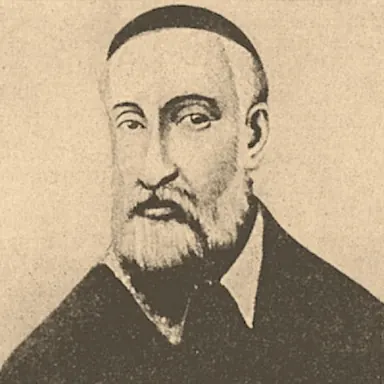
A Man of Many Deeds and a Divine Kabbalist: The Figure, Teaching and Historical Influence of Rabbi Menachem Azariah of Fano
13 min read2,546 words
Summary
This survey presents the many-sided figure of Rabbi Menachem Azariah of Fano (the Rema of Fano), a key figure of Italian Jewry who linked the worlds of halakha and mysticism in the Renaissance period. The text describes how the Rema served as an intellectual bridge who transmitted the Kabbalah of Safed to Europe, creating a harmonious synthesis between the philosophical system of the Ramak and the innovative depths of the Kabbalah of the Ari. The author emphasizes his enormous contribution as a halakhic authority and a literary patron, whose influence filtered down to the Hasidic movement and to the teaching of the Ramchal thanks to his orderly and rational style. In conclusion, the source explains his original ideas on the subjects of the commandments, the transmigration of souls and the rectification of the soul, which establish his standing as one of the most influential spiritual leaders in the history of Jewish thought.
Rabbi Menachem Azariah of Fano, known by his appellation the Rema of Fano (or Immanuel da Fano), stands as one of the pillars of Jewish thought, halakha and Kabbalah in the period of the late Italian Renaissance. His figure represents a rare synthesis between the revealed and the hidden realms of Torah, and between material wealth and the Italian aristocracy on the one hand and mystical asceticism and total devotion to the dissemination of Torah on the other.[1, 2] His work, which extended over the second half of the 16th century and the beginning of the 17th century, not only shaped the face of Italian Jewry but formed the main bridge through which the esoteric teaching of the sages of Safed passed to the communities of Ashkenaz and Poland and later to the Hasidic movement.[3, 4]
Chapter 1: Historical and Biographical Background
The Rema of Fano was born in the year 5308 (1548) in Bologna, Italy, to a distinguished and wealthy family originating from the town of Fano.[1, 2] This period in Italy was marked by an extraordinary flowering of Jewish culture on the one hand, and by religious and political struggles on the other. The Fano family was counted among the "stock of the upright," and his father, Rabbi Yitzchak Berechiah, was a dominant figure in the community.[2] The family's wealth allowed the Rema to devote his life to Torah study without the burden of earning a living, but he chose to use his resources not only for his personal growth but as a patron of the entire world of the Hebrew book.[4, 5]
Biographical Milestones and Public Activity
The Rema acquired his Torah education from the greatest rabbis of Italy, foremost among them Rabbi Yishmael Chanina of Valmontone.[5] In his youth he studied in Venice, which was then the world center of Jewish printing and learning, and there he came into contact with "the wise and kabbalist sages of the city."[2] He later served as head of a yeshiva in Reggio Emilia, where many disciples flocked to him, among them kabbalists and halakhic authorities who spread his teaching throughout Europe.[4, 5] Later in life he moved to Mantua, the city where his father-in-law, Rabbi Yitzchak Foa, lived, and there he ended his life as the supreme spiritual authority of the community.[2, 4]
Chapter 2: The Kabbalistic Turn—from the Ramak to the Ari
The central axis of the Rema's thought is the transition and synthesis between the different systems of Kabbalah of the 16th century. At the beginning of his path the Rema was a faithful disciple of the system of Rabbi Moshe Cordovero (the Ramak), which offered a comprehensive and systematic philosophical-kabbalistic structure.[4, 6] His admiration for the Ramak was so great that he paid the Ramak's widow the enormous sum of 1,000 gold coins for the right to copy his manuscripts, among them the monumental work "Or Yakar."[4, 7] He saw himself as the continuer of the Ramak's path and composed "Pelach ha-Rimon," an abridgment and digest of the book "Pardes Rimonim."[4, 6]
The Influence of Rabbi Yisrael Sarug and the Move to the Kabbalah of the Ari
The significant change in the Rema's teaching came with the arrival of Rabbi Yisrael Sarug in Italy. Sarug, who presented himself as a disciple of the holy Ari of Safed, brought with him a distinctive version of Lurianic Kabbalah.[5, 8] The Rema was captivated by the depth and novelty of the Ari's teaching and became one of its chief disseminators in the West.[5] Nevertheless, the Rema did not abandon the foundations of the Ramak's Kabbalah, but developed a complex harmonizing method.[4, 9]
Unlike other kabbalists who saw a contradiction between the systems, the Rema argued that they are two points of view on the same divine truth. In his view, the teaching of the Ari is a development and deepening of the Ramak's principles, the latter dealing more with the aspect of the "vessels" and the former with the aspect of the "lights."[4, 8] This approach enabled him to preserve the Italian logical-systematic structure within the mythic conceptual world of Safed.[8, 9] Studies indicate that the Rema's version of Kabbalah (via Sarug) is marked by a more rigid logical structure and by Neoplatonic philosophical influences, which made it easier to digest for educated people in Europe.[8]
Chapter 3: The Literary Legacy—the Rema's Bookshelf
The Rema of Fano was an exceptionally prolific author, and his writings comprise some 30 works in the fields of halakha, Kabbalah, ethics and liturgical poetry.[2, 10] His works are marked by pure, concise and precise language, which attests to orderly and systematic thinking.[5]
His Principal Kabbalistic Works
- Asarah Maamarot (Ten Articles): his kabbalistic masterpiece, composed of a series of ten separate treatises. The structural innovation of this work is its division into "Imrot Tehorot" (Pure Sayings), which contain in-depth philosophical-kabbalistic discussions.[2, 11]
- Yonat Elem: a hundred gates in the wisdom of Kabbalah, forming a fundamental and systematic introduction to the structure of the worlds and the sefirot according to his system.[2, 5]
- Gilgulei Neshamot (Transmigrations of Souls): a popular work that sets out the doctrine of transmigration, the rectifications of souls and the identification of the transmigrations of biblical figures.[1, 12]
- Kanfei Yonah: a book of the kavanot (mystical intentions) of prayer and of the yichudim (unifications), which was printed and attributed to him, although there is a scholarly dispute as to whether he is the original author or an editor of the writings of the Ari's disciples.[5, 10]
His Halakhic and Talmudic Work
The Rema was not only a kabbalist, but an influential halakhic authority who earned enormous esteem from Maran Rabbi Yosef Karo.[4]
- Alfasi Zuta: a monumental halakhic project in which the Rema condensed the words of the Rif (Rabbi Yitzchak Alfasi) and added the rulings of Maimonides (Rambam) and halakhic decisions of his own.[4, 13] This book was intended to serve as a practical aid for swift and well-founded ruling.[5]
- Responsa of the Rema of Fano: a collection of responsa that attests to his deep involvement in the life of the community and in resolving burning issues, from monetary law to customs of prayer and worship.[2, 5]
- Editing of the "Kesef Mishneh": at the age of only 26, he was entrusted with the task of editing and printing Rabbi Yosef Karo's commentary on Maimonides' (Rambam's) Mishneh Torah, a testimony to the complete trust placed in him by the greatest sages of the generation.[2, 4]
Chapter 4: His Thought and Conceptual Innovations
The thought of the Rema of Fano offers a unique view of the relationship between man, the Torah and the Divine. One of his most fascinating innovations concerns the essence of the commandments. In his view, the commandments are not merely a system of external laws imposed on a person, but an expression of his most essential and inner nature.[14]
The Commandments as a Description of Reality
The Rema distinguishes between the style in which the Torah's prohibitions are formulated and that of the positive commandments. He notes that the prohibitions (negative commandments) almost always appear in the future tense ("You shall not murder," "You shall have no other gods")—which in his view constitutes a kind of "prediction."[14] The meaning is that a person who realizes his spiritual potential will not want to commit these transgressions at all, since they are contrary to his divine nature.[14] By contrast, the positive commandments appear in the imperative ("Remember," "Honor"), since they are meant to arouse and develop powers latent in a person but which need an active push in order to be actualized.[14]
An Analysis of "Asarah Maamarot": Structure and Content
The book "Asarah Maamarot" is the very heart of his teaching. The following is a detailed account of the principal treatises and their conceptual contribution:
Chapter 5: The Doctrine of the Soul and of Transmigration
The Rema of Fano is considered one of the chief formulators of the doctrine of transmigration in later Kabbalah. His book "Gilgulei Neshamot" is not merely a catalogue of spiritual history, but a tool for understanding divine justice in the world.[12] He explains that transmigration is an expression of "chesed" (lovingkindness), whose gematria is 72, exactly like that of the word "gilgul" (transmigration).[12] Through transmigration, the Holy One, blessed be He, enables the soul to complete its rectification and to fulfill commandments it did not manage to fulfill in previous lives.[12]
In the treatise "Ha-Nefesh" (The Soul), the Rema delves into kabbalistic psychology and analyzes the various layers of the soul. His influence in this field was so great that his concepts filtered deep into the literature of mussar and of Hasidism.[16] He describes how a person's thoughts and words are recorded in the "air of the Garden of Eden" that surrounds him, an idea that emphasizes the heavy moral responsibility borne by every individual.[16]
Chapter 6: His Influence on the Communities of Ashkenaz and on Hasidism
One of the most fascinating phenomena in the study of the Rema of Fano is his enthusiastic reception precisely among the sages of Ashkenaz and Poland in the 17th century. Scholars note that the Rema's writings became canonical in these communities, and they served as a foundation for the study of Kabbalah for generations of sages.[3, 17]
The Rema and Hasidism
The Rema's holiness and erudition are mentioned frequently in Hasidic books. The author of "Shem ha-Gedolim," the Chida, lavishes praise on him and describes him as one of whom "kol raz la anis lei" (no secret was hidden from him).[16] The Alter Rebbe, the founder of Chabad Hasidism, quotes the Rema in his writings (as in the "Tanya" and in "Kuntres Acharon") as a supreme authority in both the revealed and the hidden Torah.[16]
The Lubavitcher Rebbe explained in many places the importance of the Rema's rulings, especially those that link halakha with the inner dimension of the Torah. An example is the Rema's responsum (siman 73) dealing with the Torah's language as "lashon havai" (hyperbolic language), which explains how biblical expressions that appear to be exaggeration are in fact a precise description of a spiritual reality that cannot be clothed in earthly words in their plain sense.[16]
The Rema and the Ramchal
There is a direct line linking the method of the Rema with the work of Rabbi Moshe Chaim Luzzatto (the Ramchal). These two Italian sages shared a similar aspiration: to turn Kabbalah into an orderly, logical and rational system of thought.[18] The Ramchal continued the path charted by the Rema in using intellectual tools to interpret the mysteries of the Ari, which enabled kabbalistic thought to remain relevant and influential even in the age of the Enlightenment.[18]
Chapter 7: A Reformer of Prayer and Custom
Alongside his scholarly and literary activity, the Rema was deeply involved in shaping the daily religious life of the Jews of Italy. He enacted ordinances on matters of the text of the prayers and introduced new customs based on kabbalistic kavanot.[2, 4]
- The order of Selichot: It was the Rema who instituted the custom of rising at the morning watch every day to recite Selichot, as his disciple Rabbi Aharon Berechiah of Modena attests.[2, 4]
- Liturgical poetry and liturgy: He composed piyyutim that entered the order of the service, the most famous of which is "Adon le-Khol Po'al" (Lord of All Works), which incorporates his names and his signature.[2]
- The laws of the festivals: The Rema dealt extensively with explaining the kavanot of the festival commandments, such as the order of taking the lulav, and insisted on precision in the details of the custom even in the face of criticism from his colleagues.[5]
Summary and Conclusions
Rabbi Menachem Azariah of Fano represents a unique model of spiritual leadership. Through his ability to bridge seemingly opposed worlds—between great wealth and exemplary modesty, between cool halakhic ruling and fervent mystical immersion, and between the tradition of the Ramak and the innovations of the Ari—he laid a firm foundation for the continuity of Jewish thought.[4, 5, 9]
His literary enterprise, headed by "Asarah Maamarot" and "Alfasi Zuta," remains to this day a cornerstone for students of Torah and for those seeking a path through the depths of the esoteric.[2, 5] The Rema not only preserved the wisdom of the past, but breathed into it a new, rational and systematic spirit, which ensured that Kabbalah would filter into all strata of the people and into all the spiritual currents that came after him. His image as "the disseminator of the teaching of Safed in Europe" and as "the halakhic authority of the kabbalists" remains engraved in historical memory as one of the most influential and fascinating figures in Jewish history.[3, 16]
Appendix: Index of the Treatises and Works of the Rema of Fano
The Rema of Fano thus remains an exemplary figure, who combined within himself the best of the Jewish tradition with the spirit of the Renaissance age, and bequeathed to the generations that followed a vast treasure of wisdom, halakha and pure fear of Heaven.[16]
Sources18
- 1.מחבר:מנחם עזריה מפאנו - ויקיטקסט, he.wikisource.org/wiki/מחבר:מנחם_עזריה_מפאנו
- 2.רבי מנחם עזריה מפאנו – ויקישיבה, yeshiva.org.il/wiki/index.php/רבי_מנחם_עזריה_מפאנו
- 3.The Writings of Rabbi Menaem Azariah da Fano and Their Interpretation in Seventeenth-Century Ashkenazic-Polish Milieu - Ben-Gurion University Research Portal, cris.bgu.ac.il/en/publications/the-writings-of-rabbi-menaem-azariah-da-fano-and-their-interpreta-2/
- 4.Rabbi Menachem Azariah de Fano - (5308-5380; 1548-1620 ..., chabad.org/library/article_cdo/aid/112322/jewish/Rabbi-Menachem-Azariah-de-Fano.htm
- 5.Menahem Azariah da Fano - Jewish Virtual Library, jewishvirtuallibrary.org/fano-menahem-azariah-da
- 6.Cordovero, Moses ben Jacob | Encyclopedia.com, encyclopedia.com/religion/encyclopedias-almanacs-transcripts-and-maps/cordovero-moses-ben-jacob
- 7.The Palm Tree Of Deborah - Books of Louis Jacobs, booksof.louisjacobs.org/book/the-palm-tree-of-deborah/
- 8.Israel Sarug - Wikipedia, en.wikipedia.org/wiki/Israel_Sarug
- 9.Explaining the Diversity of the Lurianic Corpus: The Disparate Hermeneutical Approaches of R. Menahem Azaria da Fano and R. Menahem de Lonzano - Bar-Ilan University, cris.biu.ac.il/en/publications/explaining-the-diversity-of-the-lurianic-corpus-the-disparate-her
- 10.מנחם עזריה מפאנו – ויקיפדיה, he.wikipedia.org/wiki/מנחם_עזריה_מפאנו
- 11.עשרה מאמרות - ויקיטקסט, he.wikisource.org/wiki/עשרה_מאמרות
- 12.ישיבת המקובלים נהר שלום | הרב בניהו שמואלי שליט"א - גלגולי נשמות, naharshalom.co.il/מאמר/1922/גלגולי-נשמות
- 13.לספרי הרמב"ם, files.anash.org/uploads/2021/12/המבוא-לספרי-הרמבם.pdf
- 14.What Are Biblical Commandments: The Teaching of Rabbi Menahem Azaria De Fano, ericlinuskaplan.wordpress.com/2015/06/29/what-are-biblical-commandments-the-teaching-of-rabbi-menahem-azaria-de-fano/
- 15.הרמ''ע מפאנו - מקדש מלך, mikdashmelech.co.il/drive/f/11UueW6x0LUaQHdsna0q_8F0ABwoddJuB/
- 16.התקשרות 764 | הרמ"ע (רבי מנחם עזריה) מפאנו - חב"ד, chabad.org.il/Magazines/Article.asp?ArticleID=5710&CategoryID=1261
- 17.The Writings of Rabbi Menaḥem Azariah da Fano and Their Interpretation in Seventeenth-Century Ashkenazic-Polish Milieu in - Brill, brill.com/view/journals/ejjs/19/1/article-p27_2.xml
- 18.חיי רבי משה חיים לוצאטו - ישיבת הר ברכה, yhb.org.il/shiurim/חיי-רבי-משה-חיים-לוצאטו/