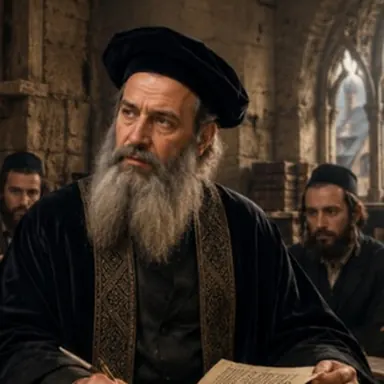
Rabbi Israel Isserlein
12 min read2,418 words
Summary
This survey examines the figure and influence of Rabbi Israel Isserlein, the Mahara"i, who was active in the 15th century and became one of the great shapers of Ashkenazi halakha and custom. The text presents his central work, "Terumat HaDeshen," as a halakhic codex organized in a symbolic structure of 354 sections, and emphasizes his distinctive manner of writing, which at times included theoretical questions for the purpose of comprehensive halakhic clarification. Beyond dry rulings, the source sheds light on custom as a supreme legal instrument and on the spiritual continuity of European Jewry after periods of destruction and persecution. Finally, it explains how the Mahara"i's teaching became the foundation for the Rema's glosses on the Shulchan Arukh, thereby securing his centrality for generations among students of Torah and halakhic decisors.
The Pillar of Late Ashkenazi Jewry: The Work and Torah Teaching of Rabbi Israel Isserlein
The Torah history of European Jewry in the fifteenth century stands under the sign of rupture and rebuilding. After the decrees of Tatnu (4856) and the frequent riots in the communities of the Rhine Valley, and after the terrible destruction of the Vienna community in 1421 (the Vienna decree), there was a need for spiritual leadership that would gather the fragments and consolidate the world of halakha and custom into a coherent work that would preserve Ashkenazi identity. The central figure of Rabbi Israel ben Pethahiah Isserlein, known by the epithet Mahara"i, towered as a halakhic giant in this period, and he is regarded as the last of the great Ashkenazi decisors of the era of the Rishonim, whose rulings shaped for generations the face of the Ashkenazi halakhic world.[1]
The Historical and Biographical Background: From the Scars of Destruction to Revival in Wiener Neustadt
Rabbi Israel Isserlein was born at the end of the 14th century in Germany, at a time when the Torah center of gravity began to migrate eastward toward Austria, Poland and Bohemia. His family was part of the Torah elite of Ashkenaz; his father, Rabbi Pethahiah, and his mother were scions of glorious genealogical lines.[2] His childhood stood in the shadow of the national traumas of that period. The Vienna decree of 1421, in which a flourishing Jewish community was destroyed by Emperor Albrecht V, left an indelible mark on his soul and on his halakhic outlook. Many members of his family were murdered in sanctification of the Name, and he himself wandered among various communities until he settled in the city of Wiener Neustadt in Austria.[2, 3]
In Wiener Neustadt the Mahara"i founded his great yeshiva, which became the central point of attraction for Torah students throughout Central Europe. His public standing was so high that he became the supreme authority for the Jews of Austria, Moravia and Germany. His activity was not confined to the four cubits of halakha alone, but extended also to public leadership, mediation in communal disputes and the rehabilitation of religious institutions after the destruction.[3]
Genealogy and Family Ties
The Mahara"i was connected by ties of family and study with the great figures of the generation. He married the daughter of the Vilna scholar Rabbi Yitzchak Yehuda Leib Rabinowitz (known as the Yelab"sh), author of the book "Darkei Teshuvah – Shabal"i HaLevat," which attests to the extensive Torah ties that crossed geographical boundaries.[2] It is interesting to note that in later sources an identical name appears, Rabbi Israel Isser Isserlin of Vilna (1827–1889), who was a moreh tzedek (rabbinic judge) in the city of Vilna and authored important books, but it is the figure of the historical Mahara"i of the 15th century that shaped the foundations of Ashkenazi custom.[2]
His Literary Work: The Structure and Essence of "Terumat HaDeshen"
The Mahara"i's foundational work is without doubt the book of responsa "Terumat HaDeshen." The book is not merely a collection of halakhic rulings, but an architectural creation that seeks to organize the totality of the Ashkenazi halakhic world in a structure at once symbolic and substantive. The book's name derives from the number of sections in it—354, equal to the gematria of the word "deshen."[1]
The Symbolism of the Number of Sections
The choice of the number 354 is not accidental. The Mahara"i's disciple noted that this number is aimed at the number of days in the lunar year.[1] This symbolism points to a cosmic conception of halakha; just as the moon encircles the year and renews itself every month, so halakha encompasses all the moments of a Jew's life and grants them holiness and order. The structure of 354 sections was intended to create a living halakhic encyclopedia, providing an answer for each day of the year.[1]
The Parts of the Book and Methodological Distinctions
The book as first printed in the Bomberg press in Venice (1519) consists of two main parts, an understanding of the differences between which is critical to understanding the Mahara"i's method [1]:
Part 1 – Responsa Terumat HaDeshen: this is the central and principal part. It includes 354 sections arranged by halakhic subjects, from daily laws to monetary law and the laws of the forbidden and the permitted. This part was written and edited by the Mahara"i himself with the aim of serving as a halakhic codex.[1]
Part 2 – Pesakim u-Ketavim (Rulings and Writings): this part contains 267 sections. It is a collection of short responsa and rulings that were actually sent to inquirers or were recorded as notes. This part was edited after the death of the Mahara"i by his disciples, and therefore its halakhic standing is at times considered lower than that of the first part.[1]
The Controversy over the "Artificial Questions" and Its Methodological Implications
One of the most fascinating and most disputed issues in halakhic research on Terumat HaDeshen is the authenticity of the questions. The decisors of later generations, among them the Shakh, the Taz and the Tzemach Tzedek, raised the supposition that the Mahara"i himself wrote not only the answers but also the questions.[1]
Why Create Artificial Questions?
The assumption is that the Mahara"i wished to create a comprehensive study tool. Instead of waiting for questions that would arrive from the public, he "invented" complex halakhic cases that make it possible to analyze topics in depth. In a letter to the Maharil (Rabbi Yaakov Molin), the Mahara"i admitted that his intention in his study is at times to "invent" questions for the purpose of pilpul and in-depth study, and not necessarily as a response to a case that occurred in reality.[1]
However, modern studies and examination of manuscripts have shown that over a hundred responsa within the book are based on real questions that were sent to him. It appears that the Mahara"i combined the two: he took real cases, distilled them of peripheral details, and added to them theoretical questions intended to complete the halakhic picture.[1]
Implications for Halakhic Ruling
The question of whether a question is artificial or not carries enormous legal significance:
- Precision of details: if the author formulated the question himself, then every detail mentioned in it is "deliberate" and carries halakhic significance. By contrast, in a question based on an actual incident, some of the details may be incidental and one should not learn from them.[1]
- Contradictions in rulings: in a case of contradiction between "Terumat HaDeshen" (the theoretical) and a responsum in "Pesakim u-Ketavim" (the practical), some decisors prefer the practical responsum because it is "halakha for practice." On the other hand, there are those who argue that precisely in the ordered work the Mahara"i's opinion is at its most refined.[1]
His Halakhic Teaching: Between the Ashkenazi Tradition and Innovations of Ruling
The Mahara"i's method of ruling is a direct and distinct continuation of the classical Ashkenazi tradition. The principal sources on which he relies are the Tosafists, the Rosh and the Mordechai.[4] The Mahara"i was active in a period when the Sefardi halakhic world (and especially the Rambam) was already known, but he consciously chose to adhere to his own home tradition.[4]
"The Halakha Follows the Later Authorities" and the Attitude toward the Sages of Sefarad
The Mahara"i was one of the fathers of the approach that prefers "the latest halakha" (halakha ke-batrai). According to this approach, one should prefer the rulings of the sages of the later generations, since they saw the words of the Rishonim and weighed them.[4] It is interesting to note that the Mahara"i hardly knew the rulings of the later sages of Sefarad, apart from the Rambam, because of the geographical and cultural isolation of that time.[4]
The Centrality of Custom
For the Mahara"i, custom is a first-rate instrument of ruling. In the Ashkenaz of that period, custom was not merely a folk tradition but an essential part of the legal structure. The Mahara"i invested great effort in investigating the source of ancient customs and in giving halakhic force to practices that were observed in the communities of Austria and Germany. The Maharshal (Rabbi Shlomo Luria) wrote of him that he "knew how to assess the ways of his own leaders, the scholars of Ashkenaz and Austria, who were pious and men of action."[1]
"Leket Yosher": A Glimpse into the Life and Conduct of the Mahara"i
In order to truly understand the Mahara"i's work, one cannot content oneself only with his official books. His outstanding disciple, Rabbi Yosef Yozpa Osterreicher, wrote the book "Leket Yosher," which constitutes a kind of "diary" of the life of the rabbi and his yeshiva.[5, 6] This book documents not only halakhic rulings but also his personal customs, his daily routine, the events of his life, and even small details about his clothing and diet.[6, 7, 8]
The Historical and Halakhic Contribution of Leket Yosher
The book "Leket Yosher" is regarded as one of the most reliable sources for understanding the world of the sages of Ashkenaz in the 15th century. It was written between 1470 and 1475 and was first printed only at the beginning of the 20th century from a manuscript found in Munich.[6] The decisors of later generations treat "Leket Yosher" as authentic testimony that faithfully reflects the figure of the Mahara"i.[5]
The Mahara"i's Influence on the Rema and the Shulchan Arukh
The Mahara"i's importance for later generations lies chiefly in the fact that his rulings formed the central foundation for the glosses of the Rema (Rabbi Moshe Isserles) on the Shulchan Arukh. The Rema regarded the author of "Terumat HaDeshen" as the last Ashkenazi decisor whose words decide the halakha.[9, 10]
Examples of Direct Influence
- Cruelty to animals and medicine: the Mahara"i ruled that in any case involving a medical need or a benefit to a person, there is no prohibition of "causing suffering to animals" (tza'ar ba'alei chayim). He proved this from the permission to castrate dogs for a certain purpose. The Rema adopted this ruling verbatim: "Anything needed for healing has in it no prohibition of causing suffering to animals."[9]
- The laws of niddah and purity: the Mahara"i's meticulous rulings on matters of examinations and stains became permanent fixtures of Ashkenazi ruling, as he combines stringency where needed with leniency in places where physiological reality allows it.[11]
The connection between the Mahara"i and the Rema is not only textual but essential; the Mahara"i supplied the Rema with the "raw material" of Ashkenazi custom, which was processed and arranged within the "Mappah" (tablecloth) that the Rema spread over the Shulchan Arukh of Rabbi Yosef Karo.
The Mahara"i's Attitude toward Torah Study and the Structure of the Yeshiva
The Mahara"i's yeshiva in Wiener Neustadt was not merely a place for memorizing laws, but a study laboratory in which Talmudic topics were tested against changing reality. His disciples, such as Mahari Bruna and the Mahariv, themselves became luminaries of the Diaspora and spread his method.[12]
Halakha for Practice versus Pilpul
The Mahara"i was known for his ability to combine deep pilpul with practical decision. He did not shrink from discussing extreme theoretical questions, but always strove to arrive at a bottom line that could be applied in the life of the community. This approach was especially vital in a period of rehabilitating communities, in which rabbis of stature were needed who could rule in unprecedented situations.[1, 4]
Comparison between the Mahara"i and Later Figures Who Bear His Name
As noted at the outset, one must distinguish between the original Mahara"i and Rabbi Israel Isser Isserlin of Vilna, who lived in the 19th century. Whereas the Mahara"i shaped early Ashkenazi custom, the rabbi of Vilna operated within an established halakhic tradition and served as a judge and moreh tzedek in the capital of the Lithuanian Torah world.[2]
It is interesting to see how the name of the Mahara"i continued to resonate in later generations, and how families of Torah scholars in Ashkenaz and Lithuania continued to bear his name with pride, as an expression of their deep connection to his legacy.
Summary and Conclusions on His Work and Teaching
Rabbi Israel Isserlein, author of Terumat HaDeshen, represents the vitality and power of Ashkenazi Torah in its most difficult moments. He was not merely a decisor but an "arranger" of an entire world. Through the 354 sections of his book, he created a bridge between the Talmud and the Rishonim and the reality of European Jews in the early modern period.[1]
His Torah teaching is characterized by deep loyalty to custom, by intellectual daring in creating "artificial" questions in order to encompass halakha, and by human sensitivity expressed in his rulings on matters of medicine and ethics.[1, 9] The fact that to this day every Ashkenazi decisor who opens the Shulchan Arukh meets first and foremost the Mahara"i's rulings through the Rema is the best testimony to the eternity of his work.[10]
The figure of the Mahara"i, as reflected through the pages of "Terumat HaDeshen" and the wondrous testimony of his disciple in "Leket Yosher," remains one of the unshakable pillars of the world of halakha, a figure who combines heaven and earth, pilpul and practice, and destruction and spiritual revival.[1, 6]
Sources12
- 1.תרומת הדשן (ספר) – ויקיפדיה, he.wikipedia.org/wiki/תרומת_הדשן_(ספר)
- 2.ישראל איסר איסרלין (וילנה) - ויקיפדיה, he.wikipedia.org/wiki/ישראל_איסר_איסרלין_(וילנה)
- 3.תרומת הדשן | ספריית ספריא, sefaria.org.il/Terumat_HaDeshen
- 4.שיטת פסיקה – ויקישיבה, yeshiva.org.il/wiki/index.php/שיטת_פסיקה
- 5.ישראל איסרלן – ויקיפדיה, he.wikipedia.org/wiki/ישראל_איסרלן
- 6.לקט יושר – ויקיפדיה, he.wikipedia.org/wiki/לקט_יושר
- 7.לקט יושר על אורח חיים - מכון שלמה אומן, machonso.org/publications/item.asp?id=16
- 8.לקט יושר על יורה דעה - מכון שלמה אומן, machonso.org/publications/item.asp?id=15
- 9.סירוס בעלי חיים בעריכת ניסויים לצרכי פוריות בני אדם - עולמות, olamot.net/shiurim/סירוס-בעלי-חיים-בעריכת-ניסויים-לצרכי-פ/
- 10.תרומת הדשן – ויקישיבה, yeshiva.org.il/wiki/index.php/תרומת_הדשן
- 11.תרומת הדשן, חלק א' רמ״ו | ספריית ספריא, sefaria.org.il/Terumat_HaDeshen,_Part_I.246
- 12.ישראל ברונא - ויקיפדיה, he.wikipedia.org/wiki/ישראל_ברונא