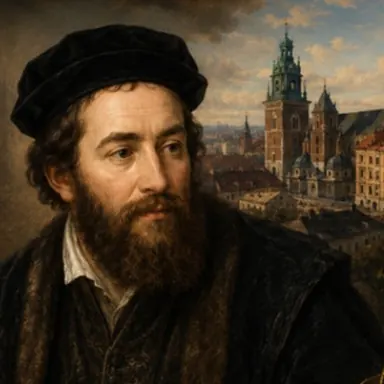
The Rema: Custom, Rationalism, and Science at the Dawn of the Modern Era
13 min read2,557 words
Summary
The text surveys the monumental work of Rabbi Moshe Isserles (the Rema), a key figure in the 16th century who shaped the world of halakha and Jewish thought at the dawn of the modern era. The central axis of the work is the enterprise of halakhic ruling and the halakhic dialogue with Rabbi Yosef Karo, in which the Rema integrated the customs of Ashkenazi Jewry into the "Shulchan Arukh" by means of the glosses of the "Mappah," and thereby prevented a cultural rift in the Jewish people. Alongside this, the source emphasizes his distinctive doctrine of custom, which grants communal tradition supreme normative validity, and the rare intellectual combination of philosophical rationalism, the exact sciences, and the esoteric teaching. The purpose of the article is to present the Rema as a living bridge between worlds, who succeeded in fusing halakhic codification, customary conservatism, and intellectual openness into a harmonious legacy that constitutes the foundation of Ashkenazi religious life to this day.
The Work of Halakhic Ruling and Thought of the Rema: Custom, Rationalism, and Science at the Dawn of the Modern Era
His Life and the Melting Pot of the Kraków Community
Rabbi Moshe Isserles (the Rema), who lived in the middle of the 16th century, worked at a historical crossroads at which the Jewish people shifted the center of gravity of its Torah creativity from western and southern Europe to Poland and Ashkenaz.[1, 2] The Rema was born in Adar I 5290 (22 February 1530) in the city of Kazimierz (adjacent to Kraków) in the Kingdom of Poland, to a family of firm economic standing and great political influence.[1] His father, Rabbi Yisrael Isserl, was one of the wealthy men and leaders of the community, and his mother, Malka, was a cousin of the Maharam of Padua—one of the fathers of late halakhic ruling in Italy.[1] This lineage connected the Rema from childhood to the world of the great figures of the generation.[1]
The Rema received his early Torah training from his father and from private tutors.[2] He then went to study in the yeshiva of Rabbi Shalom Shachna in Lublin, where he was regarded as a distinct prodigy, was ordained to the rabbinate at the age of thirteen, and even married his teacher's daughter.[1] In 5312 (1552), in the midst of a severe plague that struck Kraków, his first wife died.[1] He later married a second time, a daughter of the distinguished Katz family, sister of Rabbi Yosef Katz (and according to another version, Mrs. Krendel, daughter of Rabbi Moshe Eberlish).[1]
Despite his young age, the Rema's public and Torah standing rose rapidly. In 5312 (1552), at about the age of twenty-two, he founded in Kraków a great yeshiva that drew hundreds of students from throughout Europe.[1] Thanks to his family's extraordinary wealth, he supported his students generously and sustained them from his own pocket.[1] From 5313 (1553) he served as a judge and as head of the rabbinical court in Kraków.[1] In his great humility he used to sign last among the judges on the court rulings.[1] Shortly afterward he was appointed official rabbi of Kraków.[1]
Under his leadership Kraków became a Torah center of international authority, and the Rema maintained close correspondence of responsa with the great figures of his generation, among them the Maharshal, the Maharam of Padua, and Rabbi Yosef Karo.[1] The Rema died on 18 Iyar 5332 (10 May 1572), on Lag BaOmer, at the age of only 42 (although there is a legend that he lived 33 years, corresponding to the numerical value of "gal eini," and died on this day).[1, 2] He was buried in the ancient Jewish cemetery in Kraków, located behind the Rema Synagogue—which was built in 5313 from the estate funds of his late mother.[1] On his tombstone was engraved the splendid inscription expressing the force of his historical esteem: "From Moses to Moses there arose none like Moses."[2]
"Darkhei Moshe" and the "Mappah": The Halakhic Dialogue with Rabbi Yosef Karo
The Rema's halakhic enterprise took shape out of a hidden literary and methodological confrontation with Rabbi Yosef Karo, author of the "Beit Yosef" and the "Shulchan Arukh."[3, 4] Between 1545 and 1565 the Rema labored on the writing of his comprehensive work "Darkhei Moshe" on the book Arba'ah Turim.[3] At the start of his path the Rema worked on the book without knowing that in the Land of Israel Rabbi Yosef Karo was laboring on a similar undertaking.[3] Only when he had completed the writing of the "Orach Chaim" section did he learn that the "Beit Yosef" had already been printed and published.[3]
This discovery led the Rema to a dramatic methodological decision: he shelved his original broad book (portions of which survived and were printed later as the "Darkhei Moshe ha-Arokh") and decided to abridge and rewrite the work (the "Darkhei Moshe ha-Katzar") with the aim of turning it into a focused supplement to the "Beit Yosef."[2, 3] This decision stemmed from identifying three merits and fundamental needs that remained unaddressed in Karo's work [5]:
- Concision and brevity: Unlike the "Beit Yosef," which is very lengthy in its discussions and sources, the "Darkhei Moshe" presented a concise and focused summary.[5]
- Additional sources: The Rema integrated many Torah sources that were not brought in the Beit Yosef, among them responsa of the Geonim, rulings of the later sages of Ashkenaz, and the book "Issur ve-Heter ha-Arokh."[1, 5]
Breaking the concept of the "pillars of instruction": Rabbi Yosef Karo based his rulings on a majority among the three pillars of instruction—the Rif, Maimonides, and the Rosh—a method that gave a built-in preference to the Sephardic and Eastern tradition of halakhic ruling.[1, 5] The Rema held that this methodology ignores the traditions of the early authorities of Ashkenaz and France and the customs actually accepted in European Jewry.[1, 5]
Following the publication of the "Shulchan Arukh," the Rema understood that the work might cause the customs of Ashkenaz to be forgotten.[1, 6] He composed his famous glosses, known as the "Mappah" (the Tablecloth), which were integrated directly into Karo's text.[1, 6, 9] This image, which originates in the Rema's own introduction, presents Karo's work as a set and arranged table that is not complete until a tablecloth is spread over it that softens it and adapts it to the needs of the Ashkenazi household.[9, 10] This enterprise prevented a catastrophic legal and communal split between Sephardic and Ashkenazi Jewry, and offered a unique model of joint codification that accommodates geographical and traditional pluralism.[1, 6]
The Doctrine of Custom: The Boundaries of Halakha and Communal Practice
One of the most significant pivots of the Rema's thought is his complex and profound attitude toward the custom of Israel (minhag Yisrael).[1, 8] In the world of halakha there are different and opposing approaches to local custom. On one side stood extreme decisors such as Rabbenu Tam, who forcefully rejected customs not founded on a clear Talmudic source, and even declared sharply that "this custom is Gehenna retroactively, for if fools practiced it, the Sages did not."[11] On the other side, the "Beit Yosef" held a more moderate but qualified position, according to which a custom that contains neither a safeguard of the Torah nor a concern of prohibition has no binding halakhic standing.[7]
The Rema, by contrast, formulated a halakhic philosophy that grants communal custom the status of a supreme normative source.[7, 8] This methodological turn is attributed, among other things, to an anecdote from the beginning of his tenure as rabbi of Kraków.[8] Upon entering his post, the Rema noticed a local custom that did not please him.[8] However, after examining the matter in depth, he discovered that this custom—despite its external strangeness—served as an effective tool for preventing a grave transgression among members of the community.[8] This experience led him to a profound recognition of the hidden power of public custom, and from then on he undertook to take customs into account and to give them halakhic backing, out of an understanding that "the custom of Israel is halakha" and that the public acts out of inner spiritual inspiration ("If they are not prophets, they are the sons of prophets").[8]
This conception led the Rema to determine that the duty of caution regarding customs sometimes stems precisely from the inability of the sages to grasp their full depth and original reason.[12] In the laws of Purim he emphasized that:
"No custom is to be annulled or ridiculed, for it was not established for nothing."[12]
The importance of custom in his eyes found expression in many cases in which he decided the halakha in practice according to the prevailing practice, even when this stood in contradiction to the opinion of most decisors or to the original Talmudic law.[7] Prominent examples illustrating this approach include:
- The custom of striking Haman: The Rema gave official halakhic backing to the children's custom of striking with noisemakers or stones when Haman's name is read in the Scroll of Esther, despite the custom's disturbance of the standard reading.[12]
- Refraining from eating nuts on Rosh Hashanah: Defense of a custom based on symbolic hints and gematria (the word "egoz" [nut] equals in numerical value the word "chet" [sin]), despite the absence of a formal halakhic source.[7]
- Wearing women's clothing on Purim: The Rema decided to be lenient regarding the custom of wearing the clothing of the opposite sex on the days of Purim, basing himself on the principle that communal custom prevails and decides in a dispute among decisors, despite the sharp opposition of many later decisors.[7]
For the Rema, custom is not merely a secondary appendix to halakha, but a living and creative force capable of deciding disputes, and even of overriding explicit halakhot in situations of pressing need and doubt.[7]
The Intellectual Synthesis: Philosophy, Science, and Kabbalah in the Rema's Thought
The Rema represents the type of the Jewish intellectual of the Renaissance period, who combines different and seemingly opposed worlds of knowledge.[1] He held a broad scientific and philosophical education, engaged in astronomy and mathematics, and wrote many glosses on classical scientific and philosophical works.[1]
The Rema's thought attempted to perform an act of bridging and profound compromise between the world of rationalist philosophy and the world of Kabbalah and the esoteric teaching.[1] The Rema believed that both systems strive to understand the same divine truth, and declared that "the wisdom of Kabbalah is the wisdom of philosophy, except that they speak in two languages."[1]
This conception was clarified in later thought as a comparison of the essence of divine speech.[13] The Rema did not claim that there is an absolute structural identity between the systems—after all, in philosophy there is no division into ten sefirot or five Kabbalistic partzufim (faces).[13] His intention was that the very engagement with divinity and with the essence of the sefirot is fundamentally the same among the Kabbalists and the philosophers, except that the Kabbalists speak of the upper worlds by way of image, form, and symbolic garb, whereas the philosophers analyze the same concepts with abstract intellectual and rational tools.[13]
This open rationalism found practical expression in the running of his yeshiva in Kraków, where the Rema taught Maimonides' "Guide of the Perplexed" alongside the Zohar.[1] Nevertheless, the Rema maintained strict methodological discipline and set clear boundaries between intellectual inquiry and practical halakhic ruling: he believed in the sanctity of the Zohar, but consistently refrained from ruling halakha on its basis where it contradicted the sources of the revealed Torah and the Talmud.[1]
His Intellectual Work and the Polemics of His Era
The Rema's literary output goes beyond the boundaries of the halakhic code of the "Mappah" and encompasses books dealing with thought, exegesis, and systematic research.[1]
His central work of thought is "Torat ha-Olah"—a profound philosophical-cosmological research book devoted to explaining the reasons of the Temple, its physical structure, its vessels, and the laws of the sacrifices.[1, 14] In this book the Rema presents symbolic explanations connecting the microcosm of the Temple with the macrocosm of the universe, making extensive use of Maimonidean philosophical tools alongside Kabbalistic conceptions.[1, 14]
Another work of thought is "Mechir Yayin," an allegorical and symbolic commentary on the Scroll of Esther that the Rema wrote during the days of his exile in the town of Szydłów, to which he fled with his family from the fear of the plague that raged in Kraków.[1, 2] The work, which was sent to his father as a Purim gift (mishloach manot), likens the story of the Scroll to the spiritual and psychological struggle of the human being: King Ahasuerus represents the soul, and Haman the wicked represents the evil inclination, and the book outlines the moral and intellectual ways in which a person copes with it.[1]
The Rema's literary and halakhic activity stood more than once at the center of sharp polemics.[1] His halakhic work "Torat Chatat," which deals with the laws of the forbidden and the permitted and is based on an expansion of the laws of the book "Sha'arei Dura," aroused sharp opposition from his contemporaries.[1, 2] At the head of the opponents stood the Maharshal (Rabbi Shlomo Luria), who objected in principle to the trend of abridgment and codification represented by the Rema.[1, 2] Another prominent decisor who came out against the work was Rabbi Chaim ben Betzalel (brother of the Maharal of Prague).[1]
The opposition to the Rema's books stemmed from the fear that firm and brief rulings might lead to neglect of the study of the Talmudic sources and to errors in practical ruling.[1] Despite these polemics, the Rema's halakhic authority was not shaken; his books became permanent fixtures, and the great Acharonim of later generations—such as Rabbi Avraham Abele HaLevi Gombiner (author of the commentary "Magen Avraham")—discussed his words at length, interpreted them, and made them the unshakable foundation of religious life in Ashkenaz.[2, 15]
Summary
The legacy of Rabbi Moshe Isserles represents the victory of cultural and halakhic synthesis.[1, 6] The Rema succeeded in preserving the independence of Ashkenazi Jewry and the richness of its customs, while at the same time preventing the splitting of the Jewish people into two separate halakhic camps.[1, 6] His unique figure—combining conservative halakhic ruling with exceptional intellectual openness to science, philosophy, and the esoteric—remains to this day a model of comprehensive spiritual leadership capable of containing contradictions and translating them into a harmonious and stable system of life.[1]
Sources15
- 1.משה איסרליש - ויקיפדיה, he.wikipedia.org/wiki/משה_איסרליש
- 2.הרמא: רבי משה איסרלישׂ - כל המידע אודות הצדיק | נפטר י"ח באייר, hameir-laarets.org.il/hilulots/רבי-משה-איסרלישׂ-הרמא/
- 3.דרכי משה | ספריית ספריא, sefaria.org.il/Darkhei_Moshe
- 4.כיצד ממלאים את החסר בדפוס ישן? - הספרנים - הספרייה הלאומית, blog.nli.org.il/sodot-harama/
- 5.דרכי משה - ויקיפדיה, he.wikipedia.org/wiki/דרכי_משה
- 6.המפה - ויקיפדיה, he.wikipedia.org/wiki/המפה
- 7.תורת המנהג - מנחת אשר, minchasasher.com/he/shiur/פרשה-שיעורים/תורת-המנהג/
- 8.חשיבותו של מנהג ישראל - ארגון יוצאי קרקוב בישראל, cracow.org.il/אגדות/חשיבותו-של-מנהג-ישראל/
- 9.רבי משה איסרל'ש (הרמ"א) – ויקישיבה, yeshiva.org.il/wiki/index.php/רבי_משה_איסרל'ש_(הרמ"א)
- 10.הרמ"א פנה לבן הקצב והודיע לו בתוקף: "אני מזהיר אותך, לבל תעז למכור אפילו כזית אחד מהשומן הזה עד שאסיים את התפילה ואחזור מבית הכנסת!" - דרשו, dirshu.co.il/398255-2/
- 11.'כבר קיבלו אבותיכם': המנהג וההלכה - צירופים חדשים, zerufim.siach.org.il/minhag-and-halacha/
- 12."זהו רק מנהג"... האמנם? / ישראל ברנד - מכון שלמה אומן, machonso.org/hamaayan/?gilayon=68&id=2224
- 13.כשפים - רציו - אמונה, מחקר, ומדע, rationalbelief.org.il/כשפים/
- 14.תורת העולה - ויקיטקסט, he.wikisource.org/wiki/תורת_העולה
- 15.מחברים | Texts from the Sefaria Library - ספריא, sefaria.org.il/topics/category/authors