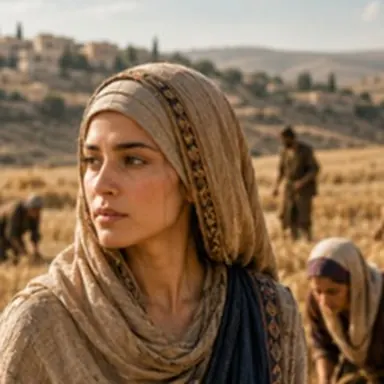
Ruth the Moabite
15 min read2,978 words
Summary
This article offers an in-depth, multidimensional analysis of the figure of Ruth the Moabite, focusing on the historical and spiritual repair (tikkun) she brings about for the lineage of Sodom and Moab through her extraordinary quality of kindness (chesed). The text examines the halakhic complexity of her conversion through the topic of the "minor convert," and emphasizes how her meticulousness about the details of the commandments and her modesty in the field made her a model of the "woman of valor" worthy of founding the royal dynasty. The literary structure of the scroll is revealed here as an axis of five stages of moral development, in which kindness turns from a private act into a redemptive force that establishes the kingdom of the House of David. Ultimately, the source seeks to show that it is precisely Ruth, the stranger who came from the margins, who gives the Jewish people the spiritual foundation of compassion and mutual responsibility, which are a necessary condition for receiving the Torah and for the coming of the Messiah.
The Torah Teaching, Halakhic Conduct and Enterprise of Kindness of Ruth the Moabite: A Hermeneutic, Historical and Halakhic Analysis
The Family Burden and the Historical Repair: From Sodom to Moab
The Scroll of Ruth offers a fresh and unique spirit in the whole of Scripture.[1] Whereas the books of Scripture deal extensively with systems of government, wars and wide-ranging theological struggles, the scroll presents a heroine who comes from the margins of society – a stranger, a widow and poor – whose deeds and character are what delineate her autonomous and assertive figure.[1] Understanding Ruth's spiritual teaching requires a deep dive into the genealogical and historical burden that she bears on her back.[2, 3] Ruth is a direct descendant of Lot, a biblical figure with a complex face.[2, 3] The name Lot equals in gematria "adam" (man) (45) [2], a hint at his lofty spiritual beginning as the only member of Abraham's family who managed to break away from Haran and follow his uncle to the land of Canaan.[2] However, Lot ended his path in a deep decline when he chose to settle in Sodom – a city characterized by extreme hatred of strangers, a prohibition on acts of kindness and a deep dread of the vulnerability inherent in relationships.[2]
The destruction of Sodom led to the birth of two abhorred nations, Moab and Ammon, out of an incestuous relationship between Lot and his daughters.[3, 4] This deed in the cave bore an extreme double face [4]: on the one hand, a grave moral sin, and on the other hand, an expression of supreme self-sacrifice on the part of the daughters, who were convinced that the whole world had been destroyed and sought to save humanity from annihilation.[4] The Sages teach that out of that historical darkness "two fine pearls" were destined to emerge: Ruth the Moabite and Naamah the Ammonite (the wife of King Solomon and the mother of Rehoboam, the continuer of the royal dynasty).[3]
Ruth, who was a Moabite princess and the daughter of Eglon king of Moab (who was the grandson of Balak) [5, 6], carries out through her deeds a retroactive hermeneutic repair of the lineage of Sodom and Moab.[2, 4] Whereas Lot fled from relationships to the other side of the Jordan, Ruth makes the opposite movement.[2] She abandons the wealth, the royal standing and the physical security of Moab, and sets out on an active journey of "finding favor" and of seeking a vulnerable and holy bond in the land of Judah.[2, 6] In this way, Ruth proves that the original motive of Lot's daughters in the cave was a rectified and noble motive meant to bring continuity to the world.[4] This distinction is also well reflected in the midrashic interpretation of the names of the two Moabite sisters: Orpah was so called because "she turned her back (oref) on her mother-in-law," whereas Ruth was so called because "she saw (ra'atah) into her mother-in-law's words."[5]
The Family Dynamics and the Genealogy of the House of Elimelech
Ruth's work was woven into the history of a distinguished family of the tribe of Judah, whose descent to the field of Moab in the wake of the famine was perceived as a national and moral betrayal.[6, 7, 8] The head of the family, Elimelech, was the son of Nachshon ben Amminadav (the prince of the tribe of Judah).[6] The name Elimelech holds within it a deep prophetic meaning: "elai yavo melekh" (to me shall a king come), "Eli melekh" (my God is king) or "el ha-melekh" (to the king).[8] The family of Elimelech was bound by close ties of kinship with Boaz, who was the son of Salmon and the cousin of Mahlon [6] (whereas according to other midrashic traditions, Elimelech and Boaz were brothers, and Elimelech was Naomi's uncle).[9]
Elimelech's decision to leave the Land in a time of trouble brought upon him and his sons, Mahlon and Chilion, a terrible punishment of death and karet (extirpation) in the field of Moab.[6, 7, 10] Nevertheless, the theological analysis of the Sages teaches that this dramatic descent was in fact "a descent for the sake of ascent."[8] Elimelech went down to Moab unknowingly in order to extract from there the soul of the future kingship, destined to break forth from the enormous covering and concealment of Ruth the Moabite, and to bring it into the process of repair in Bethlehem.[3, 8]
The Double Conversion and the Law of the "Minor Convert": Resolving the Halakhic Contradictions
Ruth's halakhic status at the time of her first marriage, to Mahlon, stands at the center of an intricate Talmudic and midrashic discussion.[7] The plain meaning of the verses attests that Mahlon and Chilion married "Moabite women," and the commentators on the Gemara in Bava Batra explain that they remained gentiles, and for this the husbands were punished.[7] In addition, Naomi urges her daughters-in-law to return "to her people and to her gods" [7]; had Ruth and Orpah been full converts at that time, this urging would have constituted a grave sin of incitement to idolatry, which is absolutely forbidden according to the ruling of Maimonides (Rambam).[7] On the other hand, the literature of the Zohar utterly rejects the possibility that Mahlon married a gentile, and rules: "Heaven forbid that Mahlon married her while she was a gentile; rather, when he married her she converted."[7] Moreover, the levirate marriage of Ruth by Boaz at the end of the scroll requires the existence of a prior bond of marriage with Mahlon, which is halakhically valid only if Ruth was Jewish at the time of the marriage.[7]
The resolution of this halakhic contradiction is based on the topic of the "minor convert" in Tractate Ketubot and in the Tosafot on Tractate Nazir.[7] According to this analysis, Ruth and Orpah underwent an initial process of conversion in their minority with the consent of a beit din (rabbinic court) at the time of their marriages in Moab.[7] According to halakha, the conversion of a minor remains in suspense [7]: upon reaching adulthood, he may protest the conversion and annul it retroactively.[7]
The division of halakhic statuses is presented in the following table:
This hermeneutic approach also explains the homily on Naomi's words to Ruth in the preparation for the meeting at the threshing floor: "Wash yourself, anoint yourself, put your garment upon you and go down to the threshing floor."[9] The Sages in Tractate Shabbat 113b connect these instructions with the laws of the Sabbath and the acceptance of the commandments.[9, 13] The Gemara's homily on the verse, "that your speech on the Sabbath should not be like your speech on a weekday," teaches that Ruth was careful about the sanctity of speech and the spiritual preparation for the Sabbath even before she came to Boaz.[9, 13] Rashi explains that the washing and anointing in question symbolize her final purification from idolatry and her adorning herself with the yoke of the commandments.[9]
Ruth's spiritual teaching in this process is compared in the Midrash Ruth Rabbah to the existential principle: "If a person does not prepare on the eve of the Sabbath, what will he eat on the Sabbath? And further: this world is like the sea, and the world from which you came is like dry land."[14] Ruth understood that her life in this world is a corridor and an "eve of the Sabbath" that require active preparation, acts of kindness and halakhic precision, in order to merit spiritual food and an eternal inheritance in the World to Come.[14]
The Three Appearances of Kindness in the Scroll: A Moral and Theological Triangle
The statement that the scroll was written entirely "to teach you how great is the reward of those who do acts of kindness" [15, 16] is reflected in a precise literary structure: the word "chesed" (kindness) appears in the scroll exactly three times.[16] These appearances represent the development of the teaching of kindness from the level of the individual to the level of the collective, and from the past to the future.[15]
The following table analyzes the three appearances of kindness in the scroll:
These three occurrences trace a movement in which kindness turns from a private behavioral trait into a national driving force.[15, 16] The concept of "gomel chesed" (one who bestows kindness) is defined in Hasidism as one who runs after the recipient and gives him the kindness so perfectly that the recipient feels that he is the giver.[15] A hint of this is found in the word "natan" (gave), which reads the same forward and backward, to illustrate that one who gives to others in fact receives himself.[15] The reward that Naomi received (family restoration and help in raising Obed) and the reward that Ruth received (the founding of the royal dynasty) reflect this complete symmetry of the act of kindness.[17]
Her Halakhic Conduct and Her Modesty in the Field: From the Laws of Gleaning to "Woman of Valor"
Ruth's work in the fields of Bethlehem goes beyond the narrow dimension of survival.[16] The scroll emphasizes that Ruth is a leader – not a classic military leader, but a leader who rules over her impulses and acts within a world of strict halakha.[16] Ruth's struggle is devoted to two fundamental values: inheritance and continuity (land and child).[16] In a world gripped by a severe crisis of values in the period of the Judges, in which social disintegration led to alienation and selfishness, Ruth brings about a process of repair that moves society from a cruel society with no regard for the other to a society in which "every man has a name, and there is a name also for the dead in his inheritance."[16]
Ruth's expertise in the laws of the Torah drew the attention of Boaz, the leader of the generation and the judge of the people.[6, 9] Her extreme modesty was expressed in her conduct in the field [6, 16]: she was careful to glean standing up the ears of grain that were upright, and when she had to pick up ears from the ground she sat down on the earth so as not to bend over in an immodest manner.[6] In addition, she was careful to take exactly two ears that had fallen from the reaper's hand and not three, since according to halakha three ears are considered "shikhechah" (forgotten sheaves) belonging to the owner of the field and are not permitted to the poor.[9]
These qualities are what led Boaz to declare to her: "for all the gate of my people knows that you are a woman of valor."[16] Thus Ruth is the only woman in the entire Bible who is explicitly called by the title "woman of valor" in direct address.[16] This conduct applies the moral command appearing in Tractate Sotah 14a concerning walking in the ways of the Holy One, blessed be He ("Just as He clothes the naked... so you too clothe the naked. The Holy One, blessed be He, buried the dead... so you too bury the dead").[17] Ruth acts according to this theological foundation, and does kindness not only with the living (Naomi) but also with the dead (Mahlon and Elimelech) by caring for the perpetuation of their name and their inheritance.[16, 17]
Cosmic Influence, Communal Standing and the Struggle over the Purity of the Davidic Line
The deep connection between the Scroll of Ruth and the festival of Shavuot is explained by the author of the "Meshech Chochmah" through an analysis of the structure of the Torah.[18] The Torah incorporated the commandments of leket (gleanings) and pe'ah (the corner of the field) within the section of the festivals concerning Shavuot (the festival of the Giving of the Torah) in order to make clear that the spiritual event of the Giving of the Torah is not exhausted by ritual laws alone, but requires "rational manners" of kindness, charity and help for the weak.[18]
On the hermeneutic level, the plot of the scroll begins in the days of the barley harvest (the festival of Passover) and ends in the days of the wheat harvest (the festival of Shavuot).[18] This transition symbolizes the spiritual passage of the human being [18]:
- The barley harvest ("eaters of barley"): represents the barley offering (animal food), which corresponds to physical freedom alone – concern for material needs and survival.[18]
- The wheat harvest ("eaters of wheat"): represents the wheat offering (human food), which corresponds to the receiving of the Torah – an ascent to a spiritual, social and human world in which a person is able to turn to the other and understand his pain.[18]
In the cosmic and kabbalistic dimension, Ruth's perfect bestowal of kindness is linked to the month of Shevat (the sign of Aquarius, the tribe of Asher, the letter Tzadi) [15], a month in which the study of Torah begins from the tree and the fruits, which express the perfection of the quality of doing good and of bestowing upon others.[15]
The end of the scroll, which details the genealogy of King David, did not pass without severe political and halakhic struggles in the following generations.[8, 19] Ruth's being a Moabite served as a weapon in the hands of David's opponents.[19, 20] The Midrashim on Psalms (118 and 52) describe how Doeg the Edomite tried to disqualify David from entering the congregation of the Lord by casting aspersions on his Moabite lineage and by claiming that the halakha "a Moabite man and not a Moabite woman" is not valid.[19, 20] Doeg the Edomite used slander and halakhic distortion to undermine the legitimacy of the House of Jesse.[20]
The weighed answer to that moral and halakhic challenge is found in the purity of the House of Jesse.[8] Jesse fathered six righteous sons in purity and enormous holiness, and only when David was born – out of three generations of proven righteous people – did all understand that the whole lineage was pure and clean, and that the permission for the conversion of Ruth the Moabite was utter truth and an exalted divine will.[8] King David, who was born and died on the festival of Shavuot [17, 21], inherited from his ancestress Ruth the quality of mercy and kindness that became the foundation of his kingship, and thanks to her he sated the Holy One, blessed be He, with songs and praises.[5, 8, 15]
Summary and Conclusions
The work and Torah teaching of Ruth the Moabite redefine the concept of belonging and devotion in the Jewish world.[21, 22] Ruth is not only an example and a model of true conversion based on total spiritual commitment [11, 12]; she represents a moral model in which kindness and halakha are interwoven without separation.[16, 21] In her meticulousness about the commandments of gleaning and in her modesty in the fields of Bethlehem, she showed that the small details are the essence, and that through strictness about them a comprehensive social and national repair can be brought about.[16]
Through her deeds, Ruth resolved the ancient human fear of connection and vulnerability that originated in Sodom, and carried out a historical repair of the lineage of Lot.[2, 4] Kingship in Israel, which is destined to bring forth the King Messiah, is not based on governmental power or on an alienated aristocratic lineage, but on a genetic and spiritual foundation of kindness, compassion and seeing the other, which Ruth the Moabite was the first to imprint on Jewish history.[1, 8, 17]
Sources22
- 1.רות המואביה - האישה הכי יפה שמעולם לא ראיתם - הספרנים, blog.nli.org.il/giborot-ruth-naomi/
- 2."אנכי רות אמתך": על חסד, עצמאות ונשיות - צריך עיון, iyun.org.il/sedersheni/אנכי-רות-אמתך-על-חסד-עצמאות-ונשיות/
- 3.דוד המלך ועוצמת התהילים - תורת אמת, toratemetfreeware.com/online/f_01680.html
- 4.מלוט ועד בועז. על דרשת 'מואבי ולא מואבית' - ערוץ מאיר - אתר היהדות הגדול ..., meirtv.com/shiurim/192438/
- 5.רות | מקורות מתוך ספריית ספריא, sefaria.org.il/topics/ruth
- 6.10 עובדות שצריך לדעת על רות המואבייה - BeitChabad.com - בית חב"ד, he.chabad.org/library/article_cdo/aid/5965635
- 7.רות המואביה – עולמות, olamot.net/shiurim/רות-המואביה/
- 8.נשמת דוד המלך - קבר דוד | David Tomb, keverdavid.co.il/היסטוריה/על-דוד-המלך/נשמת-דוד-המלך/
- 9.על רות, נעמי וגואל בשם בועז: סיפורה המרתק של מגילת רות - BeitChabad.com - בית חב"ד, he.chabad.org/library/article_cdo/aid/2223189
- 10.שכר גומלי חסדים ועונשו של פוגע - דבר תורה לחג שבועות | פרשת יהדות, parashat.co.il/שכר-גומלי-חסדים-ועונשו-של-פוגע/
- 11.שיחת השבוע 1014 | המשמעות האמיתית של גיור - חב"ד, chabad.org.il/Magazines/Article.asp?ArticleID=3037&CategoryID=856
- 12.סיכום מגילת רות - 929, 929.org.il/page/2031
- 13.שבת קיג ב - ויקיטקסט, he.wikisource.org/wiki/שבת_קיג_ב
- 14.רות רבה - ויקיציטוט, he.wikiquote.org/wiki/רות_רבה
- 15.שבט – רות / גמילות חסדים ושכרה - עולמות, olamot.net/shiurim/שבט-רות-גמילות-חסדים-ושכרה/
- 16.ליבא | החסד של מגילת רות | סיון רהב מאיר - Secured Home of leeba.org.il, leeba.org.il/9573
- 17.4 תורת חסד על לשונה , מגילת רות, meyda.education.gov.il/files/hemed/av82.pdf
- 18.להיות מאוכלי החיטים: מגילת רות ומתן תורה - צריך עיון, iyun.org.il/sedersheni/ruth-and-humanism/
- 19.מדרש תהילים קי״ח | ספריית ספריא, sefaria.org.il/Midrash_Tehillim.118
- 20.מדרש תהילים נ״ב:ב | ספריית ספריא, sefaria.org.il/Midrash_Tehillim.52.2
- 21.מגילת רות - ויקיפדיה, he.wikipedia.org/wiki/מגילת_רות
- 22.מבוא קצר למגילת רות - תוכן, מידע ומסרים - קסם התנ"ך | ד"ר חיה שרגא בן איון, magicbible.co.il/מבוא-קצר-למגילת-רות-תוכן-מידע-ומסרים/