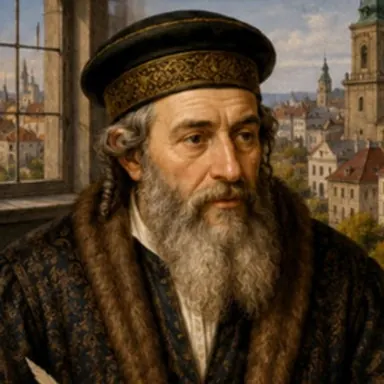
Rabbi Shalom Shachna of Lublin: A Historical, Methodological and Halakhic Analysis
13 min read2,580 words
Summary
This text surveys the highly influential figure of Rabbi Shalom Shachna of Lublin, who shaped the face of the world of Torah and of Jewish leadership in 16th-century Poland. The survey presents the distinctive method of "chilukim" and pilpul that he led in his yeshiva, discussing the methodological dispute with the Maharshal and his decisive influence on giant disciples such as the Rema. A central pivot of the work is the rabbi's philosophy of "not writing," which stemmed from humility and from a wish to preserve the flexibility of halakha, alongside his public role as a supreme authority on behalf of the Crown. Ultimately, the article highlights how his legacy combines sharp scholarship, political leadership and popular holiness, which made him one of the pillars of Ashkenazi Jewry throughout its generations.
The Leadership and Torah Teaching of Rabbi Shalom Shachna of Lublin: A Historical, Methodological and Halakhic Analysis
Introduction and Historical-Social Context
The beginning of the period of the Acharonim in Polish Jewry is characterized by accelerated demographic growth, economic flourishing and the establishment of independent institutions of leadership, which formed the infrastructure for the development of the greatest Torah center in Eastern Europe.[1, 2] At the heart of this historical process stood the figure of Rabbi Shalom Shachna son of Rabbi Yosef of Lublin (5255, c. 1495 – 1 Kislev 5319, 1558), who was active in the golden age of Poland under the rule of the Jagiellonian dynasty.[2] Rabbi Shalom Shachna established the standing of the city of Lublin as the spiritual and scholarly capital of all of Polish Jewry, and his influence encompassed the fields of education, halakhic decision-making and communal organization.[1, 2]
The historical analysis of the circumstances of his life shows the integration of his family into the economic and civic elite of the period.[2] He was born to Golda (who died in 1532) and to Yosef, who was a tax farmer and customs collector by profession.[2] His father won an achievement exceptional in those days in the form of a special residence permit from the King of Poland, Sigismund I, which allowed him and his family to live and do business within the walls of the city of Lublin.[2] This royal privilege gave Rabbi Shalom Shachna in his youth economic security and a firm social standing, which enabled him to devote his life to in-depth Torah study, and later to the establishment of influential institutions of education and leadership without dependence on outside factors.[2]
Family Ties and the Network of Scholars
Rabbi Shalom Shachna acquired his Torah from the father of the method of "chilukim" and of Ashkenazi pilpul, Rabbi Yaakov Pollak, and this connection shaped his path of study and made him his teacher's principal successor at the head of the yeshiva in Lublin.[1, 2] Around the figure of Rabbi Shalom Shachna there coalesced a network of Torah and family ties that included the greatest sages of the next generation, who shaped the world of Ashkenazi halakha and scholarship for generations.[2]
The most prominent of his disciples was Rabbi Moshe Isserles (the Rema), who, beyond being his principal disciple, was also his son-in-law in his first marriage.[2] The Rema felt enormous admiration for his teacher, and described him in his writings with epithets such as "the crowning glory, the diadem of splendor, the remaining inheritance, the lamp of Israel and a light that shines like the brightness of the firmament."[1] In addition to the close Torah and family bond, the Rema called him by titles expressing an attitude of deep paternal respect.[3] The Rema's path was profoundly influenced by this teacher, and in particular by the extreme humility he adopted from him, a trait that finds explicit expression in the Rema's introduction to his book "Torat ha-Olah," where he wrote that he had merited to do all that he did even though he possessed neither wisdom nor deeds.[3]
Another prominent disciple was Rabbi Chaim ben Betzalel, the brother of the Maharal of Prague and an important Torah author in his own right.[2] Rabbi Shalom Shachna's decisive influence on the shapers of the future generation is also documented in the words of his disciple, Rabbi Binyamin Aharon Solnik, who testified in his book of responsa "Mas'at Binyamin" that all his teachers and the great sages of his generation were direct disciples of Rabbi Shalom Shachna.[2] The family line of scholarship continued through his son, Rabbi Yisrael, who succeeded him at the head of the yeshiva, and his grandson Rabbi Yitzchak, who died on 29 Iyar 5365.[2]
Table 1: The Scholarly and Family Network of Rabbi Shalom Shachna
Public Leadership and the State Rabbinate
Alongside his Torah leadership, Rabbi Shalom Shachna was deeply involved in the political and public leadership of Polish Jewry.[2] Around 1520 he was appointed rabbi of Lublin and its environs.[2] His name as a halakhic authority spread far and wide, and his disciples throughout Eastern Europe called him by the lofty title "Light of the Exile."[2]
The political turning point in his public work came on 12 December 1541 (5302), when the King of Poland signed a royal decree appointing Rabbi Shalom Shachna to serve as one of the two official leaders of the Jews of the kingdom.[2] The official title of the appointees was "chief rabbi and elder of the Jews" (Senior Judaeorum).[2] Alongside Rabbi Shalom Shachna, who held sway over the region of Lublin and its surroundings, Rabbi Moshe Fishel of Krakow was appointed as the second "elder" of the communities.[2]
The government appointment was required at that time by the Crown in order to regulate the administrative structure of the Jewish communities, including the approval of rabbinic appointments, the supervision of the registration of marriages and the management of the system of tax collection for the state treasury.[2] Although the royal decree was later revoked because of internal opposition in the communities to government patronage, Rabbi Shalom Shachna continued to enjoy unchallenged public authority and continued to serve as the chief rabbi of Lublin until his death, when Rabbi Yehuda ben Aharon replaced him in the post.[2] This public work laid the institutional foundations from which the "Council of Four Lands," the independent leadership body of Polish Jewry, later grew.
The Methodology of "Chilukim" and the Lublin Method of Pilpul
For decades Rabbi Shalom Shachna stood at the head of the yeshiva in Lublin, which he inherited from his teacher Rabbi Yaakov Pollak.[2] Under his leadership the yeshiva became the largest and most influential Torah center in Eastern Europe, to which students streamed from all over the continent.[1, 2]
The beating heart of the yeshiva was a distinctive method of study known as the method of "chilukim" and sharp pilpul, which was perfected and reached its peak in the Lublin yeshiva.[2] This way of study was characterized by the demand for supreme intellectual sharpness and by the construction of complex logical moves whose purpose was to resolve apparent contradictions between different passages in the Gemara, in the words of Rashi and in the Tosafot.[4, 5] The pursuit of sharpness for its own sake and the intellectual delight of pilpul-style study became in this period a value in itself, intended first and foremost to sharpen the students' minds, to develop their capacity for rapid analysis and to prevent the acceptance of textual truths without meticulous investigation.[4, 5]
From a historical-methodological point of view, this method of study shares similar features with the approach of "the unity of the Torah," which was begun hundreds of years later by the Rogatchover (Rabbi Yosef Rosen) and continued by the Lubavitcher Rebbe.[5] This mode of inquiry was accepted mainly in Poland, Galicia, Lithuania and Hungary from the eighteenth century onward.[5] Whereas today the use of this method has greatly diminished in the general yeshiva world, it has remained accepted and active mainly in the Hasidic courts of Sanz and Satmar.[5] At the same time, in Rabbi Shalom Shachna's day the method also aroused fierce internal criticism within the world of Torah, since at times it led to a distancing from the plain meaning of the text and from clear halakhic decision, and focused on barren theoretical pilpul cut off from practical reality.[4, 5]
The Great Confrontation: The Lublin Controversy between Pilpul and Peshat
The sharpest opposition to the method of study of the Lublin yeshiva came from Rabbi Shlomo Luria (the Maharshal), who was one of the greatest Torah sages in Poland at that time.[4] In 1555 the Maharshal was called to serve as a head of yeshiva in Lublin, but this cooperation ran into deep methodological difficulties.[4] After about ten years in office, the Maharshal withdrew from this yeshiva, in which Rabbi Shalom Shachna and his son Rabbi Yisrael Shachna taught, and founded a yeshiva of his own in Lublin, in which he taught according to his own way.[4]
The Maharshal did not accept the way of study of the method of pilpul and chilukim, and saw in it a witty logical manipulation that takes the words of the Talmud out of their plain meaning and may lead to detachment from reality and to a decline into barren pilpul.[4] The Maharshal's methodological alternative was based on a return to the plain meaning (peshat), clarity, order, and the establishment of the correct text by means of a meticulous comparison of the Venice printing of the Talmud with ancient manuscripts of the Talmud, Rashi and the Tosafot.[4] The Maharshal held the view that the Babylonian Talmud is the sole and supreme source of halakha, and therefore no Gaon or halakhic authority has the authority to decide contrary to what is set out in it.[4]
Out of this approach the Maharshal composed his great books, which serve as cornerstones of Talmud commentary: "Chokhmat Shlomo" (glosses and short explanations on the Talmud) and "Yam shel Shlomo" (profound halakhic clarifications, from the sources down to the customs of his time, on seven tractates that have survived in our hands).[4, 6, 7] This polar dispute between the Lublin school and the school of the Maharshal shaped the face of Polish Jewry for generations.[4]
Table 2: A Methodological Comparison between the Lublin School and the School of the Maharshal
The Philosophy of "Not Writing" and the Halakhic Conception of "The Law Follows the Later Authorities"
One of the most distinctive features of Rabbi Shalom Shachna's Torah teaching is his principled refusal to leave behind written halakhic works or printed books of rulings.[2] Apart from two single responsa that appeared in his lifetime, he published nothing, and this conduct placed him in a position opposed to the trend of codification that characterized his contemporaries, such as Rabbi Yosef Karo and the Maharshal.[2, 4]
The explanation for this refusal does not lie in a lack of leisure or the absence of a method, but in a deep principled, halakhic and educational position.[2] His son, Rabbi Yisrael, testified that despite repeated entreaties from him and from other disciples to compose a book of halakhic rulings, Rabbi Shalom Shachna firmly refused out of his great humility.[2] He explained his refusal by a grave moral and halakhic concern, and declared explicitly: "I do not wish the world to rely on me."[2]
Behind this statement stands a deep understanding of the well-known rule of decision "the law follows the later authorities" (hilkheta ke-batrai: halakha is determined according to the latest authorities).[2] Rabbi Shalom Shachna understood that if a Torah scholar of his standing were to publish a book of decisive rulings, the public and the judges of future generations would tend to accept his words as an absolute obligation, without exercising independent judgment and without adapting them to the changing circumstances of place and time.[2] In this decision he directly continued the path of his teacher, Rabbi Yaakov Pollak, who also refused to publish his rulings in a book out of exactly the same concern, from a wish to preserve the vitality and flexibility of local halakhic decision-making.[2]
Although he refused to write books of rulings, his scholarly path was perpetuated indirectly through meticulous work of textual emendation.[2] He wrote glosses and short notes in the margins of his personal copy of the Babylonian Talmud.[2] These glosses were considered accurate and of great textual value, and when a new edition of the Talmud was later printed in Lublin, it was printed according to these accurate glosses of his, and thereby his glosses became an inseparable part of the study of the Talmud for generations.[2]
The Passage into Folklore and the Hasidic Tradition
Rabbi Shalom Shachna's special standing as a supreme spiritual leader of his generation did not remain the possession of scholars in the halls of the yeshiva alone, but seeped deep into the world of folklore, custom and spiritual tradition of Eastern European Jewry.[8] His long-term influence went beyond the bounds of the establishment world of scholarship and reached even the Hasidic movement in later generations.[8]
Among the Hasidim of Ruzhin and in other Hasidic groups it is customary to this day to mention his name on the eve of Friday (Thursday evening, in the night hours) with the special saying: "By the merit of Rabbi Shalom the Great," as a blessed segula (charm) for a good Sabbath.[8] The origin of this traditional segula lies in a saying of Rabbi Shalom Shachna himself, who used to say that speaking about tzaddikim on the eve of Friday is a special segula for meriting a good Sabbath ("a gut Shabbos"), and added with his characteristic humility that the segula would help and take effect even if they spoke of and mentioned him himself.[8] This folkloric testimony illustrates how the figure of the head of the yeshiva and the meticulous man of halakha from Lublin underwent a metamorphosis in popular tradition and became a symbol of holiness, lovingkindness and meta-halakhic segula power.[8]
Summary and Historical Assessment
Rabbi Shalom Shachna of Lublin represents the unique meeting point of sharp scholarship, political leadership and decentralized halakhic decision-making at the beginning of the period of the Acharonim.[1, 2] His educational path in the Lublin yeshiva raised up an entire generation of spiritual giants, headed by the Rema, who carried his scholarly and moral legacy to the generations that followed and made it the pillar of Ashkenazi halakhic decision-making.[1, 2]
The method of "chilukim" and pilpul that he developed, despite the fierce criticism it received from the Maharshal, served as a powerful pedagogical engine that sharpened the minds of the learners and preserved the dynamism of Torah study in Poland.[2, 4, 5] His conscious decision not to leave printed books behind him reflects a deep legal conception that prefers the power of the local judge, living judgment and dynamic custom over rigid and binding codification.[2] His figure, perpetuated both in the pages of the Lublin glosses to the Talmud and in the Hasidic traditions of the eve of Friday, remains one of the central pillars on which the magnificent edifice of Torah of Eastern European Jewry was built.[2, 8]
Sources8
- 1.רבי שלום שכנא מלובלין – ויקישיבה, yeshiva.org.il/wiki/index.php/רבי_שלום_שכנא_מלובלין
- 2.שלום שכנא מלובלין - ויקיפדיה, he.wikipedia.org/wiki/שלום_שכנא_מלובלין
- 3.הפולמוס החד בין המהרש"ל והרמ"א - האם רב בישראל צריך לדעת דקדוק?! | כיכר השבת, kikar.co.il/actualy/se527v
- 4.מהרש"ל – ר' שלמה בן יחיאל לוריא - קול לובלין - WordPress.com, kollublin.wordpress.com/2012/07/20/מהרשל-ר-שלמה-בן-יחיאל-לוריא-2/
- 5.שיטת הפלפול - ויקיפדיה, he.wikipedia.org/wiki/שיטת_הפלפול
- 6.רבי שלמה לוריא - מהרש"ל - הרב יורם אברג'ל ובנו הרב ישראל - המאיר לארץ, hameir-laarets.org.il/hilulots/רבי-שלמה-לוריא-מהרשל/
- 7.שלמה לוריא - ויקיפדיה, he.wikipedia.org/wiki/שלמה_לוריא
- 8.שלום שכנא מפראהביטש - ויקיפדיה, he.wikipedia.org/wiki/שלום_שכנא_מפר