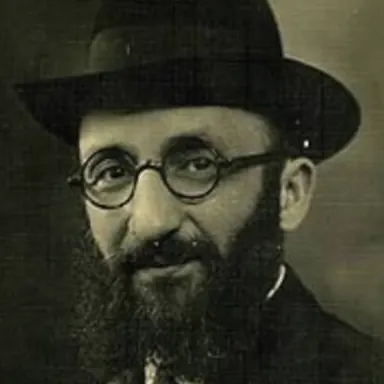
Rabbi Eliyahu Eliezer Dessler
17 min read3,369 words
Summary
The text surveys the life and teaching of Rabbi Eliyahu Eliezer Dessler, one of the outstanding thinkers of the Jewish world of mussar, emphasizing the unique synthesis he created between rigorous Lithuanian scholarship and Kabbalistic depth and Hasidic warmth. The survey details the main stations of his life, from his education in the Kelm school to his tenure as spiritual supervisor (mashgiach) of the Ponevezh yeshiva, and presents his monumental work "Michtav me-Eliyahu," which is an enduring treasure of modern Jewish thought. The core of the article analyzes basic psychological-existential concepts that he coined, foremost among them the "point of choice," which describes the dynamic moral struggle within the soul, as well as the revolutionary theory according to which giving gives birth to love and not the reverse. Finally, the source deals with his public outlook on matters of faith, trust in God and "Da'at Torah", and thereby sketches his figure as a spiritual compass seeking to give deep moral meaning to the challenges of the hour and of human existence.
The Educational Work and Torah-Mussar Teaching of the Righteous Gaon Rabbi Eliyahu Eliezer Dessler
Formative Environment and Personal Development: The Legacy of Salant and the Kelm School
The righteous gaon Rabbi Eliyahu Eliezer Dessler is regarded as one of the greatest masters of mussar and Jewish thinkers of the twentieth century.[1, 2] His figure represents an extraordinary combination of rigorous Lithuanian scholarship, deep ethical thought founded on the teaching of Kelm, and an intellectual openness that combines Kabbalah and Hasidism in a way that is uncommon in the Lithuanian yeshiva world.[3, 4] Rabbi Eliyahu Eliezer was born on 30 May 1892 (4 Sivan 5652) in the city of Gomel in the Russian Empire (today in Belarus), and died suddenly of a heart attack on 30 December 1953 (24 Tevet 5714) in Bnei Brak.[3] He was buried in the "Shomrei Shabbat" cemetery in the Zichron Meir neighborhood of Bnei Brak.[3]
His family tree is rooted deep in the origins of the Mussar movement.[1, 2] His mother, Chana Freidel, was the granddaughter of the founder of the Mussar movement, Rabbi Israel Salanter (the daughter of his son-in-law, Rabbi Eliyahu Eliezer Grodzensky, who was also the father-in-law of the renowned Lithuanian leader Rabbi Chaim Ozer Grodzinski).[1] His father, Rabbi Reuven Dov Dessler, was a devoted disciple of Rabbi Simcha Zissel Ziv, "the Alter of Kelm," and earned his living as a successful timber merchant in Gomel.[1]
To understand the foundations of Rabbi Dessler's soul, one must consider the figure of "the Alter of Kelm," Rabbi Simcha Zissel Ziv Broida, who was born in 1824 and was one of the first disciples of Rabbi Israel Salanter in Kovno.[5] The Alter of Kelm founded the "Talmud Torah" in Kelm out of an educational conception demanding absolute self-discipline, radical honesty and meticulous order.[5, 6] This method held that "composure of mind" is an essential condition for the service of God, and that a person must advance along the spiritual path gradually, step by step.[6] The influence of this method on Rabbi Dessler's father was so deep that the Alter of Kelm in his time accompanied the well-known tea magnate Kalman Ze'ev Wissotzky on his journey to Moscow in order to safeguard his spiritual level in the modern environment.[5]
Until the age of fourteen Rabbi Dessler was educated by private tutors, and he then went to study in the Kelm yeshiva under Rabbi Tzvi Hirsch Broida, the son-in-law of the Alter of Kelm.[1] This period left an indelible mark on him, and all his life he defined himself as a product of the Kelm yeshiva.[1] Later he married Sarah Leah Ziv, the daughter of Rabbi Nachum Ze'ev Ziv (the son of the Alter of Kelm).[3, 5] He was also ordained to the rabbinate by his relative, Rabbi Chaim Ozer Grodzinski.[1, 3]
His Educational Enterprises in the Diaspora and in the Land of Israel
Following the death of his stepmother in 1928, Rabbi Dessler traveled with his father to England to obtain medical treatment for his father, and decided to settle in the country.[1] At first he was obliged to remain in England alone, while his wife and daughter temporarily stayed behind in Lithuania.[1] In England he served in various rabbinic posts, among others in the East End and Dalston neighborhoods of London.[1] In Dalston he opened a local yeshiva, and he even personally taught the children of the wealthy Sassoon family, who had come from Bombay.[1]
At the beginning of the 1940s a significant turn came in his activity when he joined the kollel of young married scholars founded in Gateshead in northeast England and was appointed its spiritual leader.[1] Rabbi Dessler saw this kollel as fertile ground for deepening the study of Gemara and instilling moral awareness in young scholars.[1] He invested tremendous efforts in developing the kollel, both in charting its spiritual curriculum and in establishing the institution's finances.[1]
In 1947 Rabbi Dessler accepted the invitation of the founder of the Ponevezh yeshiva, the gaon Rabbi Yosef Shlomo Kahaneman ("the Ponevezher Rav"), to immigrate to the Land of Israel and serve as the yeshiva's spiritual supervisor (mashgiach).[1, 3] He settled in Bnei Brak, and the weekly mussar talks he delivered in the yeshiva became renowned in the Torah world and left an enormous influence on generations of students.[1, 3]
His only son, Rabbi Nachum Ze'ev Dessler, turned to educational work in the United States and founded the Hebrew Academy of Cleveland, while his son-in-law was Rabbi Eliyahu Yehoshua Geldzehler.[1, 3]
The Intellectual Foundations of "Michtav me-Eliyahu": A Broad Torah Synthesis
After Rabbi Dessler's death, his foremost disciples - headed by Rabbi Aryeh Carmell and Rabbi Chaim Friedlander - gathered his letters, notes and talks and edited them into the series of books "Michtav me-Eliyahu" ("A Letter from Eliyahu").[1, 3, 4] The five volumes of the series, published between 5715 and 5757, became an enduring treasure in both the Lithuanian yeshiva world and the religious-Zionist world, and were even translated in full into English and other languages.[4]
Rabbi Dessler's thought is characterized by a bold and wide-ranging synthesis.[4] Although he grew up in the Kelm school of mussar, he did not limit himself to the classical sources of the Mussar movement.[3, 4] His talks and writings are founded on a fusion of the Kelm method with the teachings of the Maharal of Prague, the Ramchal and Kabbalistic literature.[3, 4] Rabbi Dessler stressed that Kabbalah is not merely a theoretical system but "reveals to us how to look at our world from the vantage point of the upper world," and that man's task is "to bring this view down into our own world, and to strive to see ourselves from this point of view."[7]
Moreover, Rabbi Dessler incorporated distinctly Hasidic elements into his thought, especially from the Tanya (Chabad Hasidism) and from the writings of Breslov Hasidism.[1, 3, 4] He held the principled position that on the inner plane of the service of God there is no place for the historical separation between Hasidim and Lithuanians.[4] Fascinating testimony to this aspiration is found in a letter he wrote in the midst of the month of Av 5713 (1953) from Monsey to Rabbi Hertz, in which he expressed his deep hope that the Lithuanian yeshivot would study the teaching of Chabad Hasidism alongside the accepted scholarship and Lithuanian mussar, out of an understanding that Hasidic warmth of heart is essential to complete the spiritual world of the Torah scholar.[8]
The Psychological and Existential Structure of Free Choice: "Kuntres ha-Bechirah"
At the center of Rabbi Dessler's psychological-ethical teaching stands "Kuntres ha-Bechirah" (the Treatise on Choice), which presents a dynamic and existential model of free will.[4] His approach to the subject of choice recalls existentialist philosophical conceptions, which assume that man is thrown into a reality of life and into concrete conditions that he did not choose, yet is given full freedom to shape his personality and to choose how to relate to the framework of his life.[4]
Rabbi Dessler coined the innovative concept of the "point of choice."[4] According to this model, free choice does not exist at every moment and in every matter, but is concentrated in a narrow and dynamic zone of friction.[4] To explain this, Rabbi Dessler uses a brilliant military parable:
"When two nations wage war, the battle is at the place where the lines meet. Everything behind the army of the one nation is entirely under its control and has no opposition at all. And likewise whatever is behind the other is entirely in the domain of the other."[9]
The actual fighting takes place only on the front line.[9] Similarly, in a person's soul there are many areas that have already been completely conquered by the good inclination (for example, for an ordinary person there is no moral struggle over whether to steal money lying in front of him).[10] On the other hand, there are exceedingly lofty spiritual areas that are not at all within his present reach.[10] Free choice exists only at the exact point of friction where the forces of good and evil meet in the soul of that specific person at that moment.[11]
The point of choice is not static, but changes according to the person's decisions [4]:
- Choosing good (the retreat of evil): when a person overcomes his inclination and decides in favor of the truth, he conquers new territory.[4, 9] The matter in which he prevailed leaves the realm of struggle and becomes a natural habit, while his point of choice rises to a higher and more complex level.[4]
- Choosing evil (the retreat of good): when a person fails and yields to his inclination, he loses spiritual territory.[11] Evil becomes a habit for him, and the point of choice descends to lower levels at which he will have to fight anew.[4, 11]
Rabbi Dessler connects this dynamic with the well-known moral rule "whoever is greater than his fellow, his inclination is greater than he."[12] When a person advances in spiritual levels he merits temporary peace of mind, but immediately afterward a new and stronger evil inclination overcomes him, demanding of him "a completely new overcoming" at his new point of choice.[12] This model presents an entirely egalitarian conception of reward and punishment: each person is judged solely according to his personal starting point and the degree of effort he invested at his point of choice, and not according to his objective achievements.[11]
The Teaching of Giving and Love: "Kuntres ha-Chesed" and the Nullification of Selfishness
In his well-known work "Kuntres ha-Chesed" (the Treatise on Kindness), Rabbi Dessler analyzes the structure of human character traits and presents a revolutionary understanding of the concept of love.[4, 13, 14] He identifies two opposing root forces acting in the soul: the "power of giving" (altruism) and the "power of taking" (egoism).[4] Under the influence of the Kelm school, he sees egoism as the root of all evil and social ruin.[4, 15]
Rabbi Dessler illustrates the savagery of the power of taking with a vivid description of a pack of wolves in the snowy European winter.[15] When the wolves find a small carcass, they fall upon it with savage biting and fighting out of a drive to take for themselves, and as a result most of them are wounded and fall.[15] Humanity acting out of ego is likened to that pack, whereas the Torah offers an alternative path entirely contrary to selfish material nature.[15] On the physical, mathematical plane, when a person takes ten shekels out of his pocket and gives them to his fellow, he seems to lose.[15] But the Torah teaches an opposite spiritual reality, in which giving enriches the giver and builds his personality.[15] Kindness that is founded not on the nullification of the ego but on personal interests is defined as sin, in the sense of "the kindness of the nations is sin."[15]
Rabbi Dessler's greatest psychological innovation in Kuntres ha-Chesed is his determination that love is a product of giving, contrary to the popular conception that sees giving as a result of love.[4, 15] When a person gives to another, he invests something of himself in the recipient.[4, 7, 15] This investment causes the recipient to become an inseparable part of the giver, and since a person loves himself, he begins to love his fellow as he loves himself.[4, 15]
To prove the truth of this mechanism, Rabbi Dessler cites a historical case from the period of the war, in which a father and his son were forced to part from the mother and went through years of suffering and hardship together.[15] When the family was reunited after the war, it turned out that the emotional bond between the father and the child was incomparably stronger than the bond between the mother and the child.[15] The reason lay in the fact that it was the father who had actually invested in, protected and given to the child throughout the years of separation.[15] This giving produced a deep and boundless love, which serves as a model for building a stable marriage, domestic peace and sound social relations.[13, 15]
Faith, Trust and Effort: The Delicate Balance and the Laws of Nature and Medicine
The question of the relation between the trait of trust in God and a person's duty of practical effort occupied the sages of Israel a great deal.[16] In Rabbi Dessler's teaching this subject receives meticulous treatment, seeking to determine the exact "point of balance" for each and every person.[16]
At the basis of the understanding of the duty of effort stands the biblical prohibition "Lest you say in your heart: my power and the might of my hand have gotten me this wealth."[17] Rabbi Dessler stresses Onkelos's translation of the verse "It is He who gives you power to get wealth" - "It is He who gives you counsel to acquire property."[17] From this it follows that not only physical strength but even the "counsel" - a person's thought, initiative and business idea - originate in the blessed Creator, and the mental illusion of human independence was given solely to allow the existence of free choice.[17]
Rabbi Dessler outlines five levels of trust in God, according to which the measure of effort required of the individual is derived.[16] The point of balance changes according to the person's true spiritual level, and Rabbi Dessler warns against two main failings [16]:
- Excessive effort (a deficiency of faith): if a person multiplies material actions beyond what his inner level of trust requires, it is counted against him as a certain denial of faith, since he makes his fate depend on material screens and not on the divine decree.[16]
- Deficient effort (false trust): on the other hand, there is a grave danger of laziness disguising itself as a high level of trust.[16] A person who minimizes his effort out of laziness, without his faith being sufficiently grounded, will inevitably come to doubt and spiritual crisis ("he will regret his former deeds and deny") when he falls into economic or medical distress.[16]
A concrete implication of this principle is discussed with regard to the relation between illness and the world of medicine.[16] On the one hand, the Sages determined in Tractate Berakhot that "it is not the arvad (venomous reptile) that kills but sin," and hence the sick person's principal effort should be inward - repentance and the correction of the sin that lies at the root of the illness.[16] On the other hand, the Torah granted the physician permission to heal, from the verse "and he shall surely cause him to be healed."[16]
Rabbi Dessler explains this contradiction by means of the hiding away of the "Book of Remedies" by King Hezekiah, a deed for which the sages praised him.[16] Hezekiah hid the book because the quick remedies prevented the sick from spiritual reflection and from understanding that the source of their illness is an inner sin.[16] Nevertheless, for most people, who have a middling level of trust, going to a physician and taking medicines are an absolute duty of effort.[16] The medicine is nothing but a natural "garment" for the supernal decree, which is fixed in advance with absolute precision as to the day, the hour, the specific physician and the preparation through which the salvation will come.[16]
Historiosophical and Public Thought: Da'at Torah, Torah im Derekh Eretz and the Holocaust
Alongside his ethical and psychological system, Rabbi Dessler played a central role in shaping the Haredi outlook after the Second World War at several historic intellectual and public junctures [4]:
Establishing the Concept of "Da'at Torah"
Rabbi Dessler was one of the principal formulators of the concept of "Da'at Torah" in its modern Haredi form.[4] According to his view, the great Torah sages are granted special heavenly assistance that enables them to see the pure truth even in public, political and personal matters that do not directly concern dry halakhic rulings.[4] He demanded of the public absolute self-nullification before the decisions of the great sages of Israel, and argued that where there is a clash between a person's understanding and the words of the sages, the person must assume that his mind is biased and skewed, and nullify his own sensory perception before the pure opinion of the great sages of the generation.[4]
Rejecting the Method of "Torah im Derekh Eretz"
In direct continuation of his strict education in the Kelm yeshiva, Rabbi Dessler entirely rejected attempts to create an a priori harmonious synthesis between Torah study and general education and Western culture.[4] He saw work and concern for a livelihood as an arbitrary punishment imposed on humanity following the sin of Adam, and not as a positive religious or human value to be cultivated.[4] In his view, the ideal aspiration of the Torah scholar should be total devotion to the world of Torah, with maximal reduction of contact with the material world and general culture.[4]
The Meaning of the Holocaust in Jewish Historiosophy
In the face of the destruction of European Jewry, Rabbi Dessler presented a trenchant theological position that rejects any explanation attributing the catastrophe to historical chance.[4] In his view, the Holocaust is not an arbitrary punishment, but constitutes a system of divine "voices" that shake the world.[4] The role of these terrible sufferings is to awaken the survivors and the entire Jewish people from their moral slumber, to call them to deep self-examination, to repentance and to inner spiritual strengthening in the face of the tide of secularization and modernization.[4]
The Intellectual Foundations of Rabbi Dessler's Teaching
Rabbi Dessler's long-term public influence stems to a great extent from his ability to weave opposing spiritual currents into a harmonious and unified system.[3, 4] His views reflect a fusion of historical movements of thought in the world of Judaism, as detailed below:
Rabbi Dessler's teaching, as formulated in the five volumes of "Michtav me-Eliyahu," continues to be an enormous source of inspiration and a moral and psychological compass for Torah students and seekers of the spiritual path in our generation.[1, 3, 4] His work succeeded in bringing Lithuanian mussar out of its rigidity and giving it inner vitality, Kabbalistic depth and Hasidic warmth, while building a modern and existential psychological language that speaks to the soul of the person seeking truth.[3, 4]
Sources17
- 1.הרב אליהו אליעזר דסלר זצ"ל - ברסלב סיטי, breslevcity.co.il/הילולת-הצדיקים-כה-טבת-הרב-אליהו-אליעזר/
- 2.רבי אליהו אליעזר דסלר - אישי ישראל - WordPress.com, isheiisrael.wordpress.com/2017/11/09/רבי-אליהו-אליעזר-דסלר/
- 3.אליהו אליעזר דסלר - ויקיפדיה, he.wikipedia.org/wiki/אליהו_אליעזר_דסלר
- 4.מכתב מאליהו - ויקיפדיה, he.wikipedia.org/wiki/מכתב_מאליהו
- 5.Rabbi Simcha Zissel Ziv - Tzadikim, dailyzohar.com/tzadikim/604-Rabbi-Simcha-Zissel-Ziv
- 6.תלמוד תורה (קלם) - ויקיפדיה, he.wikipedia.org/wiki/תלמוד_תורה_(קלם)
- 7.אליהו דסלר - ויקיציטוט, he.wikiquote.org/wiki/אליהו_דסלר
- 8.הגאון הצדיק רבי אליהו אליעזר דסלר זצ"ל ועיסוקו בתורת החסידות - מעיינותיך, toratchabad.com/הגאון-הצדיק-רבי-אליהו-אליעזר-דסלר-זצל-ועיסוקו-בתורת-החסידות-2
- 9.Learning To Think - The Herd Way | חיבורים בספריא, sefaria.org.il/sheets/134606
- 10."ובחרת בחיים": על בחירה בעולם הכוללים - צריך עיון, iyun.org.il/sedersheni/חיים-בחירה-ואברכי-הכולל/
- 11.נקודת הבחירה - כיפה, kipa.co.il/יהדות/חגים/אלול/נקודת-הבחירה/
- 12.פרשת נח - תיבות התורה והתפילה מצילות מן היצרים - הרב יורם אברג'ל, hameir-laarets.org.il/parashamesilot/פרשת-נח-תיבות-התורה-והתפילה-מצילות-מן/
- 13.סדרה | מכתב מאליהו - חלק ב' - קונטרס החסד - הרב דודי ברוורמן, dudi-braverman.com/סרטונים/סדרה-מכתב-מאליהו-חלק-ב-קונטרס-החסד/
- 14.Relationshipful Meaning V - shiurim #20-25Qunterus haChessed | חיבורים בספריא, sefaria.org.il/sheets/424075
- 15.נתינה יוצרת אהבה (4) - בסוד הדברים, besodh.com/נתינה-יוצרת-אהבה-4/
- 16.בטחון והשתדלות - עולמות, olamot.net/shiurim/בטחון-והשתדלות/
- 17.מכתב מאליהו | אמונה וביטחון: טעות "כוחי ועוצם ידי" - יהודי, jew.org.il/5381-מכתב-מאליהו-אמונה-וביטחון-טעות-כוחי-ו/