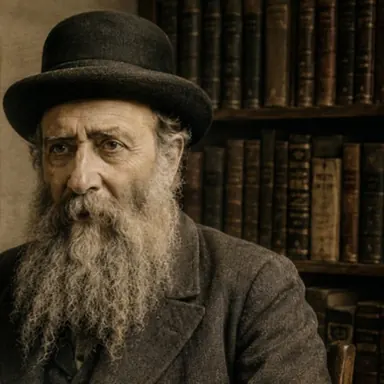
The Work, Torah Teaching and Public Legacy of Rabbi Yehuda Leib Don Yahia
11 min read2,218 words
Summary
This survey sketches a portrait of Rabbi Yehuda Leib Don Yahia as a bridging figure who blended analytical Lithuanian scholarship, Hasidic vitality of the Chabad school and practical religious Zionism. The text details his roots in an ancient Sephardi lineage, his Torah training at the Volozhin Yeshiva under the leadership of R. Chaim of Brisk, and his decisive role in establishing the Mizrachi movement as an expression of active religious duty. A central axis of the text is his thought, which sees faith as a creative force that requires a person to act for the building of the Land, alongside a historical record of great value on the life of the yeshivas and his ties with the poet Hayim Nahman Bialik. Ultimately, the source seeks to present his legacy as a model of fidelity to tradition alongside openness to national revival, while detailing the stations of his life from Soviet Russia to his immigration and activity in Tel Aviv.
Rabbi Yehuda Leib Don Yahia, known in certain bibliographic and official sources also by the pen names or recorded aliases Brody Henrik and Haim Brody, was one of the most fascinating and unique Torah figures active in Eastern Europe and the Land of Israel at the end of the 19th century and in the first half of the 20th century [cite: 1, 2]. His personality was marked by an extraordinary blend of three spiritual worlds that at the time were often perceived as opposed and even hostile to one another: the analytical Lithuanian scholarship of the Brisk school, the Hasidic depth and vitality of the Chabad-Kapust school, and practical and ideological commitment to modern Zionism within the framework of the Mizrachi movement [cite: 1, 2].
Family Roots and Historical Lineage
The Don Yahia family holds a long-standing tradition of lineage documented over about a thousand years, connecting it to Spanish Jewry and to the family of Rabbi Isaac Abravanel [cite: 3]. The first documented ancestor of the family served as a physician at the Spanish royal court and received the royal title of honor "Don" [cite: 3]. Following the expulsion from Spain, branches of the family wandered to North Africa and later to Eastern Europe, where they settled mainly in the regions of Latvia and Lithuania and established an extensive rabbinic dynasty that inclined for the most part to Chabad Hasidism [cite: 3].
Rabbi Yehuda Leib was born on 14 Elul 5629 (21 August 1869) in the town of Dreitzin in the Russian Empire (today in Belarus), to his father, who was the rabbi of the local community and one of the Chabad-Kapust Hasidim [cite: 1, 2]. In his childhood and youth he acquired the foundations of his Torah learning from his uncle, Rabbi Eliezer Don Yahia, who at that time served as rabbi of the city of Lutzin [cite: 2].
The path of Rabbi Don Yahia's personal and family life bound him by close ties of kinship to the Torah elite of the period, as detailed in the following table:
The Period of Study at the Volozhin Yeshiva and the Brisk Method
In his youth, when he was about fifteen or sixteen years old according to his own testimony, Rabbi Yehuda Leib went into exile to a place of Torah and joined the illustrious Volozhin Yeshiva, although official sources indicate the year 5649 (1889) as the time of his official entry, when he was about twenty [cite: 2]. At Volozhin he studied alongside key figures who were destined to lead the Jewish public, among them Rabbi Nathan Milikowsky (a Zionist activist and the grandfather of Benjamin Netanyahu) and Rabbi Shmuel Yitzchak Hillman (later rabbi of Glasgow and father-in-law of Rabbi Yitzhak HaLevi Herzog) [cite: 5].
At Volozhin Rabbi Don Yahia became bound by strong ties of admiration and influence to his principal teacher, Rabbi Chaim Soloveitchik (R. Chaim of Brisk) [cite: 2]. R. Chaim's innovative method of learning, based on abstract definitional analysis and precise conceptual classification of the Talmudic topics, became the methodological foundation of Rabbi Don Yahia's Torah writing throughout his life [cite: 2]. When the yeshiva was closed in 5652 (1892) because of the decrees of the Tsarist government, their paths did not part, and Rabbi Don Yahia went together with his teacher to the city of Brisk, where he continued to deepen his grasp of this unique method of study [cite: 2].
Alongside his diligence in Torah, Rabbi Don Yahia showed a deep interest in the ideas of national revival [cite: 2]. He joined the secret Zionist society "Netzach Yisrael," which operated within the Volozhin Yeshiva [cite: 2]. This activity brought him into close contact with the future national poet Hayim Nahman Bialik, and laid the foundations of his practical religious-Zionist worldview [cite: 2].
Rabbinic Posts in Europe and Immigration to the Land of Israel
After his marriage in 1899 to Musha Sheina, a daughter of the illustrious rabbinic family of Vilna, Rabbi Don Yahia began to serve in various rabbinic posts that placed him at the forefront of communal leadership in Eastern Europe [cite: 1, 2]. During these tenures he had to cope with complex political and social difficulties, and especially with the rise of the Soviet regime, which restricted the steps of religion [cite: 2].
The stations of Rabbi Don Yahia's tenure show a wide geographical spread, embracing Hasidic and Lithuanian communities alike:
Rabbi Don Yahia's immigration to the Land of Israel in 5696 (1936) was brought about with the personal and warm assistance of the Chief Rabbi of the Land of Israel, Rav Kook [cite: 1, 2]. Rav Kook, who saw in Rabbi Don Yahia an exemplary figure combining scholarship and thought with love of the Land, worked to obtain an immigration visa for him and his family, and thereby rescued him from the clutches of the Soviet regime and from the destruction that was to befall the Jews of Europe [cite: 1, 2]. He died in Tel Aviv on 6 Cheshvan (or on 9 Cheshvan according to alternative records) 5702, corresponding to 27 November 1941, and was buried in the Hasidim section on the Mount of Olives in Jerusalem [cite: 1, 2].
His Torah Teaching: A Theology of Creative Faith and Practical Zionism
The Torah teaching and thought of Rabbi Yehuda Leib Don Yahia go beyond the narrow bounds of political controversy, and present a profound theology based on the foundations of Chabad Hasidism and of the esoteric teaching [cite: 2, 3].
The heart of his conception of faith rests on the idea that faith is not a passive state of mind or merely an adherence to non-rational dogmas, but a creative force, an active labor that seeks to uncover and develop holiness within material reality [cite: 6]. This understanding is reinforced through the words of the Zohar, which liken the shade of the sukkah to "tzila di-mehemnuta" (the shade of faith) [cite: 6]. Just as building the sukkah requires physical manual labor in order to produce the space in which the Divine Presence rests, so too faith obliges a person to act proactively in the world in order to shape and establish the holy [cite: 6].
This conception served as a solid ideological foundation for his Zionist outlook [cite: 2]. In Rabbi Don Yahia's eyes, the return to Zion and the building of the Land are not a stage of passive waiting for a divine miracle, but an active duty of creation and construction [cite: 2]. The building of the Land, the founding of the colonies and the organization of the national institutions are the very ways in which the people of Israel establish their national holiness and bring it from potential into actuality. He thereby made Zionism an integral and organic part of the life of Orthodox religion and faith [cite: 2].
His Public Work and the Founding of the Mizrachi Movement
Rabbi Don Yahia translated his theological teaching into vigorous political and public activity [cite: 2]. In 5662 (1902) he took part in the founding assembly of the Mizrachi movement, held in Vilna [cite: 2]. His presence at this assembly carried great public weight, since he came to it accompanied by his father-in-law, the Vilna halakhic decisor of the generation Rabbi Shlomo HaKohen, and his brother-in-law Rabbi Nachum Grinhaus [cite: 2]. The conservative halakhic framework that these figures gave to the new movement helped to repel the sharp criticism that religious Zionism suffered from anti-Zionist Haredi circles.
A clear expression of his public standing was his signature on the declaration "Kol Kore" (public call) that accompanied the founding of the movement [cite: 2]. He was one of 67 great Torah scholars from all over Europe who signed this founding document, alongside the movement's prominent leaders and thinkers such as Rabbi Yitzchak Yaakov Reines and the historian Ze'ev Yavetz [cite: 2]. This signature expressed his declared recognition that Zionism is the halakhic and historical command of the hour for the nation [cite: 2].
His Works and Writings
Rabbi Don Yahia left behind an extensive literary legacy, combining his incisive scholarly approach with his public-religious thought [cite: 1, 2].
Bikkurei Yehuda
This is the rabbi's principal Torah work, printed in two parts and highly regarded in the Torah world [cite: 1, 2]. The first part first appeared in the city of Lutzin in 5690 (1930) and was printed a second time in 5693 (1933) [cite: 1, 2]. The second part was printed in Tel Aviv in 5699 (1939), edited by S. Daniel [cite: 1, 2]. Attached to the second part was a broad biographical introduction under the title "On the Figure of the Rabbi, the Author," written by his son-in-law Rabbi Yitzchak Neiman together with Avraham Yonish [cite: 2]. The book contains profound novellae on Talmudic topics that demonstrate the application of the Brisk method of study, alongside practical halakhic responsa and homilies of thought combining kabbalistic and Hasidic ideas [cite: 1, 2].
Zionism from the Standpoint of the Religious Outlook
This unique explanatory booklet was printed in Vilna in 5662 (1902), in the midst of the stormy public controversy around the beginnings of the Zionist movement [cite: 1, 2]. In this work Rabbi Don Yahia presents a systematic theological and halakhic analysis proving that Zionism does not contradict the foundations of faith or the expectation of redemption, but is a practical and divine instrument for rescuing the people, which is in spiritual and physical distress in exile [cite: 2].
His Memoirs of Volozhin and His Testimony on Bialik's Poetry
Rabbi Don Yahia's historiographical testimony is considered an irreplaceable source for understanding the world of the Volozhin Yeshiva at the end of the 19th century [cite: 1, 2]. His comprehensive autobiographical article "In the Volozhin Yeshiva" was first published in 1936 in the weekly "Netiva," the organ of religious Zionism, and was later reprinted in 2004 in the research volume "Yeshivot Lita – Pirkei Zikhronot" (The Yeshivas of Lithuania: Chapters of Memoirs), edited by Prof. Immanuel Etkes and Dr. Shlomo Tikochinski [cite: 1, 2]. In this article the rabbi describes in detail the routine of study, the prominent figures and the ideological tensions that prevailed within the walls of the yeshiva [cite: 2].
Special importance attaches to Rabbi Don Yahia's testimony as regards the study of the work of his fellow student at the yeshiva, Hayim Nahman Bialik [cite: 2]. Rabbi Don Yahia supplied the precise biographical identification of the figure who stood at the basis of Bialik's monumental masterpiece poem "Ha-Matmid" (The Diligent Student) [cite: 7]. According to his testimony, the real figure who inspired the shaping of the poem's hero was a student at the Volozhin Yeshiva whom his fellows called "the Matmid of Lodz" [cite: 7]. This student studied with extreme diligence about twenty hours a day, refused to sleep in a bed and made do with two or three hours of snatched sleep on the benches of the beit midrash, and almost entirely avoided conversation with his fellow students [cite: 7]. This testimony reveals the depth of the bond and mutual understanding that existed among the young men who grew up in the fascinating world of Volozhin, crossing the boundaries between the world of Torah and the world of modern Hebrew literature.
Summary and Conclusions
Rabbi Yehuda Leib Don Yahia left behind a spiritual legacy that teaches of the possibilities inherent in blending spiritual and intellectual poles [cite: 1, 2]. His halakhic writing, his public work for the founding of the Mizrachi movement, and his thought emphasizing faith as an active act of creation place him in the front rank of the thinkers and leaders of religious Zionism in its early days [cite: 2, 6]. His figure reflects a deep fidelity to the tradition of the generations alongside openness to, and a deep understanding of, the processes of the national and cultural revival of the people of Israel in its Land [cite: 2].
Sources7
- 1.Yehuda Leib Don Yihye - Wikipedia, en.wikipedia.org/wiki/Yehuda_Leib_Don_Yihye
- 2.יהודה ליב דון יחיא - ויקיפדיה, he.wikipedia.org/wiki/יהודה_ליב_דון_יחיא
- 3.משפחת דון יחיא - ויקיפדיה, he.wikipedia.org/wiki/משפחת_דון_יחיא
- 4.Rabbi Shlomo HaKohen (Vilna) - שלמה הכהן - Tzadikim, dailyzohar.com/tzadikim/1169-Rabbi-Shlomo-HaKohen-Vilna
- 5.ישיבת וולוז'ין - ויקיפדיה, he.wikipedia.org/wiki/ישיבת_וולוז'ין
- 6.Exploring Sukkot: Ritual and Meaning | PDF | High Holy Days | Kabbalah - Scribd, scribd.com/document/479379256/Constructing
- 7.המתמיד - ויקיפדיה, he.wikipedia.org/wiki/המתמיד