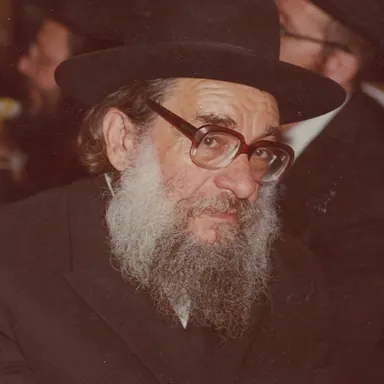
The Torah Teaching, Public Work and Thought of Rabbi Gedalia Nadel
15 min read2,981 words
Summary
This survey sketches the extraordinary portrait of Rabbi Gedalia Nadel, who was one of the prominent disciples of the "Chazon Ish" and combined meticulous halakhic conservatism with radical freedom of thought. The text details the course of his life, from his arrival at the Lithuanian-style yeshivot to his becoming a spiritual leader in Bnei Brak who earned his living by producing wine in order to preserve his economic and intellectual independence. A central axis of the text is devoted to his unique teaching, which strove to uncover the "idea of the mitzvah" and sought to reconcile the Torah with the findings of modern science, while boldly accepting the theory of evolution and the great age of the universe. Through a comparative analysis and a survey of his writings published after his death, the source emphasizes how Nadel posed an intellectual alternative uniting uncompromising public zealotry with deep rationalism and inner integrity.
Biography and Spiritual Growth
Rabbi Gedaliahu (Gedalia) Nadel (5683, 1923 – 16 Sivan 5764, 2004) was one of the most original, complex and influential figures in Haredi society in the second half of the twentieth century [cite: 1, 2]. He stood out as one of the central leaders and thinkers of the "Chazon Ish circle" [cite: 1, 2, 3], but alongside his conservative and zealous standing in the public sphere, he developed a pioneering and exceptional body of thought that sought to combine scholarly plain-sense interpretation, deep rationalist philosophy and recognition of the findings of modern science [cite: 2, 3, 4].
Rabbi Gedalia was born in the city of Šiauliai (Shavli) in Lithuania to Reuven Heshel and Henia Nadel [cite: 1, 2]. In 5697 (1937), at the age of 14, he immigrated with his family to the Land of Israel, and the family settled in Moshav Balfouria in the Jezreel Valley, where his father received an agricultural plot [cite: 2]. The first turning point in the course of his life occurred when the well-known yeshiva head and educator Rabbi Reuven Trop visited the settlement and noticed the boy's special talent [cite: 2]. Rabbi Trop suggested to his father that he send him to study at the "HaYishuv HeChadash" yeshiva in Tel Aviv [cite: 2].
At the HaYishuv HeChadash yeshiva Rabbi Gedalia formed a deep bond with Rabbi Yehoshua Yagel, one of the yeshiva's prominent educators [cite: 2]. Under Rabbi Yagel's influence, Rabbi Gedalia drew close to the Chazon Ish and began traveling to him in Bnei Brak every Friday to converse with him in learning [cite: 2]. These weekly meetings laid the foundation for Rabbi Gedalia's becoming one of the closest and most faithful disciples of the Chazon Ish [cite: 1, 2, 3]. Alongside the Chazon Ish, Rabbi Gedalia also studied with Rabbi Yoel Klopft, who was one of his principal teachers in this period [cite: 1].
When the Chazon Ish learned of the depth of the talents of the boy studying at a yeshiva high school, he came in person to the HaYishuv HeChadash yeshiva and instructed Rabbi Gedalia to leave the institution immediately and transfer to study at the Lomza Yeshiva in Petach Tikva, which was a distinctly Lithuanian and stricter Torah center [cite: 2]. Later, when it was proposed that Rabbi Gedalia marry Sarah Rachel, the daughter of Rabbi Eliyahu Yehoshua Weiner (a disciple of the "Chofetz Chaim"), his intended father-in-law hesitated to match his daughter with a young man who had studied at a yeshiva high school [cite: 2]. It was the Chazon Ish who intervened personally and encouraged the match, out of recognition of the bridegroom's future greatness in Torah [cite: 2].
After his marriage, Rabbi Gedalia lived in Jerusalem near his father-in-law [cite: 2]. In this Jerusalem period he broadened his Torah horizons and drew close to two of the great Torah figures of the time: Rabbi Shimshon Aharon Polonsky (the Tepliker Rav) and Rabbi Yitzchak Zev Soloveitchik (the Brisker Rav) [cite: 2]. These connections deepened his grasp of the varied scholarly traditions of the old world of Torah.
On his return to Bnei Brak, Rabbi Gedalia was appointed by the Chazon Ish to serve as the official halakhic decisor of "Shikun Chazon Ish," the neighborhood in which he lived [cite: 2]. After the passing of the Chazon Ish in 5714 (1953), Rabbi Gedalia became one of the most prominent and authoritative figures among the rabbis of this circle [cite: 2]. Later in his career he was appointed ram (rosh metivta) at the Vizhnitz Yeshiva in Bnei Brak [cite: 1, 2]. However, because of his independent character and his freedom of thought, he did not hesitate to disagree with the Vizhnitzer Rebbe on matters of Hasidism and zealotry, which ultimately led to his leaving the yeshiva [cite: 2]. He was then appointed one of the heads of the Chazon Ish Kollel – a prestigious position that he held until his last years [cite: 2, 4]. Despite his official standing in the kollel, Rabbi Gedalia preferred to give his analytical lectures in his private home, in a small and informal setting [cite: 2]. After his death, Rabbi Gedalia was buried in the "Netzivei Yeshivat Ponevezh" cemetery in Bnei Brak [cite: 1].
His Scholarly Teaching and Method of Study
Rabbi Gedalia Nadel's method of study was characterized by radical originality and by a unique combination of different Lithuanian traditions [cite: 1, 2, 3]. On the one hand, he adhered to the method of study he had received from his teacher, the Chazon Ish, which placed at its center the pursuit of the plain sense and the understanding of matters as they are, without artificial pilpul or overly abstract categorical distinctions [cite: 2, 3]. On the other hand, Rabbi Gedalia had an exceptionally high regard for the book of Rabbi Chaim Soloveitchik of Brisk, "Chiddushei Rabbeinu Chaim HaLevi," and defined it as one of the deepest works in the world of Torah [cite: 2].
Rabbi Gedalia's central methodological innovation, as clearly expressed in his lectures, lies in his constant attempt to uncover the "idea of the mitzvah" [cite: 5]. This approach assumes that halakha is not a formalistic, technical and meaningless system of laws, but an organic system that draws its vitality from deep moral, existential and theological ideas [cite: 5]. Rabbi Gedalia consistently strove to connect the Oral Torah back to the Written Torah, out of the conception that understanding the plain meaning of Scripture is the key to understanding the inner logic of the homilies of the Sages and of halakhic ruling [cite: 5].
His basic assumption was that all the reasonings of the Gemara, even the most intricate and profound, are ultimately directed toward "common sense" and sound human logic [cite: 3]. This conception stands in sharp contrast to formalistic tendencies that were widespread in the Lithuanian yeshiva world, which tended to separate the world of halakhic logic from simple human reason. This method of study was later researched and clarified in the works of his students and of scholars of his teaching, such as "Yesodot ve-Ekronot Parshanut ha-Talmud" (Foundations and Principles of Talmudic Interpretation) by Rabbi Eliyahu HaKohen Margaliot, as well as in the literary records of Rabbi Menachem Nabet [cite: 3].
Rabbi Gedalia's halakhic and analytical teaching was not confined to the classic Talmudic topics of the orders of Nashim and Nezikin alone. A study of his writings and of the subjects with which he dealt reveals a wide range of fields, from explanations of Rashi's commentary on the Torah, through in-depth study of collections of mishnayot, to complex and practical engagement with the laws of interest and with monetary law [cite: 6]. In each of these fields, Rabbi Gedalia sought to extract the conceptual foundation underlying the halakhic law, and to prevent a situation in which halakha is studied or applied mechanically and cut off from its original intent [cite: 5].
Thought, Science and His Attitude to Evolution
An especially significant aspect of Rabbi Gedalia Nadel's teaching, which aroused and continues to arouse many echoes, is his open and positive attitude to modern science, and in particular to the theory of evolution and to the scientific determinations regarding the age of the universe [cite: 4]. While the prevailing and official position in the Haredi public utterly rejects these theories and sees them as a threat to the belief in Creation, Rabbi Gedalia presented an approach that harmonizes Torah and science [cite: 4].
Rabbi Gedalia accepted the theory of evolution as a valid scientific description of the development of creation [cite: 4]. In his view, evolution contains no denial of the Creator's power, but on the contrary: it describes the way in which God's will operates in the world – by means of the forces of nature and its inherent laws [cite: 4]. In the book "Be-Torato shel R. Gedalia" (In the Teaching of R. Gedalia) these things are explained in explicit language, which points out that on the third day of Creation, with the creation of the plants, there is no reason whatsoever to assume that they were all created at once [cite: 7]. Instead, there took place a long development of species through genetic changes and mutations that created new species, in a process that took a very long time [cite: 7]. This approach sees Creation as a dynamic and gradual process, in which God guides creation from stage to stage, and not as a static, one-time act [cite: 4].
In order to reconcile the plain meaning of the verses in the Book of Genesis with the great age of the world as it emerges from geological and cosmological research, Rabbi Gedalia proposed two fundamental understandings [cite: 4]. First, he explained that the word "day" describing the six days of Creation can be interpreted as a long period, as we find in the words of the Sages that "the day of the Holy One, blessed be He, is a thousand years" [cite: 4]. Second, he emphasized that the tradition in our hands according to which the count of years since the creation of the world stands at 5756 years (according to the year in which the words were spoken) is a true and clear tradition [cite: 4]. But this count does not reckon the physical age of matter in the universe, but rather the time elapsed since the appearance of rational man possessing a divine soul – Adam, the first man – capable of conducting a moral and religious dialogue with the Creator.
One of Rabbi Gedalia's strongest arguments against the anti-scientific tendencies on the Haredi street was based on the halakhic principle of consistency [cite: 4]. He pointed out that in the gravest matters of saving life, halakha relies without hesitation on the determinations, instruments and medicines of physicians and scientists that are based on exactly the same research methodologies [cite: 4]. Therefore, the attempt to claim that scientists "lie" or "invent" data when it comes to the age of the world or to evolution, while relying on them completely in saving lives, is an intellectual and halakhic inconsistency that has no place [cite: 4].
Public Leadership, Zealotry and an Ascetic Way of Life
One of the striking phenomena in Rabbi Gedalia Nadel's personality is the combination of uncompromising freedom of thought and intellectual openness with zealous and radical public views [cite: 2]. This combination presents a unique model of zealotry that stems from free rational inquiry and not from blind obedience or fear of modernity. In the sphere of public activity, Rabbi Gedalia's views bore a distinctly zealous and radical character, and he stood at the head of a number of social and religious frameworks in the Haredi public [cite: 2]. He was one of the prominent leaders of the "Atra Kadisha" organization, which fights against the desecration of graves, and was actively engaged in matters of the preservation of modesty in the city of Bnei Brak [cite: 2]. For reasons of zealotry and principled opposition to the institutions of the secular state, Rabbi Gedalia consistently refrained from taking part in elections to the Knesset [cite: 2]. This zealotry also found expression in his signing the historic letter of the Chazon Ish against the National Service Law for girls, and in his active participation in demonstrations against conscription into the IDF at the end of his life, despite his great physical weakness [cite: 2]. Nevertheless, an exceptional case is recorded during the Six-Day War, in which he asked to enlist in the army out of a sense of responsibility for the physical survival of the Jewish community in the Land [cite: 2].
Rabbi Gedalia's public zealotry stemmed, to a great extent, from that same absolute commitment to inner truth that is not influenced by social pressures or political compromises. Just as he did not hesitate to present unusual theological and scientific positions that roused the conservative establishment against him, so he did not hesitate to adopt extreme zealous positions, some of which did not accord with the mainstream line of the establishment Haredi parties.
Rabbi Gedalia put his Torah conceptions into practice in his personal way of life, observing extreme asceticism, economic independence and complete distance from hedonism and luxuries [cite: 1, 2, 3]. One of the most significant decisions of his life was his absolute insistence on not earning his living from Torah study or from rabbinic positions, in accordance with the well-known ruling of Maimonides (Rambam) in the Laws of Torah Study [cite: 1, 3]. Rabbi Gedalia saw the taking of payment for studying or teaching Torah as an injury to the purity of the Torah. In order to support himself and his family with dignity and without needing the public purse, he engaged for his livelihood in a variety of physical trades, foremost among them home winemaking [cite: 1, 3]. The small home winery he operated in Bnei Brak became a symbol of intellectual and economic independence alike.
His private life was characterized by deliberate poverty and extreme asceticism [cite: 2]. Throughout his life he lived in a small, cramped and very poor apartment in Bnei Brak, and consistently preached to his students to keep away from the pursuit of material luxuries [cite: 2]. Because of his doubts about the level of kashrut of the modern, industrialized food industry, he completely refrained from consuming industrial products [cite: 2]. He ate only basic products prepared privately in his home, including meat from a special private slaughter that he supervised [cite: 2]. His students relate that he never ate ice cream [cite: 2]. This abstention did not stem from a formal halakhic prohibition, but because in his eyes this food embodied the essence of eating for pleasure alone, without any existential or health need – something that ran counter to his aspiration for a life of spiritual refinement and self-control [cite: 2].
The Project of His Writings and Their Publication
Rabbi Gedalia Nadel published nothing of his writings or his teaching during his lifetime [cite: 2]. His freedom of thought and his lack of desire to institutionalize his teaching kept him from engaging in editing his books. His written Torah legacy was passed on to the following generations solely thanks to the efforts of his close disciples, who understood the importance of these matters [cite: 1, 2, 5].
Rabbi Gedalia's books, published after his death, present the two faces of his personality: the scholarly-analytical face and the philosophical-intellectual face. These two faces were edited and printed by different groups of students, who were drawn to different aspects of his multifaceted personality [cite: 1, 2].
While Rabbi Lipa Dov Weintraub concentrated on preserving the classic scholarly writings from Rabbi Gedalia's original manuscript [cite: 1, 2], Rabbi Yitzchak Shilat turned to the recorded medium in order to rescue his philosophical and theological teaching [cite: 5]. The book "Be-Torato shel R. Gedalia" became over the years the central work through which the wider public, including researchers and academics, was exposed to Rabbi Gedalia's revolutionary conceptions on matters of religion and science, the evolution of species, and the idea of the mitzvah [cite: 4, 5].
Comparative Analysis: The Teaching of Rabbi Gedalia Nadel versus the Establishment Lithuanian Stream
A detailed comparison between the principled positions of Rabbi Gedalia Nadel and the conceptions accepted in the mainstream of the Haredi-Lithuanian public of his time sharpens his sociological and intellectual exceptionality:
Summary
The figure of Rabbi Gedalia Nadel represents a unique synthesis, almost impossible in ordinary sociological terms, between halakhic conservatism and uncompromising political zealotry on the one hand and absolute freedom of thought and rare intellectual courage on the other [cite: 2]. He refused to submit to communal dictates, whether these were social conventions of modern Lithuanian society or accepted theological assumptions that interpret Scripture in a way that does not accord with common sense and science [cite: 3, 4].
His thought, which continues to be revealed and studied through the books published by his students, offers a religious model that combines total commitment to halakha and tradition together with deep rationalism, recognition of the findings of scientific research, and a ceaseless striving to uncover the moral and conceptual meaning behind the commandments of the Torah [cite: 4, 5]. His legacy remains a source of inspiration for seekers of a path who look for a harmonious combination of loyalty to the old world of Torah and modern intellectual integrity.
Sources7
- 1.גדליה נדל - ויקיפדיה, he.wikipedia.org/wiki/גדליה_נדל
- 2.הרב גדליה נדל – ויקישיבה, yeshiva.org.il/wiki/index.php/הרב_גדליה_נדל
- 3.מיוחד: סודות תורתו של רבי גדליה נדל זצ"ל - כיכר השבת, kikar.co.il/haredim-news/402140
- 4.הרב גדליה נדל - יהדות ואבולוציה - אבולוציה ויהדות, evolution.herzog.ac.il/rav-gedalya-nadal-method/
- 5.בתורתו של ר' גדליה | YBM - מאגר השיעורים - ישיבת מעלה אדומים, tora.ybm.org.il/product-page/בתורתו-של-ר-גדליה
- 6.Betorto Shel Ri Gedalich / בתורתו של ר' גדליה | הרב שילת - My Sefer, mysefer.com/products/betorto-shel-ri-gedalich-בתורתו-של-רי-גדליח
- 7.היחס לאבולוציה ע"פ התורה - רציו - אמונה, מחקר, ומדע, rationalbelief.org.il/היחס-לאבולוציה-עפ-התורה/