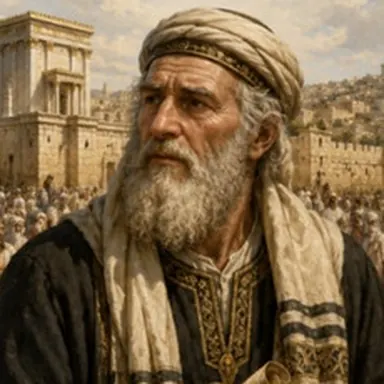
The Political Activity and Torah Teaching of Rabban Shimon ben Gamliel I in Light of the Destruction: A Comprehensive Historical and Halakhic Study
14 min read2,707 words
Summary
This study examines the figure of Rabban Shimon ben Gamliel I as a decisive link between the world of the Temple and the new spiritual center that took shape at Yavneh on the eve of the Destruction. The text surveys his moderate political leadership during the Great Revolt and his ability to combine social and economic activism, as expressed in the enactment on bird-offerings to lower the cost of sacrifices, with a realistic halakhic outlook adapted to the geopolitical reality. Alongside a survey of the dynasty of the House of Hillel and the network of family ties that fortified its standing, the study analyzes his moral and intellectual teaching in Tractate Avot, which emphasizes the value of silence and of deeds over speech. Finally, the article describes his death as a martyr, as one of the Ten Martyrs, and the way in which his personal devotion and the leadership of his successors made possible the restoration of Jewish autonomy after the Destruction.
The Transition of Leadership in the Dynasty of Hillel the Elder
Historical and Torah scholarship on the Second Temple period sees Rabban Shimon ben Gamliel I (usually called in rabbinic literature "Rabban Shimon ben Gamliel the Elder" or "Rashbag who was killed") as a key figure who bridged the political-cultic world of the Temple and the new Torah center that was destined to arise at Yavneh [cite: 1, 2]. His tenure as Nasi (President) of the Sanhedrin, which lasted about twenty years until the Destruction, was marked by unprecedented political and social upheaval [cite: 1, 2]. As the great-grandson of Hillel the Elder and the son of Rabban Gamliel the Elder, he represented the fourth generation of the glorious dynasty of the patriarchate of the House of Hillel, which led the Jewish nation for about a hundred years before the Destruction of the Temple [cite: 1, 2].
Identifying the rulings and sayings of Rashbag I poses a complex exegetical and scholarly challenge, because his grandson, Rabban Shimon ben Gamliel II (who was active in the generation of Usha after the Bar Kokhba revolt), is called by the same name in Talmudic literature, often without the identifying titles "the Elder" or "the Second" [cite: 1, 2, 3, 4]. The following table outlines the structure of the patriarchal dynasty of the House of Hillel and the fate of its heads, and makes it possible to place Rashbag I at the historical crossroads of the Destruction of the Second Temple:
Genealogy and Networks of Social Ties
The leadership strategy of the House of Hillel relied not only on the physical inheritance of the crown, but also on creating an extensive network of family ties with the Torah and priestly elite of the period [cite: 2, 5]. Rabban Gamliel the Elder, Rashbag's father, married his daughter to Rabbi Shimon ben Netanel ha-Kohen, who was one of the prominent students of Rabban Yochanan ben Zakkai [cite: 5]. Rashbag himself continued along this path when he married his daughter, Imma Shalom, to Rabbi Eliezer ben Hyrcanus – one of the greatest students of Ribaz and one of the shapers of the world of halakha after the Destruction [cite: 1, 2]. These ties created a close bond between the patriarchal family and the non-dynastic circles of the Pharisaic sages, a bond that proved critical to saving the dynasty during the war [cite: 1].
Painful testimony to Rashbag's emotional and personal involvement in the Destruction has been preserved in a saying attributed to him: "My eye has wrought upon my soul because of all the daughters of my city" [cite: 5]. This quotation, based on a verse from the Book of Lamentations, expresses the deep brokenness that the Nasi experienced in the face of the tragic fate of the women of Jerusalem during the Roman siege and the collapse of the social and security order in the city [cite: 5].
Halakhic Realism and the Case of the Etrog from Caesarea
The halakhic outlook of Rashbag I was characterized by distinct realism and a high awareness of the geopolitical and social reality beyond the borders of Jerusalem [cite: 9]. Prominent evidence of this is found in the halakhic tradition according to which Rabbi Yosi Birabbi sent him an etrog that had come from Caesarea [cite: 9]. Rashbag examined the etrog and learned three things from it: "that it is certain, that it is impure..." [cite: 9].
Analysis of this case reveals the spread of the halakhic authority of the Nasi of the Sanhedrin beyond sovereign Judea, toward mixed and distinctly Hellenistic cities such as Caesarea [cite: 9]. His determination that the etrog is "certain" (that is, certain tevel, subject to terumot and tithes, and not demai, whose doubtful status is more lenient) attests to the way the sages defined the obligations dependent on the Land in frontier regions, while laying down strict rules of impurity and purity adapted to the economic reality of the trade in fruit and vegetables in the days of the Second Temple [cite: 9]. This tendency fitted in with the moves of halakhic liberalization that he led, which were intended to reduce the economic burden on the public, such as the further development of the enactments on burial in simple and inexpensive linen shrouds instead of the costly garments that had been customary until then and had impoverished the families of the deceased [cite: 9].
Economic Activism and the Enactment on Bird-Offerings
The most dramatic encounter between religious leadership, halakhic law and regulatory intervention in the free market is documented in the Mishnah in Tractate Keritot, which presents the famous enactment of Rashbag I on bird-offerings (kinnim) [cite: 3, 7]. When the price of pairs of birds (turtledoves and young pigeons), which served as the offerings of women after childbirth and of women with a flux (zavot), rose to a gold dinar – an enormous sum that constituted an unbearable burden for the poor of Jerusalem – Rashbag swore in the Temple: "By this Abode! I will not lodge tonight before they are at [silver] dinars" [cite: 3, 7].
Rashbag did not act through toothless administrative decrees against the merchants, but activated an internal legal-halakhic mechanism that drained the demand for these offerings [cite: 7]. He entered the court and taught a new halakha, according to which a woman obligated to bring offerings for several definite births or fluxes may suffice with bringing a single offering for her full purification and for eating of sacrificial meat, and the remaining offerings are not obligatory for her [cite: 7]. This bold halakhic decision immediately collapsed the speculative demand, and the prices of the pairs of birds fell that very day to a quarter of a silver dinar (rova'atayim) – a significant reduction that brought relief to tens of thousands of families in the Land [cite: 7]. This case serves as a clear example of the way in which responsible leadership uses the flexibility of halakha to protect the public from price gouging, even at the cost of a temporary reduction in the scope of the cult in the Temple [cite: 7, 9].
The Moral and Intellectual Legacy in Tractate Avot
The Mishnah in Tractate Avot preserves Rashbag's moral principles and places them in the context of his personal growth and his growth as a leader [cite: 2, 10]. The quotation "All my days I grew up among the sages, and I found nothing better for the body than silence; and not study is the main thing, but deed; and whoever multiplies words brings sin" represents an ascetic and pragmatic conception of human speech [cite: 2, 3].
In the commentary "Magen Avot" on the passage a historical difficulty is raised: the statement "All my days I grew up..." suits a man advanced in years, yet Rashbag was appointed Nasi only at a late stage of his life [cite: 10]. The commentary suggests that his father, Rabban Gamliel the Elder, lived to an extraordinary age, which caused Rashbag to remain in the status of a student and an ordinary colleague "among the sages" for most of his years, and only toward the end of his days did he attain the crown of the patriarchate [cite: 10]. This chronological difficulty also explains why in Mishnah 17 he is called "Shimon his son" without the title "Rabban" – as the "Yachin" explains, the saying was formulated before his official appointment to the patriarchate, and therefore his original name was preserved [cite: 4].
In addition, the commentary brought in the work "Yein Levanon" explains that Shimon's saying comes to interpret and expand the teaching of Shammai the Elder, "Say little and do much" [cite: 10]. Shimon shifts the emphasis from the world of speech to the world of work and actual deed, and formulates this as an existential rule that preserves a person's wholeness [cite: 2, 3, 10].
As for the dispute concerning Mishnah 18 ("On three things the world stands – on justice, on truth and on peace..."), some scholars attribute this saying to his grandson, Rashbag II [cite: 11]. Nevertheless, many classical commentators, among them Abarbanel and the "Yachin," suggest that this mishnah too belongs to Rashbag I, except that it was said after he was appointed Nasi, and therefore his official title "Rabban Shimon ben Gamliel" appears in it [cite: 4]. These exchanges present the completeness of his outlook: justice, truth and peace are the foundations that make possible the physical existence of the world ("the world endures") after it has already been built [cite: 4, 12].
Political Leadership and Moderate Military Policy in the Days of the Great Revolt
Rashbag's part in leading the Great Revolt against the Romans presents a complex picture of moderate statesmanship [cite: 1]. When the government of the revolt was established in Jerusalem in 66 CE, Rashbag was placed at its head alongside the high priests Chanan ben Chanan and Yehoshua ben Gamla [cite: 1, 2].
The goals of this moderate government centered on three main axes:
- Establishing law and public order: preventing internal anarchy and a takeover by extreme zealot elements who envisioned a total, apocalyptic war against Rome [cite: 1].
- Preparing the ground for a political agreement: the heads of the government understood that Israel did not have the military capacity to defeat the Roman Empire in a long-term war, and their aim was to conduct an effective defensive struggle that would force the Romans to reach an honorable compromise agreement preserving the religious and political autonomy of Judea [cite: 1].
- Limited defensive organization: the government appointed military commanders for the various districts of the Land – among them the appointment of Yosef ben Matityahu (Josephus) as commander of the Galilee – with the aim of stabilizing the lines of defense and controlling how high the flames of the revolt would rise [cite: 2, 13].
The historian Yosef ben Matityahu, who mentions Rashbag in his works, describes him as a man with extensive aristocratic connections and enormous political influence in Jerusalem [cite: 13]. Josephus emphasizes that although Rashbag belonged to the moderate camp, he supported the efforts of military defense out of a realistic understanding of the situation [cite: 1, 13]. However, the moderate government of the revolt did not last long; public fury aroused by the sending of envoys to the Galilee without the government's knowledge undermined the standing of Shimon and Chanan, and the groups of extreme zealots eventually ousted the government and took control of the city, which led to the death of its leaders [cite: 1, 2].
The Chronological Dispute: Shmuel ha-Katan and Birkat ha-Minim
One of the most fascinating chronological puzzles in the study of the period of the Tannaim concerns the figure of Shmuel ha-Katan, the author of Birkat ha-Minim (the benediction against heretics), and his relationship with the patriarchal house of Rashbag I and his father Rabban Gamliel the Elder [cite: 5, 8]. On the one hand, the baraita relates that Shimon ha-Pakuli arranged the Eighteen Benedictions before Rabban Gamliel at Yavneh, and there Shmuel ha-Katan composed Birkat ha-Minim [cite: 5]. On the other hand, Shmuel ha-Katan prophesied the death of Shimon (Rashbag I) and Yishmael by the sword close to his own death, which indicates that Shmuel ha-Katan died before the Destruction of the Temple and before Rashbag was killed [cite: 5, 8, 14].
To resolve this contradiction, scholarship presents two main approaches, set out in the following table:
Analysis of this dispute teaches about the complexity of understanding the processes by which Jewish liturgy came into being, and emphasizes that Yavneh was not established out of nothing after the Destruction, but was an established focus of spiritual activity already in the days of Rashbag I [cite: 8]. Shmuel ha-Katan's noble character is also documented in an anecdote in Tractate Sanhedrin, according to which a man came up without permission to the intercalation of the year, and Shmuel ha-Katan presented himself as though he were the one who had come up without permission, so as not to shame the other man [cite: 8].
Death as a Martyr and the Restoration of Leadership at Yavneh
The death of Rashbag I is closely linked to the tradition of the Ten Martyrs [cite: 1, 2]. The baraita describes the last moments of Rashbag and Rabbi Yishmael the High Priest, who were chosen to be the first pair to be executed, out of the understanding that their colleagues were destined for slaughter and the rest of the people for plunder [cite: 14].
The chronological and midrashic fate of the death of the two is set out below:
- The casting of lots: When death was decreed upon them, lots were cast as to who would be killed first [cite: 14]. The lot fell on Rashbag and he was beheaded by the sword [cite: 14].
- Weeping and lament: His death aroused deep mourning among his colleagues; Rabbi Yishmael the High Priest wept over Rashbag's head and lamented his glorious tongue that was licking the dust, before they flayed the skin of his own face as a cosmic punishment for the sin of the sale of Joseph [cite: 14, 15, 16].
- The date of death: Their death as martyrs is fixed in tradition on 25 Sivan in the year 3828 from the creation of the world (around the year 68–70 CE) [cite: 1, 14].
The death of Rashbag I left an enormous void and endangered the future of the dynasty [cite: 1]. His young son, Rabban Gamliel of Yavneh, was pursued by the Roman authorities, who sought to destroy the memory of the House of Hillel [cite: 1]. Only the bold intervention of Rabban Yochanan ben Zakkai, who asked Vespasian to preserve "the line of Rabban Gamliel," saved the young heir and enabled him in time to take his place as Nasi of the Sanhedrin at Yavneh and to restore Jewish spiritual autonomy [cite: 1]. Thus the tragic circle of the generation of the Destruction was closed, as the blood of Rashbag I served as the spiritual fuel that nourished the revival of Yavneh and its sages [cite: 1, 8].
Sources16
- 1.פרקי אבות - רבן שמעון בן גמליאל, sites.google.com/site/pirkeyavot12/home/shimon-ben-gamliel
- 2.רבן שמעון בן גמליאל הזקן - ויקיפדיה, he.wikipedia.org/wiki/רבן_שמעון_בן_גמליאל_הזקן
- 3.משנה אבות א יז - ויקיטקסט, he.wikisource.org/wiki/משנה_אבות_א_יז
- 4.Pirkei Avos: Raban Gamliel's son Shimon? - Mi Yodeya - Stack Exchange, judaism.stackexchange.com/questions/156256/pirkei-avos-raban-gamliels-son-shimon
- 5.רבן גמליאל הזקן - חב"דפדיה, chabadpedia.co.il/index.php?title=רבן_גמליאל_הזקן&mobileaction=toggle_view_desktop
- 6.רבן גמליאל הזקן – ויקישיבה, yeshiva.org.il/wiki/index.php/רבן_גמליאל_הזקן
- 7.על העיר עפות יונים: הקולומבריום בירושלים - Eyal Davidson - ד"ר איל דודסון, eyaldavidson.co.il/על-העיר-עפות-יונים-הקולומבריום-בירושל/
- 8.שמואל הקטן - ויקיפדיה, he.wikipedia.org/wiki/שמואל_הקטן
- 9.רבן שמעון בן גמליאל (1) | מקורות מתוך ספריית ספריא, sefaria.org.il/topics/rabban-shimon-b-gamliel
- 10.משנה אבות א׳:יז עם מפרשים | ספריית ספריא, sefaria.org.il/Pirkei_Avot.1.17?lang=he&with=Commentary&lang2=he
- 11.רבן שמעון בן גמליאל - ויקיפדיה, he.wikipedia.org/wiki/רבן_שמעון_בן_גמליאל
- 12.משנה אבות א יח - ויקיטקסט, he.wikisource.org/wiki/משנה_אבות_א_יח
- 13.סיפור הדחת רבן גמליאל והמציאות ההיסטורית : ב. נשיאותו של רבן גמליאל ביבנה - תולדוט, historynet.cet.ac.il/pages/item.asp?item=20445
- 14.עשרת הרוגי מלכות - ויקיפדיה, he.wikipedia.org/wiki/עשרת_הרוגי_מלכות
- 15.עשרת הרוגי מלכות | מקורות מתוך ספריית ספריא, sefaria.org.il/topics/ten-martyrs-of-the-empire
- 16.אלה אזכרה (טיהר ר' ישמעאל) – מילים, פירושים וביצועים | מחבר לא ידוע | פיוט | הספרייה הלאומית, nli.org.il/he/piyut/Piyut1song_010057500000005171/NLI