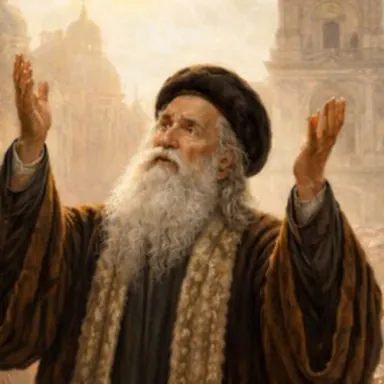
Rabbi Yehuda ha-Levi Mintz (Mahari Mintz)
14 min read2,700 words
Summary
This survey examines the figure of Mahari Mintz, an influential spiritual leader and halakhic authority who lived for more than a hundred years and served as a living bridge between the ancient Ashkenazic tradition and the beginning of the period of the "Acharonim." The text describes how his migration from Germany to Italy in the fifteenth century turned the city of Padua into an international Torah center, where halakhic conservatism was combined with the reality of Renaissance life. Although most of his writings were lost in war, the article stresses his decisive influence on halakhic ruling through the generations by way of a handful of surviving responsa, which were accepted as binding authority in the glosses of the Rema on the Shulchan Arukh. By describing controversies with the great men of his generation, the work presents his activity as a pillar that shaped the life of the Jewish community and family and stood guard over custom as an anchor of cultural identity.
The Pillar of Instruction between Ashkenaz and Italy: The Figure, Thought and Halakhic Work of Rabbi Yehuda ha-Levi Mintz (Mahari Mintz)
The historiography of the world of Jewish halakha in the fifteenth century and the beginning of the sixteenth places the figure of Rabbi Yehuda ben Eliezer ha-Levi Mintz, known by his Torah epithet Mahari Mintz (c. 1405–1508), as a central and unavoidable junction for understanding the great shift of the Ashkenazic Torah center from Germany to Italy and to Eastern Europe.[1, 2, 3] Mahari Mintz, who lived an extraordinarily long life spanning more than a century, was not only a halakhic authority and head of a yeshiva but a supreme spiritual authority who bridged the traditional world of the "Rishonim" and the early period of the "Acharonim," while shaping the character of the Jewish community in Italy and leaving an indelible mark on Ashkenazic halakhic ruling for the generations.[1, 3, 4]
When one examines his work, there emerges the figure of a leader who was conservative in the structural sense, cleaving to the ancient tradition of Ashkenaz, yet at the same time a man of vision who enabled the establishment of a flourishing Torah center in the Renaissance environment of Padua.[1, 5] The period of his activity, called the "seam" period, was characterized on the one hand by severe persecutions in Ashkenaz and on the other by cultural and intellectual flourishing in Italy, which made Mahari Mintz a key figure in the synthesis between these worlds.[2, 3, 5]
Chapter 1: Biographical Foundations and the Great Migration from Ashkenaz
Mahari Mintz was born in Ashkenaz, most likely in the city of Mainz (Magentza), around the year 5160 (1400/1405), which marked the beginning of a distinguished rabbinic dynasty whose name derives from the name of the city.[2, 5, 6] The Mintz family was part of a thin stratum of families of Jewish scholars and bankers who shaped the economic and spiritual life in the Rhineland.[5, 6] His Torah path began under the guidance of the great men of Ashkenaz, among them Rabbi Asher (Yisrael) Anshkin, a prominent Talmudic figure who greatly influenced the shaping of his method of study and ruling.[1, 5]
In 1462, in the wake of the expulsion of the Jews from Mainz and the persecutions that intensified in Germany, Mahari Mintz was forced to migrate south.[3, 5, 7] This migration was not merely a physical flight but the carrying of an entire cultural-halakhic cargo to new soil. His settlement in Padua, which was under the rule of the Republic of Venice, marked the transformation of this city into an Ashkenazic Torah center in the heart of Italy.[2, 3] The Padua of the fifteenth century was a focus of intellectual attraction thanks to its famous university, and Mahari Mintz had the wisdom to establish there a great yeshiva that drew students from all over the continent.[1, 8, 9]
Chapter 2: The Yeshiva in Padua and the Leadership of the Community
For forty-seven years Mahari Mintz served as rabbi and head of the yeshiva in Padua, a period in which the city became a Torah lighthouse without equal in the Europe of those days.[1, 2, 3] The yeshiva under his leadership was not merely an educational institution but a center of public leadership in which the great men of the next generation were shaped, among them his son Rabbi Avraham Mintz and the husband of his granddaughter, Rabbi Meir Katzenellenbogen (the Maharam of Padua).[1, 6, 11]
Under the leadership of Mahari Mintz, Padua became a crossroads at which the rigid traditions of Ashkenaz met the dynamic spirit of the Italian communities.[1, 10] His ability to preserve the Ashkenazic character of the community, including the customs of prayer and of halakhic ruling, while adapting them to the political and social reality in Italy, was a mighty achievement of leadership.[3, 5, 10] Mahari Mintz did not shut himself in the beit midrash; he was deeply involved in the management of the community and instituted enactments (communal enactments) that regulated Jewish life in the city, including matters of taxes, relations with the authorities and the management of religious institutions.[3, 10]
One of the fascinating issues in his yeshiva in Padua is the complex relationship with the local university. Although certain claims presented him as a professor of philosophy at the university, modern historical research tends to see this as a confusion with other figures such as Elijah Delmedigo.[3, 5] Nevertheless, there is no doubt that the presence of Jewish students of medicine and philosophy in the city influenced the character of the questions addressed to him and the interface between the world of halakha and the world of science.[3, 8, 9]
Chapter 3: Responsa of Mahari Mintz – A Legacy That Survived the Flames
The great tragedy of the legacy of Mahari Mintz occurred shortly after his death. During the siege of Padua in 1509, the city was plundered and most of Mahari Mintz's manuscripts, including his extensive library and his novellae on the Talmud, were destroyed or lost.[3, 5, 10] What remains in our hands today is a small but high-quality collection of 16 halakhic responsa that were discovered by his grandson, Rabbi Yosef ben Avraham Mintz.[3, 5] These responsa were published in Venice in 1553 by the Maharam of Padua, together with his own responsa and with the "Seder Gittin ve-Halitzah" of Rabbi Avraham Mintz.[3, 5, 6]
Despite their small quantity, these responsa are regarded as cornerstones of Ashkenazic halakhic ruling. They reveal a broad-shouldered authority who combines profound knowledge of the sources with a sociological understanding of his community.[3, 5, 6] The responsa deal with a wide range of subjects, from the laws of marriage and family to communal and ritual customs.[1, 5, 12]
| Analysis of Selected Responsa in the Responsa of Mahari Mintz | |
|---|---|
| Responsum 15/16: Costumes on Purim | Permission to wear masks and to change clothes from man to woman on Purim. Mahari Mintz relies on the custom of "the pious of old," who saw their sons do so and did not protest.[1, 12] |
| Responsum 13: The controversy over me'un (refusal) | Sharp opposition to Rabbi Yaakov Pollak, who permitted an act of me'un contrary to the enactments of Ashkenaz. Mahari Mintz saw in this a violation of the authority of the community and of tradition.[13, 14] |
| Responsum 5: Permitting marriage to a woman of ill repute | A leniency in the laws of differentiation for a woman given over to promiscuity, out of a social consideration that her husband would keep her from further decline.[5, 15] |
| Responsum 7/13/15: Ashkenazic customs in Italy | Cleaving to the customs of his German forefathers even in a foreign Italian environment, while preserving a continuity of ruling with Rabbi Israel Isserlein.[5, 10] |
One of his most famous rulings concerns the wearing of "faces" (masks) on Purim.[1, 12] In this case, Mahari Mintz shows surprising flexibility regarding the prohibition of "he shall not wear," arguing that the participants' intention is for joy and not for licentiousness, and that the custom is widespread among the great Torah scholars of Germany.[1] This ruling is cited to this day as an example of the weight of custom against the plain meaning of Scripture.[1, 15]
Chapter 4: The Struggle over Authority – The Controversy with Rabbi Yaakov Pollak
One of the formative moments in the halakhic history of the fifteenth century is the head-on confrontation between Mahari Mintz and Rabbi Yaakov Pollak, the founder of the method of pilpul and rabbi of Prague.[13, 14, 16] The dispute flared up around the "affair of me'un" – a procedure in which a girl who was married off by her mother or her brothers (a rabbinic marriage) can annul the marriage without a get.[13, 14] The early sages of Ashkenaz imposed severe limitations on me'un in order to prevent the cheapening of marriage, but Rabbi Yaakov Pollak permitted an act of me'un against the opinion of the majority of the rabbis of the generation.[14, 16]
Mahari Mintz, as the elder of the tribe and guardian of the tradition of Ashkenaz, saw in this a dangerous breach of the fence. In a sharp letter he ruled that if Rabbi Yaakov did not retract, he should be removed from his eminence and excommunicated.[13] This dispute represented the tension between the old and conservative generation in Italy and the new and independent forces that arose in Eastern Europe.[14, 16] Despite the intensity of Mahari Mintz's opposition, the opinion of Rabbi Yaakov Pollak later took root in Poland, which marked the beginning of the split between the various Torah centers.[14]
Chapter 5: The Controversy with Elijah Delmedigo and the Attitude toward Philosophy
In the intellectual environment of Padua, Mahari Mintz also had to face philosophical challenges. The confrontation with Elijah Delmedigo, a radical Jewish-Italian philosopher who served as a teacher of philosophy at the university, brought to the surface the question of the limits of free thought within the world of Torah.[3, 7, 8] The exact substance of the dispute was not preserved in writing, but it is known that Mahari Mintz received full support from Rabbi Eliyahu Mizrachi (the Re'em) of Turkey, which attests that the debate was perceived as being of significance to all of Jewry.[3, 5, 7]
This dispute highlights the role of Mahari Mintz as defender of intellectual conservatism. While Delmedigo sought to separate Torah from science and philosophy, Mahari Mintz saw in the Torah a total authority that embraces all areas of life.[5, 8] His ability to confront a figure of academic stature such as Delmedigo shows that Mahari Mintz mastered not only the Talmud but also the intellectual discourse of his time, even if he chose to reject parts of it.[3, 5]
Chapter 6: Longevity, Death and the Connection with Abravanel
Mahari Mintz was granted exceptional longevity, and died at about the age of 103 on 24 Tishrei 5269 (September 1508).[2, 3] His long life made him a living connecting link between the generation of Rabbi Israel Isserlein and the generation of the Maharam of Padua. The fact that at the age of 100 he took part in the Blessing of the Sun of the year 1505 became one of the formative myths surrounding his figure as "the elder of the generation."[3, 8]
Great symbolism lies in the fact that he died only five days after Don Isaac Abravanel, the Sephardic Torah giant who spent his last years in Padua.[3, 8, 10] The two were buried side by side in the cemetery of Padua, which symbolizes the merging of the Sephardic and Ashkenazic traditions in the Italian center.[3, 8] Sadly, their graves were destroyed during the wars that struck the city in 1509, but their shared memory remains engraved in Jewish history.[3, 10]
| Comparison of the Dynasty of the Rabbis of Padua (the Mintz–Katzenellenbogen Family) | |
|---|---|
| Rabbi Yehuda ha-Levi Mintz (Mahari) | The founder, rabbi of Padua for 47 years, the Ashkenazic pillar.[1, 2, 3] |
| Rabbi Avraham Mintz (Avia) | His son and successor, author of "Seder Gittin ve-Halitzah," active in Mantua and Ferrara after the expulsion.[6, 10, 11] |
| Rabbi Meir Katzenellenbogen (the Maharam of Padua) | The husband of his granddaughter, the publisher of the family's writings, a central halakhic authority in the generation of the Rema.[1, 6, 7] |
| Rabbi Yosef ben Avraham Mintz | The grandson of Mahari, who rescued the 16 responsa from the ruins of the siege in 1509.[3, 5] |
Chapter 7: The Influence of Mahari Mintz on the World of Halakha through the Generations
The influence of Mahari Mintz extends far beyond his 16 printed responsa. It is present, indirectly but powerfully, on every page of the Shulchan Arukh, especially through the glosses of the Rema.[14, 15] The Rema saw in Mahari Mintz and in the Maharam of Padua the most authoritative source for the custom of Ashkenaz, and cited them at every central halakhic juncture.[14, 15]
In addition, the "Seder Gittin ve-Halitzah," which was drafted in the beit midrash of Mahari Mintz by his son Rabbi Avraham, became the binding and accepted code in all the dispersions of Ashkenaz for matters of marriage and divorce.[3, 6, 17] The halakhic stability that the Mintz family created in these sensitive areas ensured the continuity of the Jewish communal structure even in times of wandering and political change.[3, 10]
Mahari Mintz leaves behind an important lesson about the power of quiet and consistent leadership. He succeeded in preserving the legacy of his forefathers while building a new world, and in being an authority accepted by the rabbis of Ashkenaz, Italy, Turkey and Poland alike.[1, 4, 5] His figure remains a symbol of an Ashkenazic rabbi who knew how to make Torah flourish in Italy and to leave a deep mark on the ruling and tradition of Israel – even when most of his writings were lost, the memory of his teaching and deeds continues to illuminate.[4]
Summary and Conclusions
The work and teaching of Mahari Mintz represent the peak of traditional Ashkenazic rabbinate at its point of encounter with the modern age. Through an analysis of the history of his life, his confrontation with halakhic and intellectual controversies, and the preservation of his legacy by his descendants, it becomes clear that he was one of the principal shapers of the world of halakha that we know today.[1, 2, 3] His ability to turn Padua into an Ashkenazic spiritual center in Renaissance Italy is testimony to the vitality of the Torah and to the survival capacity of Jewish scholarship.[1, 5, 8]
Mahari Mintz taught the generations to come that custom is not merely a collection of rituals but an anchor of identity; and that halakhic ruling must be rooted deeply in the tradition of the past, yet attentive to the changing needs of the present.[1, 5, 10] His legacy, reflected in the rulings of the Rema and in the accepted orders of divorce, continues to be a pillar in the Ashkenazic and general Jewish world of Torah to this very day.[14, 15, 17]
Sources17
- 1.רבי יהודה מינץ – ויקישיבה, yeshiva.org.il/wiki/index.php/רבי_יהודה_מינץ
- 2.מהר"י מינץ - ויקיפדיה, he.wikipedia.org/wiki/מהר"י_מינץ
- 3.Judah Minz - Wikipedia, en.wikipedia.org/wiki/Judah_Minz
- 4."המהר"י מינץ": הרב שחי מעל 100 שנה והנהיג דור שלם - ערוץ 2000, tv2000.co.il/article/59184
- 5.Minz, Judah ben Eliezer Ha-Levi - Encyclopedia.com, encyclopedia.com/religion/encyclopedias-almanacs-transcripts-and-maps/minz-judah-ben-eliezer-ha-levi
- 6.MINZ - JewishEncyclopedia.com, jewishencyclopedia.com/articles/10866-minz
- 7.Judah Minz - Wikiwand, wikiwand.com/en/map/Judah_Minz
- 8.Judah ben Eliezer ha-Levi Minz - Tzadikim - Daily Zohar, dailyzohar.com/tzadikim/1289-Judah-ben-Eliezer-ha-Levi-Minz
- 9.Jews, Medicine and the University of Padua A Behind the Scenes ..., seforimblog.com/2022/12/jews-medicine-and-the-university-of-padua-a-behind-the-scenes-virtual-tour-of-a-new-exhibit-at-the-jewish-museum-of-padua-november-2-2022-december-31-2022-2/
- 10.Minz / Mintz Family - Reis, Wolf, Samuel, & Other Families, reiswolfesamuel.org/?page_id=3019
- 11.אברהם מינץ - ויקיפדיה, he.wikipedia.org/wiki/אברהם_מינץ
- 12.Mask and Masekhah: Are the English and Hebrew Terms Related? - TheTorah.com, thetorah.com/article/mask-and-masekhah-are-the-english-and-hebrew-terms-related
- 13.יעקב פולק - ויקיפדיה, he.wikipedia.org/wiki/יעקב_פולק
- 14.המיאון שהביא את התורה לפולין: מי היה רבי יעקב פולק? - הידברות, hidabroot.org/article/1212557
- 15.דין הבחנה ודין מעוברת ומינקת חבירו - Mercaz Harav | מרכז הרב, mercazharav.org.il/2020/12/29/דין-הבחנה-ודין-מעוברת-ומינקת-חבירו/
- 16.הביא את התורה לפולין: מי היה רבי יעקב פולק? - הידברות, hidabroot.org/article/1197634
- 17.מחברים | מקורות מתוך ספריית ספריא, sefaria.org.il/topics/category/authors