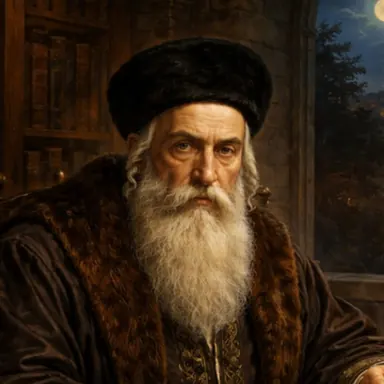
The Work, Torah Teaching and Halakhic Legacy of the Maharshal: A Multidimensional Examination of the Scholarly Revolution in the Sixteenth Century
19 min read3,757 words
Summary
The text surveys, in a multidimensional manner, the figure of the Maharshal (Rabbi Shlomo Luria), who was a spiritual revolutionary in the sixteenth century and worked to establish an independent scholarly method resting on the pursuit of absolute textual truth. The author stresses the Maharshal's opposition to the trends of "pilpul" and abridged halakhic ruling in his generation, setting the Talmud as the supreme and exclusive authority, which allows even dissent from the Rishonim. His scholarly legacy is expressed in his monumental work "Yam shel Shlomo" ("The Sea of Shlomo") and in his pioneering enterprise of textual criticism of the Talmud in the work "Chochmat Shlomo" ("The Wisdom of Shlomo"), which are integrated to this day into the page of the Gemara. Finally, the article examines the intellectual controversy with the Rema and the decisive influence of the Maharshal on shaping the world of scholarship and halakhic ruling in the generations that followed.
Introduction: The Shlomonic Revolution and Its Historical Context
The sixteenth century stands as one of the most formative periods in the history of the people of Israel in the early modern age. It is the period of transition in which the center of gravity of the Jewish world moved from the Iberian Peninsula and the lands of the West toward Poland and Lithuania, which became the most dominant Torah center. At the heart of this process stands the figure of Rabbi Shlomo Luria, known by the acronym Maharshal (Rabbi Shlomo Luria). The Maharshal was not merely a halakhic authority or Talmudic commentator but a spiritual revolutionary who set up a consistent and uncompromising alternative to the scholarly and halakhic trends of his generation.[1]
In order to understand the magnitude of his work, one must look at the Torah reality that prevailed in Poland in those years. On the one hand, the method of "pilpul and hiluqim" (distinctions) began to develop in the yeshivot of Lublin and Kraków, which sought to sharpen the minds of the students by means of virtuoso difficulties and resolutions. On the other hand, the Jewish world was experiencing the beginning of the age of the great codification, with the appearance of the works of Rabbi Yosef Karo and Rabbi Moshe Isserles (the Rema), who sought to decide halakha in a final and ruled manner.[2] The Maharshal took a stand against both of these trends: he saw in pilpul a deviation from the plain truth of the Talmud, and in the short and concentrated ruling a danger of severing halakha from its living sources. His work was characterized by a radical return to the Talmudic text as the supreme and exclusive authority, and by a demand for intellectual honesty that does not shrink from any human authority.[2, 3]
Chapter 1: Roots, Lineage and Biography – The Shaping of a Sovereign Personality
The forceful and independent figure of the Maharshal draws to a large extent on his deep consciousness of lineage. He was born around the year 5270 (1510), most likely in the city of Brest of Lithuania, into the distinguished Luria family.[1, 2] The family tradition, which won wide recognition among the great men of the generations, traces the Luria family directly to Rashi, and from him back to King David.[1, 2] This lineage gave the Maharshal a sense of mission and of continuity of the ancient tradition of Ashkenaz, and he saw himself as entrusted with guarding the accuracy and authenticity of the teaching of his forefathers.
His early life was marked by rapid maturation. His father, Rabbi Yechiel Luria, who served as rabbi and head of the rabbinic court in Slutsk, died while Shlomo was still young.[1, 4] The young orphan was sent to the house of his maternal grandfather, the Gaon Rabbi Yitzchak Klauber of Worms, who was the rabbi of Posen.[1, 4] The period of his studies with his grandfather, which lasted about seven years, was the most formative for him. The deep bond between the two was expressed in the fact that the Maharshal used to sign his writings with the names "Shlomo R. Yitzchak" or "Sar Yitzchak" in appreciation of his grandfather's teaching.[4] His grandfather, Rabbi Yitzchak, represented the scholarly tradition of Worms – a tradition that stressed precision in the text and adherence to the commentary of Rashi, matters that would become the central foundations of the method of the mature Maharshal.
At the age of 25 the Maharshal married Lipka, the daughter of Rabbi Kalonymus Jerusalimi (ha-Berkshtan).[1, 5] After his marriage there began an impressive rabbinic career that wandered among the important Torah centers of that time:
Table of the Central Stations in the Life of the Maharshal and Their Torah Influence
The Maharshal was not a figure who sought tranquility. Wherever he served, he at times found himself at the center of controversies because of his forceful personality and his unwillingness to compromise on the truth as he saw it.[1] In Lublin, the peak of his activity, he headed the yeshiva founded by Rabbi Shalom Shachna, but withdrew from it after he could not bear the method of study accepted there, and established an independent yeshiva in which he introduced his distinctive path.[2]
Chapter 2: The Methodology of the Maharshal – The War for Truth
The core of the Maharshal's Torah teaching is the struggle for "truth." For him, truth is not an abstract concept but a goal that can be reached by means of grueling labor, textual criticism and uncompromising logical analysis. In his famous introduction to his book "Yam shel Shlomo," he describes an event that was perceived in his eyes as heavenly confirmation of his path: a small candle that was supposed to burn for a short while continued to burn for many hours until he finished his study, a hint that the Holy One, blessed be He, desired the path of integrity and truth that was his.[3]
The Opposition to the Method of Pilpul and Hiluqim
The Maharshal's greatest disagreement with his contemporaries concerned the method of study. In the yeshivot of Poland in the sixteenth century, "pilpul" was regarded as the pinnacle of scholarly creativity. Its purpose was to resolve contradictions between different sources by means of fine distinctions and logical manipulations.[2] The Maharshal saw in this a spiritual danger. According to him, pilpul takes the words of the Talmud out of their plain meaning, distorts the intention of the Tannaim and Amoraim, and creates a rift between the Torah and the halakhic reality.[2]
He sharply criticized the fact that students invest their energy in building "towers flying in the air" instead of understanding the sugya in its plain sense. In his view, correct study must be founded on decisive proofs and on a logical sequence that can be defended without barren pilpul. The Maharshal was not content with theoretical criticism; he applied it in practice in his yeshiva in Lublin, where he required his students to examine every matter from its primary source in the Talmud and to labor until a clear and simple understanding was attained.[2, 3]
The Talmud as Exclusive Authority
Another fundamental principle in his teaching is the absolute supremacy of the Talmud (the Babylonian, the Jerusalem, the Tosefta and the halakhic midrashim). The Maharshal held that since the closing of the Talmud by Ravina and Rav Ashi, no halakhic authority, Gaon or Rishon has the authority to dispute its words or to rule contrary to what is explained in it.[2] This approach led him to a rare independence of thought: he did not shrink from disputing giants such as Maimonides, Rashi or the Tosafists, if he found that their words did not accord with the plain meaning of the Talmudic sugya.[1, 3]
He argued that the tendency to venerate the "old writing" only because it is ancient is "weakness of the intellect." In his view, the sages of his own generation too have "a place and a name" (yad va-shem) in the Talmud and the right to dispute earlier authorities, provided that this is done with enormous toil and deep investigation, with "seven inquiries and seven examinations."[3]
Chapter 3: The Masterpiece "Yam shel Shlomo" – Between Ruling and Commentary
The book "Yam shel Shlomo" was planned as a lifework that would encompass all the tractates of the Talmud and serve as a summarizing book of halakhic ruling. Its structure is unique: the Maharshal does not explain the Gemara page by page, but builds the discussion around the central sugyot in each chapter, analyzing them from the source to practical halakha.[1, 2]
The Anatomy of a Sugya in "Yam shel Shlomo"
In approaching a halakhic topic, the Maharshal operates through a fixed and complex mechanism:
- Presentation of the Talmudic source: examination of the language and context of the Mishnah and Gemara.
- Survey of the views of the Rishonim: citing the opinions of the Rif, Maimonides, Rashi, Tosafot and the Rosh.
- Criticism and analysis: applying the tools of logic and erudition to examine which view withstands the test of the source.
- Halakhic decision: determining the halakha, at times while rejecting accepted customs if they contradict the Talmud.[2]
One of the great points of importance of the book is the use of rare sources. The Maharshal's library was rich in manuscripts and books that were not accessible to everyone. In "Yam shel Shlomo" he cites many of these writings, and a considerable part of them were lost over the generations, so that the book serves as the sole historical testimony to the teaching of many medieval sages.[2]
The Surviving Tractates and Their Influence
Because of his enormous exactitude, the Maharshal did not manage to complete the work on the entire Talmud. Today we have only seven tractates, in which too parts are sometimes missing:
Although the Maharshal planned the book as a book of halakha, today it is studied in the yeshivot mainly as a profound commentary book that teaches the method of analysis of a sugya. His ruling is at times regarded as too "individualistic" to be accepted as a sweeping norm, but his influence on the world of scholarship is unassailable.[1]
Chapter 4: "Chochmat Shlomo" and the Emendation of the Talmud – The Architect of the Text
His second most important work, "Chochmat Shlomo" (the Glosses of the Maharshal), sets him as a pioneer in the field of textual criticism. The Maharshal was active in the early period of printing, when the first editions of the Talmud contained many errors stemming from careless copyists, the ignorance of printers or the intervention of Christian censorship.[2, 6]
The Method of Emendation: Between Manuscript and Reasoning
The Maharshal used a combination of two tools for emending the text:
- Scientific comparison: he possessed ancient manuscripts of the Gemara and of the commentaries of Rashi and the Tosafot, and compared them meticulously against the printed Venice edition.[2]
- Logical penetration (emendation by reasoning): the Maharshal believed that the Torah is a perfect logical system. If a certain sentence in the Gemara did not "work out" logically or contradicted another sugya, he proposed a correction based on his profound understanding. The great men of the generation attested that at times, by emending a single letter, he succeeded in removing enormous difficulties that had occupied students for generations.[2, 6]
The influence of "Chochmat Shlomo" was so dramatic that most of his emendations were inserted directly into the body of the text of the Talmud in later editions, or appeared in a separate section in the margin of the page (as can be seen in the "Vilna Talmud"). Almost every student of Gemara today relies, without knowing it, on the textual corrections of the Maharshal.[7, 8]
Chapter 5: The Great Controversy with the Rema – A Confrontation between Two Worldviews
One of the most fascinating and influential chapters in the history of Polish Jewry is the complex relationship between the Maharshal and his brother-in-law, Rabbi Moshe Isserles (the Rema). Although there prevailed between them a deep mutual esteem – the Rema wrote of the Maharshal that "happy is the generation in which there dwells a man as humble as Hillel" [8] – they represented two religious and intellectual poles.
The Dispute over Philosophy and Science
The most famous controversy between them was conducted around the study of philosophy and the external disciplines (Responsa of the Maharshal, simanim 6–7). The Rema, under the influence of Maimonides, saw the study of philosophy as an important tool for understanding faith and strengthening it.[9, 10] The Maharshal, by contrast, came out sharply against this trend. He feared that mixing Greek philosophical concepts into the Torah would weaken simple faith and distort the authentic Torah understanding. In his view, "the Torah of God is perfect" and does not need the aid of external disciplines.[9, 11]
The Importance of Grammar and Language
Another dispute, which perhaps seems technical but is most essential, concerned precision in the Hebrew language. The Maharshal was an uncompromising grammarian. He attacked the Rema because his linguistic style is not precise, and argued that ignorance of grammar (confusing masculine with feminine, singular with plural) is not merely an aesthetic matter but a halakhic danger. He stressed that in the writing of bills of divorce a small grammatical error might invalidate the get and lead to the status of agunah or of mamzerut.[10] The Rema, in his humility, admitted that he is not an expert in grammar but argued that the essential thing is the intention and the practical halakha.[10]
Attitude toward Kabbalah and the Zohar
While the Rema integrated Kabbalistic elements into his halakhic ruling and worldview, the Maharshal took a more cautious approach. He respected the Zohar and Rashbi, but established a clear principle: halakha is not to be ruled according to Kabbalah if it stands in contradiction to the explicit Talmud.[12] He saw in the Talmud the exclusive authority for halakhic instruction, and feared a situation in which "secrets" would replace the revealed and clear halakha.
Chapter 6: Responsa of the Maharshal – A Window onto Jewish Society in the Sixteenth Century
The Maharshal's book of questions and answers (printed in Lublin in 1574) is a precious historical source for anyone who seeks to understand the fabric of Jewish life in the golden age of Poland. The one hundred and one responsa in the book touch on all areas of life: economics, society, ethics and communal conduct.[2, 6]
Central Subjects in the Responsa of the Maharshal
- Corruption and rule: the Maharshal did not hesitate to come out against the community leaders and even against rabbis whose appointment was bought with money. He saw in the rabbinate a purely religious mission and disdained any authority based on political power or wealth.[1]
- Monetary law: his rulings are characterized by a pursuit of social justice and by protecting the weak from the oppression of the influential.
- Daily life: his responsa deal with questions such as the obligation to cover the head (his famous lenient ruling), the attitude toward gentiles, the laws of inheritance and neighbor disputes.[2]
The style of his responsa is direct, at times blunt, and always reasoned in depth from the Talmudic sources. He does not bring "fragments of verses" but analyzes the sugya from the foundation to the cornices.[2]
Chapter 7: Additional Works – The Broad Range of His Creativity
Although his main fame stems from his works on the Talmud, the Maharshal put his hand to almost every branch of the Torah, leaving his distinctive mark on each of them:
Amudei Shlomo on the Semag
The Sefer Mitzvot Gadol (Semag) of Rabbi Moshe of Coucy was one of the Maharshal's beloved books, because the author's method was based on close adherence to the sources of the Gemara. In his work "Amudei Shlomo" ("Pillars of Shlomo"), the Maharshal explains and emends the Semag, comparing it with the Talmudic sources and with works of other Rishonim such as Maimonides and the Re'em.[6, 13] These glosses are regarded to this day as an integral part of the study of the Semag.
Yeriot Shlomo on Rashi and the Re'em
In this book the Maharshal deals with biblical exegesis, but from a scholarly-critical angle. He focuses on explaining the commentary of Rashi and confronts the difficulties raised by Rabbi Eliyahu Mizrachi (the Re'em). The Maharshal, as a descendant of the family of Rashi, saw a special duty to defend the accuracy of his forefather's commentary, but did not refrain from criticizing later commentaries if they seemed to him to distance the plain meaning of the text.[6]
Menorat Zahav and Zemirot Shabbat
In these works a less "cold" and rational side of the Maharshal is revealed. "Menorat Zahav" deals with esoteric lore around the psalm "For the leader, with stringed instruments," which appears in the shape of the menorah.[6] In his work on the Shabbat hymns (Zemirot Shabbat), he combines halakhot, customs and spiritual interpretations, which shows his desire to instill Torah consciousness into every moment of a Jew's life, even in hours of joy and feasting.[6]
The Lost Siddur
It is a sad fact that the Maharshal wrote an entire prayer book (siddur), in which he incorporated all his emendations and novel insights on the text of the prayers and their intentions. Sadly, this siddur was lost and has not reached us, and one can only conjecture what textual corrections and linguistic precisions it contained, in light of his extreme care in matters of grammar.[6]
Chapter 8: Special Aspects of His Leadership and Personality
The Maharshal was not merely an intellectual but a spiritual leader whose figure inspired awe and veneration. Many stories surround his figure, illustrating his ability to recognize spiritual greatness even in hidden places.
The Story of Rabbi Avraham the Vegetable Seller
A famous tradition tells of the Maharshal that he discovered that the simple vegetable seller in his community, Rabbi Avraham, was in fact an immense Torah scholar who studied Gemara in a wonderful melody in his shop at night.[6] The Maharshal swore to him that he would not reveal his secret, and used to study with him in secret. Only after the Maharshal's death was the secret revealed. This story emphasizes the fact that the Maharshal, despite his forcefulness and lineage, valued pure Torah above every external mark of status or honor.[6]
Attitude toward Customs and the Tradition of Ashkenaz
The Maharshal saw himself as the guardian of the walls of the ancient tradition of Ashkenaz. He opposed changes that had penetrated customs under foreign influences or through inaccuracy. At the same time, he did not hesitate to abolish customs if he found that they were based on a mistake in understanding the Talmud. In his view, custom is an auxiliary tool, but it cannot stand above clear halakha.[2]
Chapter 9: The Disciples of the Maharshal and the Continuity of His Legacy
The success of a teacher is measured by his disciples, and the Maharshal raised a generation of Torah giants who shaped the face of Judaism for the generations. His yeshiva in Lublin became a magnet for anyone seeking real, profound study without pilpul.
Table of Prominent Disciples and Their Influence
These disciples, although each developed a distinctive style, bore with them the Maharshal's stamp: the search for the source, intellectual honesty and the willingness to re-examine accepted conventions in light of the Talmud.
Chapter 10: Summary and Historical Assessment
The legacy of the Maharshal is a legacy of freedom of thought within a framework of absolute loyalty to the sources. He set a high bar of Torah labor, one that is not content with easy summaries or superficial sharpness.
The Long-Term Contribution of the Maharshal
- Stabilizing the text of the Talmud: without his emendations in "Chochmat Shlomo," the study of Gemara today would be riddled with corruptions and textual errors.[2, 6]
- A brake on barren pilpul: although pilpul continued to exist, the Maharshal created a counterweight that reminded the generations that followed that the ultimate goal is the plain and clear truth.[2]
- The modern method of analysis: to a great extent, the method of study accepted today in the Lithuanian yeshivot (conceptual analysis and explanatory depth) draws its inspiration from the Maharshal's pursuit of understanding "the root of the matter."[3]
- Independence of halakhic ruling: the Maharshal gave legitimacy to authorities to dispute earlier ones if their words rest on solid evidence, thereby preventing halakha from turning into a frozen and fossilized system.[1, 3]
The Maharshal died on the 12th of Kislev 5334 (1573) and was buried in Lublin.[1, 6] On his tombstone it was written that he was "the greatest man among the giants," a description that is no exaggeration in light of his immense influence. Even today, hundreds of years after his death, the Maharshal's voice continues to resonate in the batei midrash: every time a student opens the section of glosses in the margin of the page, every time a sugya in "Bava Kamma" or in "Chullin" is studied in depth, and every time a halakhic authority seeks the refined truth of the Talmud – the Maharshal is alive and present.[6, 14]
His teaching is an eternal reminder that Torah without truth is not Torah, and that scholarship without toil is nothing but intellectual amusement. Rabbi Shlomo Luria left us "Yam shel Shlomo" – an infinite expanse of knowledge, criticism and faith, inviting every student to delve into the depths and draw from there pearls of pure truth.[15, 16]
Sources16
- 1.שלמה לוריא - ויקיפדיה, he.wikipedia.org/wiki/שלמה_לוריא
- 2.מהרש"ל – ר' שלמה בן יחיאל לוריא | קול לובלין, kollublin.wordpress.com/2012/07/20/מהרשל-ר-שלמה-בן-יחיאל-לוריא-2/
- 3.סידרת 'הקדמות לאמונה' : הקדמת 'ים של שלמה': ללמוד את כל השיטות לעומק - מכון מאיר, meirtv.com/alon-4745/
- 4.מה אמר המהרש"ל על מי שקורא לאביו או לאמו בשמם? - הידברות, hidabroot.org/article/1161528
- 5.רבי שלמה לוריא - המהרש"ל - MyTzadik, mytzadik.com/m/tzadik.aspx?id=150
- 6.רבי שלמה לוריא - מהרש"ל - הרב יורם אברג'ל ובנו הרב ישראל - המאיר לארץ, hameir-laarets.org.il/hilulots/רבי-שלמה-לוריא-מהרשל/
- 7.שמואל אליעזר הלוי איידלס - ויקיפדיה, he.wikipedia.org/wiki/שמואל_אליעזר_הלוי_איידלס
- 8.Lot 40 - הגהות בכתב יד המהרש"ל | בית המכירות תפארת, tiferetauctions.com/auction/297-נדירים-אדר-ב-he/lot-40-הגהות-בכתב/
- 9.פולמוס הרבנים אודות לימוד הפילוסופיה - ויקיפדיה, he.wikipedia.org/wiki/פולמוס_הרבנים_אודות_לימוד_הפילוסופיה
- 10.הפולמוס החד בין המהרש"ל והרמ"א - האם רב בישראל צריך לדעת דקדוק?! | כיכר השבת, kikar.co.il/actualy/se527v
- 11.Untitled, shabes.net/bs/index.php/הפולמוס_בין_המהרש"ל_לרם"א_בענייני_הגיון_ופילוסופיה
- 12.משקל הזוהר והקבלה בהלכה - מנחת אשר, minchasasher.com/he/shiur/parsha-vort/משקל-הזוהר-והקבלה-בהלכה/
- 13.ספר מצוות גדול – ויקיפדיה, he.wikipedia.org/wiki/ספר_מצוות_גדול
- 14.לכבוד היארצייט י"ב כסלו: תולדות חייו, ודברי תורתו של האדם הגדול בענקים רבי שלמה לוריא זצ"ל., ravblau.com/lesson/מהרשל-חייו-ותורתו/
- 15.מיקרופדיה תלמודית:ים של שלמה (ים שעשה שלמה) – ויקישיבה, yeshiva.org.il/wiki/index.php/מיקרופדיה_תלמודית:ים_של_שלמה_(ים_שעשה_שלמה)
- 16.ים של שלמה - אוצר הספרים היהודי השיתופי, wiki.jewishbooks.org.il/mediawiki/index.php?title=ים_של_שלמה&mobileaction=toggle_view_desktop