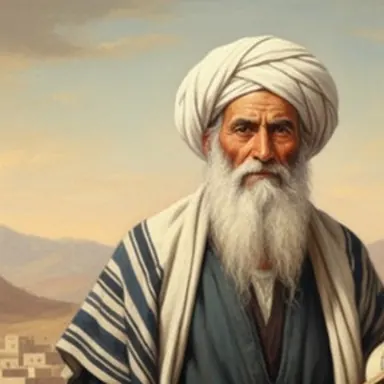
A Comprehensive Analytical Report: Rabbi Shalom Shabazi – His Life, His Torah Work and His Mystical Teaching as the Shaper of the Heritage of Yemenite Jewry
17 min read3,407 words
Summary
The report presents a broad survey of the life and influence of Rabbi Shalom Shabazi, the most formative figure in the culture of Yemenite Jewry, who was active in the 17th century in a period of harsh persecution. The text analyzes how Shabazi combined practical halakha, Maimonidean philosophy and Lurianic Kabbalah, thereby creating a spiritual foundation that enabled his community to preserve its resilience and identity in the face of the crises of exile. The author stresses his immense contribution to the liturgy through the editing of the Tiklal and the writing of thousands of piyyutim expressing longing for redemption and moral rectification, which became an inalienable treasure of Hebrew poetry. Finally, the article discusses Shabazi's standing as a mythic, paternal figure known as "Abba Shalom," whose teaching and legacy continue to serve as a cultural anchor and a historical link for the Jews of Yemen to this day.
Introduction: Rabbi Shalom Shabazi in His Historical and Theological Context
Rabbi Shalom Shabazi (5379, 1619 – 5446 or 5480, 1686 or 1720) is known as one of the most central and influential figures of Yemenite Jewry. His appellation "Abba Shalom Shabazi" reflects his standing not only as a halakhic sage and philosopher but also as an autonomous spiritual leader who became an existential symbol in a period of persecution and crisis. The present report offers an in-depth analysis of his work, from his biographical background to his Torah method, which combines halakha, midrash and kabbalistic mysticism, and the immense treasury of piyyut he left behind.
Shabazi lived in a turbulent period, in which dramatic changes occurred in the standing of the Jewish community in Yemen, apparently around the Mawza decrees (which began about a decade after he began composing the Tiklal in 1676). His work is not merely a collection of poems and writings but a theological and poetic response to a national trauma, giving the Yemenite community a stable spiritual framework and a means of coping with exile and the expectation of redemption.
Part A: The Historical Background and the Man – Rabbi Shalom Shabazi in His Context
1. Biographical and Geographical Background: Birth, Family and Wanderings
Rabbi Shalom Shabazi was born in 1619 (5379) in the village of Najd al-Walid, near the city of Taiz in southern Yemen [1, 2]. He was the son of Yosef, whose lineage included Abigad and Hanfon Mashta al-Shabazi [1]. The appellation "al-Shabazi" was added to his name after he moved to the village of Shabaz.
His life was devoted to Torah and to his family, but it was dramatically disrupted in his youth. When he was only fifteen his father died, an event that forced him to leave his home in order to provide for his family [1]. These circumstances, involving hardship and early wanderings, attest to exceptional personal resilience and to his ability to combine a life of Torah study with active involvement in the life of the community and in the material needs of his family. After this period, he lived in Qal'at al-Sa'id [1].
Rabbi Shabazi raised a family and had two sons, Rabbi Yehuda and Rabbi Shimon, as well as a daughter named Shama, whose grave lies near the village of Najd al-Ba'adan in the district of Udayn [1].
2. His Rabbinic Connections and the Historical Context of the Mawza Decree
Despite his origins in the south, Shabazi was not a leader cut off from the Torah center. He used to travel to the capital of Yemen, Sanaa, "to discuss Torah with the sages of the city" [1]. These journeys attest to his official and recognized rabbinic standing, and to an influence that extended beyond the rural areas in which he lived. He was accepted among the Yemenite rabbinic elite.
Particularly well known is his close friendship with the head of the rabbis of Sanaa, Rabbi Saadia Dirin, who wrote a commentary on Maimonides' Mishneh Torah (most of which has been lost). Shabazi dedicated to Rabbi Dirin a poem that opens with the words "Beloved of my heart, prince of the generation in his city, who meditated on the perfect Torah" [1]. This praise attests to a bond of mutual respect and esteem between Torah giants, and positions Shabazi as an equal among equals with the leading sages of Sanaa. The importance of preserving Shabazi's writings is heightened by the fact that important writings of his contemporaries, such as Rabbi Dirin's commentary, have been lost, which makes Shabazi's works a critical primary source for understanding the Torah culture of 17th-century Yemen.
The Question of the Date of His Death and His Mythic Standing
The question of Rabbi Shabazi's death arouses particular interest and reflects his transformation into a mythic figure spanning generations. There are differences in the dating of his death: some traditions state that he died in 5446 (1686), and others give a much later date, 5480 (1720), sometimes at the age of a hundred [1, 2]. His burial place is known to be in Taiz [2].
This dramatic difference in dates, spanning three decades, is not merely a biographical gap but reflects the transformation of his figure into myth. If Shabazi did indeed live until 1719/1720, it means that he not only experienced the Mawza decrees (1679–1680) but also led the community in the period of recovery that followed. This role as a spiritual leader who survived the exile and helped rebuild the community gave his poems, and especially his poems of redemption, enormous prophetic and authoritative weight in the eyes of later generations.
In addition, a famous Yemenite tradition relates that on the very day Rabbi Shabazi died, Rabbi Shalom Sharabi (the Rashash) was born, one of the greatest kabbalists and the founder of the Beit El yeshiva of kabbalists in Jerusalem [2]. This story creates a direct spiritual continuity, uniting the beginning of the penetration of Lurianic Kabbalah into Yemen (through Shabazi) with the flourishing of practical Kabbalah at the world center in Jerusalem (the Rashash). Shabazi is thereby positioned as a critical and unassailable link in the chain of transmission of the Yemenite-Jewish esoteric lore.
Table 1: Summary of Biographical Events and Historical Contexts
Part B: His Torah and Speculative Teaching – the Pillar of Yemenite Jewry
3. The Torah Path: A Combination of Midrash, Philosophy and Mysticism
Rabbi Shabazi's Torah teaching was characterized by a unique synthesis, which made it possible to absorb the new mystical ideas within a traditional theological framework. Like the sages of Yemen who preceded him, his teaching was mainly midrashic-allegorical, using in-depth interpretation of the texts as a basis for developing theological ideas [2].
Nevertheless, Shabazi placed Kabbalah at the center of his work. He added "with greater force the kabbalistic conception" [2] to the existing allegorical method, and also engaged in philosophy [2]. For Shabazi, Lurianic Kabbalah (the esoteric teaching) does not stand in opposition to the Maimonidean philosophical-allegorical method, which was the core of traditional Yemenite theology. Instead, he presented mysticism as the deepest layer of interpretation, constituting a revelation of the hidden divine secrets concealed behind the philosophical allegories. This creative synthesis enabled the community, which was deeply rooted in the Maimonidean tradition, to adopt the new esoteric teaching without giving up its rational-halakhic foundations.
4. Chemdat Yamim (on the Torah): Ethics, Halakha and Mysticism
One of Rabbi Shabazi's central works, representing his synthetic teaching, is Chemdat Yamim on the Torah [2]. The book, as reflected in his writings, is a comprehensive work combining detailed halakhic discussion, ethical practices and mystical-kabbalistic explanations.
The discussion in the book touches on very practical matters, such as the need to beware of selecting and squeezing during the Sabbath meal, citing the rulings of other sages such as the Maharit Tzahalon [3]. In addition to the laws of the Sabbath, the book deals with the secret of the prohibition of meat with milk, and specifies that one should refrain from eating meat after hard cheese, and that one should rinse the mouth with water after eating hard cheese before eating meat [3].
One of the central principles of this work is the connection of halakha and external law to inner spiritual rectification. Shabazi discusses ethical matters at length, connecting them to the theology of the Sabbath and the additional soul (neshama yetera). He warns that "one who becomes angry on the Sabbath drives away the additional soul" [3]. This is a dramatic theological statement, presenting the Sabbath not only as a halakhic day of rest but as a holy space in which a person's spiritual level is tested. The detailed discussion of anger, of strife between husband and wife, and of the prohibition of mundane speech on the Sabbath [3] shows that Shabazi regarded the refinement of character traits and the distancing of anger (which is drawn out by mundane speech) as a condition for receiving the holiness of the Sabbath. Shabazi in effect gives the secret of the additional soul an ethical-practical meaning.
He stresses the severity of the punishment for mundane speech, especially for Torah scholars, and explains the saying of the Sages "Just as He rested from speech, so you too should rest from speech" [3]. In this way he turns the observance of the Sabbath into an active task of guarding the mouth and the heart, and not merely of refraining from labor.
5. The Question of the Book Chemdat Yamim and the Scholarly Critique
An important distinction must be noted regarding the work Chemdat Yamim. While Rabbi Shalom Shabazi wrote a commentary on the Torah by this name combining halakha, ethics and practical Kabbalah (described above), there exists a later book of the same name, which deals with laws and practices according to the Kabbalah of the Ari, and whose author's identity is unknown and disputed [4]. This book was published by Rabbi Yisrael Yaakov Algazi, who acquired the manuscript in Safed [4].
The analysis of the content attributed to Shabazi (as reflected in Yemenite and ethical sources), which focuses on the laws of the Sabbath, the avoidance of anger, and the secrets of kashrut [3], is not characteristic of late theoretical kabbalistic literature, but of a work combining halakha with practical observances, befitting Shabazi's standing as a halakhic decisor and a practical kabbalist. This strengthens the possibility that Shabazi's original work had a distinctly practical-kabbalistic character, and that it differs from the more general kabbalistic book whose attribution is disputed.
6. His Contribution to Halakha and Practical Liturgy
In addition to his midrashic-kabbalistic work, Shabazi left a deep mark in the field of practical halakha and Yemenite liturgy.
A. Commentary on the Laws of Ritual Slaughter: Shabazi wrote a halakhic commentary on Maimonides' Laws of Ritual Slaughter [2]. This activity, in the practical and existential halakhic sphere, attests to a high degree of halakhic responsibility. In a period of decrees and persecution (apparently the Mawza decree or others), the subject of kosher slaughter is an existential pillar ensuring the continued existence of the Jewish community according to tradition. The work highlights his uncompromising commitment to transmitting Maimonides' precise halakhic tradition.
B. The Tiklal: Shabazi is considered one of the principal shapers of the Yemenite prayer rite. He composed and commented on the Tiklal Mashta-Shabazi [2, 5]. He began writing his manuscript of the Tiklal in 5438 (1676) [1]. The Tiklal is the central prayer book of Yemenite Jewry, and beyond being a poet whose poems were incorporated into the rite, Shabazi became the formative and supervising force over the formal text. The very effort to compose a Tiklal with a commentary attests to the need to organize and strengthen Yemenite custom and liturgy in a period of uncertainty and exile. A manuscript of the Tiklal attributed to Rabbi Shabazi can even be viewed on the website of the National Library [2].
C. A Book of Segulot: Shabazi also wrote Sefer ha-Margalit, which is a book of segulot (remedies and charms) [2]. The existence of this book points to Shabazi's dual role as a rabbi and also as a popular leader, providing an answer to the practical, medical and magical needs of the public.
Part C: The Poetry of Redemption and Poetic Mysticism – the Treasury of Yemenite Piyyut
7. Literary Characteristics and the Classical Form
The poetry of Rabbi Shalom Shabazi is the national treasury of piyyut of Yemenite Jewry, and he is considered its greatest poet. The number of piyyutim he wrote is estimated in the hundreds and even thousands of sacred poems [5].
In terms of form, Shabazi's poetry is characterized by a meticulous use of the meter of classical Spanish poetry [2]. This use of the sophisticated metrical system of the Golden Age of Spain attests to a high level of learning and cultural preservation in Yemen, and positions Shabazi as a Jewish Renaissance figure who succeeded in combining ancient poetic knowledge with contemporary spiritual content.
Most of his poems are sacred poems expressing the eternal bond between the people of Israel and the Holy One, blessed be He. However, he also engaged in other genres: a minority of them are riddle poems on Torah, intended for his rabbinic friends, as well as polemical poems and poems of amusement [2]. This versatility proves that Shabazi used the piyyut not only as a liturgical or religious tool but as a didactic, intellectual and even social tool. In all types of his poems, hints or moral lessons are hidden [2].
8. The Piyyut as a Vehicle for Mystical Kabbalah
The most essential theme of Shabazi's poetry is the decisive influence of kabbalistic teaching. Owing to his immersion in Lurianic Kabbalah, many of his poems have "a mysterious and symbolic hue" [2]. Shabazi is in fact considered the principal disseminator of Kabbalah among the broad public in Yemen. He took abstract kabbalistic concepts, such as unifications (yichudim), sefirot and rectifications (tikkunim), and translated them into an accessible poetic language that became an inseparable part of the community's prayer rite and poetry. In this way mysticism did not remain the domain of individuals but became a shared theological foundation.
Among the best-known poems are "Adon ha-Kol," "Ahavat Hadassah," "Ayumah be-Har ha-Mor," "Ayumati Te'orer ha-Yeshenim," "Ayelet Chen," and "Im Nin'alu" [6].
9. Analysis of an Example: "Ahavat Hadassah" – the Divine Presence, Exile and Redemption
The piyyut "Ahavat Hadassah" is a classic example of the combination of the motif of exile and redemption with the ethical mysticism that characterizes Shabazi's teaching [7].
The poem uses the metaphor of the cosmic wedding: "The bridegroom and the bride are joined beneath the canopy," where the bride is "the precious awesome one" (the Congregation of Israel / the Divine Presence) and the bridegroom is the Holy One, blessed be He ("her Beloved"), and "she and her Beloved bestow grace and loving-kindness" [7]. This marriage represents the complete cosmic rectification and the end of the exile.
The piyyut contains an explicit messianic call and a demand for practical redemption: "Summon our remnant and all the treasured ones" [7]. This call to gather the dispersed of Israel ("our remnant") is expressed against the background of the Land of Israel, exile and redemption, as the poet asks to drink "from the cup of salvation" [7]. One can see how this poem speaks directly to the members of his community, who suffered physically and spiritually, and provides them with an active redemptive hope.
In addition to the mystical-national layer, Shabazi weaves into the poem the consistent theological axis according to which the general redemption depends on personal refinement of character. He states that "a good name belongs to the wise of upright mind, for they surely rule over their inclination" [7]. Here Shabazi makes it clear: the longed-for redemption (which will flood the congregation "like a river of peace") will come only to one who completes the inner rectification and the moral rectification. Only one who completes the unification of the soul ("the love of my only one shines forth to the goodness of God") and rules over his evil inclination will merit "the Garden of Eden, inheriting life" [7].
Part D: His Legacy and His Cultural and Historical Influence
10. Shabazi as "Abba Shalom": Spiritual Authority and Cultural Symbol
The appellation "Abba Shalom Shabazi" [1] reflects his paternal standing among the communities of Yemen. He was perceived as a fatherly and protective figure who gave spiritual and material authority to the community in a period of crisis. His mythic figure was preserved in tradition through stories such as the tradition of the link between his death and the birth of the Rashash, which emphasizes the continuity of the kabbalistic heritage of Yemen across geographical and temporal boundaries [2].
His Torah work, and especially the Tiklal, ensured the preservation of the unified Yemenite liturgical rite. Shabazi did not merely document the customs; he wrote his manuscript of the Tiklal [1] and became the driving force behind the standardization of prayer, a vital role in maintaining a cohesive communal identity in exile.
11. Commemoration and the Preservation of the Legacy Today
The legacy of Rabbi Shalom Shabazi is not merely an academic historical matter, but a living and present foundation of Jewish culture today, especially among Jews of Yemenite origin.
A. Preservation of the grave: Rabbi Shabazi's grave in the city of Taiz is preserved as a pilgrimage site, and the organization Ohalei Tzaddikim restored the tombstone on his grave in 5768. Near the grave are a ritual bath and a synagogue, containing a Torah scroll attributed to his handwriting [2]. This physical preservation, despite the distance and the political challenges, attests to his enduring public importance as a holy figure.
B. Commemoration in Israel: In Israel, his legacy is reflected in institutional form. The Museum and Historical Archive of the Heritage of Yemenite Jewry and of the city of Rosh HaAyin is located on Shabazi Street [8]. The museum presents the unique story of the immigrants from Yemen and their integration into Israeli society, while dealing with "the difficulties of absorption and cultural crises" [8]. Shabazi symbolizes the cultural anchor and the firm spiritual foundations on which the community relied in order to preserve its unique identity in the face of the challenges of exile and immigration. He represents the cultural resilience that stems from the combination of rigorous halakha with mysticism that gives meaning.
Conclusions and Academic Assessment: A Model of Jewish Synthesis
Rabbi Shalom Shabazi is a multidisciplinary genius whose Torah and poetic work is marked by synthesis. He successfully combined four central elements into a complete Torah teaching:
- The Yemenite midrashic-allegorical method (based on Maimonides).
- Lurianic kabbalistic mysticism (of which he was one of the principal disseminators in Yemen).
- Practical halakha (as reflected in his commentary on the laws of ritual slaughter and the laws of the Sabbath).
- Classical Spanish piyyut (sophisticated meter and form).
The union of these elements created a coherent Torah model, in which spiritual and moral rectification (refraining from anger and mundane speech, mastery of the inclination) is a necessary condition for national redemption and cosmic rectification (the union of the bridegroom and the bride).
Shabazi's standing underwent a metamorphosis from a regional sage and leader into a national-religious figure. The gap in the dates of his death attests to his transformation into a figure spanning eras, who belongs not only to history but is a formative factor in the culture of the Jews of Yemen to this day. His poetry, full of hints and symbols, became an inalienable liturgical and musical treasure, and it constitutes the pillar of Yemenite Jewish poetry. As the shaper of the Tiklal and the great instiller of Kabbalah in Yemen, he in effect shaped the spiritual and cultural face of the community until its immigration to the Land of Israel.
Sources8
- 1.רבי שלום שבזי - מרכז דהאן, dahancenter.co.il/רבנים/רבי-שלום-שבזי/
- 2.שלום שבזי - ויקיפדיה, he.wikipedia.org/wiki/שלום_שבזי
- 3.ספר חמדת ימים - חלק א - תורת אמת, toratemetfreeware.com/online/f_01830.html
- 4.חמדת ימים (ספר) - חב"דפדיה, chabadpedia.co.il/index.php/חמדת_ימים_(ספר)
- 5.איש האלוקים: גדול משוררי תימן רבינו אבא שלום שבזי זיע"א - המאורות - ישיבת מאורות הרש"ש, kav.meorot.net/8080/
- 6.קטגוריה:שירי רבי שלום שבזי - ויקיטקסט, he.wikisource.org/wiki/קטגוריה:שירי_רבי_שלום_שבזי
- 7.אַהֲבַת הֲדַסָּה - אהבת הדסה - קהילות שרות, kehilotsharot.org.il/p96
- 8.בית המייסדים ומוזיאון מורשת יהדות תימן והעיר - עיריית ראש העין, rosh-haayin.muni.il/בית-המייסדים-ומוזיאון-מורשת-יהדות-תימן-והעיר/