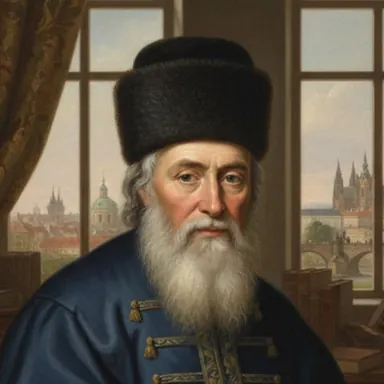
Rabbi Yechezkel Landau, the "Noda bi-Yehuda"
16 min read3,234 words
Summary
This source surveys the life and work of Rabbi Yechezkel Landau, known by his appellation the "Noda bi-Yehuda", who was one of the great spiritual leaders and halakhic decisors of the 18th century. The text presents the rabbi's move from the community of Yampol to the rabbinate of the city of Prague, where he shaped a scholarly method that distances itself from abstract pilpul and strives for straightforward reasoning connected to practical reality. The author examines the rabbi's groundbreaking rulings on issues such as the Get of Kleve, autopsies and shaving on Chol ha-Moed, alongside his complex engagement with the Hasidic movement on the one hand and the first buds of the Haskalah movement on the other. In conclusion, the article stresses his monumental contribution to halakhic literature through his principal works, and describes how he combined loyalty to the government with conservative yet pragmatic leadership in an era of profound social change.
Halakhic Leadership in an Era of Change: The Work, Torah Teaching and Storms of the Generation of Rabbi Yechezkel Landau, the "Noda bi-Yehuda"
Biography, Family Lineage and His Rise to Leadership
Rabbi Yechezkel Segal Landau was born on 18 Cheshvan 5474 (7 November 1713) in the city of Apta (Opatów) in Poland, to the Landau family, whose lineage is traced back through the generations to Rashi.[1] His father, Yehuda Segal Landau, served as a parnas (lay leader) of the Apta community and as a prominent leader in the Council of Four Lands, and his mother Chaya was the daughter of Rabbi Eliezer, head of the rabbinic court of Dubno.[1] These family roots gave him a unique social standing and access to the centers of Torah and of public leadership in Europe, which later found expression in the building of close ties with the leadership of the various communities and with the institutions of government.[1]
Rabbi Yechezkel received his early education from his father and from the rabbi of Apta, Rabbi Moshe Yaakov, with whom he engaged in Torah dialectics as a child.[1] Until the age of eleven he studied with Rabbi Yitzchak Isaac Segal of Ludmir, and at the age of bar mitzvah he went to study in the famous Kloyz in Brody.[1] There he acquired an especially broad Torah education, which included, alongside in-depth study of the Babylonian Talmud and the halakhic decisors, also the study of Scripture and its commentators, Kabbalah, Jewish philosophy, Hebrew grammar, languages (mainly German), mathematics and medieval history.[1] This multidisciplinary education shaped the practical, moderate and realistic approach that he adopted in later years toward the demands of modernity and of the government.[1, 2]
At the age of eighteen he married Liba, daughter of the magnate Yaakovke of Dubno, and moved to live in Brody.[1] At the age of only twenty, in the year 5494 (1734), he was appointed a dayan (judge) in one of the community's rabbinic courts and served there for about ten years.[1] His tenure in Brody was cut short following a trenchant and uncompromising ruling he issued against the wife of the city's magnate, who was suspected of grave adultery.[1, 3] This ruling, which challenged the economic hegemony of that period, led to a vicious denunciation to the authorities, and Rabbi Yechezkel was forced to leave the city in haste.[1, 3] Other leading dayanim left together with him, among them Rabbi Meir Margaliot and Rabbi Avraham Gershon of Kitov, the brother-in-law of the Baal Shem Tov.[1]
After a short transitional period in his father-in-law's home in Dubno, he was appointed in the year 5505 (1745) rabbi and head of the rabbinic court of Yampol, where he founded a yeshiva and enacted the first communal ordinances.[1] In the year 5515 (1755) he accepted the rabbinic post in the community of Prague – one of the most important and largest communities in Central Europe – where he served until his death.[1, 4]
The beginning of his tenure in Prague was accompanied by intense internal tensions, when a group of local Torah scholars who opposed his appointment tried to trip him up by preparing a list of complicated and intricate halakhic questions.[5] Rabbi Yechezkel solved them all successfully except for one question, on which he gave an erroneous ruling, yet despite this single stumble he established his unshakable scholarly standing in the community.[5]
During his years in Prague, Rabbi Yechezkel developed a close relationship with the authorities of Bohemia and with the Empress Maria Theresa.[1] During the Seven Years' War he showed deep loyalty to the Habsburg royal house, delivered eulogies in Yiddish on the death of the Empress, and later even encouraged the Jewish soldiers who enlisted in the imperial army following the compulsory conscription law imposed by Emperor Joseph II in 1789.[1, 6]
In the year 5532 (1772) a great fire broke out that burned his house and consumed most of his manuscripts, a disaster after which he began systematically to restore and publish his works.[1] In his last years, after the death of his wife in the year 5544, he handed over the post of head of the yeshiva to his son, Rabbi Shmuel Segal Landau, who continued his path in the leadership of the community and in the rabbinic court of Prague after his death on 17 Iyar 5553 (29 April 1793).[1, 4]
The Scholarly Method: The Struggle against Abstract Pilpul and the Connection of Torah to Reality
In the eighteenth century the Torah world of Ashkenaz and Poland underwent a profound methodological upheaval. The sharp "pilpul" method, which had developed since the days of the Tosafists and became extreme in the period of the Acharonim, often turned into an abstract intellectual pastime cut off from the aim of reaching practical halakhic rulings.[7] This method led to the pursuit of acuity for its own sake, while drifting away from the plain meaning and from the connection between the Torah and the real circumstances of life.[7, 8] As a result, many yeshiva students tended to delve into abstract pilpulim, while their practical halakhic knowledge remained meager and superficial.[8]
Rabbi Yechezkel Landau stood firmly against this trend and offered a clear educational and scholarly alternative. In the yeshiva he founded and directed in Prague, he instituted a strict daily schedule in which he gave four fixed lectures every day: two in Gemara and two in Shulchan Arukh.[1] This structure reflected his scholarly worldview, according to which in-depth Talmudic study must not be separated from settled halakha. His method was characterized by a constant striving for "straightforward reasoning" (sevara yeshara) and for the plain meaning of the texts, while rejecting idle pilpulim not grounded in sound logic and comprehensive erudition.[8] Through this method the Noda bi-Yehuda restored the crown of halakhic ruling to the center of yeshiva activity, and raised students who saw study as a living tool shaping the practical life of the Jewish community.
His Halakhic and Torah Writings
The works of Rabbi Yechezkel Landau are regarded to this day as solid foundations of the literature of halakha and of scholarly-Torah inquiry, each of them addressing a different layer of the Jewish bookshelf.
Groundbreaking Halakhic Rulings and the Controversies of the Generation
Rabbi Yechezkel Landau was known as a decisor of exceptional stature who did not hesitate to express independent and original opinions, at times with a tendency to be lenient where he identified a pressing public or economic need, while confronting a conservative and forceful rabbinic front.
Shaving on Chol ha-Moed and the Halakhic Mechanism of a Rabbinic Penalty
One of the most famous and daring rulings of the Noda bi-Yehuda is his permission to shave during Chol ha-Moed under certain conditions.[1, 3, 9] The source of the law is the Mishnah in tractate Mo'ed Katan (13b), which forbids shaving during the festival, except in special cases such as one who comes from overseas or from captivity.[9] The Gemara explains that this prohibition was intended "so that they should not enter the festival in an unkempt state", that is, the Sages imposed a penalty on one who did not shave on the eve of the festival in order to compel him to enter the festival in a dignified manner.[9]
Relying on the opinion of Rabbenu Tam (quoted in the Tur, Orach Chaim, section 531), the Noda bi-Yehuda argued that one who shaved before the festival (on the eve of the festival) is not included in this penalty, and is permitted to shave on Chol ha-Moed, since he has shown that he did not enter the festival unkempt.[9] The Noda bi-Yehuda ruled to permit this in practice (Orach Chaim, section 13), a ruling that aroused fierce opposition among the great authorities of his generation.[3, 9] The Chatam Sofer forbade it with sharp stringency and argued that "destruction will come of it", out of concern that permitting shaving would lead to the nullification of explicit words of the Gemara.[9] The Chida too forbade it firmly, out of concern that permitting shaving on Chol ha-Moed would eventually lead to permitting shaving on Shabbat.[9]
Autopsies and the Principle of "a Patient Before Us"
A medical-halakhic issue with long-term influence was formulated by the Noda bi-Yehuda in his famous responsum on autopsies (Yoreh De'ah, section 210).[3, 10] He laid down a fundamental and severe prohibition on autopsies for the purposes of general medical study and research, on account of the prohibition against disfiguring the dead.[10] Nevertheless, he defined the single exception, based on the definition of "a patient before us" (choleh lefaneinu).[10] According to this principle, only when there is a specific patient currently under medical treatment whose life depends directly and immediately on the information to be obtained from the autopsy is it permitted to disfigure the dead, because saving a life overrides everything.[10]
Over the years, and with the development of medical technology, this principle acquired a new and fascinating meaning. In the modern era, in which computerized databases and global communication networks share medical information in real time, there are decisors who argue that today every study and every autopsy counts as a situation of "a patient before us", since the information is disseminated at once and helps heal active patients all over the world.[10] This complex position highlights the dynamism of his ruling, although reasonings of this kind for permitting sweeping medical studies for kohanim or unrestricted autopsies were utterly rejected by later decisors, foremost among them Rabbi Moshe Feinstein.[10]
The Affair of the Get of Kleve
The affair of the Get of Kleve (1766–1767) was one of the greatest halakhic storms that divided the rabbinic world in Europe.[11] A bridegroom named Yitzchak Neuburg of Mannheim, who suffered from severe mental anxieties and a fear of death immediately after his wedding to Leah Gunzhausen of Bonn, took the dowry money and fled.[11] Later, he asked to divorce his wife so as not to leave her an agunah before he sailed to England.[11] The get was arranged in the town of Kleve by the community's rabbi, Israel Lipschitz, who was persuaded that the bridegroom spoke in a settled and rational state of mind.[11]
The bridegroom's father turned to the rabbi of Mannheim, Rabbi Tevele Hess, and he declared the get void on the grounds that the bridegroom had been "a fool and insane" at the time he gave it, and was therefore not fit to divorce.[11] The rabbis of the Frankfurt community (among them Rabbi Avraham Abish of Lissa) joined the opinion of Rabbi Hess and determined that the woman was still a married woman, while refusing to give reasons for their ruling and relying on ancient communal ordinances that prevented outside rabbis from interfering in their affairs.[11]
Rabbi Yechezkel Landau intervened actively in the affair and led a firm and uncompromising halakhic line in favor of validating the get.[3, 11] He sided with Rabbi Lipschitz of Kleve, and together with prominent spiritual leaders such as Rabbi Yaakov Emden, Rabbi Saul of Amsterdam and Rabbi Aryeh Leib Gunzberg (the "Sha'agat Aryeh"), declared the get entirely valid.[11] This ruling prevented a grievous case of iggun and protected the authority of local rabbinic courts against the high-handed dictates of powerful communities.[11]
Standing at the Front of Legitimate Conservatism: Hasidism and Haskalah
Rabbi Yechezkel Landau worked in a period in which two powerful ideological movements began to challenge the traditional structure of the Jewish community in Europe: the Hasidic movement on the one side, and the Haskalah movement on the other.[1, 2]
The Struggle against Hasidism and the Recitation of "Le-Shem Yichud"
The Noda bi-Yehuda's opposition to Hasidism stemmed mainly from his fear of the breaching of accepted halakhic boundaries and of communal division, particularly against the background of the trauma of Sabbateanism, which still hovered over European Jewry.[1] A prominent point of friction was the Hasidic custom of prefacing every commandment and prayer with the recitation of the formula "Le-shem yichud Kudsha Brikh Hu u-Shekhintei" (for the sake of the unification of the Holy One, blessed be He, and His Divine Presence).[12, 13]
In his famous responsum (Yoreh De'ah, section 93), the Noda bi-Yehuda came out with great fury against this custom and called those who practice it "destroyers of the generation".[13] He argued that uttering secret, kabbalistic intentions aloud, based on the teaching of the Ari, harms the simple intention of the heart and creates an illusion of mystical understanding among masses who are not worthy of it.[12, 13] Of this generation he said with biting irony: "The ways of the Lord are right, and the righteous walk in them, but the Hasidim stumble in them" (deliberately replacing the original word "u-foshe'im" (but transgressors) with the word "chasidim").[13]
His strictness on this subject found practical expression when he refused to lend his personal lulav to a Jew who wished to preface the blessing with the kabbalistic "Yehi Ratzon" prayer, out of a desire to uproot any deviation from the accepted liturgical text.[13]
This conception of his is consistent, in certain respects, with the teaching of Rabbi Chaim of Volozhin (the foremost disciple of the Vilna Gaon), who stressed in his books "Nefesh ha-Chaim" and "Ruach Chaim" that the essence of "Torah for its own sake" is the study of Torah for the sake of the commandment itself and the joining of thought to the fear of Heaven before study, without any need to recite verbal "Le-shem yichud" formulas.[12]
The Complex Attitude to the Haskalah Movement and the Epistle "Divrei Shalom ve-Emet"
In 1782 Naphtali Herz Wessely published the public epistle "Divrei Shalom ve-Emet" (Words of Peace and Truth), in which he called on the Jews of the Empire to carry out a comprehensive reform in the education of children and to include secular studies and foreign languages, following the "Edict of Tolerance" issued by Emperor Joseph II.[2] The Noda bi-Yehuda's response to this epistle reveals a sophisticated pattern of action that distinguishes between an uncompromising ideological struggle and a practical and moderate approach to the economic needs of the hour.[2]
On the eve of Rosh Chodesh Shevat 5542 (15 January 1782), when the epistle reached him, the Noda bi-Yehuda delivered a sharp sermon before the Jews of Prague in which he condemned Wessely and called him an "apikoros" (heretic), but at the same time praised the Emperor and the demands of the Edict of Tolerance.[2] He sent letters to other leading rabbis in Europe, among them Rabbi Meir Barby of Pressburg and Rabbi Gershon Chayes of Nikolsburg, and determined that Wessely "deserves to be excommunicated".[2] He refrained from placing a formal ban on him solely because of the legal prohibition imposed by the government on imposing communal bans without government approval.[2]
In his Shabbat ha-Gadol sermon in Nisan 5542 he again attacked Wessely for his words disparaging Torah scholars who lack "derekh eretz", but once more stressed his loyalty to the laws of the state and his support for the study of the German language and grammar.[2]
His practical educational approach was formulated clearly in his sermon of the month of Tishrei 5544 (printed in his book "Olat Chodesh Sheni").[2] In this sermon he declared that he did not object to accustoming the children – when they leave the school in which they studied the Torah of the Lord – to learn also writing, a foreign language and arithmetic, and he even called these studies "a great improvement and an improvement for the state".[2] He explained that there is a real concern that some of the children will not persevere in Torah study when they grow up, and will eventually become merchants.[2] In such a situation, without knowledge of the written language, basic arithmetic and the language of the land, they would not be able to make an honorable living, and the inhabitants of the land would not understand one another's speech.[2] This position makes clear that the Noda bi-Yehuda knew how to distinguish between an ideological reform that threatens the authority of halakha and the practical inclusion of secular studies necessary for the economic integration of the masses of the people.[2]
His Foremost Disciples and the Continuation of His Legacy
The network of the Noda bi-Yehuda's disciples spread his Torah teaching throughout Central Europe, and led the communities during the difficult transition to the modern era.[1]
The most prominent of his disciples was Rabbi Elazar Fleckeles (1754–1826), who served as head of the rabbinic court of Prague.[14, 15] Rabbi Elazar served as a dayan close to his teacher, fought vigorously against the Sabbatean sect that operated secretly in Prague, and composed the famous book of responsa "Teshuvah me-Ahavah".[14, 15] He explained the choice of the book's title by four complementary reasons that reflect the spirit of learning he received from his teacher [15]:
- The responsa were not composed out of desire for money or personal benefit, but out of love for the pure halakhic answer.[15]
- The book is meant to be a response and an answer for whoever reads the words out of love and understanding, and not out of prior hatred and enmity.[15]
The title contains an allusion to his personal name in gematria: the word "shuv" is equal to the numerical value of "Elazar", and the expression "Teshuvah me-Ahavah" is equal to the numerical value of "Elazar son of our master Rabbi David of blessed memory".[15]
The offering of a prayer and an expression of hope that the book and its rulings will be beloved and acceptable before the Omnipresent (the Holy One, blessed be He).[15]
Alongside Rabbi Elazar Fleckeles, the Noda bi-Yehuda raised other prominent disciples, among them Rabbi Betzalel Ronsburg, Rabbi David Deutsch, and Peretz Beer.[1] These disciples founded yeshivot and led communities, combining the straightforward scholarly method of Prague with responsible public leadership connected to the needs of the generation and the changes of the time.[1]
Sources15
- 1.יחזקאל לנדא – ויקיפדיה, he.wikipedia.org/wiki/יחזקאל_לנדא
- 2.דברי שלום ואמת – ויקיפדיה, he.wikipedia.org/wiki/דברי_שלום_ואמת
- 3.נודע ביהודה – ויקיפדיה, he.wikipedia.org/wiki/נודע_ביהודה
- 4.רבי יחזקאל לנדא, ה"נודע ביהודה" - אישי ישראל - WordPress.com, isheiisrael.wordpress.com/2018/01/01/רבי-יחזקאל-לנדא-הנודע-ביהודה/
- 5.מדוע נכשל הנודע ביהודה? - BeitChabad.com - בית חב"ד, he.chabad.org/library/article_cdo/aid/1344549
- 6.רבי יחזקאל לנדא – ויקישיבה, yeshiva.org.il/wiki/index.php/רבי_יחזקאל_לנדא
- 7.שיטת הפלפול - ויקיפדיה, he.wikipedia.org/wiki/שיטת_הפלפול
- 8.לשלב לימודי הלכה בישיבות - צריך עיון, iyun.org.il/sedersheni/halacha/
- 9.ביאור:גילוח בחול המועד - מקורות להיתר ואיסור - ויקיטקסט, he.wikisource.org/wiki/ביאור:גילוח_בחול_המועד_-מקורותלהיתר_ואיסור
- 10.לימוד רפואה לכהנים - עולמות, olamot.net/shiurim/לימוד-רפואה-לכהנים/
- 11.הגט מקליווא – ויקיפדיה, he.wikipedia.org/wiki/הגט_מקליווא
- 12.אמירת לשם ייחוד - מנחת אשר, minchasasher.com/he/shiur/פרשה-שיעורים/אמירת-לשם-ייחוד-תשעז/
- 13.דברי הנודע ביהודה כנגד ה"לשם יחוד" של האריז"ל - כיכר השבת, kikar.co.il/haredim-news/sjjx3q
- 14.אלעזר פלקלס | מקורות מתוך ספריית ספריא, sefaria.org.il/topics/elazar-fleckeles
- 15.אלעזר פלקלס - ויקיפדיה, he.wikipedia.org/wiki/אלעזר_פלקלס