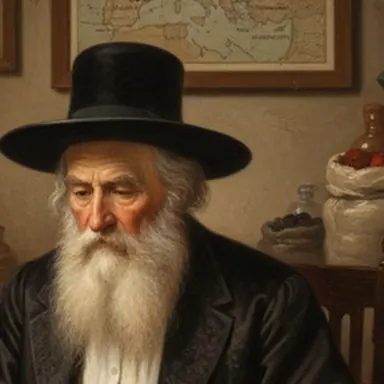
Rabbi Avraham Danzig
15 min read2,964 words
Summary
This text surveys the halakhic and educational teaching of Rabbi Avraham Danzig, a key figure in Eastern Europe who linked the world of classical Torah scholarship with the modern era. The work emphasizes how his personal experience as a merchant and man of affairs enabled him to make halakha accessible to the broad public in clear language, while creating a synthesis between the learning methods of Prague and Vilna. At the heart of his work is the book "Chayei Adam", which became a pillar of Ashkenazi halakhic decision-making thanks to its organization by thematic "principles" (kelalim) and to its giving a reason for every law, a step that later served as a central foundation for the writing of the "Mishnah Berurah". Beyond dry legal ruling, the source sheds light on the author's moral worldview, as expressed in his testament and in his varied works, which encompass all areas of Jewish life and faith.
The Torah Teaching and Halakhic Work of Rabbi Avraham Danzig: A Multidimensional Analysis of "Chayei Adam" and Its Era
The history of halakhic decision-making in Eastern Europe at the turn of the 18th and 19th centuries cannot be fully understood without a thorough examination of the figure and work of Rabbi Avraham Danzig . As one who lived and worked in the heart of the Torah center of Vilna, in the period of transition between the world of the classical "Acharonim" and the beginning of the modern era, he succeeded Rabbi Avraham Danzig in bringing about a quiet but profound revolution in the way halakha was made accessible to the masses of the people and to scholars alike.[1, 2] His central work, the book "Chayei Adam", became one of the pillars of Ashkenazi halakhic decision-making, and served as a methodological bridge that eventually led to the writing of the "Mishnah Berurah" almost a hundred years later.[3, 4] His work reflects a unique combination of deep scholarship, a modern educational conception and rich life experience as a merchant and man of affairs, a combination that gave his rulings special validity and a direct connection to the everyday reality of European Jewry.[5]
Roots and Growth: The Biographical Path and the Influences of Prague
Rabbi Avraham Danzig was born in 5508 (1748) in the city of Danzig (Gdańsk) in Poland, which at that time was a significant commercial and spiritual center.[2, 6] The environment of his birth, marked by exposure to European cosmopolitanism on the one hand and to a deep scholarly tradition on the other, laid the foundations for his broad and systematic approach. In his youth he went to study in Prague, which was one of the most important Torah centers in Central Europe. There he became the principal disciple of Rabbi Yechezkel Landau, author of the "Noda bi-Yehuda", and he also studied with Rabbi Yosef Liberman.[2, 5]
His period of study in Prague was decisive for his methodological formation. The "Noda bi-Yehuda" was known for his clear style, his striving for the plain meaning (peshat) and his approach, which combined straightforward pilpul with realistic halakhic decision. These influences are clearly evident in all of Rabbi Avraham's writings, which move away from abstract pilpul in favor of categorical clarity. Testimony to his early maturity in Torah can be found in the certificate of "chaver" that his teacher, Rabbi Yosef Liberman, granted him when he was only 18. In this certificate Rabbi Avraham was described as "young in days and tender in years, yet his mind as settled as the mind of elders", with emphasis on his exceptional mastery of the Talmud and the halakhic decisors.[5] This certificate of ordination is not merely a formal document, but testimony to the recognition by the great sages of the generation that a sage of stature had grown up before them, combining comprehensive erudition with a mature capacity for analysis.
After his marriage to Sarah, daughter of Moshe son of Rabbi Akiva Segal, Rabbi Avraham moved to live in Vilna.[2] Vilna at that time was under the mighty influence of the Gra (the Gaon Rabbi Eliyahu), and Rabbi Avraham's move from the scholarly world of Prague to the world of Vilna created a fascinating synthesis in his writings. He became one of those closest to the Gra's circle, a connection that grew even closer when his son married a granddaughter of the Gra (the daughter of Rabbi Yehuda Leib).[1, 5] This tie by marriage gave him direct access to the Gaon's teaching, which he disseminated and transmitted in his books, although more than once he maintained the independence in halakhic ruling that had characterized his years of study in the West.[5]
The Ideal of "Torah with Derekh Eretz": The Merchant as Halakhic Decisor
One of the features that set Rabbi Avraham Danzig apart from the other decisors of his generation is his consistent refusal, for most of his years, to earn his living from the rabbinate. He saw this as the fulfillment of the ideal "not to derive benefit from the crown of the Torah".[2] For his livelihood he engaged in trade, and he was a regular participant in the great fairs in Leipzig, where he came into contact with merchants and men of affairs from all over Europe.[6] This period of his life was not merely an economic necessity, but a human and halakhic laboratory. It enabled him to understand in depth the challenges facing an observant Jew who is on the road, engaged in trade and required to make quick halakhic decisions in a changing reality.
The influence of his world as a merchant is clearly evident in the style of writing of "Chayei Adam". He does not write as one who sits in an academic ivory tower, but as one who knows the limited time of the working man.[7] In his introduction to the book he explains that his aim is to provide a halakhic code accessible to every person, so that even one whose time is not his own may know the deed he must do, precisely and clearly.[8] Only in his old age, after he lost his wealth following heavy losses in his trade, did he accede to the request of the Vilna community and take upon himself the office of dayan (rabbinic judge).[1, 6] His tenure as a dayan in Vilna was highly significant; he testified of himself that "instruction did not depart from his house and nothing was done in Vilna without his consent", testimony to his central standing in the leadership of the community, both in Torah and in public affairs.[5]
The "Adam" Enterprise: The Structure and Methodology of the Halakhic Books
Rabbi Avraham Danzig's halakhic work is organized around the concept of "Adam" – a name that is an acronym (notarikon) of his first name, but that also reflects an anthropocentric conception of the Torah: the Torah is meant to shape the life of the human being.[9] His literary enterprise is divided into two main layers, corresponding to the two parts of the Shulchan Arukh most relevant to daily life: Orach Chaim and Yoreh De'ah.
Chayei Adam and Nishmat Adam: The Jewish Code of Conduct
The book "Chayei Adam", first published in 1810, deals with the "Orach Chaim" part – the laws of prayer, blessings, the Sabbath and festivals.[1, 10] The book's methodology was innovative for its time: instead of following the order of the "simanim" (sections) of the Shulchan Arukh, Rabbi Avraham arranged the laws in thematic "kelalim" (principles).[3, 10]
- Accessibility: The book was written in simple and clear language, with the intention that it could be studied in public or individually without the need for complex commentaries.[1, 4]
- Reasoning and context: For each law its reason is given – whether it is from the Torah, from the words of the Scribes, a custom or "a matter of piety" (milei de-chasiduta).[8] This distinction was critical in a period of social change, so that the learner would know what is the core of the obligation and what is a stringency.
- Nishmat Adam: As a companion to "Chayei Adam", Rabbi Avraham composed "Nishmat Adam" – the section of analyses and pilpul intended for Torah scholars, in which he gives the grounds for his decisions on the basis of the sources in the Gemara, the Rishonim and the Acharonim.[1, 2] This division allowed him to keep a simple text for the masses without giving up scholarly depth for the elite.
Chokhmat Adam and Binat Adam: The World of the Forbidden and the Permitted
In 1812 he published "Chokhmat Adam", corresponding to the "Yoreh De'ah" part, which deals with the laws of kashrut, vows, mourning and more.[1, 11] In the name of the book he alluded to the words of the Sages that wisdom (chokhmah) is what a person learns from others, whereas understanding (binah) (which appears in the companion book "Binat Adam") is the ability to understand one thing from another.[9] This book is considered more challenging because of the nature of the laws in it, but Rabbi Avraham succeeded in creating a masterly summary of the positions of the Turei Zahav (Taz) and the Shach, deciding their disputes according to the accepted rules of halakhic decision.[1, 12]
The Relationship with the Gra of Vilna: Esteem, Criticism and Adaptation
The relationship between Rabbi Avraham Danzig and the Gra is one of the complex subjects in his teaching. On the one hand, he saw the Gra as the supreme authority and the "guide" of the generation. In his book "Zikhru Torat Moshe" he meticulously documents the order of study of the Gra, whom he calls "my kinsman by marriage, our master, our teacher and our rabbi, the Gaon of Israel and its holy one", and he argues that this order is "as if commanded to us from the mouth of Moses our teacher".[5] His esteem for the Gra also found expression in the eulogies he delivered for him and in the extensive incorporation of his rulings into "Chayei Adam".
Nevertheless, Rabbi Avraham was not a self-effacing follower. As one who had been educated at the knees of the "Noda bi-Yehuda", he preserved his intellectual independence and did not hesitate to disagree with the Gra in places where he held that the halakhic tradition or the plain meaning of the Talmudic passage required otherwise.[5] This phenomenon aroused resentment among some of the Gra's disciples in Vilna. In response, in his later work "Chokhmat Adam", Rabbi Avraham took a more cautious approach: he refrained from citing the words of the Gra in places where he intended to disagree with him, so as not to offend the honor of his teacher and kinsman in public.[5] This tension reflects the transition of the Lithuanian Torah world from an era of solitary genius to an era of orderly codification, in which the decisive tradition of the "Acharonim" plays a central role.
Pulverpurim: The Personal Miracle That Became a Family Tradition
Rabbi Avraham's life was not free of personal dramas. A formative event took place in 1804 (5564), when a fire broke out in a gunpowder store ("pulver" in Yiddish) next to the Danzig family home in Vilna. The violent explosion that followed caused the deaths of 31 people and great destruction.[2] Members of Rabbi Avraham's family were in the house at the time, and although the house collapsed on them, they came out of the event only injured but alive.
Rabbi Avraham saw their rescue as a manifest miracle and a wondrous act of particular providence. In memory of the event, he instituted for his family a fixed annual festival on 4 Tishrei (the later day of his death), which he called "Pulverpurim" – a Purim of gunpowder.[2] He laid down special regulations for this day, including a feast of thanksgiving and gifts to the poor, thereby continuing the Jewish tradition of creating a "personal Purim" to mark deliverance from disaster. This event testifies to the depth of his faith and to his conception that everyday life is interwoven with miracles that call for recognition and thanksgiving.
Further Works: From the Laws of the Sabbath to the Commandments of the Land
The list of Rabbi Avraham Danzig's works is long and varied, and it shows the scope of his knowledge and his desire to encompass all areas of Jewish life:
- Zikhru Torat Moshe: A systematic abridgment of the laws of the Sabbath. The book is known for its methodical division and for its arrangement of the 39 categories of forbidden labor in a way that makes them easier to remember and to apply in practice.[1, 2, 6]
- Mitzvot Moshe (an abridgment of Sefer Charedim): An adaptation of the famous work of Rabbi Elazar Azikri. Rabbi Avraham rearranged the 613 commandments according to the limbs of the body that perform them, thereby creating a moral and halakhic aid for self-education.[1, 2]
- Sha'arei Tzedek: A work exceptional for its time in the Diaspora, dealing with the commandments dependent on the Land. The book is divided into two gates: "the Gate of the Commandments of the Land" and "the Gate of the Laws of the Land".[2, 13, 14] The writing of the book stemmed from his great esteem for the Land of Israel and from the conception that the Torah must be studied in its entirety, including those parts that do not apply in practice outside the Land.
- Toldot Adam: An in-depth commentary on the Passover Haggadah, combining halakhic explanations with ideas of faith.[1, 2]
- Divrei Chakhamim: A book recently discovered in manuscript (and printed in 5783), which includes novellae on the Talmud and homilies on the Torah portions that he composed in his youth, most of them from the mouths of his teachers in Prague.[2]
His Moral and Educational Teaching: The Testament "Beit Avraham"
Rabbi Avraham Danzig's importance extends beyond the world of pure halakha into the world of mussar and education. His work "Beit Avraham", which is his spiritual testament, was first printed in 5581 (1821), close to his death, and became one of the most widespread mussar books in Lithuania (more than 20 editions up to the middle of the 20th century).[5]
In his testament Rabbi Avraham stresses the importance of Torah study for its own sake and with the fear of Heaven, but he does not content himself with general guidance. He instructs his descendants in the proper ways of study, in the duty to maintain absolute integrity in business, and in the importance of humility and lowliness of spirit.[5] The testament reflects his conception that the Torah is not merely a collection of laws, but a formative force that changes a person's character. Further testimony to his spiritual world is the "Tefillah Zakkah" (Pure Prayer) that he composed, which is recited in all the communities of Israel on the eve of Yom Kippur before "Kol Nidrei" – a prayer steeped in personal confession and in asking forgiveness between one person and another.[5, 15]
Reception and Influence: "Chayei Adam" as a Source of the "Mishnah Berurah"
The success of the book "Chayei Adam" was immediate and unprecedented. Throughout Lithuania and Russia "Chayei Adam societies" were founded – groups of ordinary Jews and merchants who gathered every day to study a chapter of halakha from the book.[5, 15] Its popularity stemmed from the fact that it filled a void: it provided a final and clear ruling where the Shulchan Arukh and its commentaries were at times too complex for anyone who was not a full-time Torah scholar.
Rabbi Avraham Danzig's most decisive influence was on Rabbi Yisrael Meir HaKohen, the Chofetz Chaim, when he came to compose the "Mishnah Berurah". The Chofetz Chaim regarded "Chayei Adam" as a source of authority of the first rank, and he cites it hundreds of times in his work.[4, 10] In some cases the ruling of the "Mishnah Berurah" is in fact an adoption of the decision of "Chayei Adam". The connection between the two works is so close that to this day many study "Chayei Adam" alongside the "Mishnah Berurah" in order to understand the development of halakha in that period.[16]
Summary of His Figure and Legacy
Rabbi Avraham Danzig represents the best of the scholarship of Lithuania and of Prague alike. He was a man of many talents who joined worlds: yeshiva pilpul and turbulent commercial life, communal religious leadership and educational writing for the masses. His books, foremost among them "Chayei Adam", are not merely halakhic books but testimony to an attempt to create a Jewish society aware of its obligations and acting according to a clear and accessible ethical and halakhic code.[1, 4, 7] His death on 4 Tishrei 5581, at the age of 73 (the numerical value of the name of his book "Chayei Adam"), marked the end of a glorious chapter in the leadership of Vilna, but his legacy continues to pulse in the study halls and in Jewish homes to this very day.[5]
Sources16
- 1.אברהם דנציג | טקסטים ודפי מקורות מן התורה, התלמוד וספריית המקורות של ספריא., sefaria.org.il/topics/abraham-danzig
- 2.אברהם דנציג - ויקיפדיה, he.wikipedia.org/wiki/אברהם_דנציג
- 3.חיי אדם - ויקיפדיה, he.wikipedia.org/wiki/חיי_אדם
- 4.חיי אדם - מנוקד - מוקטן - המדף היהודי, hamadaf-y.co.il/חנות/הלכה-ושותים/עוד-בהלכה/חיי-אדם-מנוקד-מוקטן/
- 5.צוואת רבי אברהם דנציג בעל "חיי אדם" – ווילנא, תקפ"א – מהדורה ראשונה - Kedem Auctions, kedem-auctions.com/he/ספר-בית-אברהם-–-צוואת-רבי-אברהם-דנציג-בעל-חיי-אדם-–-ווילנא-תקפא-–-מהדורה-ראשונה
- 6.אנציקלופדיה יהודית דעת - דנציג רבי אברהם ;, daat.ac.il/encyclopedia/value.asp?id1=60
- 7.הקדמת המחבר א׳ - ספר ספר חיי אדם - אשובה, ashoova.co.il/ask/k/הקדמת-המחבר-א׳-ספר-ספר-חיי-אדם/
- 8.חיי אדם - ויקיטקסט, he.wikisource.org/wiki/חיי_אדם
- 9.חכמת אדם, הקדמת המחבר, sefaria.org.il/Chokhmat_Adam,_Author's_Introduction
- 10.חיי אדם - ספריא, sefaria.org.il/Chayyei_Adam
- 11.חכמת אדם -- דנציג, אברהם בן יחיאל מיכל, 1748-1820 - HebrewBooks.org Sefer Detail, hebrewbooks.org/14718
- 12.בינת אדם - ספריא, sefaria.org.il/Binat_Adam
- 13.ספר שערי צדק [שני חלקים בכרך אחד] [ירושלים 1864] / דנציג, אברהם בן יחיאל מיכל. - The Book Gallery, bookgallery.co.il/content/hebrew/bookpageschema.asp?BookPageID=82941
- 14.HebrewBooks.org 35741 שערי צדק -- דנציג, אברהם בן יחיאל מיכל, 1748-1820, beta.hebrewbooks.org/35741
- 15.בית וילנה והסביבה, vilna.co.il/האיגוד/אודות/דלת-הכניסה-של-בית-וילנה/
- 16.חיי אדם עם נשמת אדם ע"פ משנה ברורה - ב"כ - Judaica Spot, judaicaspot.com/products/חיי-אדם-עם-נשמת-אדם-עפ-משנה-ברורה-בכ