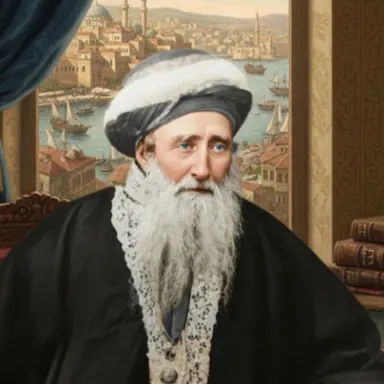
Halakha as social leadership: ethics, peace and education as a binding public system.
Biography
A halakhic authority and leader who founded charitable and educational institutions, set communal ordinances, and left an enormous body of writing despite losing manuscripts in a fire.
Writings on Sefaria
The writings of Hayyim Palache can be read on Sefaria, a free library of Jewish texts. A title opens the text itself.
Leadership, Halakha and Social Repair: The Work and Torah Teaching of Rabbi Chaim Palagi (the Chabif)
12 min read·2,462 words
Summary
This survey outlines the life and Torah teaching of Rabbi Chaim Palagi (the Chabif), one of the greatest halakhic decisors and leaders of Sephardic Jewry in Izmir in the 19th century. The text stresses how, alongside a phenomenal literary productivity that includes dozens of works combining halakha and Kabbalah, the Chabif acted as a radical social leader who fought for social justice through reforms in communal taxation and enactments of compulsory education for children. Beyond his religious standing as "Chacham Bashi," the source describes the exceptional state recognition he received from the Ottoman authorities, which illustrates his decisive influence on shaping the modern face of the Jewish community. The article sums up his legacy as a rare combination of conservative halakhic authority and deep human sensitivity, which turned the Torah into an instrument of social repair and public health.
Biographical Introduction and Family Background in Izmir
Rabbi Chaim Palagi, called in Torah and historical literature the Chabif or Moharchaf, is regarded as one of the greatest halakhic decisors and leaders of Sephardic Jewry in the nineteenth century.[1, 2, 3] He was active in the city of Izmir in the Ottoman Empire, which was at that time a vibrant spiritual and cultural center.[2, 4] The Chabif was born into a distinguished and highly influential family; his father, Rabbi Yaakov Palagi, was a renowned rabbi and kabbalist, and his mother, Kali Kadin, was the daughter of the leader of the generation, Rabbi Yosef Raphael ben Chaim Chazan.[4, 5] The grandfather, author of the monumental book of responsa "Chikrei Lev," served at the end of his life as Rishon LeZion in Jerusalem and was the central figure who shaped his grandson's education, public standing and halakhic path.[4, 5]
Rabbi Chaim's diligence in his childhood and youth was proverbial in the accounts of his life. Various biographical testimonies note that from his early youth until he reached the age of twenty he did not cease from his study day and night, avoiding any neglect of Torah.[4, 6] He acquired the foundations of his learning in the "Beit Yaakov Rabbi" yeshiva in Izmir, where he studied under the guidance of the greatest sages of the time, among them Rabbi Yitzchak Mayo, Rabbi Yitzchak Gatigno and Rabbi Pinchas Raphael Yehoshua de Segura.[4, 6, 7] At the age of nineteen he married Esterula, the daughter of the magnate Rabbi Yitzchak Rabbi, one of the yeshiva's chief financial supporters.[4, 6] This marriage into a house of Torah and greatness enabled him to continue devoting himself to his study without the burden of earning a living.[6]
Historical research points to a number of chronological discrepancies in the various sources concerning the dates of the Chabif's birth and death, as well as the exact age at which he was appointed to his various offices. This lack of clarity usually stems from the complex transition between the different calendars (Hebrew, Julian and Gregorian) that were current in the Ottoman Empire and in Europe at that period.
The Family Dynasty and Imperial Standing in the Tanzimat Era
The period of Rabbi Chaim Palagi's leadership largely overlapped the "Tanzimat era" in the Ottoman Empire, a period characterized by modernizing reforms, increased governmental centralization and a reorganization of the status of religious minorities.[4, 5] Against this background, the Chabif's official appointment as Chacham Bashi in the year 5615 (1855) was not merely an internal religious event, but received an official imperial seal through a royal decree (a "nişan") granted to him by Sultan Abdülmecid I.[4, 9] This decree gave him de facto broad judicial and enforcement powers, including supervision of tax collection and management of public order with the assistance of the Ottoman security forces.[4, 9]
In terms of family, the Chabif stood at the head of a splendid rabbinic dynasty that continued to lead the community devoutly.[5] He raised three sons, all of them prominent Torah scholars: Rabbi Avraham, Rabbi Yitzchak (Rachamim Nissim) and Rabbi Yosef.[4, 5] The sons held conservative worldviews, like their father, and resolutely opposed the penetration of modern Western influences, such as the adoption of European dress among members of the community.[5] The two elder sons later even succeeded him in the leadership of the city.[5] In addition, his grandson (the son of Rabbi Yaakov), named after him Rabbi Chaim Palagi II, continued the dynasty of teaching and served as rosh yeshiva in the central yeshivot "Beit Hillel" and "Beit Yaakov Rabbi."[3] The Chabif's high public standing was also expressed in the award of the prestigious imperial decoration of honor, the "Order of the Medjidie," Third Class (Mecidiye Order Third Class), by the Ottoman authorities, an unprecedented tribute to a Jewish leader at that time.[5]
The Chabif's Literary Empire and His Halakhic Teaching
Rabbi Chaim Palagi is regarded as one of the most prolific authors in the history of halakhic literature and Jewish thought among the Acharonim.[2, 4] The arsenal of his works includes between 70 and 80 books covering all branches of Torah creativity: Bible, Talmud, Midrash, halakha, Kabbalah and mussar.[1, 4, 5, 8] The Chabif used to write his books in the course of his study at the "Beit Hillel" yeshiva, where he conceived most of his works.[4, 5, 8]
Through his writing, the literature of questions and answers (responsa) took on an international dimension; halakhic questions were addressed to him from distant communities in Europe, North Africa and the Middle East.[4, 5, 8] A prominent example of the bibliographical complexity of his books is the monumental book of responsa "Lev Chaim."[5, 10] The book, whose first part was printed as early as the 32nd year of his life, originally suffered from serious printing problems: broken and worn letters that made it very difficult for students.[2, 10] Moreover, the parts of the book were not originally arranged according to the accepted order of the four parts of the Shulchan Arukh, which created a significant difficulty in locating material for rabbinic judges and halakhic decisors.[10] Only in later generations, within the framework of publishing initiatives such as "Ahavat Shalom," was the book reprinted in splendid editions that correct these defects and add detailed indexes.[10]
The Chabif's methodology of halakhic ruling combined the world of formal halakha with the world of the hidden and of Kabbalah.[2] He relied on the hierarchical rules of decision that had taken shape among the sages of Sepharad, and especially on those formulated in the book "Knesset HaGedolah" by Rabbi Chaim Benveniste.[11] These rules direct that where the words of the Zohar and the kabbalists disagree with the Talmud and the decisors, one should rule according to the words of the Gemara.[11, 12] However, in cases where there is no explicit decision in the Talmud, or where there is a dispute among the decisors, the words of Kabbalah and the Zohar serve as a deciding factor.[11, 12] From this methodology grew his books of practices, such as "Kaf HaChaim" and "Moed LeKhol Chai," which combine pure halakha with the kabbalistic intentions of the deed and with ethical practices.[2, 4, 5, 13]
Social Reforms, Public Health and Practical Leadership
The figure of the Chabif was engraved in public memory not only as a detached halakhic genius, but as a courageous and radical social leader who fought valiantly for the weaker strata of society.[4, 8] His leadership placed at its center social justice, the education of children and the health of the public, using his Torah authority to impose structural changes on the community.
Taxation Struggles and the "Gabela" Controversy
One of the most important reforms that Rabbi Chaim led was the controversy over the meat tax (the "gabela").[4] The custom of the communities at that time was to impose a heavy indirect tax on the slaughter of kosher meat in order to finance the community's institutions, a tax that weighed mainly on the poor while the rich avoided paying direct progressive taxes.[4] Rabbi Chaim came out sharply against the rich, accusing them of placing the community's burden on the shoulders of the poor.[4]
He laid down an unequivocal halakha according to which part of the revenue from the "gabela" must be set aside directly to finance the education of the children of the poor and to support Torah students.[4] He made it clear that collecting a tax on meat without this allocation is considered "robbery and violence."[4] This bold ruling led to severe political and economic confrontations with the leadership of the city's magnates, but the Chabif resolutely stood his ground.[4]
The Enactment of Compulsory Education and the Protection of the Child
Rabbi Chaim was ahead of his time in creating a social and educational safety net for children.[4] He instituted a communal enactment amounting to a kind of "compulsory education" law, according to which fathers were forbidden to withdraw their sons from educational institutions and send them to work as apprentices with craftsmen at a young age.[4]
Rabbi Chaim laid down that a boy may not begin to work unless he has completed his basic studies at the Talmud Torah and knows how to read and fully master the order of prayer.[4] For this purpose special supervisory committees were set up, which examined the boys and approved their entry into the labor market only after they had met the requirements.[4] To enable poor families to comply with this enactment, the Chabif saw to the establishment of support funds and of special yeshivot in which the students received respectable living stipends to support their households.[4]
Public Health Enactments and Practical Halakhic Guidance
Another field in which his innovative rulings stood out was public health.[4, 8] The Chabif was among the first halakhic decisors to warn against the harm of smoking and of addiction to tobacco and to strong drink.[9] He instituted a public enactment calling for abstention from smoking cigarettes not only on Shabbat but even on weekdays, because of the health danger involved.[4, 8]
In his book "Kaf HaChaim" (section 11, halakha 19) the Chabif addressed a practical question that combines health, religious decorum and human relations: the custom of taking snuff in the synagogue.[15] The Chabif ruled that it is forbidden to take snuff in the synagogue during the prayer and the cantor's repetition, in order to preserve the sanctity of the prayer and cleanliness, and that if a person gives his fellow snuff, he must do so in an offhand manner so as to prevent levity.[15] However, he qualified this and permitted the distribution of snuff at times that are not clearly times of prayer (such as during the sale of the honors), out of a deep sociological understanding that this custom "increases peace" and brings the hearts of the worshippers closer together.[15]
The Last Days and Passing of the Chabif
Toward the end of his days, on reaching the age of seventy (in the year 5617), the Chabif resolved in his heart to leave Izmir and go up to the Holy Land, an aspiration that had accompanied him all his life.[4] However, word of his intention to leave aroused a storm among the members of the community; the city's notables and sages begged him not to abandon them at this time, and he yielded to their entreaties and remained on the rabbinic seat in Izmir.[4]
On Simchat Torah of the year 5628 (1867), when he was called up to the Torah and read the verse "So Moses died there" with heart-rending weeping, the members of the community sensed that their leader was taking leave of them and that his end was near.[4] In the month of Shevat of that year the Chabif completed the writing of his last book, "Birkat Moadekha LeChaim," signing the introduction just one day before his passing.[2, 4] On the last night of his life he performed Tikkun Chatzot (the midnight lament) with weeping and grief over the exile of the Shekhinah, and on 17 Shevat 5628 (10 February 1868) he returned his soul to his Creator at a ripe old age.[2, 4, 9]
The funeral procession of Rabbi Chaim Palagi is regarded as one of the impressive historical events in the history of Turkish Jewry. Exceptional state honor was accorded to him by the Ottoman authorities; a battalion of armed Turkish army soldiers escorted his coffin, an honor given to only two or three chief rabbis throughout the history of the empire.[4, 5, 9] His funeral was attended by crowds of worshippers, the rabbis of the city and diplomatic representatives of foreign states, with the crowd marching with lit candles and carrying dozens of his books.[4, 5, 8]
He was buried in the old Jewish cemetery of Izmir.[4, 5, 8] His tombstone is the only one in the entire cemetery that faces east (while all the other tombstones face south), a biographical and archaeological peculiarity whose halakhic or kabbalistic reason remains a mystery to this day.[4]
Summary
The work and teaching of Rabbi Chaim Palagi reflect a combination of conservative and uncompromising halakhic authority on the one hand, and deep social and reformist sensitivity on the other. In an era of sharp political and cultural upheavals, the Chabif did not withdraw into the four cubits of halakha, but turned Jewish law into an instrument for achieving social justice, protecting children, fighting economic tyranny and safeguarding public health. The written legacy he left behind, dozens of books that serve to this day as foundational works of halakhic ruling and thought, together with the dynasty of leadership he established, establishes his standing as one of the most influential leaders in shaping the face of Sephardic and Eastern Jewry in the modern era.
16.רבי חיים פלאג'י זצ"ל כותב, שאם יש על אדם גזירה - בעיה בריאותית, עיכוב בשידוך, או שהפרנסה קשה - והוא מנסה לעשות הכל, אך הדבר לא עולה בידו, העצה עבורו היא.. - דרשו, dirshu.co.il/498527/
Document 2/2
The Work, Leadership and Torah Teaching of the Chabif (Rabbi Chaim Palagi)
15 min read·3,071 words
Summary
This text surveys the life and monumental contribution of Rabbi Chaim Palagi (the Chabif), who was among the most prominent spiritual and public leaders of Sephardic Jewry in the 19th century. The article outlines his figure as a many-sided personality who combined profound halakhic learning, expertise in the esoteric teaching and extensive political activity vis-a-vis the Ottoman authorities on behalf of the community in Izmir. Among the central topics of the text are his vast literary enterprise, which includes more than seventy works, and his distinctive method of halakhic ruling, which prefers the principle of "the latest halakha" and combines the revealed world with Kabbalah. In addition, the source stresses his modern social leadership, which found expression in the founding of charitable and medical institutions and in public enactments to improve the health and welfare of the common people.
Lineage, Family Background and the Stages of His Torah Growth
Rabbi Chaim Palagi II, known in the Torah world by the acronym the Chabif (the Gaon Rabbi Chaim ben Yaakov Palagi), stands as one of the greatest and most prolific respondents, kabbalists and halakhic leaders of Sephardic Jewry in the era of the Acharonim.[1, 2, 3] His work, which spanned most of the nineteenth century in the city of Izmir in the Ottoman Empire, was characterized by a rare fusion of profound Talmudic learning, broad kabbalistic expertise and active public leadership in an era of upheaval and modernization.[1, 2]
The Chabif was born in Izmir on 17 Tevet 5548 (28 January 1788) into a distinguished family of sages, and was named after his grandfather, Rabbi Chaim Palagi I, who was the father of Rabbi Yaakov.[1, 2, 3] His father, Rabbi Yaakov Palagi, was a renowned kabbalist and one of the sages of the "Beit Yaakov Bei Rav" yeshiva.[2, 3] His mother, Kali Kadin (or Kali Kadin Chazan), was the daughter of one of the greatest halakhic decisors of his generation, Rabbi Raphael Yosef Chazan, author of the book "Chikrei Lev" (the Chakal), who served as rabbi of Izmir and later went up to the Land of Israel and served as Rishon LeZion.[1, 2, 3]
In his childhood and youth he stood out for exceptional diligence; he testified of himself that from the age of twenty he did not cease from his study by day or by night, without any neglect of Torah at all.[1] He studied under the tutelage of his grandfather, the "Chikrei Lev," and of the renowned sages of Izmir such as Rabbi Yitzchak ben Elyakim Gatigno and Rabbi Pinchas de Segura.[1, 2, 3] In the year 5567 (1807), at the age of nineteen, he married Esther, the daughter of Yitzchak Rabbi.[1, 2, 3] After Esther's death in the year 5594 (1834), the Chabif married a second time, in the year 5601 (1841), Vida Nechama.[3]
In the year 5573 (1813), at the age of twenty-five, he was ordained by his grandfather with the lofty title "HeChacham HaShalem" (the complete sage) and was invested with the traditional robe of the sages.[1, 3] On his father's death in the year 5588 (1828), he began to serve officially as a rabbinic judge and as head of the "Beit Yaakov Rabbi" yeshiva, and also taught at the "Etz HaChaim" yeshiva, where his grandfather had taught.[1, 3] He wrote most of his Torah works at the "Beit Hillel" yeshiva in the city.[1, 3] In the year 5597 (1837) he was appointed head of the great rabbinic court of Izmir, and in the year 5615 (1855) he reached the peak of his public influence with his appointment to the office of "Chacham Bashi" (chief rabbi) of Izmir.[1, 2, 3]
His three sons were also distinguished Torah scholars and prominent leaders who continued the dynasty of leadership and Torah creativity in Izmir and beyond: Rabbi Avraham Palagi (author of "VaYikra Avraham"), Rabbi Rachamim Nissim Yitzchak Palagi (author of "Yafeh LaLev") and Rabbi Yosef Palagi (author of "Yosef Et Echav").[2, 3, 4]
✦
Public and Political Leadership in an Era of Upheaval
Rabbi Chaim Palagi's leadership took place against the background of the "Tanzimat" period, the era of liberal and legal reforms in the Ottoman Empire.[2] The Chabif knew how to use his official standing and his diplomatic ties with the central government to fortify the standing of the Jewish community, to protect its poor and to reshape the patterns of public life in Izmir.[1, 3]
In the year 5615 (1855) the Chabif was appointed to the office of "Rav HaKolel" (communal chief rabbi) and "Chacham Bashi" of Izmir.[1, 3] A year later, in the year 5615, he received an official appointment from the Ottoman Sultan Abdülmecid I, which granted him broad civil and religious powers to manage the community with a firm hand.[1, 3] These powers were expanded still further with the accession of the next sultan.[3] In recognition of his public and political work, the Ottoman government awarded him the official decoration of honor, the "Order of the Medjidie," Third Class (Mecidiye Order Third Class).[2]
Under the Chabif's leadership the community had to cope with severe internal and external challenges. In the second half of the nineteenth century relations between the Jewish community and the Greek population of Izmir steadily worsened, and during the years 1864–1901 six serious cases of anti-Jewish blood libels occurred in the city.[4] The Chabif had to pursue a firm and tight policy toward the Ottoman authorities to ensure the protection of the community from riots.[3, 4]
Even earlier, during the severe blood libels in Damascus and Rhodes in the year 5600 (1840), the Chabif activated his diplomatic connections and persuaded Sir Moses Montefiore to act for the annulment of the decrees.[3] Following this joint activity a deep friendship developed between the two, and Montefiore donated generously to the Chabif's charitable institutions in Izmir.[3] In honor of him and of his wife Judith the Chabif composed the book "Derakhav LeMoshe" (or "Derakhav LeChaim LeMoshe Tehillah"), in which he described the Damascus libels and the work of the communal activists to save the community.[3, 5] He also composed in Ladino (Spanyol) the booklet "Matza Chaim" in honor of the Queen of England, Victoria, as a token of appreciation for her active political involvement in the defense of the Jews, comparing her to Bithiah the daughter of Pharaoh, who saved Moses from the Nile.[3, 5] The Chabif's political intercession on behalf of the community almost cost him his life, when on one occasion one of the king's ministers beat him severely.[3]
In the internal communal arena the Chabif worked tirelessly to establish unity of ranks and on behalf of the common people.[1] He set up many welfare institutions for the poor of his city and called for care for their dignity.[1] With the help of Moses Montefiore and Baron Benjamin Rothschild, the Chabif founded a modern Jewish hospital in Izmir intended to provide advanced medical services to the entire public.[1, 3, 6] He also founded a kollel for outstanding young married scholars so that they could devote their time to Torah in economic comfort and without the burden of worries about a livelihood, and he also served as an arbitrator and as a sole judge to settle disputes, quarrels and problems of domestic peace in the community.[3, 6]
✦
Social and Health Enactments
The Chabif's conception of leadership was not confined to the religious and ritual arena, but encompassed everyday aspects of the health of body and soul. He became famous for his precedent-setting enactments against taking snuff, drinking strong liquor and smoking cigarettes, out of a deep awareness of the harm of addiction and of the damage to body and soul.[3, 6]
His distinctive enactment forbidding smoking on Shabbat rested on an original halakhic and psychological argument: the Chabif explained that the addicted smoker experiences deep suffering, distress and mental torment on Shabbat because of his forced abstention from smoking, and thereby he desecrates and loses the commandment of "oneg Shabbat" (delight in the Sabbath).[3] Therefore he called for abstaining entirely from smoking and taking snuff on Shabbat, and even instructed the public to reduce or avoid smoking on weekdays for reasons of health and the prevention of an addiction harmful to the body.[1, 6]
In his book "Masa Chaim," which deals with the laws of the state, communal agreements, enactments and taxes, the Chabif anchored the authority of the rabbinic leadership to institute binding civil and health enactments, out of a holistic view that connects the observance of the commandments with the preservation of public health and the physical well-being of the members of the community.[5, 7]
✦
His Halakhic Teaching: "The Latest Halakha" and the Relation between the Revealed and the Hidden
Rabbi Chaim Palagi's halakhic teaching is characterized by an exceptional breadth of scope and a consolidated methodology. He answered hundreds of questions addressed to him from every corner of the world: from Egypt, Libya and Morocco, through Jerusalem, Tunisia and Syria, to the Ashkenazi communities in Germany, Holland, France, Russia, Poland and Switzerland.[3, 8] This fact attests to the global recognition he received as a supreme halakhic authority bridging differences of custom and culture between East and West.[3]
The Principle of "The Latest Halakha"
In his methodology of halakhic ruling, the Chabif clearly represents the approach that prefers the principle of "the latest halakha" (the halakha follows the later authorities) over "the earliest halakha."[9] He gave decisive weight to the later codification, above all to the Shulchan Arukh and its commentators, out of the conception that the later decisors weigh all the opinions of the Rishonim and create a consolidated ruling adapted to present-day reality.[9] The Chabif preferred the ruling appearing in the "Beit Yosef" and the "Shulchan Arukh" absolutely, rejecting the approach that tries to bypass the Shulchan Arukh by returning directly to the Rishonim who preceded it.[9]
The Combination of Halakha and Kabbalah
A central issue in the Chabif's teaching is the integration of the esoteric teaching and the Zohar into the fabric of practical halakhic ruling.[1, 10] As a distinguished kabbalist, the Chabif attached enormous importance to the Zohar and to the writings of the Ari, but worked within a strict and sophisticated system of rules for deciding in places of conflict between the revealed and the hidden [1, 10]:
A direct dispute between Kabbalah and the Talmud/decisors: where the Zohar or the masters of Kabbalah disagree directly with the Babylonian Talmud and the great decisors, it is laid down that one should follow the Talmud and the decisors.[10] However, if the words of Kabbalah indicate a more stringent practice, it is fitting and proper to be stringent according to Kabbalah.[10]
The silence of the Talmud and the decisors: in cases where a certain law is not mentioned at all in the Gemara and in the books of the decisors, but is mentioned in the writings of Kabbalah and in the Zohar, one should act according to the words of Kabbalah (although the public is not compelled to act so if it does not wish to).[10]
Deciding a dispute among decisors: where the decisors were divided in their opinions and did not reach a decision, the weight of the words of Kabbalah and the Zohar comes to the fore, and they serve as a deciding factor tipping the halakhic equation to one side.[10]
Doubtful blessings and Kabbalah: the broad halakhic rule "in a doubt concerning blessings, one is lenient" is often applied even against the ruling of the Shulchan Arukh or the words of the Ari, while examining the complex relation between the instructions of the Ari and the halakhic rules of doubt.[10]
The Chabif saw Torah writing as a holy act with metaphysical dimensions. He used to say a special "LeShem Yichud" prayer before every writing of a halakhic responsum, a ruling or a halakhic clarification, in order to cleanse his thought of any personal motive or error.[3] Likewise, out of holy awe and concern for the welfare of the public, he used to pray every Shabbat eve that no mishap should come about through him and that it should not be necessary to desecrate Shabbat in Izmir because of danger to the life of a sick person.[3]
✦
The Monumental Literary Enterprise and the Disaster of the Fire
Rabbi Chaim Palagi was one of the most prolific writers in the history of rabbinic literature. He began to compose books as early as the age of seventeen (when he wrote his book "Peulat Tzaddik LeChaim" on tractate Avot) and continued writing without interruption until his last day.[1, 3, 5]
However, his literary enterprise suffered a grievous blow in the year 5601 (1841/1840), when a huge fire raged in Izmir and consumed large parts of the Jewish residential quarter.[3] In this disaster about fifty-four volumes of manuscripts ready for printing that the Chabif had written were burned.[3] The traumatic event caused the rabbi to fall ill from great grief, but a display of exceptional spiritual resilience and the help of his eldest son, Rabbi Avraham, enabled him to reconstruct from memory and from partial notes a considerable part of the lost writings.[3]
In all, more than seventy books were printed in his lifetime and after his death, covering all parts of the Torah: Bible, Mishnah, the Babylonian and Jerusalem Talmud, halakha, responsa, Kabbalah, Midrash, mussar and prayers.[1, 5] Almost all his books bear the word "Chaim" in their titles, as an allusion to his personal name and as an expression of the idea that the Torah is the source of life.[3] The Chabif held a noble moral conception regarding the dissemination of Torah; he used to distribute his books free of charge to Torah students and did not sell them for personal profit.[1, 3] Each time he finished writing a book, he used to hold a festive seudat mitzvah (a meal celebrating a commandment).[1]
✦
A Phenomenology of Segulot, Dreams and His Last Days
Rabbi Chaim Palagi enjoyed enormous veneration among the masses of the people, who saw him as a holy man and turned to him to receive blessings and segulot (spiritual remedies).[13, 14] The Chabif included in his works a variety of segulot and prayers intended to ease the suffering of those who turned to him.[3, 13, 14]
Among the famous segulot he recorded, well known is his segulah for banishing alien and evil thoughts during prayer, by reciting three verses seven times in succession: "A perpetual fire shall be kept burning upon the altar; it shall not go out," "I hate those of divided mind, but Your Torah I love," and "How fair and how pleasant you are, O love, with delights."[13]
Another famous segulah, intended for the eve of the festival of Shavuot, directs one to set aside a sum of 91 perutot (equal to the numerical value of "amen" and "malakh," angel) and to supplement it up to the measure of twice the word "ben" (son) in gematria, equal to 104 perutot, and to give them to a poor and humble Torah scholar.[15] The Chabif stressed that this act constitutes a rectification of the sin of Adam, the sin of the golden calf and the blemish of the covenant, and also serves as a segulah for the childless and brings the redemption nearer.[15] Likewise, the Chabif attached great importance to the power of the prayer "Aleinu LeShabeach" recited with intention, and promised that a person who acts thus will, as is tried and tested, be delivered from his troubles.[14]
The Chabif's mystical conception was also expressed in his attitude to dreams; he was granted many revelations from heaven through dreams, and noted in the introductions to his books (such as "Peulat Tzaddik LeChaim," "Lev Chaim" and "Kaf HaChaim") that the titles of his books and various halakhic hints were transmitted to him in a dream of the night as heavenly approval of his Torah work, and he was even warned in his dreams of harsh decrees that were destined to come upon the community.[3, 6]
In his last days the Chabif continued to lead the community and to write without interruption, despite the heavy public burden he bore on his shoulders.[6] On the night before his passing, the Chabif performed Tikkun Chatzot and wept bitterly over the exile of the Shekhinah and over the suffering of Israel.[6] On 15 Shevat 5628 he completed his last spiritual rectification on earth, and on 17 Shevat 5628 (10 February 1868), at the age of eighty, he returned his soul to his Creator.[1, 2, 6]
The Chabif's funeral was an unprecedented display of honor in the history of Turkish Jewry. Masses of people from the Jewish community, the rabbis of Izmir and public figures took part in the funeral procession.[1, 3, 6] Out of special and deep respect for his work, the Ottoman government sent official representatives and soldiers who escorted his coffin, alongside diplomatic representatives from foreign states.[1, 3, 6] The Chabif was buried in the old Jewish cemetery "Bahri Baba" in Izmir, and his grave was later moved to the sages' plot in the "Gurçeşme" cemetery in the city, a place that serves to this day as a focus of pilgrimage and prayer for the multitudes of the House of Israel who seek to be remembered favorably in the merit of the Torah giant from Izmir.[2, 16]
14.רבי חיים פלאג'י זצ"ל כותב, שאם יש על אדם גזירה - בעיה בריאותית, עיכוב בשידוך, או שהפרנסה קשה - והוא מנסה לעשות הכל, אך הדבר לא עולה בידו, העצה עבורו היא.. - דרשו, dirshu.co.il/498527/