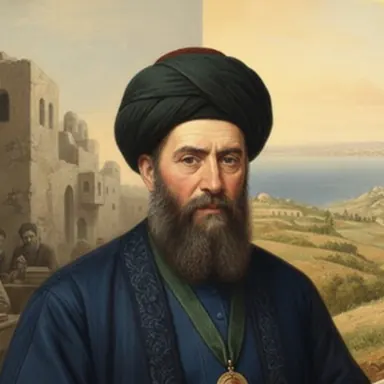
The Torah Teaching and Historical Work of Rabbi Dr. Yehuda Aryeh Leon Bibas: Herald of Active Zionism
9 min read1,874 words
Summary
The text surveys the revolutionary portrait of Rabbi Dr. Yehuda Aryeh Leon Bibas, an exceptional figure who combined profound Torah scholarship with broad academic and medical learning. The writing highlights his contribution as central among the forerunners of Zionism, since he called for abandoning passive expectation of a miracle and moving to an active redemption that includes mass immigration, settlement and even the establishment of a Jewish military force. By presenting the stations of his life, from Gibraltar to Hebron, his decisive influence on his disciple Rabbi Alkalai, and through him on the roots of Herzl's political Zionism, is explained. Finally, the article closes with his personal story in the Land of Israel, focusing on the mystery of his lost library and on the locating of his historic grave in Hebron, which forms the closing of a circle for his national vision.
Introduction: The Intellectual Portrait of a Multidimensional Leader
Rabbi Dr. Yehuda Aryeh Leon Bibas represents a pioneering and exceptional figure in the landscape of the spiritual and public leadership of Judaism in the modern era.[1, 2] His work departed from the routine patterns of the rabbis of his generation, since he combined profound Torah scholarship as a halakhic decisor and kabbalist with broad academic learning and a doctorate in medicine.[1, 2] His multicultural personality, his command of a variety of European languages and his many travels among different Jewish communities in the Mediterranean basin and in Western Europe shaped a unique cosmopolitanism.[1, 2] This involvement in the affairs of the world enabled him to develop a broad-horizoned historical and political outlook, by virtue of which he formulated one of the earliest and boldest national doctrines of the modern era.[1, 2]
Rabbi Bibas's central contribution lies in his being one of the founding fathers of the proto-Zionist movement (the forerunners of Zionism).[1, 2] Decades before the appearance of the institutionalized political Zionism of Binyamin Ze'ev Herzl, Rabbi Bibas laid the conceptual and practical foundations for the modern vision of the Return to Zion, calling for abandoning passive expectation of a miraculous redemption and encouraging an immediate transition to active endeavor, political settlement and even military self-defense in the Land of Israel.[2, 3]
Biographical Development and the Growth of a National Consciousness
Rabbi Bibas's geographical and intellectual path is interwoven with the history of the communities of the exiles from Spain in Western Europe and North Africa.[1] His wanderings and the various stations of his life served as fertile ground for the growth of his national worldview, since they exposed him both to the hardships of exile and to the modern national struggles of the peoples of Europe.[1, 4]
The Theological Revolution: A Transition from Passive Expectation to Active Redemption
Rabbi Bibas's most significant contribution to Torah thought in the modern era lies in the change of the theological paradigm regarding the concept of "redemption."[2] In the nineteenth century, the overwhelming majority of the Torah world held a conservative and passive position, according to which one must await the coming of the Messiah with simple faith and in expectation of a supernatural divine miracle.[2] Rabbi Bibas challenged this conception and proposed a revolutionary interpretation of the sources.[2]
Redefining the Concept of Repentance
According to Rabbi Bibas's view, the biblical and rabbinic concept of "teshuvah" – usually perceived as spiritual repentance, including fasts, self-mortification, prayers and weeping – requires a practical transformation.[2] He argued that the term "teshuvah" bears its most direct literal meaning: a physical and actual "return" (shivah) of the people to its land.[2] The general and collective teshuvah required of the people of Israel before the redemption is not a religious inward withdrawal in exile, but a physical, large-scale and organized immigration to the Land of Israel and the establishment of permanent settlement in it.[2, 4] These active deeds are the prior and sole condition by means of which the divine will can be aroused and the end of the exile brought near.[2]
Diagnosing the Exile as a National and Spiritual Illness
Rabbi Bibas did not see the exile and the geographical dispersion of the people of Israel as a decree of fate to which one must grow accustomed, but as a grave pathological state, which he defined as a physical and spiritual "illness" of the nation.[4] His thought presented a direct and reasoned response to the motif of the "Wandering Jew" – a widespread Christian theological conception that claimed that the Jews were condemned to wander forever without a homeland as punishment for rejecting Christianity.[4] Rabbi Bibas turned this on its head; he explained that the dispersion and the mass wandering of the people among the lands are nothing but symptoms of the disease of exile, and that the only and absolute remedy for this state is national territorial concentration in the Land of Israel.[4]
Geopolitical Inspiration and the Vision of Practical Liberation
Rabbi Bibas's political conception was deeply influenced by the dramatic historical processes that took place in Europe and in the Mediterranean basin during the nineteenth century. His period of service as chief rabbi of Corfu brought him into close contact with the national struggle of the Balkan peoples.[1] The courageous stand of the Greeks and the Serbs in revolt against the rule of the Ottoman Empire, and their success in achieving political independence, served for him as tangible proof that national liberation does not happen of itself but requires sacrifice, organization and practical struggle.[1]
From this geopolitical analysis, Rabbi Bibas proposed an idea that was unprecedented and especially bold in the rabbinic world of his day: the establishment of a defensive Jewish military force.[3] He held that the Jewish people must cease to be at the mercy of the nations, must show military resourcefulness, take up arms and liberate the Land of Israel from Turkish rule by force of arms if necessary.[3] This vision of security and military sovereignty preceded by decades the thought of the leaders of practical and political Zionism, and made him the distinct herald of the conception of Jewish self-defense in the modern era.[1, 3]
The Chain of Influence: From Gibraltar to Political Zionism
Although Rabbi Bibas did not leave behind many printed books, his halakhic and conceptual system was handed down to later generations through his principal disciple, Rabbi Yehuda Alkalai.[1, 6] In 1831, with Rabbi Bibas's appointment as rabbi of Corfu, the two met, and Rabbi Bibas became the spiritual mentor of Alkalai, who was then serving as a young religious functionary in Zemun in Serbia.[1, 6] Rabbi Alkalai adopted without reservation his teacher's revolutionary views on active redemption, pioneering immigration and political organization, and began to spread them throughout Europe through his sermons and his Torah writings.[2, 6]
Through Rabbi Alkalai a direct historical link was created to the father of political Zionism, Binyamin Ze'ev Herzl.[3] Shimon Leib Herzl, the grandfather of Binyamin Ze'ev Herzl, was an active member of Rabbi Alkalai's community in Zemun and was directly influenced by Alkalai's national teaching, which drew its sources from the teaching of Rabbi Bibas.[3, 6] Thereby Rabbi Bibas serves as the first and essential link in a chain of intellectual transmission that ultimately led to the establishment of the World Zionist movement.[3]
The Last Chapter in Hebron: His Estate, the Mystery of His Library and the Locating of His Grave
In 1852, a year after the death of his wife, Rabbi Bibas decided to turn theory into practice and to end his life in the Holy Land.[1] Upon his arrival at the port of Jaffa, he was received with royal honor and great love by his many disciples who had awaited his coming.[1] From Jaffa he continued to the city of the Patriarchs, Hebron, where he chose to settle.[1, 5] In Hebron the rabbi established a significant Torah study hall and housed in it his enormous and unique library, which he had brought with him from Europe, a library that contained rare manuscripts and varied books in the fields of Torah and science.[1]
His life in the Land of Israel was rather short; only about two months after his immigration, on 17 Nisan 5612 (6 April 1852), Rabbi Bibas passed away.[1, 2] He was buried in the ancient Jewish cemetery of the Sephardi community in Hebron, in a holy plot designated for rabbis and kabbalists.[1, 5]
Historical Testimonies and His Monetary Estate
According to the historical records of James Finn, the British consul in the Land of Israel at that time, Rabbi Bibas left behind a monetary estate of 2,000 piasters.[4] Half of the sum was given to the two faithful disciples who accompanied him on his last journey to the Land of Israel.[4] The other half of the money was dedicated, according to his will, to covering the costs of his expensive burial and to financing the recitation of special prayers for the elevation of his soul every year during the prayer of the eve of Yom Kippur in the synagogue of the Sephardi community in Hebron.[4]
The Mystery of the Rabbi's Library and the Connection to the Dead Sea Scrolls
During the Hebron massacre of 1929 (the riots of 5689), the synagogues and Torah institutions of the Jewish community in the city were looted, and Rabbi Bibas's splendid library vanished as though it had never been.[1] In 1953 the well-known scholar Prof. Solomon Zeitlin put forward a revolutionary and controversial theory, according to which some of the hidden scrolls (the Dead Sea Scrolls) discovered in those years in the caves of Qumran had in fact come from Rabbi Bibas's private library, which had been looted in 1929 and found its way into the hands of local dealers.[1] Although this conjecture has remained a scholarly curiosity and has not won scientific consensus, it attests to the enormous reputation of the library as a bearer of rare and ancient spiritual treasures.[1]
Locating the Grave Anew
For decades the exact burial place of Rabbi Bibas in Hebron was not known, as a result of the great destruction wrought by the Jordanians in the ancient Jewish cemetery between 1948 and 1967.[1, 3] The growing historical and scholarly interest in his figure in recent years prompted meticulous search efforts and a renewed examination of archival testimonies.[1, 3]
The solving of the mystery was finally made possible thanks to the memories of Yosef Ezra, a native of the city of Hebron, who provided precise topographical information that made it possible to identify Rabbi Bibas's grave within the ancient plot of the rabbis and kabbalists in Hebron.[3, 5] The rediscovery of the grave constituted the closing of a historical circle for a great thinker who foresaw the revival of the people of Israel in its land, and found his final rest in the city of the Patriarchs.[5]
Sources6
- 1.Yehuda Bibas - Wikipedia, en.wikipedia.org/wiki/Yehuda_Bibas
- 2.יהודה ביבאס – ויקיפדיה, he.wikipedia.org/wiki/יהודה_ביבאס
- 3.נפתרה התעלומה: אותר קברו של רבי יהודה ביבס בחברון - ערוץ 7, inn.co.il/news/663594
- 4.הרב יהודה ביבאס מבשר הציונות-יעל ויילר ישראל | מורשת יהדות מרוקו, moreshet-morocco.com/2021/09/17/הרב-יהודה-ביבאס-מבשר-הציונות-יעל-ויילר-3/
- 5.נפתרה התעלומה: אותר קברו של רבי יהודה ביבס בחברון, hebron.org.il/נפתרה-התעלומה-אותר-קברו-של-רבי-יהודה-בי/
- 6.יהודה אלקלעי - ויקיפדיה, he.wikipedia.org/wiki/יהודה_אלקלעי