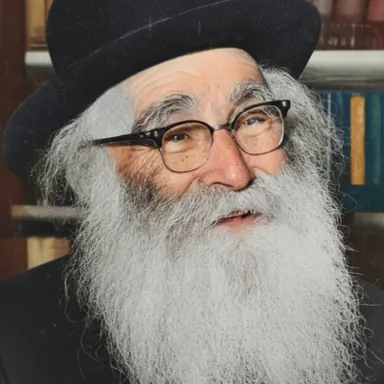
Rabbi Aryeh Levin
17 min read3,357 words
Summary
This text surveys the life and character of Rabbi Aryeh Levin, sketching a mosaic that combines profound Torah scholarship with boundless social kindness. The survey opens with his roots in Lithuania and his formative encounter with Rav Kook, and continues with a description of his unique work as "the Rabbi of the Prisoners," who served as a spiritual support for the fighters of the underground organizations and accompanied those condemned to death in their final moments. Alongside his national activity, the text emphasizes the exceptional moral sensitivity he showed toward marginalized groups, such as the leprosy patients at the Hansen Hospital, and his educational method, based on love and on drawing hearts close. The aim of the article is to show how Levin's personality bridged gaps in Israeli society and made him a symbol of "radical love of Israel" that fuses halakhic precision with pure humanism.
The Figure of the Jerusalem Tzaddik: The Torah, Moral and National Work of Rabbi Aryeh Levin
The historiography of the Jewish community in the Land of Israel in the twentieth century is replete with leadership figures, but few personalities have won such broad consensus and such deep affection among all strata of the people as Rabbi Aryeh Levin (5645–5729). His figure, known by the epithets "the Rabbi of the Prisoners," "the Father of the Prisoners" and "the Jerusalem Tzaddik," cannot be summed up in dry biographical terms alone.[1, 2] This was a personality that fused within itself rigorous Lithuanian scholarship, the spiritual openness of the Torah of the Land of Israel in the style of Rav Kook, and absolute moral self-sacrifice for the weak and the oppressed.[3, 4] An analysis of his work and his Torah teaching requires a deep dive into the formative stations of his life, from the small towns of White Russia to the besieged alleys of Jerusalem in the period of the British Mandate and the War of Independence.
Roots in Lithuania and the Shaping of His Torah Identity
Rabbi Aryeh Levin was born on 6 Nisan 5645 (22 March 1885) in the town of Orla, near Białystok, within the Jewish "Pale of Settlement" of the Russian Empire.[1, 5] His father, Binyamin Beinush, was a simple forester, and his mother, Etil, ran a home marked by material poverty but spiritual wealth.[2, 5] The heavy economic hardship in his parents' home forced him to set out wandering among yeshivas at a very young age, a path that was common among "prodigies" (illuyim) in that period.[3]
The young Rabbi Levin's course of study is a map of the Lithuanian yeshiva world at the height of its glory. He studied in Slutsk, Slonim, Brisk and Pinsk, and each station added another layer to his method of study.[5] One of the most significant stations was the yeshiva of Halusk, where he had the privilege of studying with Rabbi Baruch Dov Leibowitz, author of "Birkat Shmuel," who was considered one of the greatest scholars of his generation.[5] The influence of Rabbi Baruch Dov is evident in the halakhic precision and clarity of thought that characterize Rabbi Levin's later writings.
His great aspiration was to be admitted to the Volozhin yeshiva, "the mother of the yeshivas." At first he was rejected because of his young age, but after a year of stubborn perseverance he was admitted to study under Rabbi Raphael Shapira.[2, 5] In Volozhin he absorbed the tradition of in-depth study and the ideal of "hatmadah" (diligence)—continuous Torah study day and night, an ideal that accompanied him all his life.[2]
The Encounter with the Land of Israel and Rav Kook: A Revolution of Consciousness
In 5665 (1905), at the age of 19, Rabbi Aryeh Levin decided to immigrate to the Land of Israel.[3] His arrival at the port of Jaffa was a turning point not only in his personal life but also in the shaping of his rabbinic model. In Jaffa he met for the first time Rabbi Abraham Isaac HaKohen Kook, who was then the rabbi of the city and of the moshavot (the agricultural colonies).[3] The encounter between the two was not merely technical; it represented a joining of the old Lithuanian scholarship with the "lights" of the revival of the Land of Israel.
Rabbi Levin described in his memoirs how Rabbi Kook received him cordially and conversed with him on words of Torah.[6] A formative event of that period took place during a walk the two took in the fields of Jaffa after the afternoon (Mincha) prayer. Rabbi Levin absentmindedly plucked a flower or a blade of grass, and Rabbi Kook gently remarked to him that he had always refrained from plucking plants without need, since "every blade of grass sings a song."[6] This saying, taken from the world of Kabbalah and Hasidism, seeped deep into Rabbi Levin's soul and became the moral foundation of his attitude to every living creature.
The bond with Rabbi Kook deepened over the years. It was Rabbi Kook who recognized in Rabbi Levin the lofty qualities suited to the role of "Rabbi of the Prisoners," and it was he who sent him on this mission in 5691 (1931), understanding that only a person of such spiritual stature could bridge the gaps between the Haredi world and the world of the young fighters in the underground organizations.[3, 7]
The Leader within the Home: Family and Modesty
Shortly after his arrival in Jerusalem, on 8 Tammuz 5665, Rabbi Aryeh married Tzipora Chana Shapira, the daughter of Rabbi David Shapira of Kovno.[1, 5] This marriage brought him into the heart of Jerusalem's Torah elite; his father-in-law was the son of Rabbi Chaim Yaakov Shapira and the brother-in-law of Rabbi Tzvi Pesach Frank, the rabbi of Jerusalem.[2, 5]
Rabbi Levin's family life was marked by extreme material poverty but by great spiritual happiness. The couple lived in a small one-room apartment in the "Mishkenot" neighborhood (Har Grizim Street, later renamed Rabbi Aryeh Levin Street).[5, 8] During the First World War the family went through years of severe hunger, during which two of their daughters died because of the shortage of food and medicine.[5] Despite these tragedies, Rabbi Levin's home remained open to anyone in need. He used to share the little food he had with his neighbors, and in the War of Independence, when Jerusalem was under siege, he hastened to distribute food products that members of Lehi had brought him among the needy families around him.[1]
The best-known story about his married life is his visit to the doctor with his wife. The rabbi turned to the doctor and said: "My wife's leg hurts us."[9] This sentence became a symbol of his capacity for complete identification with another person, to the point of erasing the partition between another's pain and his own. The rebbetzin herself testified that their life was marked by a spirit of mutual yielding and deep connection, "like a pair of doves."[9]
His Educational Teaching at "Etz Chaim": A Pedagogy of Love
From 5677 (1917), Rabbi Aryeh Levin served as mashgiach (spiritual supervisor) at the Talmud Torah and yeshiva "Etz Chaim" in Jerusalem.[5, 10] The role of a mashgiach in the yeshiva world of that time was usually associated with enforcing discipline and with sharp moral preaching. Rabbi Levin, however, brought about a quiet revolution in this role. He chose the path of "pleasant ways," out of the belief that the only way to shape a child's soul is through warmth and love.[11]
He saw children as the "dust and stones" of the Land of Israel, in the sense of "For Your servants take pleasure in her stones, and cherish her dust."[12] For him, stroking a child's face was a religious commandment no less than studying a page of Gemara. He believed that "good traits are acquired through good deeds," and that the educator must be a living example of a person possessing such traits.[3] His students at "Etz Chaim" remember him as one who never gave up on any child, even those labeled "difficult" or "rebellious," and who always found the way to soften their hearts with pleasant speech and a cheerful countenance.[11]
The Rabbi of the Prisoners: National Mission and Religious Devotion
The title "Rabbi of the Prisoners" or "Father of the Prisoners" is not merely an honorific but an accurate description of a life's work that lasted about 25 years.[2, 5] It all began in 1931 (5691), when the British Mandate authorities were looking for a rabbi to visit the Jewish prisoners in the jails.[3] Rabbi Kook referred them to Rabbi Levin, explaining that this difficult task required a person of spiritual fortitude and exceptional qualities.[7]
Every Sabbath and festival, regardless of the weather, the security situation or days of curfew, Rabbi Levin would walk on foot from his home in the Mishkenot neighborhood to the Central Prison in Jerusalem (in the "Russian Compound") or to Acre.[5, 13] He refused to use vehicles on the Sabbath, despite the great distance and the dangers, out of devotion to halakha and a desire to show the prisoners his personal commitment to them.[10, 13]
The prisoners, among them members of the Etzel and Lehi underground organizations, saw him as a father figure. Rabbi Levin did not engage in politics; he saw in every Jewish prisoner a "holy spark" in need of encouragement.[8] He would memorize detailed greetings from the prisoners and deliver them to their families after the end of the Sabbath, making his rounds throughout Jerusalem on his weary feet.[3] For the prisoners, the visit of "Reb Aryeh" was the only ray of light in the darkness of the cell.[1]
His Relationship with the Olei HaGardom
The peak of his activity in the prison was accompanying those condemned to death, the "Olei HaGardom" (those who went up to the gallows). Rabbi Levin formed a deep spiritual bond with fighters such as Moshe Barazani and Meir Feinstein.[7, 14] He described in tears how he put tefillin on them for the last time before their execution, and how they wept because they would not merit to fulfill this commandment again.[14] Although some of them did not observe the Torah and the commandments in their daily lives, in Rabbi Levin's presence they felt at ease revealing their hidden faith.
Although he was a Haredi rabbi, he won unprecedented admiration from the secular underground fighters. They saw him as their "rabbi," the one who understood their self-sacrifice for the sake of national redemption.[1, 8] Shortly before his death in 1969 he was awarded the "Fighters of the State Decoration" for this work, a decoration he accepted with his characteristic modesty.[5, 10]
"Father of the Lepers": Kindness in the Most Shunned Place
One of the most moving episodes in Rabbi Aryeh Levin's life is his volunteering at the "Hansen" leprosy hospital (Hansen) in the Talbiyeh neighborhood of Jerusalem.[15] In those days leprosy was considered not only a severe physical disease but a terrible social stigma. The patients were isolated from society, and many of them were abandoned by their families, who feared contagion.[15]
Rabbi Levin came to the place after hearing a weeping mother tell that her son was hospitalized in the hospital and that she did not dare visit him.[15, 16] Without hesitation, the rabbi took his life in his hands and began visiting the hospital regularly.[16] There he discovered other Jewish patients who lived in utter loneliness. The rabbi decided to take them under his protection; he visited them every week, brought them kosher food cooked by his wife, and attended to all their spiritual needs.[15]
Every Rosh Hashanah he would come to the hospital with his sons to blow the shofar for the patients.[15] This act embodied the essence of his moral teaching: true kindness is not done in glittering places, but precisely in places at which no one wants to look. The patients testified that Rabbi Levin was the first person who treated them as equal human beings, and not as "lepers" to be kept at a distance.[5, 16]
The Lottery of the Gra and the Identification of the Fallen of the Lamed-Heh: Between Mysticism and Nationalism
After the War of Independence, the young State of Israel faced a grave national tragedy. 12 of the 35 fighters of the Lamed-Heh ("Thirty-Five") platoon, who fell on their way to Gush Etzion, had not been identified with certainty when their bodies were transferred for permanent burial in Jerusalem.[2, 17] The military rabbinate and the bereaved families had reached a dead end.[17]
At this stage, in consultation with the rabbi of Jerusalem, Rabbi Tzvi Pesach Frank, it was decided to perform the "Goral HaGra" (the Lottery of the Gra)—an ancient Jewish procedure attributed to the Gaon of Vilna, intended to obtain answers to fateful questions by randomly opening a book of the Bible (Tanakh).[18, 19] The task was entrusted to Rabbi Aryeh Levin, who was perceived as the most authoritative and holy figure to perform the ceremony.[19]
The ceremony was held in the rabbi's home in the presence of representatives of the bereaved families (among them Reuven Mass and Yitzhak Dov HaKohen Persitz).[19] The rabbi used an old Bible printed in Amsterdam in 5461.[19] The results were astonishing and left an indelible impression on those present.
The identifications were accepted without dispute by the families and the IDF, and the fallen were brought to burial under their own names on Mount Herzl.[19] This event demonstrates how Rabbi Levin served as a connecting link between the world of ancient Jewish tradition and the acute needs of the renewing Israeli society, while granting spiritual balm to bereaved families from every part of the spectrum.[19]
His Torah Teaching in Writing and in Deed
Although his public image centered on acts of kindness, Rabbi Aryeh Levin was a distinguished Torah scholar with an exceptional ability in writing and analysis. His most important Torah work is "Mishnat Aryeh," a systematic and comprehensive commentary on the Mishnah.[2, 20] The manuscript of this work, extending over two thick notebooks and more than a thousand pages, was discovered only after his death.[20]
In "Mishnat Aryeh," Rabbi Levin displays vast erudition in the Rishonim and Acharonim, distilling the plain meaning of the Mishnah in light of the words of the Talmud (Shas). The work was published by "the Committee for the Publication of the Writings of Rabbi Aryeh Levin," edited by Rabbi Yechiel Sternberg, and is an enduring treasure of the yeshiva world.[20, 21, 22]
In addition, Rabbi Levin attached great importance to preserving the legacy of his teachers and those close to him. He wrote the biography of his relative by marriage (mechutan), the kabbalist Rabbi Shlomo Elyashiv, author of "Leshem Shevo ve-Achlama."[2, 23] His connection with the "Leshem" was especially deep; after Rabbi Elyashiv immigrated to the Land of Israel, Rabbi Levin became his foremost disciple and helped him greatly in his personal and public affairs.[5, 23]
Further books that collect his moral teaching and his stories are:
"Rabbi Aryeh Used to Say" ("R' Aryeh Haya Omer") – Tractate Avot with sayings heard from his mouth, edited by Simcha Raz.[2]
"He Was a Righteous Man" ("Ish Tzaddik Haya") – a detailed and inspiring biography written by Simcha Raz, which became one of the most influential books on the figure of the "tzaddik" in Israeli culture.[8]
The "Beit Aryeh" Yeshiva
With the establishment of the State, Rabbi Levin founded the "Beit Aryeh" yeshiva in the courtyard of his home in Jerusalem.[5, 10] He chose to place at its head his son-in-law, Rabbi Eliezer Palchinsky, a grandson of "the Alter of Slabodka."[10] The yeshiva was founded not as a center of power and dominion, but as a hothouse for raising Torah scholars in the spirit of Rabbi Levin's virtues and kindness.[5] The place continues to operate to this day and is a place of pilgrimage for people who seek to taste the atmosphere of old Jerusalem.[5, 8]
Ethics and Interpersonal Conduct: The Practice of Holiness
In Rabbi Levin's eyes, the true measure of fear of Heaven lay not only in Torah study but in one's attitude to the simplest person. He made a point of greeting Jerusalem's street sweepers with "Good morning" on his way to the vatikin prayer at sunrise (following the custom of the Gra).[13] When asked why he paid them such attention, he replied that he appreciated the people who work hard while others sleep, so that Jerusalem will be clean and dignified.[13]
He actively pursued peace. It is told that he once heard a neighbor reporting a thief breaking into a kiosk. The rabbi hurried to the spot and, instead of shouting or calling for help, turned to the thief in a fatherly whisper: "My son, perhaps you have forgotten what is written in the Torah: 'You shall not steal'?"[13] The thief, surprised by the non-judgmental and respectful approach, put down what he had stolen and left the place in shame.
Spiritual Legacy and Conclusion
Rabbi Aryeh Levin passed away on the eve of Shabbat HaGadol, 9 Sivan 5729 (26 May 1969), and was buried in the Sanhedria cemetery next to his wife's grave.[1, 10] His death marked the end of an era in which rabbinic figures could serve as a living bridge between such distant extremes of Israeli society.
Rabbi Levin's Torah and moral teaching can be summed up in the concept of "radical love of Israel." It was not a theoretical love, but a love that found expression in every single step in the alleys of Jerusalem, in every letter he wrote to a prisoner and in every caress he gave an orphaned child.[8, 24] He proved that meticulousness in the commandments of the Torah does not contradict deep social sensitivity, but on the contrary—it is its driving force.
His spiritual testament, engraved on his tombstone, asks everyone who comes to his grave to avoid strife, to love one another and to recite the "Ani Maamin" ("I believe") article concerning the resurrection of the dead.[3, 5] Rabbi Levin's figure continues to shine today as well, through his books, the yeshiva he founded, and above all through the countless stories of his acts of kindness, which are a beacon of refined Jewish humanism in the heart of the stormy history of the people of Israel in the modern era.[5, 8]
In historical perspective, Rabbi Aryeh Levin was not merely a "rabbi" in the institutional sense of the word, but a "tzaddik" in the most ancient and profound sense—a person whose whole being was consecrated to the community, and who, through his wondrous personality, succeeded in turning the suffering of others into prayer and their distress into an act of redemption.[8, 19]
Sources24
- 1.הרב לוין אריה - המכונה אבי האסירים - העמותה להנצחת מורשת לח״י, lehi.org.il/he/הרב-לוין-אריה-המכונה-אבי-האסירים/
- 2.הרב אריה לוין – ויקישיבה - אתר ישיבה, yeshiva.org.il/wiki/index.php/הרב_אריה_לוין
- 3.ו' ניסן תרמ"ה, הרב אריה לוין נולד - היום לפני - משב - מה שיהודי בישראל, mashav.tv/today/rabbi-aryeh-levin/
- 4.מי שלח את רבי אריה לוין לבתי הסוהר? - הקיבוץ הקדוש, hakibbutz.org.il/1670
- 5.ביוגרפיה – מרכז מורשת הרב אריה לוין, betaryeh.org/biography/
- 6.כל עשב אומר שירה - תנועת בני עקיבא בישראל, bneiakiva.org.il/act/kol-esev-omer-shira/
- 7.;quot&הצדיק הירושלמי;quot& ו;quot&אבי האסירים;quot&, museums.mod.gov.il/sites/Jerusalem/Documents/arie levin.pdf
- 8.איש צדיק היה מאת שמחה רז | סימניה - ספרים, סופרים וחברים, simania.co.il/bookdetails.php?item_id=23193
- 9.בדרכו של ר' אריה; חיזוק אסירים ושמחת ההודיה של אגם - אמס, emess.co.il/radio/1696868
- 10.הרב אריה לוין, betaryeh.org/
- 11.מפתיע ומרגש: העונש שנתן רבי אריה לוין לילד ב'עץ חיים' - דרשו, dirshu.co.il/219313-2/
- 12.הרב אריה לוין זצוק"ל -"רב האסירים" - ברסלב סיטי, breslevcity.co.il/הילולת-הצדיקים-ט-ניסן-רבי-אריה-לוין/
- 13.סיפורים על ר' אריה לוין – תנועת אריאל, tariel.co.il/guides/110/
- 14.שיחת השבוע 1587 | להתרגש ולהודות - צעירי אגודת חב"ד, chabad.org.il/Magazines/Article.asp?ArticleID=13368&CategoryID=2172
- 15.בית חולים הנסן (בית המצורעים) בירושלים - אהבת ירושלים, jerusalem-love.co.il/?page_id=10163
- 16.הצדיק הירושלמי שביקר אצל המצורעים | כיכר השבת - Kikar, kikar.co.il/haredim-news/354488
- 17.אגדת הל"ה - בית ספר שדה כפר עציון, k-etzion.co.il/אגדת-הל"ה
- 18.הטקס הקבלי העתיק שאיפשר את זיהוים של חללי מחלקת הל"ה - הספרנים, blog.nli.org.il/kabala_ceremony/
- 19.רבי אריה לוין וגורל הגר"א: כך זוהו קברי הל"ה - הידברות, hidabroot.org/article/115133
- 20.ספר משנת אריה - הספרייה הלאומית, nli.org.il/he/books/NNL_ALEPH990033796220205171/NLI
- 21.משנת אריה: מועד, א׳,ב׳ - אריה לוין - Google Books, books.google.com/books/about/משנת_אריה_מועד_א_ב.html?id=QgI6uwEACAAJ
- 22.משנת אריה - תלמוד ומשנה - כללי, moshebooks.com/items/418552-משנת-אריה
- 23.רבי אריה לייב לוין זצ"ל | למה כדאי להיות אדם נמוך קומה? | כיכר השבת, kikar.co.il/actualy/suc5o0
- 24.ר' אריה – סיפורי מופת על רבי אריה לוין זצ”ל, breslev.co.il/product/ר-אריה-סיפורי-מופת-על-רבי-אריה-לוין-זצל/