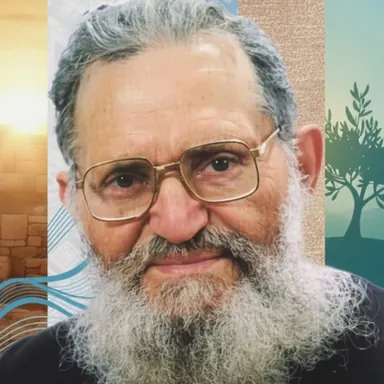
The Torah Teaching and Educational-Public Work of Rabbi Moshe Tzvi Neria: Architect of the Knitted-Kippah Generation
17 min read3,314 words
Summary
This text surveys the work of Rabbi Moshe Tzvi Neria, who is regarded as the father of the knitted-kippah generation, and details how he shaped modern religious-Zionist identity in Israel. The survey traces his roots in the Jewish underground in the Soviet Union and his deep attachment to Chabad Hasidism, alongside his becoming a foremost disciple of Rav Kook who translated his teaching into pioneering educational practice. The crowning achievement among his accomplishments is the founding of the Kfar HaRoeh yeshiva, in which the model of the yeshiva high school took shape, combining sacred studies with general education and active involvement in the State. The article emphasizes his theological conception, which sees Israel's sovereignty as "Atchalta de-Tikvah" (the beginning of hope), and describes his wide-ranging influence through his literary writing, his public leadership and the raising of a generation of leaders who combine loyalty to halakha with service for the common good.
Introduction: The Cultural-Educational Revolution of the Father of the Knitted-Kippah Generation
Rabbi Moshe Tzvi Neria (21 Shevat 5673 – 19 Kislev 5756; 29 January 1913 – 12 December 1995), who was born Moshe Tzvi Menkin, is regarded by scholars and historians as the spiritual and educational father of the "knitted-kippah generation."[1, 2, 3, 4] He acted as a living and turbulent bridge between the old Eastern European yeshiva world and the emerging Israeli society, and led an unprecedented sociological and cultural revolution within religious Zionism.[2, 4, 5] His central vision was driven by the aspiration to spread Torah study among the young generation in the Land of Israel, on the basic premise that Torah education would produce a moral and high-quality majority that would shape the system of laws, the culture and the leadership of the young sovereign state.[6]
Rabbi Neria translated the theological and metaphysical philosophy of his foremost teacher, Rav Kook, into everyday educational and social practice.[2, 4, 5] He succeeded in instilling in the pioneering youth a proud self-awareness that combines absolute loyalty to halakha with active involvement in building the Land, in military service and in practical life.[5, 7] An analysis of his work and his Torah teaching reveals a multidimensional figure who joined deep-rooted Lithuanian scholarship, the depth and fervor of Chabad Hasidism, and active Zionist nationalism.[4, 8]
Spiritual Development and Stations of Life: From the Soviet Underground to Merkaz HaRav
Rabbi Neria's roots lie in the town of Lodz in Poland, where he was born to his father, Rabbi Petachia Menkin, and his mother, Rebbetzin Rachel.[3, 4, 9] Because of the decrees of the Soviet regime, which closed the traditional Jewish educational institutions, he was forced to learn Torah from his father in his childhood.[3, 9] At the age of only 13 he exiled himself to a place of Torah and went to study at the Minsk yeshiva headed by Rabbi Yehoshua Horodner, which operated under harsh underground conditions and in constant danger from the Soviet secret police.[4] In Minsk his deep attachment to the world of Hasidism began, when he joined a secret study group in the city's "Lubavitcher shtibel" taught by the mashpia Rabbi Avraham Baruch Pevzner.[4] This group, organized by a student named Lipa, studied "Sha'ar HaYichud VeHaEmunah" for an entire year, and in the month of Elul "Iggeret HaTeshuvah" together with the "Kuntres HaTefillah" of the Alter Rebbe, and took part in secret farbrengens (hitvaaduyot).[4]
In 5680–5689 Rabbi Neria moved to Shklov, where he studied with Rabbi Mordechai Feinstein, the brother of the posek of the generation Rabbi Moshe Feinstein, until the arrest of the yeshiva's students on the night of 23 Shevat 5690.[4] He fled to Moscow and lived in cramped conditions with his brother, Rabbi Yosef Menkin.[4] In Moscow he met Zisel Bunin and R' David Chanzin, with whom he established a regular chavruta in the suburb of Cherkizovo.[4] The two studied Tractate Bava Kamma in depth and Tractate Pesachim in broad survey.[4]
To escape from the Soviet Union, the enormous sum of thirty dollars was required for a passport.[4] Rabbi Neria turned to various personalities abroad, and in the end the Rebbe Rayatz of Lubavitch sent him the full sum, which made possible his rescue and his immigration to the Land of Israel on 23 Sivan 5690 with the assistance of Rabbi Tzvi Yehuda Kook.[4] Upon arriving in the Land he entered the "Merkaz HaRav" yeshiva in Jerusalem, where he became bound with cords of love to Rav Kook and became his close disciple.[2, 4, 5] Rabbi Kook even set up a regular chavruta with him and Rabbi Shaul Yisraeli to prepare his weekly general lecture.[2] In this yeshiva Rabbi Neria shaped his national consciousness and his literary name "Neria," which began as an underground pen name for writing articles in Bnei Akiva, out of a desire to avoid political disputes, and in the course of time became his official surname.[2, 5]
The Founding of the Kfar HaRoeh Yeshiva: The "Republic" of Bnei Torah and the Controversy over Secular Studies
The Bnei Akiva yeshiva in Kfar HaRoeh, founded on 10 Cheshvan 5700 (1939), is regarded as the mother of the Bnei Akiva yeshivas and the great experimental laboratory of religious Zionism.[10] The founding of the yeshiva stemmed from the fierce demand of the "Torah circles" in the Bnei Akiva branches in Jerusalem, Haifa and Petah Tikva, who wanted a pioneering yeshiva in which they would study in Hebrew and in the spirit of the movement.[10]
In the summer of 5699 (1939) the members of the circles went out to a "preparation camp" in Kfar HaRoeh, directed by Tzvi Kaplan and accompanied by Rabbi Avraham Zuckerman.[10] Rabbi Neria himself was not present at the camp, since at that time he was serving as a delegate to the 21st Zionist Congress in Geneva.[10] With the outbreak of the Second World War, fundraising met with severe difficulties; the president of Mizrachi, Rabbi Meir Bar-Ilan, refused to help because of the circumstances of the war, while Moshe Chaim Shapira provided a temporary budget for the experiment, and Rabbi Yehuda Leib Maimon supported the project out of his own pocket.[10]
On 10 Cheshvan 5700 the first 13 students, headed by Rabbi Neria, arrived at the moshav, settled into the synagogue hut and began studying Tractate Beitzah.[10, 11] The unique curriculum combined Gemara, the Mishnah of Seder Zeraim, the Bible (Tanakh) and the writings of Rav Kook.[10, 11] Rabbi Neria defined the way of life in the institution as a "republic of bnei Torah," in which an elected student committee managed the social life, set the regulations and decided on the admission of new students.[10, 11]
In the early years of the yeshiva, agricultural work was combined with sacred studies.[10, 12] However, in the yeshiva's tenth year a sharp internal controversy developed over the demand of the parents and of Rabbi Avraham Zuckerman to introduce structured high-school studies that would make it possible to obtain a matriculation certificate.[10] Rabbi Zuckerman held that a father's halakhic obligation to teach his son a trade is fulfilled in our day through a secondary education.[10]
Rabbi Neria at first opposed this in an extreme manner, fearing harm to the totality of Torah study, and even expressed himself to Yisrael Sadan in the sharp words: "Hair will grow on the palm of my hand before secular studies are taught in the yeshiva."[10] In the end, following heavy social pressure and the founding of "Midreshiat Noam," which enabled matriculation studies, Rabbi Neria was forced to compromise.[10] At the end of the 1940s high-school studies were introduced into the yeshiva at the expense of manual labor, under the direction of Dr. Shmuel Auerbach and with the encouragement of Rabbi Zuckerman, while Dr. Shimshon Novick served as the first chemistry teacher.[10] This compromise proved historic, since it shaped the model of the "yeshiva high school," which was copied in dozens of institutions and enabled the growth of the modern religious-Zionist elite.[10, 11]
His Torah Teaching and Thought: A Theology of Sovereignty, "Atchalta de-Tikvah" and Practical Halakha
Rabbi Neria's Torah thought presented a complex and original theology regarding the State of Israel and its institutions.[5, 7] In contrast to simplistic messianic conceptions, Rabbi Neria developed an outlook that sees the State as a vital instrument for the physical and spiritual survival of the people of Israel, and defined it as "Atchalta de-Tikvah" (the beginning of hope).[7] He emphasized that the State is the only place in the world where Jews are multiplying, speaking Hebrew and developing an independent national identity.[7] His great dream was to raise up a young generation that would wage a constant struggle for a "State of the Torah"—a state in which the army, the economy, the Foreign Ministry and the Interior Ministry would all be conducted according to the laws of the Torah and halakha.[5, 7] For this, an education was required that speaks of the army, the state and Zionism from within the beit midrash itself.[5]
Rabbi Neria was a prolific creator who integrated his spiritual world into the writing of songs and liturgy.[5] He composed the anthem of the Bnei Akiva movement, "Yad Achim" ("A Brotherly Hand") [2, 5] and edited the version of the prayer and thanksgiving for Independence Day, which was accepted almost in its entirety in the synagogues of religious Zionism.[2, 5] His halakhic work, as expressed in his many Torah articles, was characterized by a systemic view of the challenges of the generation, dealing with a variety of subjects [14]:
The general rules of the commandments and practical halakha: clarifications on the subjects of intention in the performance of commandments, "one who hears is like one who answers" (shome'a ke-oneh), the laws concerning minors and commandments, and the blessing over commandments.[14]
The authority of the Sages and halakhic policy: articles on "You shall not turn aside" (lo tasur), the authority of the Great Court, the nature of halakhic decision-making, the place of custom, and the reciprocal relations between prophecy and halakha.[14]
- Social issues and the value of life: pikuach nefesh (saving life), the law of the pursuer (rodef), the rescue of lives, sanctification of God's Name and the laws of "be killed rather than transgress."[14]
- Interpersonal relations and social justice: deception (geneivat da'at), lashon hara (evil speech), the commandment of rebuke, "love your neighbor as yourself," and the prohibition of "before the blind."[14]
At the center of his educational teaching stood a personal, warm and empowering approach toward the student.[13] He coined the famous saying that defines the vocation of the teacher:
"Every educator must have two loves and three faiths. Love for the students and love for the profession; faith in his own powers as an educator, faith in the values he seeks to impart to his students, and faith that they will absorb what he invests in them." [1]
He demanded spiritual totality of his students and called on them to take the yeshiva with them everywhere—to the home, to the street and to the synagogue.[1] Every morning he would wake his students with a call imbued with a Hasidic melody: "Israel, holy people, arise to the service of the Creator."[1]
The Bridge to Chabad Hasidism and the Lubavitcher Rebbe: Internalizing the Inner Dimension of the Torah
Despite being a prominent religious-Zionist leader, Rabbi Neria maintained throughout his life a direct and deep spiritual and practical connection with Chabad Hasidism and its Rebbes.[4] This connection, which began in his secret studies in Minsk and was strengthened by the saving of his life by the Rebbe Rayatz, permeated deeply into his personal conduct.[4] Rabbi Neria used to pray from the Chabad siddur in the Nusach HaAri, to put on tefillin according to the Chabad custom, and to study every day the daily passage in the Rebbe's book "Hayom Yom."[4] His wife, Rebbetzin Rachel, testified that the Tanya lay permanently on his Sabbath table, and his students related that on the night of Rosh Hashanah he would immerse himself in fervent study of the Alter Rebbe's "Likkutei Torah."[4]
The relationship between him and the Lubavitcher Rebbe was marked by deep mutual esteem, by exchanges of letters and by lengthy private audiences (yechidut) in Brooklyn, in which they discussed educational and halakhic issues for long hours.[4] Among the subjects raised were the limits of modesty in the activity of a mixed youth movement, the obligation to maintain a mechitzah (partition) at public events, and the theological significance of the State.[4]
The Rebbe acted actively to help Rabbi Neria; in 5717, when Rabbi Neria came to the United States to raise funds for his yeshiva, the Rebbe's secretary, Rabbi Hodakov, at the Rebbe's instruction, telephoned the Gaon Rabbi Nissan Telushkin and asked him to use his influence in Mizrachi circles in the United States to support Rabbi Neria.[4] The Rebbe also referred to him students who sought to consult with him on matters of combining vocational studies with Torah.[4]
His attachment to Chabad also found expression in his influence on his students in the yeshiva, many of whom in the course of time became devoted Chabad Hasidim, among them Rabbi David Meir Drukman (the rabbi of Kiryat Motzkin) and Rabbi Yosef Hartman.[4] At the conclusion of Simchat Torah 5744, when he received a bottle of mashke (spirits) from the Rebbe for the yeshiva, Rabbi Neria drank from it despite his doctors' prohibition at the time, and declared with emotion that "mashke from the Rebbe cannot do harm."[4]
Political and Public Activity: Between the Walls of the Knesset, Disillusionment and the Ideas of the Greater Land of Israel
Alongside his educational work, Rabbi Neria was a key figure in the public and political arena in the State of Israel, and followed a winding path of parliamentary involvement and of disillusionment with it.[4, 5]
His Term in the Knesset and His Political Regret
Rabbi Neria was elected to the Seventh Knesset (1969–1973) as a representative of the Mafdal (National Religious Party).[1, 2, 4] He saw his membership in the Knesset as an instrument for fortifying the standing of the Torah and spreading the values of religious education at the national level.[3] However, his direct encounter with the party apparatus, the cynical compromises and the narrow interests caused him deep disappointment.[4] On his retirement from parliamentary life he expressed sharp public regret, saying that his entry into politics had been a grave mistake and that he had "dirtied his hands" in this arena.[4] He emphasized that he incomparably preferred the pure and direct work of education to party politicking.[5]
The Founding of the Matzad Movement and of the Union of Rabbis
Despite his disappointment with the establishment, Rabbi Neria did not abandon the public struggle over the character of the State.[3] In 1983, against the background of internal disagreements in the Mafdal and a desire to lead an uncompromising ideological line on the issues of the integrity of the Land, he left the party and founded, together with his student Rabbi Chaim Drukman, the Matzad movement (Religious Zionist Party).[4, 12] In the elections to the 11th Knesset he was placed in a symbolic position (the 116th place) on the list of the "Morasha" party.[12]
Rabbi Neria was a member of the executive of the "Movement for the Greater Land of Israel."[2] In 1993, following the signing of the Oslo Accords and out of his desire to establish a firm halakhic and public front against handing over territories, he founded, together with Rabbi Shaul Yisraeli and Rabbi Avraham Shapira, the organization "Union of Rabbis for the Land of Israel."[2, 12] This activity emphasized his belief that the integrity of the Land and the security of the people are supreme Torah commands that are not subject to temporary political decisions.
The Work of Creation and Commemoration: Mediating the Teaching of Rav Kook and Passing It On to the Generations
One of Rabbi Neria's most important enterprises was making the profound and complex teaching of Rav Kook accessible to the general public.[3, 5, 15] Rabbi Kook's teaching was written in a poetic, kabbalistic and abstract style, and Rabbi Neria took upon himself the task of giving it a human, experiential and accessible face through stories, ethical talks and descriptions of the rabbi's ways of life.[15]
His literary enterprise began with a series of articles he published in the newspaper "Hatzofe," which were later collected into key books published in cooperation with the Torah VeHaAretz Institute and the Beit El library.[15, 16, 17] The books combine original passages of Rav Kook's thought, stories carefully collected from witnesses who heard and saw, and documents from the archive of his father, Rabbi Petachia Menkin, who was close to Rav Kook's circles in Jerusalem.[3, 15]
Parallel to his Torah writing, his educational work has been commemorated through an extensive network of Bnei Akiva yeshivas and ulpanot throughout the country.[2, 4, 10] His personal archive, which includes drafts of books, political correspondence and historical letters, is kept in the National Library and constitutes a valuable research resource for the study of the history of religious Zionism.[3]
Summary and Conclusions
Rabbi Moshe Tzvi Neria acted as a social and spiritual architect who profoundly influenced the shaping of the character of the modern State of Israel.[2, 3] His figure and his work present central conclusions and implications for the development of the religious-Zionist public:
- A unique cultural synthesis: Rabbi Neria proved that it is possible to create a complete religious identity that combines rigorous halakhic scholarship, Hasidic warmth and experience, and uncompromising civic and pioneering commitment.[4, 5, 8] He broke the old dichotomy between the closed yeshiva world and modern secular pioneering.[5, 10, 12]
- Establishing the revolution of Torah-secondary education: The model of the Kfar HaRoeh yeshiva, despite the controversies that accompanied its founding, became the prototype of religious-Zionist educational institutions.[10] The introduction of secular studies in the spirit of the obligation of "teaching a trade" enabled generations of religious young people to integrate into key positions in academia, the economy, the army and the legal system.[10]
- Raising a generation of leaders and pioneers: Rabbi Neria's students, among them Rabbi Chaim Drukman, Rabbi Yaakov Ariel, Rabbi Dov Lior and Hanan Porat, became the shapers of the path of religious Zionism and its Torah and settlement leaders.[2] In this Rabbi Neria realized his vision of raising up high-quality and influential human resources in the heart of Israeli society.[6]
Rabbi Neria left behind him a theological legacy that sees Jewish sovereignty as an immense religious opportunity and a demanding spiritual challenge, while keeping the rule he coined in his life: "Do not say 'tomorrow,' for tomorrow belongs to God, and today you have been given to live and to create."[1, 7]
Sources19
- 1.משה צבי נריה - ויקיציטוט, he.wikiquote.org/wiki/משה_צבי_נריה
- 2.הרב משה צבי נריה – ויקישיבה - אתר ישיבה, yeshiva.org.il/wiki/index.php/הרב_משה_צבי_נריה
- 3.ארכיון משה צבי נריה | פריט NNL_ARCHIVE_AL997011664976005171 | הספרייה הלאומית, nli.org.il/he/archives/NNL_ARCHIVE_AL997011664976005171/NLI
- 4.משה צבי נריה – חב"דפדיה, chabadpedia.co.il/wiki/משה_צבי_נריה
- 5.30 שנה לפטירתו: עשרה דברים שלא ידעתם על הרב משה צבי נריה - סרוגים, srugim.co.il/1273475-30-שנה-לפטירתו-עשרה-דברים-שלא-ידעתם-על-הר
- 6.קווים לדמותו של הרב נריה, מייסד הישיבות בציונות הדתית - מקור ראשון, makorrishon.co.il/judaism/article/268577
- 7.אתחלתא דתקווה - נאמני תורה ועבודה, toravoda.org.il/אתחלתא-דתקווה/
- 8.רב חסיד היה: "הניגון היה חלק מעולמו הרוחני של הרב נריה" - מקור ראשון, makorrishon.co.il/judaism/article/276079
- 9.תולדות חייו של הרב משה צבי נריה זצ"ל - תנועת אריאל, tariel.co.il/guides/1629/
- 10.ישיבת בני עקיבא כפר הרא"ה - ויקיפדיה, he.wikipedia.org/wiki/ישיבת_בני_עקיבא_כפר_הרא"ה
- 11.מרכז ישיבות ואולפנות בני עקיבא - ויקיפדיה, he.wikipedia.org/wiki/מרכז_ישיבות_ואולפנות_בני_עקיבא
- 12.משה צבי נריה - ויקיפדיה, he.wikipedia.org/wiki/משה_צבי_נריה
- 13.ישיבת בני עקיבא כפר הראה: בית, haroe.tik-tak.school/
- 14.הרב משה צבי נריה - ספריית אסיף, asif.co.il/files_author/הרב-משה-צבי-נריה/
- 15.מועדי הראי"ה - ויקיפדיה, he.wikipedia.org/wiki/מועדי_הראי"ה
- 16.מועדי הראי"ה / ר' משה צבי נריה - אוצר הספרים, sefer.org.il/items/3731423-מועדי-הראי-ה-ר-משה-צבי-נריה-הוצאה-לאור-ספריית-בית-אל
- 17.ישיבת בית אל - ויקיפדיה, he.wikipedia.org/wiki/ישיבת_בית_אל
- 18.כל כתבי הרב משה צבי נריה - סט 5 כרכים - ספריית חוה, chavabooks.co.il/product/בשדה-הראיה/
- 19.סט כתבי הרב משה צבי נריה ה' כרכים - אוצר הספרים, sefer.org.il/items/3730428-סט-כתבי-הרב-משה-צבי-נריה-ה-כרכים